Category Archives: Career Goals

There’s Networking, and Then There’s NETWORKING

Do It Before You Need It

I started this blog out of frustration.  I had just talked to my umpteenth client/friend/student/colleague who found him/herself out of a job with a stone cold network and a total freak out about what to do.  (See my first blog post–Get Ready to Lose Your Job)  Networking definitely helps when you need to find a job.  In fact, it is probably the best tool to have in your arsenal for finding a job.  These days, a powerful network can make the difference between finding a job in weeks or months and it taking more than a year.

Networking also helps with just about everything else you might need–getting promoted, finding business opportunities, selling products, building your reputation/brand, getting answers to tough questions, staying in touch, and even finding someone to date (I’ll leave this last one to other blog writers).  You can build your network purposefully, or you can build it serendipitously, but be sure to keep building it. Remember, though, networks are about RELATIONSHIPS, not about numbers or names or tools or connections.

Serendipity

Let’s talk first about building it serendipitously.  There are marvelous tools available now that make it easy and fun.  Facebook, Linkedin, and Google+ are the top tools right now, but there are many more–Plaxo, Twitter, MyLife, etc. Not being involved in a social network these days is like not having a resume or appropriate business attire.  To function in today’s business world–no matter your age or organizational position–you have to be saavy enough to be using social networks.  If you participate in these social networks–let’s say Facebook or Linkedin–and just reach out to people you know and accept invitations from people who reach out to you, you will build your network.  If you particpate in LinkedIn Groups discussions, answer questions and comment on people’s status, you will strengthen the connections/relationships.  If you share a little of who you are on Facebook and comment on friends’ posts, you will build the relationships.  It starts at one level and grows to other levels.  It has to be real.  Superficial interactions are obvious and quickly shunned.  If you do it gradually  over time, then it doesn’t take a lot of time and you have the beginnings of what you need when you need to look for a job or a promotion or business opportunities.

This serendipitous network building also has the benefit of creating a network of strong connections–you know all these people pretty well.  When you need something from these folks, you are more likely to be comfortable asking, and they are likely to respond.  Not much work/lots of potential benefit.  Why not?

Purposeful

The other way to build your network is purposefully.  This is what I recommend.  Take a look at your networks.

On Facebook using myfnetwork :

Visualize your facebook network using myfnetwork

On Linkedin using LinkedIn Maps

Visualize your network using LinkedIn Maps

What do you see?  If your networks are anything like mine (and they may not be–every network is unique), you will see people who are “hubs,” and you will see clusters.  For me, one of the interesting things about these two pictures is that some of the “hubs” of my Facebook network are on the edges of my “clusters” on LinkedIn.  This makes sense to me, because I see these as two different networks.  One is more friends and family and one is more professional.  There is strong overlap between the two, but there are lots of people on one and not the other.  The LinkedIn Maps feature allows you to label the colored clusters.  This provides you with the ability to see the relationships among the groups in your network.

Now, pull up.  Look again.  What do you see?  What is there?  What is missing?

What Do You Want From Your Network?

Do you want a job?  Do you want to make a career change?  Do you want a promotion?  Do you want to make sales?  Do you want business opportunities? Do you want venture capital money? Do you want to build your brand?

Now, based on what you want, look at your network again.  Can it get you what you want today?  What’s missing?  Professional connections in a particular field?  Venture capitalists? Senior executives at other companies?  Senior executives at your company? Are there people at all levels in organizations?  Are there people at all generations in companies?  What about geography?  Do you have a strong network in all the locations you need?

What Are You Going to Do About It?

First, let’s go old school.  On paper, or using mind mapping software, do a brain storm of who you know.  Start with the groups you belong to or are associated with.  Once you’ve listed the groups, start listing the people associated with the groups.  Who are the key players in those groups?  Who are the best connected?  Who have you talked to lately?  If you haven’t talked/connected with people, then reach out to them.  Do it via email, phone or one of the social networking sites.  Prioritize people according to the purpose of your network.
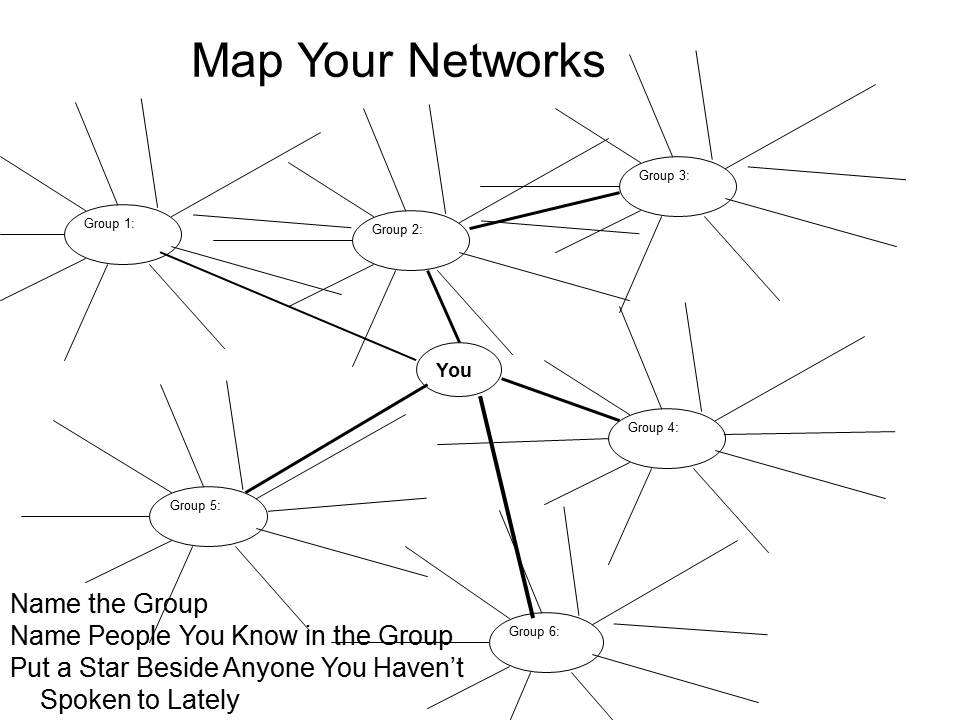
Map Your Network Worksheet

Address what is missing.  How can you reach out to people you need to be connected to in those areas that you need to grow?  Get introductions through your existing connections.  Use the helpful tools that LinkedIn provides.  Attend professional functions, follow thought leaders’ blogs and make comments.  Participate in Linkedin Groups discussions.

Create a plan on how you’re going to keep up with your network.  Do regular (but not obsessive) work to stay in touch with your existing network and to grow it.

Some Myths About Networking

  • It’s  about the numbers. IIt’s really about quality connections.
  • It’s about your connections’ job title.  Looking at the visualization of your network should show you that the ‘most’ connected people are not necessarily (and not even likely) the highest ranking.

Some Truths About Networking

  • It has to be real.
  • It takes time.
  • It’s about mutual win/win.
  • It works.

Some Books

10 Comments

Filed under Books, Career Development, Career Goals, Executive Development, Goal Setting, Networking, Recession Proof, Success

Selling Your Brand

Have You Thought About Your Brand?Sell Your Brand

Have you ever thought about how your boss thinks about you?  Not what he thinks, but how he thinks?  What about how the organization thinks about you? How about the top leadership in your organization? What about the folks in your professional organizations? Do you stand out in any way?  Do they think of a certain kind of expertise or talent?  Do they think of a certain kind of results?

When you think of McDonald’s you get a “picture” of what McDonald’s is.  Depending on your age and interests, that image might be different, but it pops into your mind.  The same is true of Coke, or Apple or Sears or Fanta.  You make decisions about those brands based on your values, interests, likes/dislikes, income and other demographics.  You want to be able to control (or at least strongly influence) how people think of you (your brand) when they think of you.  The more you influence your brand and the more aware you are of it, the more likely you are to be able to manage your career successfully.

How I Learned This Lesson–The Hard Way

I worked for many years in a large, rapidly growing organization.  There was a period of time when I was “stuck” in the same position for several years.  The men who had started in the organization with me were moving past me and I was standing still.  I was very confused by this. Rightly or wrongly, I rejected the idea that it was a gender thing.  I thought it was something about me.  I was VERY frustrated.  I was quite angry about it. (Although looking back on it, I’m not sure just how clear I was about what was causing my frustration.)

Our CEO had a leadership meeting and announced the formation of a trilogy of high performance projects.  He announced that the people selected to work on these projects would be those who were identified across the organization as the “best” in each of the areas.  I was thrilled.  I was the “best” at one of them.  (Ok, maybe I wasn’t really, but at the time, I was absolutely, completely, without a doubt sure of it.)  So . . . I waited for the invitation.  It didn’t come.  Someone else in my division got selected.  Someone who not only wasn’t as good at it as me, but who wasn’t even interested.  I went from being angry to being FURIOUS!  How could they announce that the ‘best’ would be selected and then not pick me!?!?!  I couldn’t let it go.  I asked my manager.  I asked the VP of HR.  They didn’t know.  I finally asked my VP.  His reaction was one of the best lessons I ever got–although not at all fun!

He was completely, genuinely surprised that I even thought I should have been selected.  It hadn’t occurred to him.  It was in this very painful way that I realized that he really didn’t know that I was the ‘best.’  The person he had selected was a charming, talented person who regularly delivered results.  He didn’t know anything about the subject matter at hand, but that didn’t really matter that much.  He was easy to get along with.  He was very competent (at other stuff).  He was charming.  He got results.  So he got picked.

I, on the other hand, was pretty much an unknown to the VP who had my career in his control.  He certainly didn’t think of me–at all.  This was completely eye opening.  And when I got over the shock of it, I got over being so mad, too.  I could see how and why he was oblivious to my strengths.  I was pretty much totally responsible for that.  I hadn’t made a point of selling my abilities to the ‘powers-that-be’ in the organization.  I hadn’t made sure that I was thought of as an expert in the organization.  Once I figured this out, I went about building my ‘brand’ in the organization.  And I got ‘unstuck’–promoted within less than a year.  And then I got promoted again.  And then again.

How do you build your brand?

  • Be an expert.  Build your expertise.  Within your organization, become THE expert on something.  Be the ‘go-to’ person for that subject.
  • Help other people.  Create mutually beneficial situations.  Create ‘organizational trade routes.’
  • Act like you’re dating. Remember back to the days when you were dating.  Somehow or other you always managed to be in the right place at the right time to ‘meet’ up with the person of interest.  You managed to ensure that s/he knew how great you were.  You managed to appear to be as smart as possible, as talented, as charming as possible.  Do that again–just in a different context–prove how ‘right’ you are for the organization.
  • Be brave.  Stand out.  Blending in will not do you any good long-term.  What’s different/better/a more perfect fit about you?  How can you get it communicated?
  • Make sure other people are ‘selling’ you.  The theory behind social media marketing is that buzz created among ‘friends’  is more credible than advertising by the company.  I can’t tell you how many times I was in meetings of managers who were deciding who got what job.  The candidates who were known of by more deciders were the ones who got the jobs.  EVEN IF THEY WEREN’T the most qualified on paper.  If you know of someone, you feel more comfortable choosing him than a total unknown.  Imagine how much better someone did who was known of (because they had effectively sold their brand) by all the deciders.
  • Get over any thoughts that ‘selling’ your brand is unseemly. This is your life, your livelihood, your career.  This is the way you do it.

2 Comments

Filed under Brand Yourself, Career Development, Career Goals, Communication, Executive Development, Networking, Recession Proof, Success

Career Check-up

Why a Career Check-up?

Those of us who do what we should have annual physical check-ups.  People who practice preventative health care are much healthier.  We take our cars for their regularly scheduled maintenance milestones.  Our cars last longer, drive better and have higher resale values.  Regular house maintenance (how many of us have given our houses great makeovers when we’re selling them?) leads to fewer crises and higher sales prices.  But how many of us do that with our careers?  Most of us get an annual review for our job, but what about our careers? A job is a role that you play, specific functions you perform.  A career is a professional or work life, a broader view, transportable, beyond your current employer, beyong your current job.  Transportable.  In today’s economy, transportable is priceless.

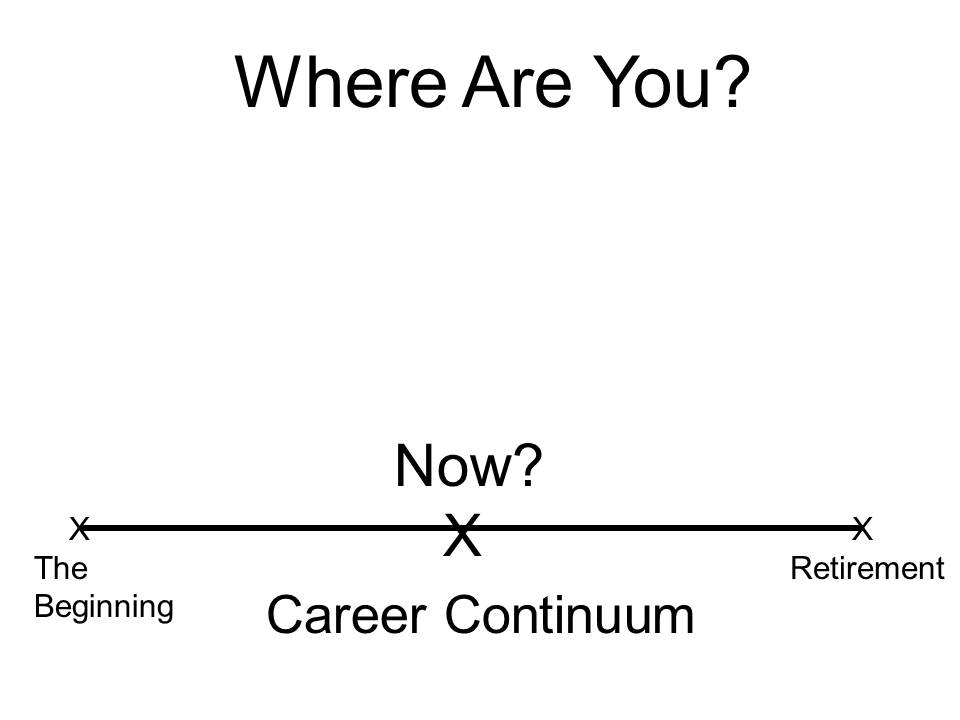
Career Continuum

Career Path

Where are you on the your career continuum?  Where on you compared to where you want to be?  In terms of time–how long have you worked?  How much longer will  you work?  Are you 1/3 done?  Are you 1/2 done?  Between now and what is left, what do you want to accomplish?   As you look at where you are, what do you need to move your career along as fast as you need to in order to get to where you want?

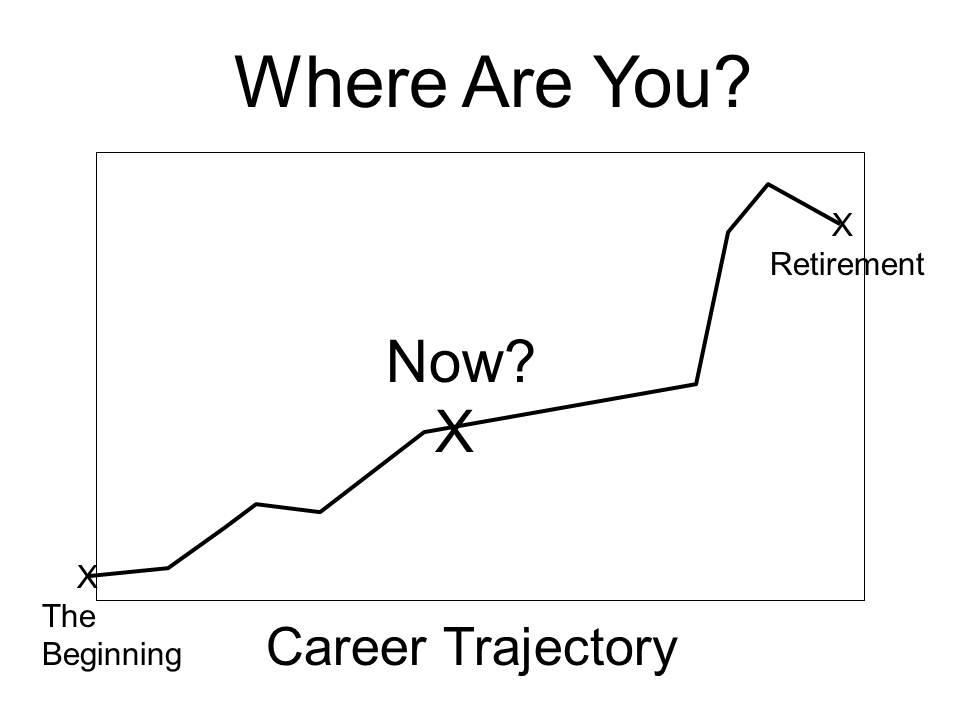
Career Trajectory

Now look at where you are in terms of what level you want to be?  If you are a Director now, do you want to be C-level?  Do you want to have your own business?  Do you want to move into another field?  Do you want to accelerate how much money you’re making?  Are you moving as fast as you want to? Are you being considered for the types of positions you should be to get to the level you want?

What’s Going On Now?

Look at what’s going on at your current organization WITH CLEAR EYES:

  • Are You Valued?
  • Do You Think Your Company Has the Right  Direction?
  • Do You Trust Your Organization’s Leadership?
  • Are There Growth Opportunities?
  • Is There Enough Challenge?
  • Is This Work What You Thought It Would Be?
  • Do You Fit in the Culture?
  • Is This Meaningful for You?
  • Are You Motivated at Work?
  • Do You Make Enough Money?
  • Is This the Right Work-Life Balance for You?

Depending on the answers, you need to decide whether your current organization is the right place for you to accelerate your trajectory pace.  If not, face it now.  That doesn’t mean you need to move now–it means that you need to get ready to move.  (It took me six years to get ready for my next step beyond an organization I truly loved–but once I saw that I needed to go, my focus changed to the next step rather than continuing to stay in an organization that couldn’t deliver my end-state for me).

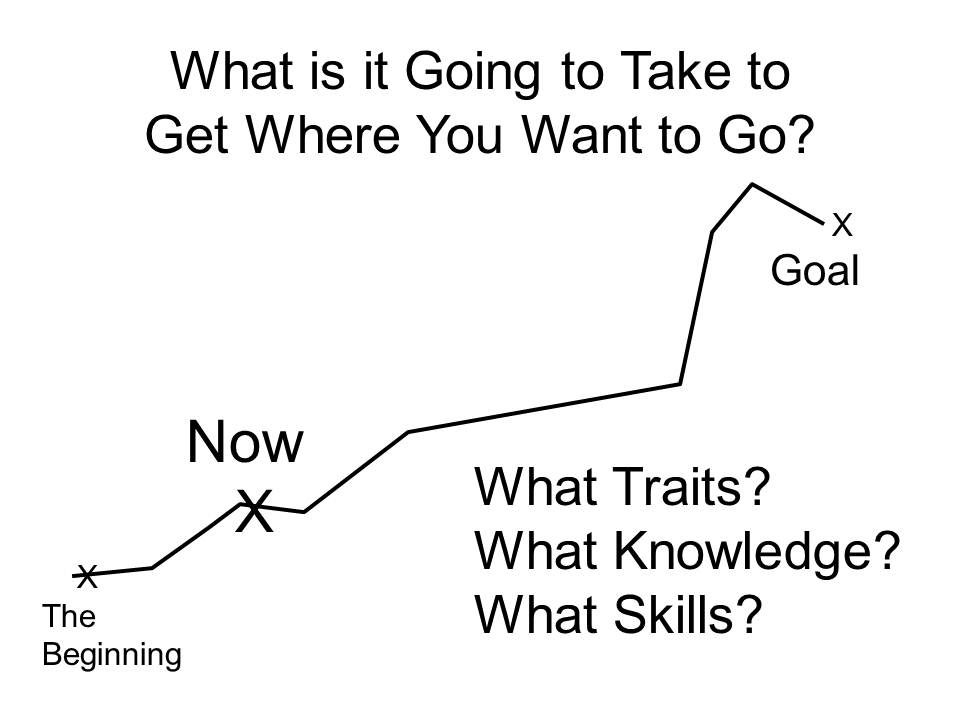
Start Working on What it Will Take

Skills Traits Knowledge

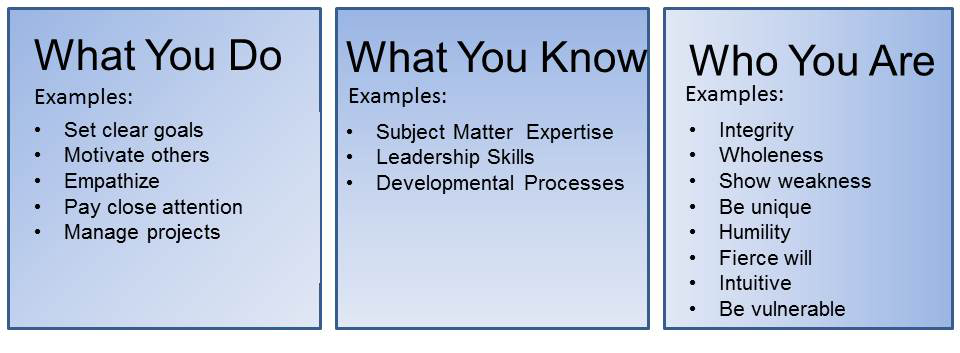
The more specific you can be in understanding what you need to know, do and be in order to reach your goal, the better you can prepare to do it.  If, for example, you are a Director and you want to be C-level, you may need to be much more financially literate than you are now.  You may have to be able to see the big picture better and pull yourself out of your detail focus.  If you are a Project Manger and you want to be a Program Manager, you may need to know how to understand enterprise-level governance of projects and programs.

How Do You Figure This Out?

Look at People Who Do What You Want to Do:

  • What Do They KNOW?
  • What Can They Do?
  • What Are They Like?
  • What is Their “Brand?”

I can rarely persuade people to actually do informational interviews until they are looking for jobs, and usually even then, they are out of a job before they’ll do it.  It is an incredibly helpful tool for a career check-up.  It helps you to understand what it takes to get to the level you want when you talk to people who’ve done it.

  • What do they wish they had known when they were at your level?
  • What is the most important skill at their level?
  • What was hardest to learn/do?
  • What would they do differently?
  • What advice do they have for you?

You walk away with a perspective on what you need to know/do/be.  You are also likely to walk away with an advocate who may start looking out for you.

Create a Project Plan

You know how to do this:

  • Set your goals
  • Identify your critical path tasks
  • Identify the resources
  • Set your timeline
  • Do a kick-off
  • Git-ur-done!

Leave a comment

Filed under Brand Yourself, Career Development, Career Goals, Executive Development, Goal Setting, Personal Change, Success

Do a Personal SWOT

Career Strengths Weaknesses Opportunities Threats

Most of us have done a SWOT (Strengths, Weaknesses, Opportunities, Threats) for our organization at one time or another.  It is a part of most strategy development efforts.   Try doing a personal SWOT as a part of your career development plan.  It is an excellent, and pretty quick, way to look at where you are and what is in your way of getting to where you want to be.

Strengths–Guiding Questions

  • What makes you unique in the world of work and your  personal life.
  • What have you been trained to do?
  • What unique skills have you developed throughout your career?
  • What are your significant accomplishments?
  • What are you most proud of in your career?
  • What difficult challenges have you overcome?
  • What would your bosses say about your successes throughout  your career?
  • What makes you different?

Weaknesses–Guiding Questions

  • What have you heard (and maybe ignored) on performance reviews.
  • What skills do you need to develop?
  • Do you have the requisite education for where you want to be?
  • Who do you not know in the organization power structure?
  • Are your skills out of date?
  • Do you have a robust network?
  • Are you seen as an up-and-comer?
  • Are you motivated?
  • Remember, your strengths are frequently your weakness

Opportunities–Guiding Questions

  • What have you always wanted to do?
  • Look at  career goals since childhood, extracurricular activities,hobbies, beyond-work-activities, areas of interest, learning.
  • What trends/patterns do you see in these that offer ideas for your future?
  • If you could re-invent yourself, who/what would you be?
  • What are your interests that could be made into a career path?
  •  Can you do some damage control where you are?
  • What would it take to motivate you?
  •  Can you turn what you do into a career that crosses into other industries ?
  • Are there other industries that interest you?

Threats–Guiding Questions

  • Have you overstayed your welcome?
  • What is the financial stability of your organization?
  • Are there downsizings, leader changes, mergers on the horizon?
  • Are you getting along with your boss? Your boss’ boss?
  • Are you getting along with your peers?
  • Are you getting the “plum” assignments?
  • Have you felt a “shift” in relationships lately?
  • Do you FIT in the organization?
So, What Do You Do?

Pick anything.  Work on leveraging your strengths.  Work on eliminating or reducing or “plan b-ing” your threats.  Take advantage of your opportunities.  Work on improving your weaknesses.  Just start.

Leave a comment

Filed under Career Development, Career Goals, Executive Development

What The Heck Are Unwritten Rules?

Four Problems

There are four problems to being able to understand the unwritten rules in your organizations.  The first is that you believe you know the rules (these are your beliefs about how organizations are supposed to work) and that creates a blind spot for the unwritten (unspoken/invisible) rules that you don’t know.  The second problem is that the unwritten rules keep changing.  As new leaders come in, as the organization gets purchased or reorganized, the unwritten rules can change.  The third problem is that the “unwritten rules” aren’t the same from organization to organization.  So, when you change organizations (even subunits within your current organization), you need to reassess what the unwritten rules are.  The fourth is probably the biggest problem.  It is that the unwritten rules are communicated through informal networks, and if you’re not a member, it is hard for you to find out about them.  They aren’t necessarily talked about, but people who are new learn to emulate the rules from the people in their networks.

Unwritten Rules in Organizations

What Are the Unwritten Rules?

The unwritten rules are the “way things work” in the organization.  People who know these rules aren’t necessarily able to articulate them, because it is likely that they “picked” them up without someone clearly telling them.  These are things like how you’re supposed to dress, how you’re supposed to interact with others, how late you’re supposed to work, how and with whom you go to lunch, and a whole host of other things.  You are evaluated by the organization by how well you follow these rules, even though no one has ever told you what they are.

The Research

Catalyst is an organization founded in 1962 to provide research and support for the inclusion of women in business.  They do significant research on many work related topics.  They have researched unwritten rules in organizations and the impact that they have  on career success. In research done in 2008, The Unwritten Rules, What You Don’t Know Can Hurt Your Career, they identified common areas of unwritten rules that exist  in many organizations:

  • Communication and Feedback–speaking up/being assertive/challenging (or in some organizations-not challenging)
  • Performance and Results —exceeding performance agreement is expected
  • Career Planning –you’re expected to have a plan and you’re expected to push for it
  • Seeking Visibility — sometimes this is an expectation, not considered “brown-nosing”
  • Building Relationships –joining and building networks, establishing trade routes of informal relationships
  • Increasing Face Time –just because you do a good job it isn’t enough, you need to build the relationship, and be present
  • Working Long Hours
  • Clearly Communicating a Willingness to Work Many Hours

Unwritten Rules for Promotion

Looking at “unwritten rules” associated with getting promoted, they identified:

  • Network and build relationships within and outside the organization
  • Find ways to become visible
  • Play politics and lobby for yourself and your work
  • Be a team player, work well with others
  • Communicate effectively and ask for lots of feedback
  • “Fit in” with the organizational culture
  • Perform well, produce results
  • Be knowledgeable, competent
  • Find a mentor, coach, sponsor
  • Be energetic, work a lot
  • Work long hours
  • Be strategic, savvy
  • Develop a good career plan
  • Be communal

How Do You Figure Out the Unwritten Rules?

In 2010, Catalyst followed up with a second study, The Unwritten Rules, Why Doing a Good Job Might Not Be Enough, asking how respondents had learned the unwritten rules.  The top responses were:

  • Learned through observation
  • Learned through trial and error
  • Learned through mentoring and feedback
  • Learned through previous work experience

So, What Does This All Mean?

Get a Mentor.

Just because you don’t know them, it doesn’t mean there aren’t unwritten rules.  The research shows that one of the best ways to learn them is to have a mentor who can help you.    How?  Find someone in your organization who you think knows what’s going on and ask him/her if s/he will be willing to be your mentor.  Most people would be flattered by the request.  Don’t get hurt feelings if the answer is no, go find someone else.  Have a couple of conversations–over coffee is good–to see if the chemistry is right.  Ask him/her about his/her career/success/path/learnings.  People are almost always willing to talk about this.  Listen to the stories looking for evidence of the unwritten rules.  It’s ok to ask about the unwritten rules, but I wouldn’t do it in the first conversation.

Observe

Start watching people closely.  Especially the powerful and successful ones.  Pretend you’re in a foreign country trying to figure out what’s going on.  What do they do?  How do they do it?  How do the bosses react?  Do you have the same reactions?  If not, how are yours different?  What are you missing?  What values seem to be at play?  Practice a little with your own behaviors.  Flex your style a little.  What reactions do you get?

Ask for Feedback

Ask people about how they think you fit in.  Ask them about your behaviors against what they perceive as the unwritten rules.  (It is highly likely that a peer would welcome this conversation because he would be interested in the same feedback.)  Take the lists of “unwritten” rules above and ask for feedback.  How did the responses fit with what you think?

Cringing

Did you cringe at anything above?  At the rules as listed?  At the thought of asking someone to be a mentor?  At the thought of asking for feedback?  At the thought that there are mysterious unwritten rules?  If so, then chances are you need to think about it some more.  That’s ok.  Go ask some people you trust.  See what they think.

5 Comments

Filed under Career Development, Career Goals, Communication, Executive Development, Success, Unwritten Rules

Get Off Your Butt! DIY Executive Development

I’m going to rant a little

l talk to people all the time who are sitting around waiting for their company to “do something” about their development.  They know that they are talented (and for the most part, the company agrees), they know that they are “hi po” (high potential–recognized by the company as having potential to move up), and they know that they do a good job.  So, why doesn’t the company send them to Executive Development programs, or provide them with developmental opportunities, or generally take an interest and develop them?

There are all kinds of reasons

Maybe the company doesn’t have a well-developed Executive Development system.  Maybe the company doesn’t classify these people as “hi po” enough.  (Lots of companies, maybe most companies, take the view that only the most “hi po” gets developed).  When I ran an Executive Development Program for a company, I found that the “hi po”s who were selected by the ‘deciders’ were all over the place.  Potential is in the eye of the beholder.  You may not fit the profile for hi potential for the person in YOUR management chain who makes the decision.  The company may be trying to develop a certain skill (like innovation) at this time and are picking people who they think have the most potential in that area.  Someone up there may not like you.  There are all kinds of reasons why it is not you, not this year, not at this company.

So What?

So why am I going to rant?  Because I think it’s totally nuts for ANYONE to sit around and wait for your company to develop YOU.  Who cares more about your career and your abilities more than you?  Who wants you to succeed  than you?  How long will you stay at THIS company?  They will develop you for their organizational profile and needs.  Will that make you a fully rounded Executive candidate? Maybe, but probably not.  What one organization believes are the key attributes of leadership is another organization’s rejection list.

Get Off Your Butt and Develop You

Most well run organizations have well thought out Executive Development plans and programs (just because it doesn’t focus on you doesn’t mean that there isn’t a plan).  These programs look at what the organization needs, what it has, and puts in place a plan to hire or develop the necessary skills to take the organization to the next level.  You can do the same thing, with you, and only you, as the hi po being developed.  (this applies to you hi pos who are already “being developed” by your organization—make if faster, or develop skills that are outside the organization’s focus that you know you need).  If you do this right, it could have more impact than an MBA (although it is possible that an MBA is a necessary part of your personal development plan).

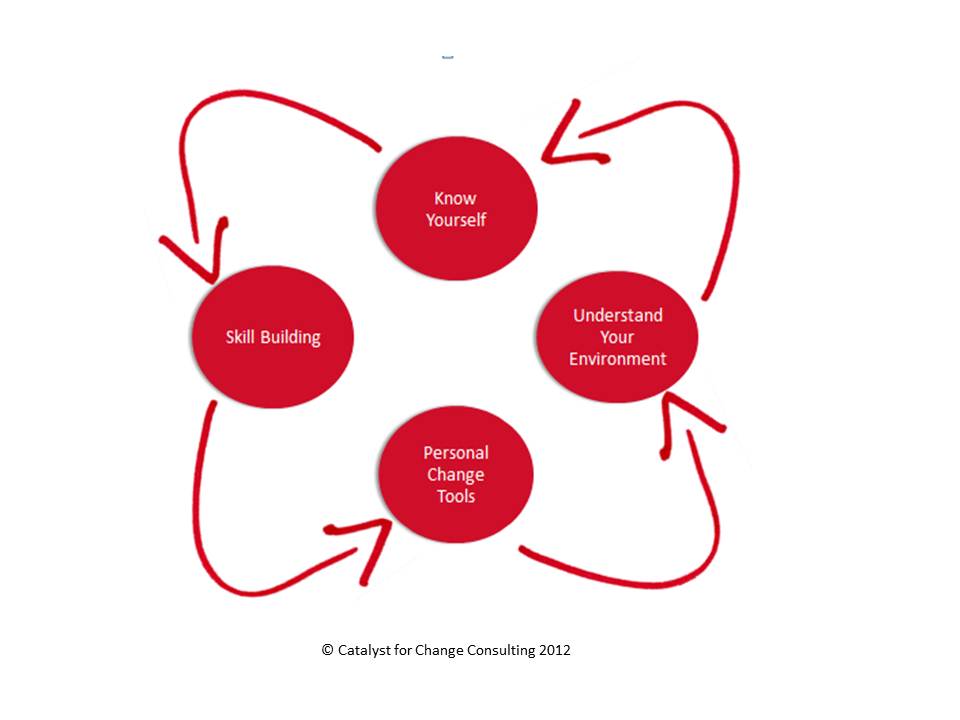
After years of helping organizations develop Executive Development programs and of coaching all kinds of individuals, I’ve come up with an outline of what needs to be addressed in Do-It-Yourself Executive Development.

DIY Executive Development

Do-It-Yourself Executive Development

I know the print on the diagram is too small to read, but I wanted you to see how it all fit together.  There are four areas of developmental concentration:  1) Know Yourself, 2) Understand Your Environment, 3) Personal Change Tools and 4) Skill Building.   You can start anywhere—they all support each other.

4 Essentials for Do-It-Yourself Executive Development

The Recipe for DIY Executive Development:

Know Yourself–Understand Your:

  • Motivation
  • Habits
  • Personality
  • Beliefs About How Things Work
  • Strengths/Weaknesses
  • Temperament
  • Flaws (aka Derailers)

Understand Your Environment:

  • What is the Culture?
  • What is Your Fit in that Culture?
  • What is the Power Structure?
  • What Gets Rewarded?
  • What is the Organization Life Cycle Stage?

Personal Change Tools–Understand:

  • Reframing
  • Habits
  • Feedback

Skill Building–Develop:

  • Execution Skills
  • Leadership
  • Financial Acumen
  • Organization Assessment
  • Organizational Political Saavy
  • Personal Brand Management
  • Emotional Intelligence
  • Organizational Change Management

The well-rounded, and highly successful Executive has all of these.  No one is born with all of them; they need to be developed.  If you want to be a successful Executive, stop waiting for your organization to do it.  Get off your butt and start working on developing yourself.  You’ll do a much better job than any organization if you focus on it.

Leave a comment

Filed under Brand Yourself, Career Development, Career Goals, Derailment, Executive Development, Hi Po, Leadership, Personal Change, Recession Proof, Reframe, Success

Looking for a job? Look in the HJM!

Looking for a job?

Soooooo many people are looking for jobs these days.  People who have been laid off are looking.  People who are dissatisfied are looking.  People who have been underemployed for a while are finally feeling like things are moving enough that they can look.  Maybe it’s just the people I know, but it seems like everyone is looking in the wrong places.

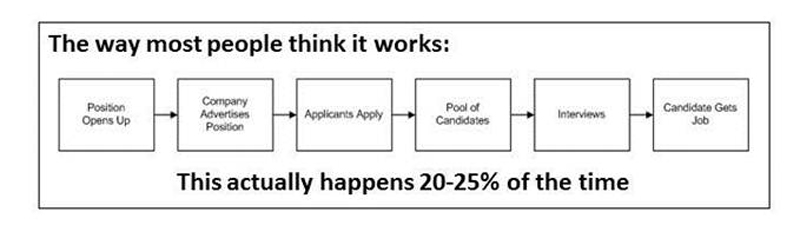
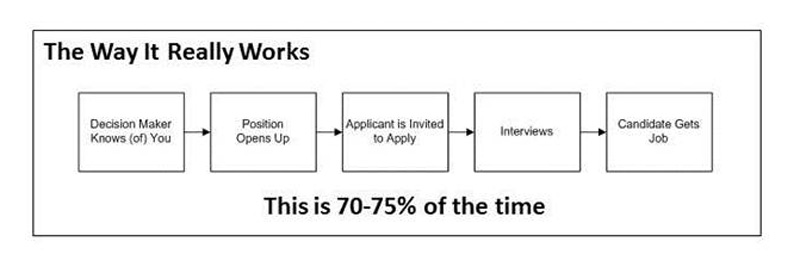
Seventy five to eighty percent of all jobs are NOT advertised.

And remember, this type of hiring (20-25%) includes  the McDonald’s and other entry-level jobs. This also includes all the internet job postings, newspaper job postings, and LinkedIn job postings.

Seventy five to eighty percent of the jobs are in the HIDDEN JOB MARKET.

 The other 5% of hiring happens when the candidate persuades the decider to create a specific job for him.  (Not common, but it happens).

Don Asher in his book Cracking the Hidden Job Market says that you get a job by talking to people.  He’s not talking about interviewing.  He means talking to pretty much everyone who will listen about your job search.  He recommends using every technique available:  face to face, email, phone, LinkedIn, Facebook, and even snail mail.  People are much more comfortable hiring you–or even considering you–when they know you, or when someone close to them knows you.  It’s a lot like dating.

You also need to know what kind of job you want–what industry, function, role, company type.  Then you need to TARGET those jobs.  It is like deciding you want to marry a millionaire.  That is more focused than if you want to marry someone or if you just want to date.  Where do you find millionaires?  How do you know which ones would fit with you?  How do you have to come across to marry a millionaire.  You get the point–it isn’t just throwing your resume at recruiters who have posted jobs.

There are a few  books that I recommend:

Now the Excuses

  • It’s way more work to do it this way.
  • I don’t want people to know I’m out of a job.
  • No one I know knows of any jobs–they would tell me if they did.
  • And on and on and on

Yeah, it is more work.  You want a job, you do the work.  People who know how to work these systems and find the hidden jobs control their careers.  The rest of us are flotsam floating on the river of chance.  EVERYONE knows about jobs or knows someone who does.  It isn’t top of mind.  By talking to people about your job search, you help them remember you when they hear about jobs.

Oh, and don’t wait till you need a job to do this.  Start building the network and targeting the organizations now so that you are ready.  Get ready to lose your job!

1 Comment

Filed under Books, Career Development, Career Goals, Executive Development, Job Hunt, Networking, Recession Proof

Can You Really Earn a Living Doing What You Love?

Do What You Love The Money Will FollowDo What You Love, The Money Will Follow

You hear it all the time.  “Do what you love and the money will follow?” But is it true?  I’d have to say, “Kind of.”  When you are working doing things you love, then it really isn’t work.  It all flows.  You forget what time it is.  You have all the energy you need.  The problems are interesting instead of overwhelming.  At the same time, there are lots of things that people love to do that aren’t easy to earn a living doing.  Golf.  Reading.  Collecting.  Gardening.  Eating.

If you’re like me, as you read the above list, you can think of ways to make a living doing those things.  If you extend these things beyond to related things, there are even  more ways to make a living from them. Lots of ways.  The thing is that we want to make LOTS of money doing things we love.  We want to just do what we love and have a business magically sprout around us.  It doesn’t work that way.  So, if you’re thinking about it that way, then, no, you can’t.

You Have to Work to Do What You Love

It still takes work to do what you love and earn a living from it.  Take me, for instance.  I do what I love.  I coach people to achieve their dreams.  I consult with companies to improve their performance.  I LOVE doing these things.  BUT . . .  I also have to do marketing, proposals, hustle for business.  I don’t particularly enjoy those things.  They are necessary in order for me to be able to do the things that I love.  And because they enable the things that I love, they aren’t as bad as they would be otherwise.

I had to do a lot of work to be able to know how to do the things that I love.  I had to learn, practice and deliver while working for companies–a.k.a. jobs.  I worked at jobs like all the other people who supposedly are earning a living not doing what they love.  A major difference was that I was learning in order to do what I wanted.  I thought of it that way.  That made it easier.  I was working toward doing what I loved.  And because it was going to enable the things that I loved, it wasn’t as bad as it would be otherwise.  Knowing that I was working toward doing what I loved gave me a lot of energy to keep doing it.

Figure Out What You Love

Maybe the hardest thing is to figure out what you love, and then to figure out how to make a living doing it.  If you love quilting, for instance, you can quilt (to earn a living doing this, you either have to make very good quilts that people will pay a lot for, or you need to make lots of quilts (get a quilting machine)).  Or you could have a online quilting auction service.  Or you could have a business that sells quilting tools or supplies.  Or you could design fabric.  Or you could write about quilts.  Or you could take quilt pictures.  Or you could develop  and deliver quilt training.   Or . . . you get the point.

You can love working for a company.  Lots of people do.  You don’t necessarily love working for all companies, but working for some can prepare you to work for the one you love.  It may be a certain kind of company that you love–a restaurant or a trading company– or it may be a particular role in a company that you love.  Whatever works for you.

The way I figured out what I loved was to evaluate all the parts of the jobs that I had really enjoyed–in my case, teaching, figuring out how to fix parts of organizations, presenting, advising–and to figure out what “job” that was.  I had never thought of being a consultant until I went through this process. Once I figured it out, though, the rest was easy.  What skills did I need to be able to do it?  How could I learn them? What was my timeframe?

Not Magic, But Worth It

There was nothing magic about it.  Money didn’t instantly appear.  I had so much fun, though, that it didn’t really matter.  The problems were interesting, not insurmountable.  Doing what I loved helped me pick myself up after setbacks and keep going.  The more I learned, the more fun I was having.

So, yes, you can earn a living doing what you love.  You just have to work at it.

Leave a comment

Filed under Career Development, Career Goals, Executive Development, Goal Setting, Personal Change, Success

Leadership Lessons From MLK

His Name Always Comes Up

Leadership Lessons from MLKIn my leadership classes, I always asked my students for the names of great leaders.  I’ve never had a class where Martin Luther King’s name didn’t come up.  This week is the 44th anniversary of his death.  We’re still struggling to realize his dreams, but we have made significant progress.  But why do we remember his so clearly?  Many of my students weren’t born when he died, but they identify him as a great leader.  He is still leading us.

What are the lessons that leaders can learn from MLK?

  • Dream –MLK dreamed a BIG dream.  His dream was not to be a good minister at a Church in Atlanta.  His dream was thought to be impossible among some of his followers–‘I have a dream that one day this nation will rise up and live out the true meaning of its creed: “We hold these truths to be self-evident, that all men are created equal.’ . . I have a dream that one day on the red hills of Georgia the sons of former slaves and the sons of former slave owners will be able to sit down together at the table of brotherhood.  .  . I have a dream that my four little children will one day live in a nation where they will not be judged by the color of their skin but by the content of their character.”  Sadly, at that time, that was a big dream.  Joyfully, some of this dream has come to pass.  There are young people reading this who can’t imagine the way it was.  Unfortunately, we still have the cancer of racism in our American body.  I’d like to think that had MLK lived, we’d be much further along.

As a leader, are your dreams big enough?  Is it enough to dream of making this year’s numbers, or finishing this project on time, or delivering the product in your strategy?  The difference between a leader and a great leader is the size of the dream.

  • Inspire  –MLK inspired people from all parts of the country, from all walks of life and of all ages to fight for his dream.  His dream became theirs.  His peaceful methods became theirs. He inspired through his words and through his actions.

As a leader, do you inspire or do you tell? Do you speak to some and ignore others?  Do you act your beliefs and words, or are you a hypocrite? Are you brave and do you speak truth to power, or do you go along.

  • Take Risk –MLK kept going despite the risks.  He knew them, but his dream was bigger.  His commitment was bigger.  Risk was a constant in his life as a black man in the South. The risks he took as a leader were breathtaking.

MLK’s risks put most of the risks that today’s leaders take (or don’t take) into perspective.  The stakes for most of us are much smaller.  Even so, we resist risk.  As MLK knew, change doesn’t happen without risk.  I worry that readers will take this point wrong–I don’t want to diminish MLK’s accomplishment by comparing the risk he lived with with the risks that leaders take today.  Understanding and taking risk, however, is essential to great leadership.  Risking your life isn’t necessary, but risking your ego is.  Risking your identity is.  Risking being wrong or failing is necessary for great leadership. When was the last time you took a breathtaking risk?

  • Be Persistent He was tired.  He was exhausted.  He kept going.  He kept standing.  He kept inspiring.  He kept dreaming.  He got results.

He went to jail! To Jail!  To be a great leader, you’ve got to keep believing  it can happen.  You’ve got to help your people believe that it can be done.  Pretty much every great person I know is persistent.  Persistent in the face of set backs, failures, temptations and loneliness.

MLK was a great leader.  He was a great man.  He continues to inspire me to be a better person and a better leader.  Thinking about MLK and his contributions to my world gives me perspective on what is possible and how much more growing I have to do.

2 Comments

Filed under Career Goals, Communication, Executive Development, Leadership, Personal Change

It’s the End of First Quarter. How Are Your Resolutions?

Most of Us Make Resolutions

The website, The Statistical Brain, says that 45% of us make New Year’s Resolutions and 8% of us succeed with them.  Thirty nine percent of folks in their twenties succeed, compared to fourteen percent of folks over age fifty.  (Now what is that about?)  The bottom line, lots of us make resolutions and few of us manage to succeed at them.  I’m not going to go into all the reasons this is true, but I will give you some tips on how to keep working on them (if you still are), or how to start again if you’ve already given up.

New Years Resolutions

Pick One

Look at your resolutions.  If you have more than one, pick the MOST important one.  If you only did one this year, which should it be?  If you’re anything like me, then many of your resolutions are inter-related.  That’s ok–one is still more important, or more foundational than the rest.   Now, in order to accomplish that resolution, what is the first step?  The VERY first step?  When are you going to do that?  Be specific.  VERY specific.

Write It Down

Use a journal.  Write down the goal.  Write down the steps.  Write down the dates.  Now, write down what it’s going to be like when you have accomplished it.  Specifically.  VERY specifically.  How will you feel?  Who will be happy?  How will things be better?  When will you be able to start on your next resolution because you finished the first one?  Write it all again.  And again.  Write it till it isn’t writing about the future, but it feels like the present.  Write it till you are so familiar with it that it feels uncomfortable because what you’re writing hasn’t happened yet. Write it.  Write it. Write it.  Write it every day.

Change

In his new book, The Power of Habit, Charles Duhigg says that about two-thirds of our behaviors are based on habit.  Our morning routine, our drive to work, our morning email, internet usage, our interactions with our co-workers, and on and on and on.  There is a good reason for this.  It is how our brain economizes–it routinizes what it knows and can then use the brain power on other things.  I do my best thinking when I’m driving.  Just think–if I had to pay as much attention to driving as I did when I was sixteen–what tremendous thinking would be lost:-)  The bad news is that in order to acquire a new habit (and succeed with a resolution), you have to overwrite the old habit, one that the brain has efficiently and effectively turned into rote behavior.

In order to create a new habit, you need a cue–a signal to your subconscious that you’re about to perform the new habit.  Example:  Resolution is exercise; running is exercise of choice; cue is putting on running clothes as soon as you get up; new habit is run first thing in the morning.  Then you need a reward.  It actually doesn’t have to be much, just something that feels good after you perform the new habit.  Listening to your favorite song.  A small glass of your favorite juice.  Something.  Every time.

Dubigg says that when a habit is formed, the brain stops participating fully in the decision-making.  So, you need to put the brain back into the decision-making as you extinguish the old habit and take it back out when the new habit is established.  There is evidence via MRIs that different parts of the brain fire as old habits (and brain patterns) are replaced with new.

The Power of Habit is the best book I’ve read so far this year.  I highly recommend it.

Get to work on those resolutions!

4 Comments

Filed under Books, Career Development, Career Goals, Executive Development, Goal Setting, Personal Change, Success