
Most of Us Make Resolutions
The website, The Statistical Brain, says that 45% of us make New Year’s Resolutions and 8% of us succeed with them. Thirty nine percent of folks in their twenties succeed, compared to fourteen percent of folks over age fifty. (Now what is that about?) The bottom line, lots of us make resolutions and few of us manage to succeed at them. I’m not going to go into all the reasons this is true, but I will give you some tips on how to keep working on them (if you still are), or how to start again if you’ve already given up.
Pick One
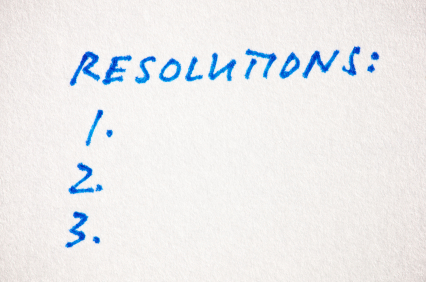
Look at your resolutions. If you have more than one, pick the MOST important one. If you only did one this year, which should it be? If you’re anything like me, then many of your resolutions are inter-related. That’s ok–one is still more important, or more foundational than the rest. Now, in order to accomplish that resolution, what is the first step? The VERY first step? When are you going to do that? Be specific. VERY specific.
Write It Down
Use a journal. Write down the goal. Write down the steps. Write down the dates. Now, write down what it’s going to be like when you have accomplished it. Specifically. VERY specifically. How will you feel? Who will be happy? How will things be better? When will you be able to start on your next resolution because you finished the first one? Write it all again. And again. Write it till it isn’t writing about the future, but it feels like the present. Write it till you are so familiar with it that it feels uncomfortable because what you’re writing hasn’t happened yet. Write it. Write it. Write it. Write it every day.
Change
In his new book, The Power of Habit, Charles Duhigg says that about two-thirds of our behaviors are based on habit. Our morning routine, our drive to work, our morning email, internet usage, our interactions with our co-workers, and on and on and on. There is a good reason for this. It is how our brain economizes–it routinizes what it knows and can then use the brain power on other things. I do my best thinking when I’m driving. Just think–if I had to pay as much attention to driving as I did when I was sixteen–what tremendous thinking would be lost:-) The bad news is that in order to acquire a new habit (and succeed with a resolution), you have to overwrite the old habit, one that the brain has efficiently and effectively turned into rote behavior.
In order to create a new habit, you need a cue–a signal to your subconscious that you’re about to perform the new habit. Example: Resolution is exercise; running is exercise of choice; cue is putting on running clothes as soon as you get up; new habit is run first thing in the morning. Then you need a reward. It actually doesn’t have to be much, just something that feels good after you perform the new habit. Listening to your favorite song. A small glass of your favorite juice. Something. Every time.
Dubigg says that when a habit is formed, the brain stops participating fully in the decision-making. So, you need to put the brain back into the decision-making as you extinguish the old habit and take it back out when the new habit is established. There is evidence via MRIs that different parts of the brain fire as old habits (and brain patterns) are replaced with new.
The Power of Habit is the best book I’ve read so far this year. I highly recommend it.
Get to work on those resolutions!


Leave a comment