Get Better At Your Job. Now.

How Good Do You Want To Be?

What kind of employee do you want to be?  What kind of a manager?  What kind of a leader?  What kind of a boss? What kind of a sales person?  What kind of a General Manager?  What kind of an Executive?  This is a serious question (or I guess several serious questions).  Do you want to be “OK” at your job?  Do you want to be good at it?  Or do you want to be extraordinary?  What is your ideal performance?  Are you hitting it?

If you’re not hitting it, I’m not going to ask you why not.  That conversation is for another time.  I’m going to ask you what, precisely, would you be doing if you were performing at your ideal level?  Would you be spending more time at something?  Would you be finishing things (in a more timely manner)?  Would you be talking to people you aren’t talking to?  Would you be hustling harder?  Would you be less complacent? Would you be getting better results?  Would your boss be happier with you?

What Would It Take?

Write down the things that you would be delivering if you were hitting your ideal job performance.  Be precise.  Look at the list.  What do you have to do differently than you are doing now to get those results?  Would you be on the Internet as much as you are?  Would you be taking hour lunches?  Would you be wasting your time in hour long meetings that could get the same results in 15 minutes?  Would you be going along to get along?  Would you be delegating better?  Leading more? Would you be more focused on what you are doing–all the time?

Do you work like you want to be the best?  Or do you work like you want to be “OK?”  The difference is a change in attitude.  Get serious about what you’re doing.  Don’t treat it like a job–9 to 5–it’ll be here tomorrow if I don’t get it done.  Treat it like a dead-serious goal.  You’ve GOT to get it done.  You’ve GOT to increase your performance.  You’ve GOT to keep it moving.

Try changing your attitude–even for a day and notice the difference.  It is much more fun, interesting and fulfilling when you are ALL IN.

Leave a comment

Filed under Career Development, Career Goals, Executive Development, Personal Change, Reframe

Are You Making Mistakes On Purpose?

We all make mistakes.  Mistakes have consequences.  We learn from our mistakes and don’t make them again.  Or do we?  Sometimes, especially when you find yourself doing something over and over again—being late, forgetting to send something, leaving certain people off invitations, forgetting status reports, losing important information, doing things that make the boss mad—it isn’t just a mistake.  Sometimes it is self-sabotage.  Shooting yourself in the foot.  Failing on purpose (albeit sometimes unconsciously).  Proving that you aren’t ‘good enough,’ ‘ready for the position,’ ‘at the right level.’

Identity

Each of us has a self-image that pretty much dictates our identity.  I’m a mother, a daughter, an introvert, smart, good at math, an Executive, a business woman, etc., etc.  When something happens that challenges that identity, we have something called cognitive dissonance.  Cognitive dissonance is the experience of having two conflicting “cognitions”—ideas, thoughts, ‘mental models’—simultaneously.  This is so stressful to us that we take action to bring them into alignment.

For example, when I wrote “good at math” above (which I am not), I went back three different times to amend it.  I first put “(just kidding),” erased it and then put “not really,” erased that and then wrote “(wanna be)” in front of it.  I was so uncomfortable with writing something that is so much not a part of my identity that I had a really hard time leaving it unadorned while I wrote the rest of the paragraph.  If I have such a strong reaction to something so minuscule, imagine the difficulty I would have if something happened to challenge my “mother” or “business woman” or “Executive” identities.

This is why people who are laid off have such a hard time.  Most of us these days identify with what we do.  If we can’t do it anymore, then it is extremely painful.

Why Do We Self-Sabotage?

This is equally true of good things about our identity and bad things about it.  If we think badly about certain aspects of ourselves—that we aren’t good at math, or that we aren’t smart or that we shouldn’t be at an Executive-level, or that we aren’t likeable—then we will struggle to reconcile those two cognitions.  We will do things that prove, despite the fact that we just got promoted, or that we are being praised for a job well done, or that our boss likes us—that we don’t deserve the promotion, or being praised, or liked.  We will self-sabotage until we are back where we are most comfortable.  We will do things like miss important appointments, become unresponsive to assignments, or tell off our boss until we prove (to ourselves and others) that our self-image is right.

So How Do You Know If You’re Self-Sabotaging

Pay attention to what is going on.  Are there consistent patterns that keep you from getting to where (you think) you want?  Do you have the same experience in position after position, or in company after company, or in relationship after relationship?  Do you get uncomfortable when people praise you or when you are considered for/get a promotion?  Do you keep getting stuck at a certain level in organizations and not seem to be able to climb to the next rung, no matter what?  These can all be signs of self-sabotage.

Recognizing it is most of the battle.  If you see that you’re doing it, then you will have to do some really hard work to adjust your self-image.  If you never see it, however, you never have the opportunity to start changing.  Self-sabotage is related to your self-image.  Once you change your self-image, then stopping the self-sabotage is pretty easy.   You have already changed your self-image.  You don’t think the same of yourself as you did at 12 or 18 or 24 or . . .  You can change again, and again.  You just need to be more conscious, mindful and determined to create the self-image that you want.

1 Comment

Filed under Career Development, Derailment, Executive Development, Reframe, Success

How Do You Lead From the Middle?

Many people are frustrated by their managers.  We want our managers to live up to our expectations, our hopes, our projections.  We want them to be charismatic, thoughtful, insightful, inspirational, good communicators, etc., etc., etc.  Some managers are good, but few are perfect.  Some are far from even being good.  What if that is your manager?

Do you just stop?  Do you wait for that manager to get moved, fired, or retire?  Do you look for another job?  I vote that you do none of these things.  I vote that you start being a leader.  Get proactive.  Lead from where you are.

How Do You Lead From The Middle?

Figure Out What You Want To Accomplish

What is it that you think your manager should be doing but isn’t?  How can you accomplish that without your leader actually doing it?  Is it something that your manager’s manager has to agree to?  Or his peers?  If so, how can you persuade them?  How can you help them see the problem and the solution?  Maybe they can persuade your manager if his blessing is required.  Or maybe his blessing isn’t really required.  Think about it.  If his boss can bless it, then figure out how to make that happen.  If that is your goal, then you can get creative about how to do it.

What if no one really has to bless it?  What if you and your peers can do it if you are working together to do it.  How can you persuade your peers to do it?

Figure Out What Is In Your Way

So often it is our mind set about how the organization works that stands in our way of getting things done.  We think that the top has to tell the middle who has to tell the bottom to actually get things done.  That actually is not the best way for an organization to run.  Organizations are much more effective and well run if people step up and do what they can and leave the problems/the barriers/the white space to the upper levels.  In other words, your organization will be much better run if you actually step up and do what you know is right for the organization.

Obviously, some organizations don’t work this way.  Some managers get really threatened by this kind of behavior.  Don’t assume that is true of your organization, though, unless you test it out a bit.  I’m sure you’ve heard the expression, “It’s better to ask for forgiveness than for permission.”  It certainly is more practical.  If you have to wait for someone to decide to focus on what you think needs to happen, to then be persuaded, and to then give permission, then you’ve just inserted significant delays into the process.  Take a long hard look at whether you’re deferring because you are conditioned to do that or because it really is not safe to go ahead without permission.

Being Proactive Is Really Career Enhancing

I’ve participated in hundreds of interviews over the course of my career.  When it is obvious that a candidate is likely to be proactive, to seek out ways to make things better without waiting to be told, then that candidate is much more likely to succeed in the process.  I’ve had people tell me that it is possible to tell whether someone has the education or the experience necessary to do the job, but very difficult to tell from the resume whether s/he is likely to be proactive.

Leading from the middle is simply being proactive.  See the problem.  Figure out how to fix it.  Fix it.  So much of it is attitude and confidence.  So next time you’re frustrated with your manager for not getting something done, ask yourself why you aren’t getting it done instead.


Leave a comment

Filed under Career Development, Career Goals, Communication, Executive Development, Leadership, Success

Why Doesn’t Your Team Work?

All of us get to spend time on teams.  Some of us spend all of our time on teams. There are terrible teams, good teams and great teams.  Most of us rarely get to spend much time on great teams.  For one thing, it takes time to build a great team–more than a few months, usually.  Few of us know how to build a good team, though, even with enough time.

Let’s talk about what makes a great team.

Unlike the common assumptions, great teams are not made up of friends, or people who are the same.  The best teams have lots of different kinds of people, with different temperments and skills.   Meredith Belbin, a British researcher who focuses on teams, started his research with the assumption that if he created a team of the smartest people–”A” players–then it would be a high performance team.  What he found was that intelligence itself was not enough.  A high performing team needs team members with a variety of skills and perspectives.  He identified the following roles necessary for a high performance team:

  • Plant:  Someone who is creative and who brings ideas to the table. (For my non-British readers:  think of this as someone who is embedded in the team who is a source of ideas.)  Someone who looks at things differently and is the team problem solver.
  • Resource Investigator: Someone who is the networker of the group.  Someone who is ‘connected’ in a way that helps the team find the resources and/or sources for whatever they need to be able to deliver team results.
  • Chairman (called the  Coordinator after 1988): Someone who ensures a balance among the members of the team–making sure that they all contribute to discussions and decisions. Someone who makes the goals clear, and ensures that the roles and responsibilities are clear.
  • Shaper:   Someone who challenges team members and who pushes them to overcome barriers.  Someone who pushes for agreement and decisions.
  •  Monitor-Evaluator:  Someone who is able to point out the challenges to other people’s solutions.  Someone who sees all the options, asks questions, points out the issues.
  • Team Worker: Someone who focuses on the interpersonal relationships within the team.  Someone who is sensitive to the nuances among the interactions of the team members.  Someone who helps ensure the long-term cohesion among team members.  Someone who helps deal with conflict, the group mediator.
  • Company Worker ( Implementor after 1988):  Someone who can figure out how to create the systems and processes that get the team the results they want.  Someone who is practical and pragmatic.
  • Completer Finisher:   Someone who is detail-oriented.  Someone who sees the defects before anyone else.  Someone who is clear on where the team is in relationship to its deadlines.  Someone who focuses on completing tasks, finding errors, making deadlines and staying on schedule.
  • Specialist: Someone who brings specialized knowledge to the team, like someone who is the Finance expert, or the Supply Chain expert or the Contract specialist.

Remember, these are ROLES, not people.  One person can potentially fill more than one role, but ideally not more than two.  We are more naturally comfortable in some of these roles than others.  The Plant (the idea person) is usually not good at being a Monitor–figuring out all the problems with the ideas.  Many of these role-fillers drive others crazy.  They balance each other out and reduce the risks of rushing to decisions or dragging to decisions or running people off or being too focused on deadlines or too focused on people or too focused on details.  Belbin has written several books on his research on teams.

When team members are presented with Belbin’s Team Role Assessments® it is amazing how they stop being irritated with each other and start appreciating the traits that had previously driven them all nuts.

Let’s Talk About the Work of Being a High Performance Team

The “who” of a team is only half the battle, though.  The other part of a high performance team is the work that teams have to go through to become great.  There are two models that help describe that work.  The first is the Forming, Storming, Norming, Performing stages of Bruce Tuckman’s model of group development.  Most of us have heard of this one.  It is useful to acknowledge that group behavior goes through stages and movement through these stages is necessary to develop the trust and authentic interactions necessary to be a good team.

The other model is less well-known, but is the one that I’ve taught to my graduate management classes.  It is the Drexler-Sibbett Team Performance ™ Model.  The Drexler-Sibbett Model acknowledges that team development is dynamic.  Teams have set backs, add people, change goals, get new managers, have failures, traumas, successes and constantly need to back up and ‘re-do’  some stage in the team’s development.  It is this focus on dynamic/interactive progress and re-setting that seems to me to be extremely realistic.  The Drexler-Sibbett stages are:

  • Orientation:  Why am I here? (Note–it isn’t why are we here–if you don’t answer for each and every person why s/he is there, they won’t even begin to engage.)
  • Trust Building: Who are you? and you? and you?  (Most ‘team building’ activities are focused on this stage.
  • Goal Clarification: What are we doing here? Few teams get very clear on goals.  They rarely get past the goals of all the individuals to the team goal.  The person from finance is there to protect finance’s interests, the person from IT is there to protect IT’s interest.  It is only when the individual goals are replaced by the team goal that the team begins to move to high performance.
  • Commitment:  How are we going to do it?  This gets into the messy part of resources, who, when, how.  This is when the theory and planning turn into reality and the trouble really starts.
  • Implementation:   Who does what, when, where and how.  The real stuff.  Things start to be hard.  Things start to get delivered.  Things don’t work and have to get fixed.  Misunderstandings and mistakes are uncovered and dealt with.  The struggle and the payoff happen in this stage.
  • High Performance: This is where things really hum.  People cooperate and trust and do and finish things.
  • Renewal:  This is where it all starts again.

The important concept of this model is that teams move forward and backward as the situation warrants.  New people come in, the Orientation and Trust Building stages may need to be done again (sometimes in an abbreviated way).  If Implementation isn’t working, then Commitment may need a refresh.

A Powerful Career Tool

Getting teams to high performance is hard work.   It can’t be done through a team building exercise, or through the boss announcing what the goals are.  Learning to build great teams, however, can be enormously helpful in getting you to the next level of your career.  People who know the mechanics of building great teams can do it over and over and over.  They can do it in different organizations and they can  deliver different kinds of goals.  They can do it at all levels of the organization and in all sizes of organizations.  Well worth learning!

Leave a comment

Filed under Books, Career Development, Career Goals, Diversity, Executive Development, Teams, Trust

How Do You Get Noticed?

Do You Get Noticed?

Do you feel like you work as hard as every one else?  Do you feel like your deliverables are better than others?  Do you feel like no one notices how hard you work, or how good your work is?  You may be right.  Working hard, in and of itself, isn’t usually enough to be noticed.  Doing great work isn’t the only thing that people get judged on.

During my time as a manager and an executive, I usually noticed people who were:

Proactive:  People who don’t wait to be asked to do things, but who suggest that they can contribute, or who even just do it usually stand out.  When you think of it from the manager’s perspective, making sure that you’ve circled back with everyone and made sure that they know what to do, when to do it, how to do it, adds to the job.  If you have someone who steps up and suggests or asks if they should do something, lifts some of the load.  If you show that you are seeing more of the big picture and some of the things that need to get done, then you have marked yourself as having potential beyond your current position.

High Energy:  People who display high energy stand out in a crowd.  They are fun to be around (even for managers).  Not only do they usually do a lot of work, they are perceived at doing more than they do because they just keep at it.

Able to Jump on Something and FINISH It:  Part of this is being obvious about starting and part of this is being obvious about finishing.  Some people are good at one of these and others are good at the other, but it is the people who are consistently good at both who get noticed.  These people who seem to start quickly and consistently and obviously finish the job are the ones that managers and executives come to rely on.

An Expert:  Become the specialist on something.  Become known in your organization as the person to go to for answers with . . . whatever.   Make sure you are quite knowledgeable on the things that are important to doing your job, but also on the things that your boss thinks are important.

Able to Get Things Done With Other People:  People who are networked, who work well in teams, who are persuasive, who are leaders–basically, who get things done through/with other people consistently get noticed.  It is a surprisingly rare talent.

Not a Diva:  People who take more energy to deal with than they are worth don’t last long.  The thing is–if you are worth a lot, people are willing to deal with a lot.  Its hard to know when you cross over that line.  It is just better to not take a lot of work to deal with so that you won’t be surprised when they get tired of your drama.  (Of course, you have to NOT BE A DIVA in addition to one or more of the others  to be visible–just NOT BEING A DIVA is not noticable in most organizations.  People who are the noticeable in the ways listed above, but who are also divas, are noticed in good ways.)

What Kinds of People Do You Notice?

2 Comments

Filed under Brand Yourself, Career Development, Executive Development, Goal Setting, Hi Po, Personal Change, Recession Proof

Can’t Trust Your Boss?

What is Trust?

First, let’s talk about what trust is.  Trust is the ability to rely on a particular response from another person.  If I trust you, then I’m pretty sure that you’ll do what I expect you to do and if you don’t, I’m pretty sure that there was a good reason why you didn’t do it.  If I trust you, I give you the benefit of the doubt.  If I don’t trust you, then I don’t think you’ll do what I need you to do, and if you say you’ll do it, I don’t really give you the benefit of the doubt.

In our world, we trust a lot of people, and they deserve it.  We trust that someone at the electric company will do his/her job and that our electricity will stay on.  We trust that someone will deliver the food to the grocery store and that it will be there when we go to buy it.  The grocery store trusts that we will pay for the groceries with legal money and that we won’t steal the food instead of paying for it. We trust that people will drive on the correct side of the street and that teachers will actually teach our children.  We trust pilots to follow the rules in flying their planes.  We trust (rely) in standard behaviors.

BUT, we don’t trust bankers not to set up deals that are unfair.  We don’t trust politicians.  We don’t trust lawyers.  We don’t trust . . .  complete your list.  Well, actually, the truth is that we do trust these folks according to my definition of trust.  We trust (rely on a particular response) that these folks are going to act in their own interest.  (Yeah, yeah, I know there are bankers, politicians and lawyers who don’t act in their own interest –but you’d never know it by talking to most people/listening to the news, etc.)  So . . . if we use my definition of trust, what can you trust your boss to do?

What Can You Trust Your Boss To Do?

This is a serious question—what can you rely on your boss to do consistently?  Good or bad? 

  • Does he show up?
  • Does she help you understand what the organization is trying to accomplish?  The vision?
  • Is he clear about what you should be doing?  Your deadlines?
  • Does she take your side with your peers?  With her peers? With her boss?
  • Does he always disagree with you?
  • Does she act in your interest?  In her interest?  When conflicted, which way does she come down?

When you use my definition of trust–able to rely on a particular response–chances are good that you actually CAN trust your boss more than you think you can.  There are probably consistent responses that you see from your boss.  When you say you can’t trust your boss, you aren’t likely using my definition of trust.  You more likely mean that you think your boss will act in his/her own interest instead of  yours when faced with the choice.

We All Act In Our Own Self-Interest

There are even those who argue that altruists are acting in their own interest.  I don’t know if I’d take it that far, but we all have lines that we draw.  Most of us would put our children, our families, our communities over others.  It’s hard not to choose to for yourself, even when you feel conflicted between your own good and the greater good. It’s pretty human. If you feel that your boss chooses his/her own self interest every time over your self interest, you are probably right.  S/he may not even see it that way.  S/he may be in denial about it.  Regardless, it is likely you don’t like it.  BUT if it happens on a regular basis, then you can rely on that particular response.  You can trust your boss to act in a way that you don’t like–to act in his/her own interest instead of yours.

Shift the Way You Look at This

If you can rely (trust) on your boss to act in a certain way, you can begin to figure out how to use your boss’ reactions, by learning to get consistent reactions, to be successful.  If you can stop feeling hurt/distrustful/unhappy about the fact that your boss doesn’t act in your interest, but rather in his own, then you can learn how to get consistent reactions from your boss.  If you want your boss to do something in particular, how can you frame her decision so that she sees it as a decision in her self interest?  If your boss consistently decides things to support ‘favorites’ then figure out how to frame the decision as supporting those folks.

As long as you are struggling to get things done in a way that protects your self-interest, or is for the ‘greater good,’ and are frustrated and angry because your boss doesn’t do that, you aren’t succeeding.  If you reframe it for your boss–you can think of it in any way you like–so that your boss feels like he is making the decision for whatever his purposes are, then the decision can go the way you want it to.  You win.  Why the hell do you care that the boss isn’t making the decision for the ‘right’ reason?  You win. 

See–you CAN trust your boss–even if you can’t.

Leave a comment

Filed under Career Development, Executive Development, Trust

Will Your Style Get You To The Next Level?

You have gotten to where you are based on a lot of things, but a key element of your success is your style.  Are you the “expert/straight-forward/opinionated” person?  Are you the “social/make everyone comfortable/cheerful” person?  Or are you the “large/take charge/tell ’em the way it is” person?  Which ever style you have, it has worked for you so far.  What ever success you’ve had, you style has contributed to it.  As you move up organizations, though, your style isn’t necessarily going to be as  helpful at the next level.

Think About It

When you look up the organization chart, do the people have a style like yous?  Or do they have a different style?  What styles do you see?  Are there a range of styles?  Or does it seem that everyone above you has one style. Look closer.  There are two possibilities.

The Top Has The Same Style As You

It is possible that you were hired in the ‘style’ of the organization.  If so, then you need to check out the nuances of the styles of others above you.  It may actually be harder to discern the ways in which you need to work on your style if the top of the organization has the same style as you.  You have to look harder at what is different.  Do they vary their style when they are talking to different people–customers or superiors or subordinates?  Does that work well?  Do they connect with you well?  Are there people in the organization that they don’t connect with?  Can you tell why?

The Top Has A Different Style Than You

This is actually more common, especially in bigger organizations.  There are two aspects to this.  The first is whether or not a different style is actually going to be more effective at a higher level in the organization.  The second (and more important) is whether people making decisions about promoting you perceive that it takes a different style to be successful at the next level.  Either way, you need to figure out whether you can/should adjust your style.

So How Do You Do That?

The first thing you need to do is overcome your reluctance to change your style.  You style is not you.  Think about the way you were in junior high school v. the way you were in high school v. the way you were in college.  You had different styles, right?  Those changes weren’t necessarily voluntary, but over time you learned to present yourself differently to fit in, to be comfortable in the situation, and to get what you wanted.  You are different at work, at church and at home.  A lot of this difference is external, a lot of it is style.  The real you is more like the way you are at home, but you manage to (easily) be different at work.

What we’re talking about here is simply being deliberate about changing your “outside” style to be more effective.  If you’re introverted and you’re a sales person, you figure out how to be more extroverted to be a good sales person.  This is the same.  What do you need to be ‘more’ of or ‘less’ of to be successful at the next level of the organization?

Leave a comment

Filed under Career Development, Executive Development, Personal Change, Uncategorized

Sorry. You Are Not Indispensible.

We all see ourselves as the hub of our own universe.  This is not a bad thing–and it is natural.  It does create blind spots, however. When we evaluate our importance to the organization it is through our own eyes.  We know what we do, did and frequently compare our performance against our peers (and even our managers).  The thing is, everyone is doing the same.  Let me try to be clearer.

My Perspective

When I work late to finish the report that is due tomorrow, I feel virtuous.  I gave up dinner with my friends to make sure the report got done.  I went to the extra effort to talk to all the affected departments and get their input (and that is what took so long and why I had to stay late to finish it before tomorrow).  I am aware that I went over and above, doing special research to make sure all my recommendations were right and would work.  I worked extra hard on the graphs and had to teach myself some new techniques in Excel and PowerPoint (again, that probably contributed to why I had to stay late to get it done).  My intent and goal is for this report to be perfect.  I don’t know exactly what it is to be used for, but whatever that is, I want whoever uses it to be blown away by how good it is.  This organization is very lucky to have someone who cares so much and works so hard.  What would they do without me?

My Boss’s Perspective

The report was on time.  It looked pretty thorough, but it was pretty detailed and there wasn’t a concise Executive summary.  It was a little off point of what I was looking for, but I can use it.

So What Causes This Kind of Disconnect?

What I Should Have Done:

  • Before even starting, I should have been VERY clear on what the purpose of the report was, who the audience was, what the report would be used for, and what its relative importance was.
  • It is completely fine to develop new skills (Excel, Powerpoint) in the process of creating work product, but that is on you–not on your organization, especially if the product of those new skills is not specifically necessary for the product you are creating.  The fact that it caused me to have to work late to create the report is not a reason for the organization to be happy with me.
  • Perfectionism can get you into more trouble than it is worth sometimes.  I should have made the report good enough to satisfy the goal, but I should not have spent a lot of extra time making it perfect–unless there was some reason (outside of my standards) for it to be perfect.
  • I need to appreciate the fact that my standards–working hard, working long hours, learning new skills, making sure I’ve talked to everyone and was inclusive, and that the report was perfect–do not (usually) translate into the organization’s view of my performance (or my indispensability).
  • I need to be understand that my boss is not aware of my intent, my hard work, my learning, or my extra effort unless someone tells him/her.  It is not inherently obvious from my work product.
  • Meeting the goal of the assignment precisely and specifically for the intended audience is WHAT COUNTS.

What My Boss Should Have Done

  • My boss should have been very clear about the goal, purpose and audience for the assignment.
  • My boss should have been clear about any expectations of over and above/extra effort.
  • My boss should have made efforts to understand how hard I worked to meet the goal.
  • My boss should have found ways to give me constructive feedback and to appreciate my effort in order to motivate me to continue to work toward getting better.

Next Time

The next time you notice that you are congratulating yourself on how hard you’re working, on how great your work is and on how indispensable you are, ASK YOURSELF if your boss sees it the same way.  Ask yourself if you DELIVERED what was needed, when it was needed, for the intended goal.  Because when you consistently deliver exactly what is needed, when it is needed, maybe you can become indispensable.

Leave a comment

Filed under Career Development, Communication, Executive Development, Reframe, Success

The Way You Think Is Wrong

No Matter Who You Are

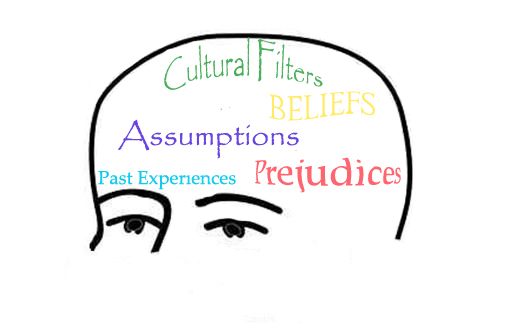
No matter who you are–black, white, Hispanic, French, Executive, Gen X, Retiree–the way you think is wrong.  Oh, I left out Democrat or Republican.  Our brains are truly wonderful things.  They are efficient processors of information.  There are a lot of tools that our brains us to make us more efficient and effective in our daily lives of being human.  I call all of these, generally, being on autopilot.  Being on autopilot is your enemy in terms of controlling your future.  Being on autopilot is also your friend in terms of making you more efficient at all the things you have to do in daily life.  The key is to learn the tricks your mind plays on you and to learn to turn these tools on and off to make better judgements when appropriate.

Let Me Be More Specific

Our brains use a number of tools or shortcuts that help us process information:

  • Halo Affect: assumption that because someone is good at doing one thing, s/he will be good at doing other things
  • Availability Heuristic:   assumption that because you think of something more frequently it is more likely to happen
  • Generalizations:  assumption that people, challenges, mistakes, organizations,  . . . pretty much everything . . . are just like the ones we have already experienced.  We tend to generalize trustworthiness, bad intentions, skills, incompetence, etc. based on other similarities.  Examples:  Asians are smart, Senior executives are bad, old people are degenerating,  Gen X’s are . . . (depending on your view).
  • Illusion of Understanding:  assumption that familiarity with something means you understand it
  • Hindsight bias: the tendency to view things as more predictable than they are
  • Motivated forgetting: re-remembering things to avoid blame
  • Overconfidence bias: the belief that your abilities are greater than they are–80% of drivers believe that they are in the top 30% of drivers
  • Recency bias:  giving more credibility to more recent data–the last presenter, the last candidate, the last answer
  • Clustering illusion:  seeing patterns where none exist

We All Do It

All of us use these tools.  They were developed back in the day when we lived in caves and hunted.  They are tools that help us make instant decisions without a lot of effort.  The problem is that they don’t work as well with today’s problems as when we were outrunning lions and tigers and bears.  The worst part about them is that we are generally unaware of them.  We value eyewitness testimony over other kinds of evidence, even though it is highly defective.  We choose candidates like us because we are generalizing and making assumptions at the subconscious level without really evaluating the basis for our assumptions.  We take risks based on shortcuts our brains make without even being aware of them.

What Can You Do?

The best thing to do is to educate yourself about these “tricks” that your mind plays.  There are several great books that can help:

Then Practice!

Learn to take control of the way you think by practicing.  Ask yourself, “Why do I think this?”  “How do I know this?”  “How can I think of this differently?”

4 Comments

Filed under Books, Career Development, Executive Development, Personal Change, Reframe

The Water You Swim In

Culture is Like Water to a FishUnderstanding Your Organization’s Culture

Organization culture for people is like water is for fish.  It is there.  It is critical to how the organization works.  It shapes people’s interactions.  It guides how work gets done, what is considered success, who is powerful and who is not.  It is also invisible.  People are not consciously aware of it.  It is probably the single most important thing in the organization, and most people know nothing about it.

If you want to be successful in an organization, one of the first things you should do is work on understanding the culture.   You will be able to use the culture to help you be effective.  You will be able to avoid getting into trouble by understanding the rules of engagement, power and territory.  You will be able to use the informal networks to grease your requests and deliverables.

What is Organizational Culture?

The culture is the set of assumptions, beliefs, customs, behaviors, rites, rituals, behaviors and values that exist within an organization.  These sometimes come directly from the founder (think Steve Jobs), then get influenced by subsequent leaders (think John Scully, then Steve Jobs).  The culture is sometimes a creation of combined organization cultures, or an organization culture that has been transplanted into another geographic region—Apple in China, Honda in the US.  The culture is never JUST what the company says it is.  In 2000, Enron’s stated values were:

  • Respect We treat others as we would like to be treated ourselves. We do not tolerate abusive or disrespectful treatment. Ruthlessness, callousness and arrogance don’t belong here.
  •  Integrity We work with customers and prospects openly, honestly, and sincerely. When we say we will do something, we will do it; when we say we cannot or will not do something, then we won’t do it.
  •  Communication We have an obligation to communicate. Here, we take the time to talk with one another and to listen. We believe that information is meant to move and that information moves people.
  • Excellence We are satisfied with nothing less than the very best in everything we do. We will continue to raise the bar for everyone. The great fun here will be for all of us to discover just how good we can really be.

Obviously, there was more at work in the culture than what they said.  There were other things driving behavior.  The culture rewarded conformity and punished dissent.  Individualism was valued over other behaviors (Jeff Skilling’s favorite book was Dawkin’s The Selfish Gene.)  There was a belief that the people who worked at Enron were the “best and the brightest.”  Eighty hour work weeks were the norm.  There was a “rank and yank” performance system.  Cumulatively, these things and lots of others, describe the Enron culture.

Disney has a very different culture.  Google has a differently culture.  Organization cultures are the (organizational) DNA combination of all of kinds of inputs.

How Can You Figure Out Your Organization’s Culture?

 Answers to the following questions can help you begin to understand the culture:

  • Who founded the company and what were his/her beliefs?  About   the organization?  About the way things should be?
  • Is the founder viewed as a hero?  A villain?
  • Is the founder still with the company?
  • If not, what impact have subsequent leaders had?
  • Are any of them considered saviors?  Heros?  Villians?
  • What are the stories that are told about the company?
  • What kind of person(s) seem(s) to be favored?
  • What behaviors are accepted?  Regulated? Discouraged?
  • How does communication flow?
  • What parts of the organization’s history are important?
  • What traumas have happened to the company?  Are there psychic scars from those traumas?  Do people still talk about them years later?  Have behavioral norms been put in place to avoid the same trauma in the future?
  • What is the dress code?  How rigidly is it enforced?
  • What are the social norms?  Do peoples socialize together?  Have  lunch?  Spend time outside of work? Are there cliques?  Does inclusion/exclusion impact your career?
  • Who speaks in meetings?
  • What is the power structure? How do people break into the power structure? What kind of people are in the power structure?
  • What are the performance evaluation norms?
  • How is information shared/not shared?  Who controls it?

Once you’ve thought about these, identify the ways in which you can use/benefit from how the culture works.  Focus specifically on:

Leave a comment

Filed under Career Development, Executive Development, Organization Culture, Uncategorized