Category Archives: Success

Not Your Mad Men Career Ladder

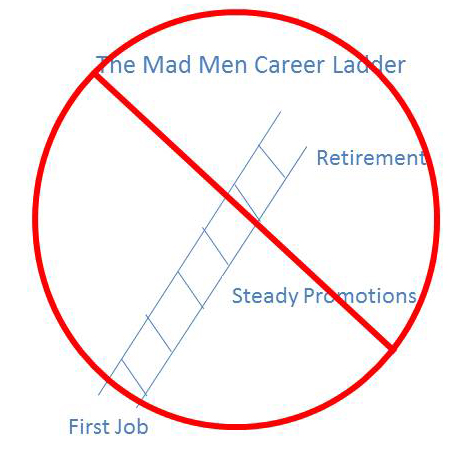
Way back, before most of us were working, you got a job with a company and you stayed with that company–making steady progression–until you retired.  You were, of course, a man.  If you got fired, you had done something pretty bad.  Layoffs didn’t happen very often.  There were career ladders that you took all the way from your first position to your last position.

traditional career ladder is no more

This is so long ago that many people reading this don’t get it, don’t know why we still talk about it, and think this is a no-brainer.  We still talk about it because this model still shapes our expectations in many ways.  Our infrastructure is not set up to support the current reality–if so, we’d have portable health insurance and retirement plans.  We’d also be much more focused on taking care of ourselves in our careers rather than leaving it to companies.  It is time for our mental models to catch up with reality.

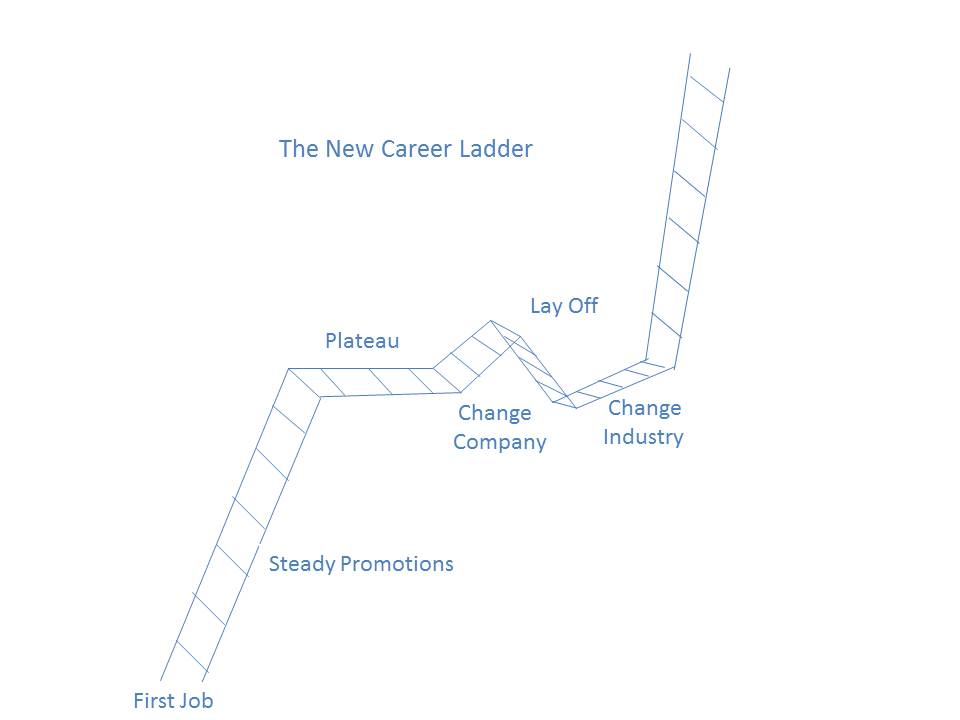
The current ‘career ladder’ looks a lot more like those cool folding ladders that can be shaped over obstructions and can bend in several directions as necessary to do the job.

todays career ladder

The current ‘career ladder’ takes you up when that is possible and helps you deal with the plateaus, job losses, industry and functional changes that are necessary to remain resilient and successful in today’s economy.  Today’s ‘career ladder’ needs to focus on skills and trends rather than specific roles in specific companies in specific industries.  Find ways to “Genericize Yourself,” that enable you to move across industries.  Find ways to specialize (I know, those sound like opposite pieces of advice, but they aren’t), so that your value (brand) is obvious.  Build your resilience for all kinds of shifts in the economy–think of the shifts that have happened in publishing, electronics, e-marketing, and are happening in health care and communications now.  You can’t know what is coming, but you can be ready.

Leave a comment

Filed under Brand Yourself, Career Development, Executive Development, Job Hunt, Recession Proof, Success

Manage Your Resistance

Manage Your Resistance

Put Your Leader Hat On

Who would you rather work with if you’re implementing a new change in your organization?  Would you rather work with someone who has been there for ten years–who knows his/her way around the organization, who knows how to make things happen in the organization?  Or would you rather have someone who has been there a couple of months, who has begun to know where the bathroom is and where important people sit?

The ten-year guy, right?

Wrong!

Why is that? Because the ten-year person is really committed to the way things are–‘the way we do it.’  Even if s/he doesn’t like it.  Even if s/he complains about it.  The ten-year person has been through all the ‘we tried that and it didn’t works,’ all the times s/he had to be reorganized or was left to do the work of those who left, who had to learn new systems, and who may or may not remember the good parts (results) of those changes, but who does remember the problems.  The ten-year person doesn’t want any more change (unless s/he gets to direct it).

The new person not only doesn’t have that history, or those scars, but also EXPECTS to have to go through those kinds of changes and challenges.  The new person follows directions and tries to please whoever is in charge.

Now, Which Are You?

Are you the new person who is emotionally and intellectually ready to not only participate, but also to help?  Or are you the long-term employee who isn’t?  You may be telling yourself that you are change-ready.  And maybe you are.  But change burnout, or change immunity, happens to all of us.  Yes . . . even me.

I’ve been doing change management for a long time.  I really know how to spot resistance and how to deal with it.  I got a new boss one time, after having changed bosses 3 times in the past 12 months.  I didn’t even realize how done with new bosses I was.  That is, I didn’t realize it until one of my employees said to me, “For someone who knows so much about change, you sure don’t handle it very well.”  She was right.  I wasn’t handling it well.  My capacity to deal with change had been used up and I was on the resistance end of the continuum.  My employee did me a favor.  I didn’t really realize how much my fed-up-ness was showing until she said that.

Wouldn’t it be a good idea to put yourself in that new employee mindset?  Wouldn’t it be a good idea to try to think like someone new to the organization (while at the same time bringing all your organization skill, knowledge and abilities to the table)?  Whenever I become aware that I’m in ‘resisting’ mode, I remind myself–if I had just started today, I wouldn’t think about all the reasons this is a stupid idea–I would just accept it and do it.

Try it.  It helps.

Note:  I am not saying that you should blindly follow without contributing opinions and constructive criticism.  Just be sure that that is what you’re doing though, and not resistance.  Resistance is a normal reaction, but it isn’t helpful to your career, so learn to manage it.

2 Comments

Filed under Career Development, Executive Development, Leadership, Success

Promoted! Now What?

success at work

Congratulations!  You just got promoted.  Or you just got reorganized into a new department.  Or you just got a new boss.  How do you make this a step in the right direction and keep from crashing and burning.  Ok, crashing and burning is unlikely–you did persuade someone that you deserved the promotion.  Getting stuck is a possibility.  Looking like you weren’t ready is a possibility.  Not making a great impression is definitely a possibility.  So, what do you do?

It’s a New Job

One of the most important things to do is to understand that this is a NEW job.  Treat it as if you just got to a new company.  Look at the experience through new eyes.  Who are the people?  What is the power structure?  What does the company need to be successful.  What does the department need to accomplish in the short term?  In the long term? What does the department need from you to be successful?  Go talk to people as if you’re meeting them for the first time.  What is important to them? What are their goals? How can you hit the ground running?  How can you quickly show that choosing you was the right choice?

There is a subtle difference for most of us when we change jobs within the company and when we change companies.  When we go to a new organization, we are completely aware that we don’t know everything.  We have our hyper-alert antenna out.  We are in the “conscious unconscious” state of learning.  We are aware of all the things that are different from our last experience (although we frequently miss things because of our ‘old company’ mindset).  When we change jobs within the same organization, we think we know how it is.  We know a lot of the people (although through the eyes of the last group we were in), we know the business (ditto), we know the problems, challenges, opportunities (ditto, ditto, ditto).  The problem is, the new job within the same organization is just as new as the other.  If you put yourself in the same hyper-alert state, you are much more likely to be highly successful.  You are much more likely to impress, because people will see you differently (than they had before) too.

First Impressions

Remember that although people may know you (some may even have been your peers before your promotion), you still have the opportunity to make a ‘new’ first impression.  If you are really trying to make a good impression, you’re likely to get attention again.  Make sure it’s the right impression.  Make sure you don’t come across as arrogant or smug (especially to your former peers).  Make sure you come across as smart and interested and capable and willing.  Make sure that people see results QUICKLY.  The best way to do all of this is to treat the promotion as if it were a new job at a new company.

Helpful Books

Congratulations!  And good luck.

2 Comments

Filed under Books, Career Development, Executive Development, Leadership, Reframe, Success

Appreciate What You’ve Got

This is all going to end.

I know this doesn’t come as news to most of you, but everything we have is quite transient.  Possessions (think hurricane/fire/tornado), health, and even life itself.  There are two ways to approach this fact.  You can live in fear of losing it all, or you can really appreciate what you’ve got.  Including your job.

I’m a consultant.  I have a lot of jobs (serially).  I really like being a consultant.  I like what I get to do and I like the people I meet.  I love that I learn something every single day that I’m working as a consultant.  I especially like the variety.  Ironically, I don’t like leaving my jobs, though, when they are done.  I miss the routine, the company and especially the people.

I started a new gig this week, and today, on my second day, I walked in resolved to appreciate every single day.   I want to appreciate the ups and downs, the people, the tasks, the challenges, and the things that I learn.  The thing is, I know that this will come to an end.  It might be at the end of the contract time frame established up front, or I might get extended, or it might be earlier.  I know, for sure, however, that it will end.  I want to be aware of that every day so that I can appreciate what I’ve got.  I think it will help with the frustrating parts, but I also think it will help with the end—when I leave I know I will have pushed this experience to its limit.  No matter when that is.

How about you?  You’re not a consultant, so it doesn’t apply to you, you say.  I beg to differ.  The job you’re in now will end.  It might be when you retire.  It might be tomorrow.  It might be when you get a new job or a promotion. You might know the end is coming or you might get called into a meeting and get told.  I know someone who once showed up at work and there was a sign on the door.  It will end.

What Would You Miss?

Do you appreciate what you have?  Do you appreciate the people who you work with and see every day?  Do you appreciate the facilities?  The amenities?  The inside jokes?  The get-togethers?  The things that you learn?  If it ended tomorrow, what would you miss?  If you knew when it was going to end, what would you be doing between now and then?  What is your work ‘bucket list’ to do before you leave?

How about getting started on it? (Just in case:-))

8 Comments

Filed under Personal Change, Reframe, Success

Get Your ‘Get Up and Go’

motivate yourself

I spent much of Sunday morning watching a few hundred people participate in their first triathlon.  It was sixty-something degrees and drizzling.  What would possess these people—all ages, shapes and sizes—to come out in the rain to inflict discomfort on themselves?  They swam a quarter of a mile in a lake, biked 12 miles on rain slick country roads and ran 3.1 miles over hilly trails.  At the beginning and end of each portion of this event, each person had a small cheering section, but for the most part, each participant swam/biked/ran alone, competing against the elements and motivated by him/herself.  How did each person motivate him/herself?  How can you motivate yourself to do whatever your goal is?

Well, the good news AND the bad news is that motivation is individual.  Every person is motivated differently.  Some people need praise to be motivated.  Some people need to feel like they’re contributing.  Some people need to be able to tick off the boxes of their goals to be motivated.  Some people like public recognition, some hate it.  Few people, believe it or not, are motivated solely by money.  In fact, money can be a demotivater–it’s not enough or it’s less than so and so got–you spend more time thinking about the negative than the positive of money rewards.  Anyway, the way you are motivated is unique to you.  You need to figure out how that is and then put it to work for you.  You need to NOT wait for someone else to motivate you.  Others can help (like the individual cheering sections at the triathlon), but you need to take the responsibility and develop the skill to motivate yourself.

There are two types of motivation:  external and internal motivation. External motivation is in play when you are thinking that you “should” or you “want” to do something.  You’ve got internal motivation when you “love” something or you “gotta do it.”

There is a motivational continuum between external motivation and internal motivation.

Motivate yourself

If you are all the way at the external motivation end of the continuum, then your motivation comes not only from outside yourself, but actually from other people—people who tell you what to do.  You’re not doing it for yourself, but rather for others.  If you are at the internal motivation end of the continuum, then you do it because you feel whole when you do it.  You do it despite all the excuses/distractions/opportunities not to do it.  You REALLY do it.

The question is, how do you push yourself toward the internal motivation end of the spectrum?  First you need to understand what motivates you.

  • Are you a planner?  A list person?
  • Do you need to be encouraged by others? Recognized by others?
  • Do you need to feel like you accomplished something? Made a difference?

Think about times when you were most motivated.  What made that happen?  Was it that someone was proud of you?  (External motivation)  Was it that you could look at what was happening and you were proud of yourself? (Internal motivation). Whatever it is that pushes you, figure out a way to put that in your life.  Create a situation that provides the reward(s) that work for you.  They don’t have to be big rewards.  Frequently people are just as motivated by any reward–that they care about–as a big reward.

The key is that you have to take charge of your own motivation.  You will see your performance rocket significantly.  Steve Chandler’s book. 100 Ways to Motivate Yourself, will give you lots (100 to be precise) of ideas on how to motivate yourself.

Start experimenting.

3 Comments

Filed under Career Development, Career Goals, Executive Development, Goal Setting, Success

How to Increase Your Visibility in Your Organization

Who Knows Who You Are?

One of the most important things to realize as you work your way up the ladder at your organization is that other people are rarely as aware of you as you think.  You work hard.  You deliver great results.  You deliver more projects/faster/better than anyone else.  The Powers-That-Be rarely are aware of the nitty gritty detail of who does what to get the results.  Your manager may not even be as aware of what you’re doing/delivering as you think.  Your peers may think they had as much to do with what you delivered as you do.  This is not malicious–it’s human nature.  We live in our own little world and we filter out that which is not most important.  Other people’s accomplishments are rarely as important to us as our own.

Stand Out In Your Organization

How Do You Do It?

Tell people what you’ve done.  Find a way that is comfortable for you to tell what you’ve accomplished.  You know how to do this with friends and family.  Use the techniques you used when you were dating–figure out how to make it interesting and not narcissistic.  Leaders find out who is doing well through being told.  It has to start with you.

Seek out and volunteer for projects. Make sure your leadership knows you are willing and capable when the organization needs someone to step up and make things happen.

Figure out how to get your manager and your peers to be advocates for you.  The best way to do this is to be advocates for them. They will likely mirror your behavior.  Don’t be afraid to ask for support from your boss or peers to advocate for you being on a project or recommending you.

Make sure key executives (not just your own) know who you are.  Figure out a way for them to know your work.  One of the best ways to do this is to volunteer for projects in other executives’ areas of responsibility.  In other words, be your department’s representative on cross-departmental projects.

Be involved outside your job, especially in organizations where  senior leaders participate. Attend and volunteer in professional organizations.  Make sure your organizational leadership knows about your successes in these outside organizations.

Speak up.  If you don’t contribute to the conversation, people think you can’t/don’t know anything.  They don’t make any more thorough analysis than that. If you aren’t speaking up because you don’t think you have anything clever to contribute, the good news is that people don’t judge what you say too closely.  So, they do judge when you don’t talk, and they don’t judge the quality of what you say very harshly.  Go figure.  But speak up.

Become an expert.

Build your expertise.  Within your organization, become THE expert on something.  Be the ‘go-to’ person for that subject. Stay current in your expertise so people know you are the one who will know when something changes.

Leave a comment

Filed under Career Development, Executive Development, Networking, Success

Work As We Know It Is Changing–Get Ready!

That Was Then

My maternal grandmother went to work when she was thirteen years old at a china factory that made dishes for hotels and restaurants and, eventually, naval ships.  She stayed in a rental room with her two-year-older sister during the week and went home on the weekends.  She got married when she was seventeen and continued to work at the factory sporadically.  She was very good at what she did.  She was a Master Painter and she supported her family of eight during the Depression by painting.  It never occurred to her that that factory wouldn’t always be there, but when she was forty-seven the plant went out of business, taking hundreds of jobs with it.

Carr China Grafton WV

China from Carr China

My paternal grandfather spent his entire professional life at the Baltimore & Ohio Railroad, most of it as engineer driving passenger trains.  He told my father not to go to work for the railroad, because it wasn’t going to last.  The Baltimore & Ohio Railroad went out of business three years after my grandfather retired–taking hundreds of jobs with it.

Baltimore & Ohio Passenger Train

B&O Passenger Train

My mother’s cousin was forced to retire from the steel mill when he was fifty years old.  He wrote about it in an article published in the Beaver County (Pa) Times, “Now time has changed again, old friend [the steel mill] and now times are not certainly in your favor.  I am reasonably certain that my sons will never know you as I have but you can be sure I will tell them your story and how finally you were befallen by so many uncontrollable factors, and how you, who meant so much to so many, now sit mostly idle as wind whistles through your empty buildings; your coke batteries, your blast furnaces and continuous caster are now cold, dark, and silent.”  And hundreds of jobs gone.

Steel Mill in Pennsylvania

Steel Mill in Aliqiuppa, Pa

You may have similar stories from your grandparents, parents and even from your own experience.  This is happening to us.  Companies and work as we know it are changing irrevocably.  It’s sad.  There is a lot to grieve.  There are things you can do about it, though, so when YOUR company and YOUR job change, you land on your feet.

This Is Now

I read a couple of things over the weekend that discuss something that I’m seeing in the workforce among my coaching  and organizational clients. It is the next way that work will be.  The longer you don’t believe it, the louder you rail against it, the longer it will be before you are ready for the next “way we work.”  The first thing I read was  The Rise of the Supertemp by Jody Greenstone Miller and Matt Miller in Harvard Business Review.  They describe a phenomenon that many of us have seen.  Companies are going to contract workers.  According to a McKinsey  2011 study cited in the article, 58%  of US companies surveyed are planning to increase use of temporary employees AT ALL LEVELS.   Not only are they using project, technical and finance contract workers, they are starting to hire contract Executive talent–business development, marketing, lawyers, CFOs, and even CEOs.  BOTH companies and Executives need to adjust to this new reality.

Companies need to learn how to organize work so that these Supertemps can come in and make a difference. Mostly this means that work needs to be organized into project-type work.   Executives need to package and sell themselves for this work.  The most telling thing in the Harvard article, however, is that those who have done this work DO NOT want to return to the ‘old way.’  This is true of the people I know who have done this kind of work as well.  They really like it.

Think about how you make yourself a well qualified candidate for these positions.  There are some ideas for that in the second thing I read this weekend–The Finch Effect by Nacie Carson.  Carson suggests that like Darwin’s finches, today’s workers need to evolve to adapt to the current work environment.   She points out that unlike the time it takes other species to evolve, humans can evolve their behaviors to adapt as they choose.  Her suggested strategies for adapting to the new work environment:

  • Adopt a ‘gig’ mindset: piece together a combination of contracting, consulting, and free lance work that gives you a income equal to or more than your ‘full time’ job
  • Identify your value:  this is your professional brand–it communicates intangibles like values, personality and mission
  • Cultivate your skills: you (not your company) take responsibility for growing your skills
  • Nurture your social network: use appropriate sites for appropriate messages, rebrand as necessary, communicate your brand
  • Harness your entrepreneurial energy: look at your job and skills from a position of personal responsibility, initiative and personal direction

AND you can apply all of these to you ‘real’ job.  They will help you stay in it and succeed.  And they will help you be ready for the next ‘way we work.’

5 Comments

Filed under Books, Career Development, Career Goals, Job Hunt, Leadership, Networking, Reframe, Success

There’s Networking, and Then There’s NETWORKING

Do It Before You Need It

I started this blog out of frustration.  I had just talked to my umpteenth client/friend/student/colleague who found him/herself out of a job with a stone cold network and a total freak out about what to do.  (See my first blog post–Get Ready to Lose Your Job)  Networking definitely helps when you need to find a job.  In fact, it is probably the best tool to have in your arsenal for finding a job.  These days, a powerful network can make the difference between finding a job in weeks or months and it taking more than a year.

Networking also helps with just about everything else you might need–getting promoted, finding business opportunities, selling products, building your reputation/brand, getting answers to tough questions, staying in touch, and even finding someone to date (I’ll leave this last one to other blog writers).  You can build your network purposefully, or you can build it serendipitously, but be sure to keep building it. Remember, though, networks are about RELATIONSHIPS, not about numbers or names or tools or connections.

Serendipity

Let’s talk first about building it serendipitously.  There are marvelous tools available now that make it easy and fun.  Facebook, Linkedin, and Google+ are the top tools right now, but there are many more–Plaxo, Twitter, MyLife, etc. Not being involved in a social network these days is like not having a resume or appropriate business attire.  To function in today’s business world–no matter your age or organizational position–you have to be saavy enough to be using social networks.  If you participate in these social networks–let’s say Facebook or Linkedin–and just reach out to people you know and accept invitations from people who reach out to you, you will build your network.  If you particpate in LinkedIn Groups discussions, answer questions and comment on people’s status, you will strengthen the connections/relationships.  If you share a little of who you are on Facebook and comment on friends’ posts, you will build the relationships.  It starts at one level and grows to other levels.  It has to be real.  Superficial interactions are obvious and quickly shunned.  If you do it gradually  over time, then it doesn’t take a lot of time and you have the beginnings of what you need when you need to look for a job or a promotion or business opportunities.

This serendipitous network building also has the benefit of creating a network of strong connections–you know all these people pretty well.  When you need something from these folks, you are more likely to be comfortable asking, and they are likely to respond.  Not much work/lots of potential benefit.  Why not?

Purposeful

The other way to build your network is purposefully.  This is what I recommend.  Take a look at your networks.

On Facebook using myfnetwork :

Visualize your facebook network using myfnetwork

On Linkedin using LinkedIn Maps

Visualize your network using LinkedIn Maps

What do you see?  If your networks are anything like mine (and they may not be–every network is unique), you will see people who are “hubs,” and you will see clusters.  For me, one of the interesting things about these two pictures is that some of the “hubs” of my Facebook network are on the edges of my “clusters” on LinkedIn.  This makes sense to me, because I see these as two different networks.  One is more friends and family and one is more professional.  There is strong overlap between the two, but there are lots of people on one and not the other.  The LinkedIn Maps feature allows you to label the colored clusters.  This provides you with the ability to see the relationships among the groups in your network.

Now, pull up.  Look again.  What do you see?  What is there?  What is missing?

What Do You Want From Your Network?

Do you want a job?  Do you want to make a career change?  Do you want a promotion?  Do you want to make sales?  Do you want business opportunities? Do you want venture capital money? Do you want to build your brand?

Now, based on what you want, look at your network again.  Can it get you what you want today?  What’s missing?  Professional connections in a particular field?  Venture capitalists? Senior executives at other companies?  Senior executives at your company? Are there people at all levels in organizations?  Are there people at all generations in companies?  What about geography?  Do you have a strong network in all the locations you need?

What Are You Going to Do About It?

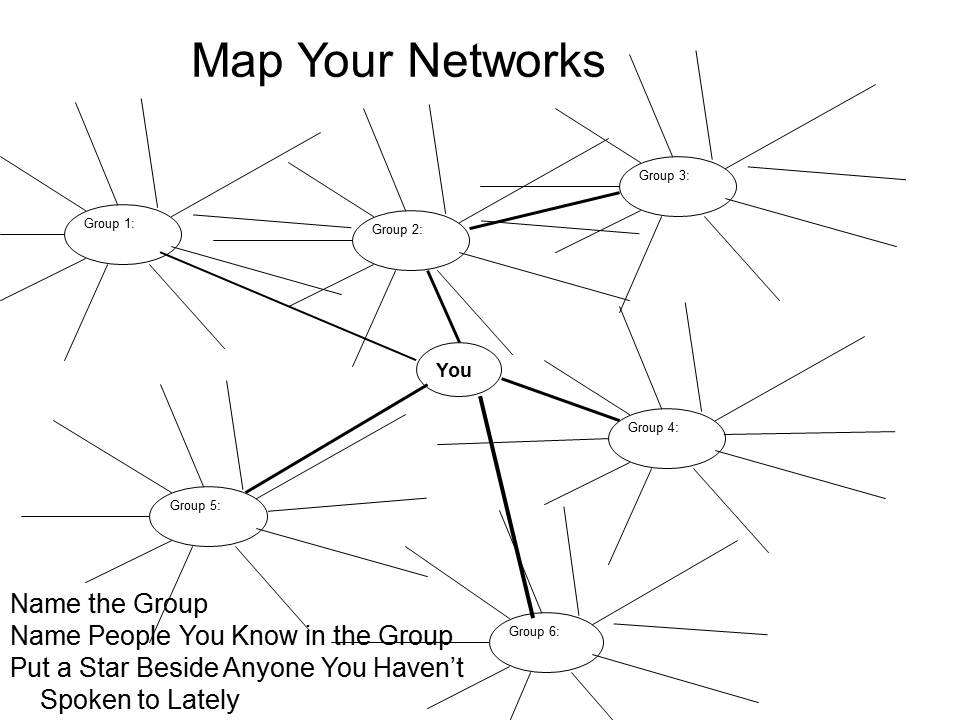
First, let’s go old school.  On paper, or using mind mapping software, do a brain storm of who you know.  Start with the groups you belong to or are associated with.  Once you’ve listed the groups, start listing the people associated with the groups.  Who are the key players in those groups?  Who are the best connected?  Who have you talked to lately?  If you haven’t talked/connected with people, then reach out to them.  Do it via email, phone or one of the social networking sites.  Prioritize people according to the purpose of your network.

Map Your Network Worksheet

Address what is missing.  How can you reach out to people you need to be connected to in those areas that you need to grow?  Get introductions through your existing connections.  Use the helpful tools that LinkedIn provides.  Attend professional functions, follow thought leaders’ blogs and make comments.  Participate in Linkedin Groups discussions.

Create a plan on how you’re going to keep up with your network.  Do regular (but not obsessive) work to stay in touch with your existing network and to grow it.

Some Myths About Networking

  • It’s  about the numbers. IIt’s really about quality connections.
  • It’s about your connections’ job title.  Looking at the visualization of your network should show you that the ‘most’ connected people are not necessarily (and not even likely) the highest ranking.

Some Truths About Networking

  • It has to be real.
  • It takes time.
  • It’s about mutual win/win.
  • It works.

Some Books

10 Comments

Filed under Books, Career Development, Career Goals, Executive Development, Goal Setting, Networking, Recession Proof, Success

Are You a Good Fit For Your Organization?

What is the Culture of Your Organization?

Two key components of managing your career to success are to know yourself well and to understand your organizational environment.  The next step is to evaluate your fit within your organizational culture.  All organizations have cultures–like personalites.  The culture of an organization is like the water that fish swim in. The people who work in the organization are pretty much unaware of the culture on a daily basis.  It surrounds them and drives a lot of the behavior, it includes the unwritten rules and the things that are important, the values, the rituals and the history.   It is very likely that you know a lot about the culture without really realizing that you do.  This exercise will help you see your behavior within the context of the organization.

Evaluate Your Behaviors

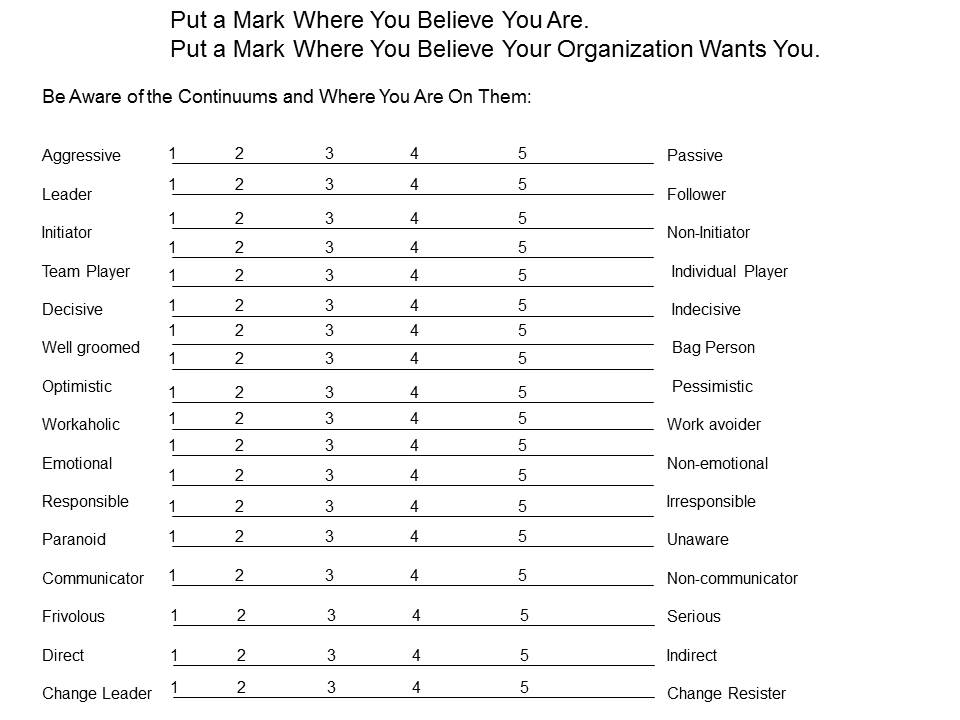
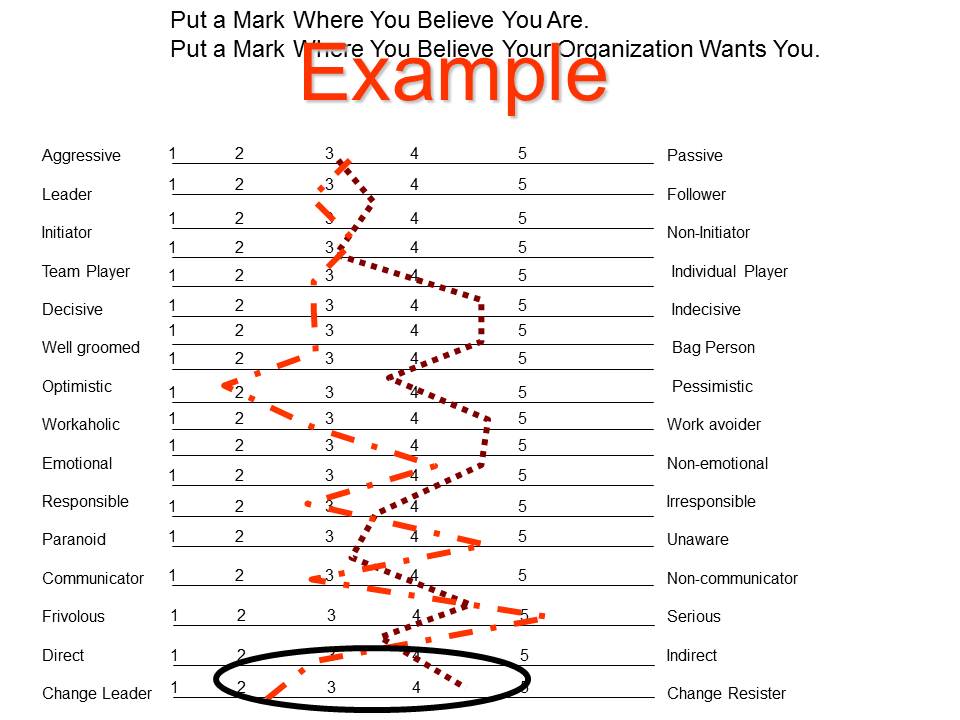
One good way to evaluate your fit in the organization is to first assess your behaviors, like decisiveness or leadership, on a continuum and then to do the same assessment looking through the lens of what the organization rewards in that behavior.  Take a list of behaviors like those below and first mark where you believe that you are on the continuum between the two extremes of the behavior.  Go with your gut.  Try not to answer according to where you “should” be, but rather where you believe you are.  Then make a mark on the same continua according to where you believe your organization wants you to be.  Think about what you’ve heard from managers, in 360 assessments, in reviews.  Think about the people in your organization who are obviously successful and highly thought of–where does their behavior fit? Even if you aren’t completely right about what your organization wants, you will be able to identify the biggest discrepancies.

Behavior continuum analysis

Once you have marked where you think you are and where you think the organization wants to you to be, connect each set of marks like in the example below.  This will provide you with a graphic that shows you where the gaps are between where your behavior is and what the organization’s norm is.  For example, if you look at the continuum Optimistic . . . Pessimistic or at the bottom, Change Leader . . . Change Resister, you see that there is a gap.

Example of behavior continuum evaluation

PDF Version of Worksheet

Address The Gaps Between Your Behaviors and the Cultural Norms

Once you are aware of the gaps, then you can decide what you want to do about them.  You have several choices:

  1. You can do nothing.  You can decide this is who you are and you aren’t willing to change to fit better in your organization.
  2. You can decide to change your behaviors (remember, behavior is not WHO you are).  Think about the way you are different at your boss’ staff meeting than at home, or how you are different at church than you are at girls-night-out.  You can change your behavior without changing who you are.  When you learn to change your behavior, you have more control over your career.
  3. You can be selective about which behaviors you want to change.  Which behavior have you heard the most about?  Which one do you think would be the easiest to work on (it is always best to start with baby steps)?

If you decide that you want to change a behavior, here are some steps that will help:

  • Observe others who have the behavior you would like to have.  Imitate them. Try it out.
  • Share with someone that you’re trying to change and ask him to give you feedback on how you’re doing.  Just knowing that someone is watching you will help you be more aware and will push you to try harder.
  • Practice “being” different in your mind.  Imagine what you look like, what you say, how you sound.
  • If the behavior you’re trying to change is something you’ve heard about in your reviews, make sure that you demonstrate the new behavior in front of your boss.

It’s normal to be uncomfortable as you go through this process.  Keep trying.  Don’t expect others to notice at first. It will take a while.  That makes it easier, though, because it gives you some time to practice and get more comfortable.

1 Comment

Filed under Career Development, Executive Development, Feedback, Personal Change, Success

Selling Your Brand

Have You Thought About Your Brand?Sell Your Brand

Have you ever thought about how your boss thinks about you?  Not what he thinks, but how he thinks?  What about how the organization thinks about you? How about the top leadership in your organization? What about the folks in your professional organizations? Do you stand out in any way?  Do they think of a certain kind of expertise or talent?  Do they think of a certain kind of results?

When you think of McDonald’s you get a “picture” of what McDonald’s is.  Depending on your age and interests, that image might be different, but it pops into your mind.  The same is true of Coke, or Apple or Sears or Fanta.  You make decisions about those brands based on your values, interests, likes/dislikes, income and other demographics.  You want to be able to control (or at least strongly influence) how people think of you (your brand) when they think of you.  The more you influence your brand and the more aware you are of it, the more likely you are to be able to manage your career successfully.

How I Learned This Lesson–The Hard Way

I worked for many years in a large, rapidly growing organization.  There was a period of time when I was “stuck” in the same position for several years.  The men who had started in the organization with me were moving past me and I was standing still.  I was very confused by this. Rightly or wrongly, I rejected the idea that it was a gender thing.  I thought it was something about me.  I was VERY frustrated.  I was quite angry about it. (Although looking back on it, I’m not sure just how clear I was about what was causing my frustration.)

Our CEO had a leadership meeting and announced the formation of a trilogy of high performance projects.  He announced that the people selected to work on these projects would be those who were identified across the organization as the “best” in each of the areas.  I was thrilled.  I was the “best” at one of them.  (Ok, maybe I wasn’t really, but at the time, I was absolutely, completely, without a doubt sure of it.)  So . . . I waited for the invitation.  It didn’t come.  Someone else in my division got selected.  Someone who not only wasn’t as good at it as me, but who wasn’t even interested.  I went from being angry to being FURIOUS!  How could they announce that the ‘best’ would be selected and then not pick me!?!?!  I couldn’t let it go.  I asked my manager.  I asked the VP of HR.  They didn’t know.  I finally asked my VP.  His reaction was one of the best lessons I ever got–although not at all fun!

He was completely, genuinely surprised that I even thought I should have been selected.  It hadn’t occurred to him.  It was in this very painful way that I realized that he really didn’t know that I was the ‘best.’  The person he had selected was a charming, talented person who regularly delivered results.  He didn’t know anything about the subject matter at hand, but that didn’t really matter that much.  He was easy to get along with.  He was very competent (at other stuff).  He was charming.  He got results.  So he got picked.

I, on the other hand, was pretty much an unknown to the VP who had my career in his control.  He certainly didn’t think of me–at all.  This was completely eye opening.  And when I got over the shock of it, I got over being so mad, too.  I could see how and why he was oblivious to my strengths.  I was pretty much totally responsible for that.  I hadn’t made a point of selling my abilities to the ‘powers-that-be’ in the organization.  I hadn’t made sure that I was thought of as an expert in the organization.  Once I figured this out, I went about building my ‘brand’ in the organization.  And I got ‘unstuck’–promoted within less than a year.  And then I got promoted again.  And then again.

How do you build your brand?

  • Be an expert.  Build your expertise.  Within your organization, become THE expert on something.  Be the ‘go-to’ person for that subject.
  • Help other people.  Create mutually beneficial situations.  Create ‘organizational trade routes.’
  • Act like you’re dating. Remember back to the days when you were dating.  Somehow or other you always managed to be in the right place at the right time to ‘meet’ up with the person of interest.  You managed to ensure that s/he knew how great you were.  You managed to appear to be as smart as possible, as talented, as charming as possible.  Do that again–just in a different context–prove how ‘right’ you are for the organization.
  • Be brave.  Stand out.  Blending in will not do you any good long-term.  What’s different/better/a more perfect fit about you?  How can you get it communicated?
  • Make sure other people are ‘selling’ you.  The theory behind social media marketing is that buzz created among ‘friends’  is more credible than advertising by the company.  I can’t tell you how many times I was in meetings of managers who were deciding who got what job.  The candidates who were known of by more deciders were the ones who got the jobs.  EVEN IF THEY WEREN’T the most qualified on paper.  If you know of someone, you feel more comfortable choosing him than a total unknown.  Imagine how much better someone did who was known of (because they had effectively sold their brand) by all the deciders.
  • Get over any thoughts that ‘selling’ your brand is unseemly. This is your life, your livelihood, your career.  This is the way you do it.

2 Comments

Filed under Brand Yourself, Career Development, Career Goals, Communication, Executive Development, Networking, Recession Proof, Success