Tag Archives: Reframe

Selling Your Brand

Have You Thought About Your Brand?Sell Your Brand

Have you ever thought about how your boss thinks about you?  Not what he thinks, but how he thinks?  What about how the organization thinks about you? How about the top leadership in your organization? What about the folks in your professional organizations? Do you stand out in any way?  Do they think of a certain kind of expertise or talent?  Do they think of a certain kind of results?

When you think of McDonald’s you get a “picture” of what McDonald’s is.  Depending on your age and interests, that image might be different, but it pops into your mind.  The same is true of Coke, or Apple or Sears or Fanta.  You make decisions about those brands based on your values, interests, likes/dislikes, income and other demographics.  You want to be able to control (or at least strongly influence) how people think of you (your brand) when they think of you.  The more you influence your brand and the more aware you are of it, the more likely you are to be able to manage your career successfully.

How I Learned This Lesson–The Hard Way

I worked for many years in a large, rapidly growing organization.  There was a period of time when I was “stuck” in the same position for several years.  The men who had started in the organization with me were moving past me and I was standing still.  I was very confused by this. Rightly or wrongly, I rejected the idea that it was a gender thing.  I thought it was something about me.  I was VERY frustrated.  I was quite angry about it. (Although looking back on it, I’m not sure just how clear I was about what was causing my frustration.)

Our CEO had a leadership meeting and announced the formation of a trilogy of high performance projects.  He announced that the people selected to work on these projects would be those who were identified across the organization as the “best” in each of the areas.  I was thrilled.  I was the “best” at one of them.  (Ok, maybe I wasn’t really, but at the time, I was absolutely, completely, without a doubt sure of it.)  So . . . I waited for the invitation.  It didn’t come.  Someone else in my division got selected.  Someone who not only wasn’t as good at it as me, but who wasn’t even interested.  I went from being angry to being FURIOUS!  How could they announce that the ‘best’ would be selected and then not pick me!?!?!  I couldn’t let it go.  I asked my manager.  I asked the VP of HR.  They didn’t know.  I finally asked my VP.  His reaction was one of the best lessons I ever got–although not at all fun!

He was completely, genuinely surprised that I even thought I should have been selected.  It hadn’t occurred to him.  It was in this very painful way that I realized that he really didn’t know that I was the ‘best.’  The person he had selected was a charming, talented person who regularly delivered results.  He didn’t know anything about the subject matter at hand, but that didn’t really matter that much.  He was easy to get along with.  He was very competent (at other stuff).  He was charming.  He got results.  So he got picked.

I, on the other hand, was pretty much an unknown to the VP who had my career in his control.  He certainly didn’t think of me–at all.  This was completely eye opening.  And when I got over the shock of it, I got over being so mad, too.  I could see how and why he was oblivious to my strengths.  I was pretty much totally responsible for that.  I hadn’t made a point of selling my abilities to the ‘powers-that-be’ in the organization.  I hadn’t made sure that I was thought of as an expert in the organization.  Once I figured this out, I went about building my ‘brand’ in the organization.  And I got ‘unstuck’–promoted within less than a year.  And then I got promoted again.  And then again.

How do you build your brand?

  • Be an expert.  Build your expertise.  Within your organization, become THE expert on something.  Be the ‘go-to’ person for that subject.
  • Help other people.  Create mutually beneficial situations.  Create ‘organizational trade routes.’
  • Act like you’re dating. Remember back to the days when you were dating.  Somehow or other you always managed to be in the right place at the right time to ‘meet’ up with the person of interest.  You managed to ensure that s/he knew how great you were.  You managed to appear to be as smart as possible, as talented, as charming as possible.  Do that again–just in a different context–prove how ‘right’ you are for the organization.
  • Be brave.  Stand out.  Blending in will not do you any good long-term.  What’s different/better/a more perfect fit about you?  How can you get it communicated?
  • Make sure other people are ‘selling’ you.  The theory behind social media marketing is that buzz created among ‘friends’  is more credible than advertising by the company.  I can’t tell you how many times I was in meetings of managers who were deciding who got what job.  The candidates who were known of by more deciders were the ones who got the jobs.  EVEN IF THEY WEREN’T the most qualified on paper.  If you know of someone, you feel more comfortable choosing him than a total unknown.  Imagine how much better someone did who was known of (because they had effectively sold their brand) by all the deciders.
  • Get over any thoughts that ‘selling’ your brand is unseemly. This is your life, your livelihood, your career.  This is the way you do it.

2 Comments

Filed under Brand Yourself, Career Development, Career Goals, Communication, Executive Development, Networking, Recession Proof, Success

What The Heck Are Unwritten Rules?

Four Problems

There are four problems to being able to understand the unwritten rules in your organizations.  The first is that you believe you know the rules (these are your beliefs about how organizations are supposed to work) and that creates a blind spot for the unwritten (unspoken/invisible) rules that you don’t know.  The second problem is that the unwritten rules keep changing.  As new leaders come in, as the organization gets purchased or reorganized, the unwritten rules can change.  The third problem is that the “unwritten rules” aren’t the same from organization to organization.  So, when you change organizations (even subunits within your current organization), you need to reassess what the unwritten rules are.  The fourth is probably the biggest problem.  It is that the unwritten rules are communicated through informal networks, and if you’re not a member, it is hard for you to find out about them.  They aren’t necessarily talked about, but people who are new learn to emulate the rules from the people in their networks.

Unwritten Rules in Organizations

What Are the Unwritten Rules?

The unwritten rules are the “way things work” in the organization.  People who know these rules aren’t necessarily able to articulate them, because it is likely that they “picked” them up without someone clearly telling them.  These are things like how you’re supposed to dress, how you’re supposed to interact with others, how late you’re supposed to work, how and with whom you go to lunch, and a whole host of other things.  You are evaluated by the organization by how well you follow these rules, even though no one has ever told you what they are.

The Research

Catalyst is an organization founded in 1962 to provide research and support for the inclusion of women in business.  They do significant research on many work related topics.  They have researched unwritten rules in organizations and the impact that they have  on career success. In research done in 2008, The Unwritten Rules, What You Don’t Know Can Hurt Your Career, they identified common areas of unwritten rules that exist  in many organizations:

  • Communication and Feedback–speaking up/being assertive/challenging (or in some organizations-not challenging)
  • Performance and Results —exceeding performance agreement is expected
  • Career Planning –you’re expected to have a plan and you’re expected to push for it
  • Seeking Visibility — sometimes this is an expectation, not considered “brown-nosing”
  • Building Relationships –joining and building networks, establishing trade routes of informal relationships
  • Increasing Face Time –just because you do a good job it isn’t enough, you need to build the relationship, and be present
  • Working Long Hours
  • Clearly Communicating a Willingness to Work Many Hours

Unwritten Rules for Promotion

Looking at “unwritten rules” associated with getting promoted, they identified:

  • Network and build relationships within and outside the organization
  • Find ways to become visible
  • Play politics and lobby for yourself and your work
  • Be a team player, work well with others
  • Communicate effectively and ask for lots of feedback
  • “Fit in” with the organizational culture
  • Perform well, produce results
  • Be knowledgeable, competent
  • Find a mentor, coach, sponsor
  • Be energetic, work a lot
  • Work long hours
  • Be strategic, savvy
  • Develop a good career plan
  • Be communal

How Do You Figure Out the Unwritten Rules?

In 2010, Catalyst followed up with a second study, The Unwritten Rules, Why Doing a Good Job Might Not Be Enough, asking how respondents had learned the unwritten rules.  The top responses were:

  • Learned through observation
  • Learned through trial and error
  • Learned through mentoring and feedback
  • Learned through previous work experience

So, What Does This All Mean?

Get a Mentor.

Just because you don’t know them, it doesn’t mean there aren’t unwritten rules.  The research shows that one of the best ways to learn them is to have a mentor who can help you.    How?  Find someone in your organization who you think knows what’s going on and ask him/her if s/he will be willing to be your mentor.  Most people would be flattered by the request.  Don’t get hurt feelings if the answer is no, go find someone else.  Have a couple of conversations–over coffee is good–to see if the chemistry is right.  Ask him/her about his/her career/success/path/learnings.  People are almost always willing to talk about this.  Listen to the stories looking for evidence of the unwritten rules.  It’s ok to ask about the unwritten rules, but I wouldn’t do it in the first conversation.

Observe

Start watching people closely.  Especially the powerful and successful ones.  Pretend you’re in a foreign country trying to figure out what’s going on.  What do they do?  How do they do it?  How do the bosses react?  Do you have the same reactions?  If not, how are yours different?  What are you missing?  What values seem to be at play?  Practice a little with your own behaviors.  Flex your style a little.  What reactions do you get?

Ask for Feedback

Ask people about how they think you fit in.  Ask them about your behaviors against what they perceive as the unwritten rules.  (It is highly likely that a peer would welcome this conversation because he would be interested in the same feedback.)  Take the lists of “unwritten” rules above and ask for feedback.  How did the responses fit with what you think?

Cringing

Did you cringe at anything above?  At the rules as listed?  At the thought of asking someone to be a mentor?  At the thought of asking for feedback?  At the thought that there are mysterious unwritten rules?  If so, then chances are you need to think about it some more.  That’s ok.  Go ask some people you trust.  See what they think.

5 Comments

Filed under Career Development, Career Goals, Communication, Executive Development, Success, Unwritten Rules

Get Off Your Butt! DIY Executive Development

I’m going to rant a little

l talk to people all the time who are sitting around waiting for their company to “do something” about their development.  They know that they are talented (and for the most part, the company agrees), they know that they are “hi po” (high potential–recognized by the company as having potential to move up), and they know that they do a good job.  So, why doesn’t the company send them to Executive Development programs, or provide them with developmental opportunities, or generally take an interest and develop them?

There are all kinds of reasons

Maybe the company doesn’t have a well-developed Executive Development system.  Maybe the company doesn’t classify these people as “hi po” enough.  (Lots of companies, maybe most companies, take the view that only the most “hi po” gets developed).  When I ran an Executive Development Program for a company, I found that the “hi po”s who were selected by the ‘deciders’ were all over the place.  Potential is in the eye of the beholder.  You may not fit the profile for hi potential for the person in YOUR management chain who makes the decision.  The company may be trying to develop a certain skill (like innovation) at this time and are picking people who they think have the most potential in that area.  Someone up there may not like you.  There are all kinds of reasons why it is not you, not this year, not at this company.

So What?

So why am I going to rant?  Because I think it’s totally nuts for ANYONE to sit around and wait for your company to develop YOU.  Who cares more about your career and your abilities more than you?  Who wants you to succeed  than you?  How long will you stay at THIS company?  They will develop you for their organizational profile and needs.  Will that make you a fully rounded Executive candidate? Maybe, but probably not.  What one organization believes are the key attributes of leadership is another organization’s rejection list.

Get Off Your Butt and Develop You

Most well run organizations have well thought out Executive Development plans and programs (just because it doesn’t focus on you doesn’t mean that there isn’t a plan).  These programs look at what the organization needs, what it has, and puts in place a plan to hire or develop the necessary skills to take the organization to the next level.  You can do the same thing, with you, and only you, as the hi po being developed.  (this applies to you hi pos who are already “being developed” by your organization—make if faster, or develop skills that are outside the organization’s focus that you know you need).  If you do this right, it could have more impact than an MBA (although it is possible that an MBA is a necessary part of your personal development plan).

After years of helping organizations develop Executive Development programs and of coaching all kinds of individuals, I’ve come up with an outline of what needs to be addressed in Do-It-Yourself Executive Development.

DIY Executive Development

Do-It-Yourself Executive Development

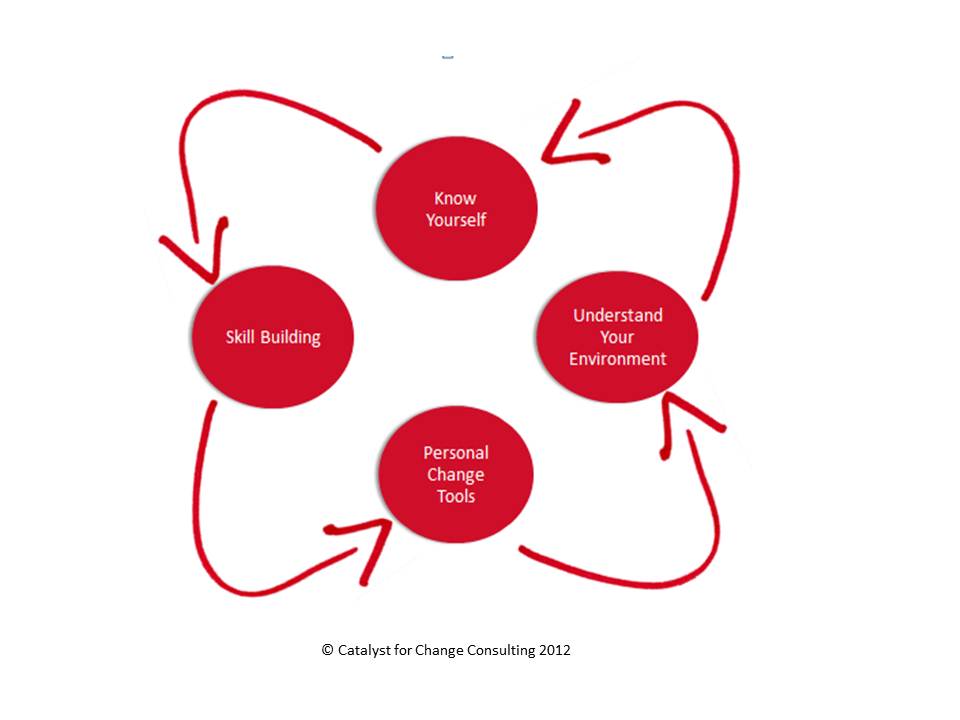
I know the print on the diagram is too small to read, but I wanted you to see how it all fit together.  There are four areas of developmental concentration:  1) Know Yourself, 2) Understand Your Environment, 3) Personal Change Tools and 4) Skill Building.   You can start anywhere—they all support each other.

4 Essentials for Do-It-Yourself Executive Development

The Recipe for DIY Executive Development:

Know Yourself–Understand Your:

  • Motivation
  • Habits
  • Personality
  • Beliefs About How Things Work
  • Strengths/Weaknesses
  • Temperament
  • Flaws (aka Derailers)

Understand Your Environment:

  • What is the Culture?
  • What is Your Fit in that Culture?
  • What is the Power Structure?
  • What Gets Rewarded?
  • What is the Organization Life Cycle Stage?

Personal Change Tools–Understand:

  • Reframing
  • Habits
  • Feedback

Skill Building–Develop:

  • Execution Skills
  • Leadership
  • Financial Acumen
  • Organization Assessment
  • Organizational Political Saavy
  • Personal Brand Management
  • Emotional Intelligence
  • Organizational Change Management

The well-rounded, and highly successful Executive has all of these.  No one is born with all of them; they need to be developed.  If you want to be a successful Executive, stop waiting for your organization to do it.  Get off your butt and start working on developing yourself.  You’ll do a much better job than any organization if you focus on it.

Leave a comment

Filed under Brand Yourself, Career Development, Career Goals, Derailment, Executive Development, Hi Po, Leadership, Personal Change, Recession Proof, Reframe, Success

Don’t Take Your Needs to Work

Basics/Needs/Wants

My first exposure to the idea of how my needs impacted my career came from Laura Berman Fortgang’s book, Take Yourself to the Top. Fortgang divides things into basics/needs/wants.  Most of us can tell what the basics are–enough food, housing, warmth, safety.  Most of us also can tell the “wants”–house at the beach, Thunder season tickets, designer wardrobe, fill-in-the-blanks.  It gets tricky when we are dealing with needs.  Needs are sometimes disguised wants, but more often, they are buried in our subconscious–we don’t even recognize them when they are running our lives.

Examples

The kind of needs I’m talking about are those that start in early childhood–usually because of deprivation or mistreatment–and drive our behavior for the rest of our lives.  Someone very close to me grew up incredibly poor and without things that practically everyone has–things like soap, combs, jelly, sufficient clothes, or coats.  Her need was to never feel deprived again.  She accumulated stuff to prevent the feeling of deprivation.  It drove her whole life.

Some have the need to be appreciated.  Some have the need to be respected.  Some have the need to be treated fairly.  Some need to be right.  You get the idea.  These needs are all wrapped up in our self-worth.  If you don’t respect me, then you have shaken the very foundations of my belief in myself.  When this happens at work, then you are behaving like the same five-year-old who initially developed this need.  You probably aren’t aware that you are acting like a five-year-old.  You probably feel completely righteous in your reaction.  You won’t stop talking about it.  You tell your co-workers how wronged you are, and they probably are somewhat intimidated by your level of emotion.  They may or may not agree with you, but they are reluctant to challenge you because of how you are coming across about it.

This happens all the time.  It happens to pretty much everyone.  The way you can recognize it is by how upset you are.  How driven you are to fix it.  How much you talk about it.  How much you think about it. These needs are legitimate.  You came by them legitimately.  My friend who was so deprived in her childhood was trying to protect herself from ever feeling that horrible again.  But you need to get your needs out of your work.  They will do much more damage than it is worth.  People will think you’re completely irrational about weird stuff.  They will not be able to connect the dots between your behavior that they see and your need that you are trying to address and whatever happened to you that created that need.

What Do You Do?

So, what do you do?  Think back.  Think of times when even you could tell you were being irrational.  What was driving it?  Are there patterns?  Same reaction to similar situations?  Same reaction to similar people?  Figure out which needs are driving you (literally) crazy.  Try to reason with yourself (this isn’t usually all that successful).  Point out to yourself that that was then (when you were 5) and this is now (when you are an adult who really shouldn’t care if your GenY employee isn’t respecting you as much as you think she should).  If trying to talk yourself out of it doesn’t work, don’t give up, but there is a Plan B.

irrational at workWhen you feel yourself getting irrational (ok, not irrational–incredibly irritated), try to think of another way that you can get this need met OUTSIDE OF WORK.  Where can you be respected that matters more?  Church?  Home? Professional group?  Who appreciates you who matters more than people at work?  Can’t you go tell someone else you were right without rubbing your peer’s face in it?

Why Should You Go To That Much Trouble?

Because it really does have a negative impact on your career.  When you are being driven by things that are outside your conscious awareness, then you aren’t really in control.  When you aren’t in control, then you will do something that looks stupid to people who can make decisions about your future.  So, get your needs away from your work.

Leave a comment

Filed under Books, Career Development, Executive Development, Personal Change, Reframe, Success, Uncategorized

Dealing with A**holes

For some reason I’ve talked to a lot of people in the last couple of weeks who were having problems with people in their lives—mostly at work.  The problem when you have to deal with people who are difficult is that you have to keep dealing with them.  It is the rare workplace that offers the perk of being able to trade out your coworkers on a whim.  So how do you deal with the jerks?

It’s a Relationship

First of all, hard as it is, you’ve got to stop blaming the other person (EVEN IF IT IS ALL HIS FAULT).  You can’t make real progress at making the situation better if you think it is all the other person’s fault.  It is a relationship.  A relationship by definition is between (at least) two people.   If you are one of those people, you can do things that will affect the interactions between the two of you.   As long as you are in the frame of mind that it is entirely the other person, you are unlikely to be open to trying some of the things that I suggest.   A good book on the subject is Barry Duncan and Joe Rock’s  Overcoming Relationship ImpassesDuncan and Rock’s premise is that if you stop reacting in the same pattern to the same situation, you will disrupt the normal interactions and allow a new interaction/reaction to happen that can make things better.  For example, when the person starts once again with  the list of all the things you do wrong, if, instead of defending, you say something like, “you’re right, it must be difficult to deal with someone who you think can’t do anything right,” the other person has no place to go next. He shuts up or says something like, “I don’t think you do EVERYTHING wrong.”

The Relationship is Half You

Ask yourself what you are doing to contribute to what is wrong with the relationship.  What are you doing to improve the relationship?  Before you get all exasperated with me (because it is all the other person’s fault), remember that you only have one tool to make this better—your behavior.  You can’t directly control the other person’s thoughts or behaviors, so you can only use your own behavior to make a change.  You are the instrument of change here.   

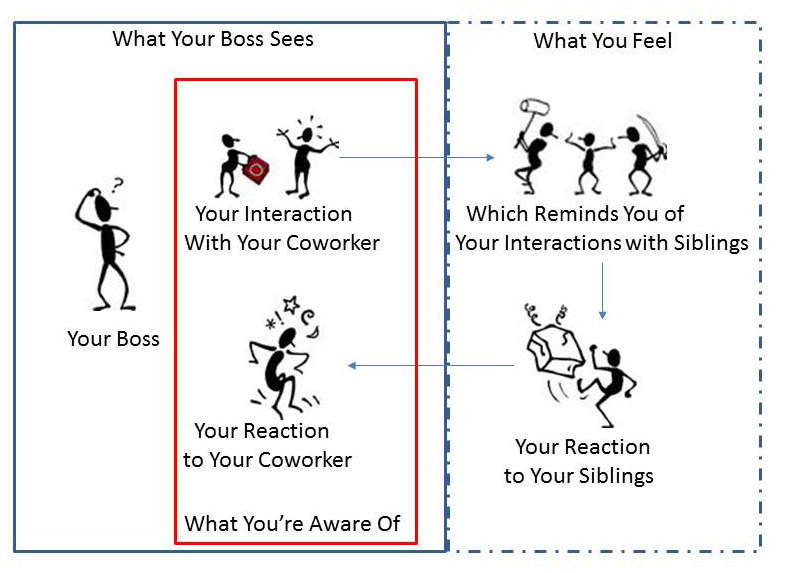
Why Does This Person Drive You Crazy?

So, let’s start with trying to figure out with why this person drives you so batty.  Ok, yeah, I know he’s an a**hole, but I know that you’ve dealt with other a**holes in your life.  What is it about this one that is so bad?

  1. Who does this person remind you of?  Your brother?  Your father?  Your ex?
  2. Which of this person’s behaviors is so bad?  His micro-managing?  His criticism?  His inability to make a decision?
  3. Is there a time or a place that is worse?  In meetings?  In one-on-ones? When so-and-so is present?
  4. Are there things that happen first, before you get the urge to run screaming from the room?

If you look at the answers to these questions, can you see anything that you can change to reduce the angst that you encounter in dealing with this person?  Can you not have one-on-one meetings? Can you not have meetings that include the person who makes it worse?  Can you talk yourself out of the insight that this person is just like your big brother who made your life a living hell for eleven years?  What change(s) can you make, either to the circumstances of spending time with this person or to your thinking that makes this person easier to deal with?

Why Do You Drive Him Nuts?

Let’s look at it the other way.  What is it about you that drives him nuts?  Can you spot a specific situation that seems to make it worse for him?  Do you remind him of someone?  Can you spot a particular behavior of yours that seems to set things off?  Can you do something to change any of this?

What is he trying to accomplish?  There is a great book, Dealing with People You Can’t Stand, by Brinkman and Kirschner,  that describes common difficult people as

  1. The Tank (pushy, ruthless, loud and forceful)
  2. The Sniper (identifies your weaknesses and uses them against you)
  3. The Know-It-All (knows 98% of anything)
  4. The Grenade (when they blow their top, shrapnel hits everyone in range)
  5. The Yes Person (quick to agree, slow to deliver)
  6. The Maybe Person (keep putting off crucial decisions until it’s too late)
  7. The Nothing Person (no verbal feedback)
  8. The No Person (doleful and discouraging)
  9. The Whiner (there’s a plan for their lives and they’re not in it)

Recognize your a**hole in any of these? Each of these types of people is trying to accomplish something with their behavior.  In other words, there is a REASON they are the way they are.  The authors say that this is what these types are trying to accomplish:

  1. GET IT DONE:  The Tank, The Sniper, and The Know-It-All
  2. GET APPRECIATED:  The Grenade, Sniper, The Know-It-All
  3. GET ALONG: The Yes Person, The Maybe Person, The Nothing Person
  4. DO IT RIGHT: The No Person, The Whiner, The Nothing Person

(for quick description of this, see http://www.rickbrinkman.com/dealingwithpeople/ftp/dr_brinkman-color-lens.pdf )

If you help them with what they’re trying to accomplish, then they don’t have to use so much of their “difficult behaviors” to accomplish it.  I know that this is hard to do.  If it were easy, then none of us would experience the “a**hole people in our lives.  Just because they are there, though, doesn’t mean that YOU can’t deal with them.

REFRAME

Finally, use my most reliable tactic—reframe the situation.  Figure out a way to “see” the a**hole in a different way that allows you to interact differently with him.  He’s a customer, or she’s someone’s grandmother, or he’s an alien. The effort that it takes to deal with these folks can help distract you from the difficulty.   Whatever it takes.

4 Comments

Filed under Books, Career Development, Communication, Executive Development, Personal Change, Reframe

My Boss Doesn’t Listen to Me!

What Language Are You Speaking?

My first question to you is– Are you speaking your boss’ language?  And, I’m sure your answer is, “Of Course!”  But are you really?  One of the most important tools that I use to help people understand this problem is the Myers Briggs Type Indicator.  The Myers Briggs is a tool that enables great conversations about your personality and the personalities of others.  It is one of many tools that can facilitate these conversations and investigations..  I like it best because of the research behind it, but it doesn’t matter if you use this tool.  Just look at your own personality/behaviors/interactions through the lens of a tool that helps you evaluate yourself in the context of interactions with others.

Anyway, Myers Briggs divides people into 16 different types using four dichotomies:

  • Extroversion(E)————————————Introversion(I)
  • Sensing(S)——————————————–Intuition (N)
  • Thinking(T)——————————————Feeling(F)
  • Judging(J)——————————————–Perceiving(P)

Myers Briggs assigns personality types based on these dichotomies. I am not going to go into Myers Briggs in detail here. Check it out on the Internet. Or pick a different tool, such as DISC, to apply what I’m saying here. The point is, a ESTJ (Extrovert/Sensing/Thinking/Judger) looks at the world very differently, processes information and needs to be communicated with differently than a INFP (Introvert/Intuitive/Feeling/Perceiver). The practical impact of this is that if your boss has a different type (or DISC profile) than you, then it is highly likely that the problem is not that you aren’t listening to each other. The problem is most likely that you are both sending messages out into the universe and they are falling into space without being “heard.”

What Type Are You?

For example, someone who is an MBTI “Extrovert” gets his ENERGY from interacting with people. He goes to a party and gets energized.  An MBTI “Introvert” gets her ENERGY from being alone, from reading, from spending a quiet evening at home.  An Extrovert might take a break at work and walk around and talk to people to get a second wind.  An Introvert boss might see this as an employee who is wasting her time.  A MBTI “Senser” boss needs hard cold facts to make a decision.  An “Intuitive” employee will struggle to tell the boss how she knows what she knows.  She just “knows” it.

I frequently do the exercise in class sessions where I divide the “Judgers” and “Perceivers” into separate groups and have them plan a vacation. The “Judgers” plan everything right down to when and where they are going to go buy new underwear for their vacation. The “Perceivers” are lucky if they actually come up with a destination and a mode of transportation.  Both of these are adequate plans (for the ones doing the planning) and completely deficient and faulty plans for the other group. So, if you are a “P” and you have a “J” boss, your plan is unlikely to be considered a “real” plan.  If you a “P,” the “J’s” plan is likely to be serious overkill.

These communication gaps cause more problems at work than probably anything else.  I highly recommend the book, Type Talk at Work, How the 16 Personality Types Determine Your Success on the Job, by Otto Kroeger and Janet Thuesen, to provide you with examples and strategies to deal with these gaps.

So, Fix It

So . . . since this is a problem on both sides–boss and subordinate–why should you step up and do something about it instead of your boss?  Of course your boss should do something about it.  I tell all the leaders that I coach that they should (and of course, they have the same problems with their bosses, too).  If your boss isn’t doing it, though, you have limited options.  You can go on failing to successfully communicate with your boss (framed as “my boss won’t listen to me), or you can work on these skills, develop the ability to successfully communicate with any boss (framed as “my boss always listens to me) and you can succeed at what you’re trying to do.

I had a boss for whom I used to prepare long, detailed (and if I do say so myself) brilliant reports that answered all his questions.  He would take them, set them aside and repeatedly ask me questions that were answered in the reports.  I finally figured out that not only was he not reading them, he also didn’t value the time that I put into preparing them AT ALL.  I started paying attention to the kinds of questions he was asking, and put together a VERY SHORT bullet  list that answered the questions.   (OK, this was a long time ago, and I’m a lot smarter now.)  He stopped being so frustrated with me and I stopped being so insulted that he was ignoring my work and we became much better boss/subordinates for each other.

Stop being so frustrated with your boss and solve the puzzle of HOW to communicate with him. (By the way, if you have an employee who won’t listen to you, re-read this post substituting the word boss with employee and save me from having to write another post:-))

Leave a comment

Filed under Books, Career Development, Communication, Executive Development, Inclusion, Leadership, Reframe, Success

What You Believe About How the Organization Works is WRONG

If you are the CEO-Founder of the organization, nothing I’m going to say applies to you.  If you are anyone else, it probably does.  We all have beliefs about how organizations work.  For the most part, at least some of these beliefs are myths.

organization mythsSome Typical Myths:

  • If you work hard, you will be rewarded.
  • Organizations are meritocracies.
  • Leaders Are Heroes.
  • The more hours you put in, the more you will be rewarded.
  • Organizations are families.
  • This organization is better (than all others).
  • I have unlimited potential.
  • The organization will recognize what I do.
  • I am irreplaceable.
  • If I just do a good job, I can ignore organizational politics.
  • Younger employees have more potential than older employees.
  • Older employees are more wise than younger employees.
  • If I work hard enough and do a good job, my career will take care of itself.

But, you say, (some of) “these are true!”  Or, “I don’t believe any of those.”  That’s the thing about myths–they exist as myths or truths in the eye of the beholder.  And they are powerful enough to control your behavior, if not your life.  A myth is only a myth if it isn’t reality.  (Yeah, I know–what the heck did that mean?)

Whose Reality Is It?

I started this post with the statement that if you are the CEO-Founder this doesn’t apply to you.  If you are the CEO-Founder of your organization, then your beliefs are the reality of the organization.  Everyone else’s beliefs are the myths.  Of course everyone has some beliefs that are true (and therefore reality), such as if  ‘I get to work on time, I won’t get in trouble for being late’.  Hmm, even this is not “true” in some organizations.  I used to work in an organization where the official start time was 8am, but the expected start time was more like 7am.  Why?  Because that is what leadership thought was indicative of a motivated, productive, successful workforce.  It is critically important to understand what the top of your organization believes about how organizations work, and how that is different from what you believe.

We come to our beliefs about how things work through a circuitous route.  Our parents drill things into our head.  Work hard, you will be rewarded with grades. (Lesson–effort leads to reward)  Our teachers reinforce beliefs.  You can do anything you want to do. (Lesson–unlimited potential)  Our coaches add to it.  Always get the ball to Russell; whatever you do, get the ball to Kevin!  (Lesson–irreplaceability)  These lessons stick in our minds and we begin to apply them to other venues.

By the time we get to our first jobs, they are pretty much set.  As a coach, I work with people helping them understand the unwritten rules in their organizations.  The reason people struggle so much with this, is that these “rules”–the accumulated “realities” of leadership over the years–don’t match their own “rules.”  And it makes no sense.  When you put in long hours and you aren’t rewarded and appreciated for it, you get disillusioned and angry.  What you don’t understand is that the person(s) in charge believes that it is results that count and effort in and of itself is irrelevant.

Interestingly, as I have started working with more men who work in woman-run organizations, they are finding themselves with the same problem–the “rules” make no sense to them.  Why should we “talk” about it?  Let’s just DO it.  Who cares if we have a consensus?  (Not that I’m saying these “rules” apply to all female run organizations–these are examples I’ve encountered).

It Is Hard

It is REALLY hard to let go of your beliefs.  They are tightly wound with how you derive your sense of personal value.  If you find yourself angry at work a lot–angry at not being appreciated, at not being valued, at not being rewarded, you need to look deeply at how you believe things should work.  Then you need to look–really look–at evidence that it is true in your organization.  Look hard for what the organization’s leadership believes about how things work.  How is it different?  Don’t dismiss these differences.  (Remember, however, that leadership is likely to be in the same boat to some extent about their own beliefs, unless they founded the company.)

Experiment

Experiment with reframing your communications to match the beliefs of those who evaluate you.  If you think results are most important, but your boss talks about effort–communicate your results AND the effort it took to get them.  If your boss thinks she is irreplaceable, decide whether you want to frame communications in terms of that belief.  If you understand these beliefs and their impact on your work life, then it gives you more options and tools to improve your work experience and enhance your career.

. . . just sayin’

3 Comments

Filed under Career Development, Communication, Executive Development, Leadership, Reframe

Great Leaders and Their Paradoxes

I have always loved the concept of paradoxes.  A paradox is a self-contradictory proposition.  Paradoxes  are the embodiment of complexity.  Great leaders are full of them.

Extreme Self Confidence v. Humility:

I don’t think you can be a leader without having self-confidence.  Self-confidence and self-worth combined make up self-esteem.  I’ve seen leaders (although not great leaders)  without a good sense of self-worth, but I don’t think I’ve ever encountered a leader who didn’t have a realistic belief in his own ability to deal with the situation.  It is this self-confidence that inspires others to follow.

At the same time, great leaders demonstrate real humility.  Self-confidence does not preclude humility.  Since self-confidence is a realistic view of your abilities, humility is a realistic view of your limitations.    Humility is a demonstrated sense of modesty.  Humble leaders can take feedback, can admit their mistakes, and are much more respected by their followers.

Decisive v. Consensus Building:

A great leader is comfortable making decisions based on the information that is available.  Decisions are the lubrication that make organizations go.  Without decisions, things slowly grind to a halt.  Sometimes there just isn’t enough information to make a comfortable decision.  Great leaders step up and make the decisions anyway.

At the same time, great leaders have the skill and know the value of consensus building.  There are times when it is best to take the time for the group to make the decision, rather than for the leader to make the decision alone.  Great leaders know not only that is, but they also know how to do it.  They allow followers to participate in the organization decision making and get follower buy-in in the process.

Leader v. Follower:

Leaders challenge and change.  They inspire and energize.  Leaders lead.  It goes without saying that great leaders are leaders.  Leaders do not lead 100% of the time, however.  Leaders follow sometimes, too.  They follow thought leaders.  They follow their bosses and their heroes.  Sometimes, they even follow their followers.  Great leaders are as comfortable being followers as being leaders because they aren’t so into themselves that they need to lead all the time.

Detail Focused v. Big Picture:

There are tons of examples of Executives who failed because they weren’t paying attention to the details.  This does not mean that you need to be in the details all the time;  in fact, that is probably as bad as not being able to deal with details at all.  You do need to be able to dive into the details and spot the aberrations when the situation arises that demands it.  Steve Jobs was famous for his ability to crawl into the details of his products.

At least as important is the ability to see the big picture.  The big picture includes what is going on outside your organization, outside your community, and outside your industry.  You need to be able to see how things fit together and “what is wrong with this picture.”   Fred Smith saw the big picture when he came up with the idea of Federal Express.  Steve Jobs saw the big picture when he saw the need to combine extreme marketing concepts with bleeding edge technology ideas.  The ability to see the big picture can keep you going long after others would have given up.

Hands Off v Hands On:

Delegation is a very important skill for leaders.  The higher up you go the more you need to be able to delegate.  Except when you need to be hands-on.  Situational Leadership Theory by Hershey and Blanchard suggests that different leadership styles are required in different situations.  In other words, it isn’t always appropriate to delegate, even if you are at the top of the organization and have Executives reporting to you.  It isn’t appropriate to be hands-on all the time–your more experienced/senior employees will feel micro-managed.  You need to understand what your personal style is, when you should be using it and when you should be flexing your style.

The Dark Side–The Success Paradox:

Success changes us.  Those changes are mostly good.  We become more confident, more comfortable in our skins.  But we also develop blind spots.  Success robs us of the uncertainty that helps us be more sensitive to our environment.  We develop blind spots about our personal flaws.  We discount negative feedback about our interpersonal skills.  We aren’t as open to seeing organizational issues.  Most importantly, we miss the big, external-to-the-organization contextual issues–the world is changing around the organization and the organization is so busy doing what it does, that it misses it.  Think Borders with Amazon.

Great leadership requires complex responses.

Leave a comment

Filed under Career Development, Executive Development, Leadership, Reframe, Success

Fail. Fail. Fail.

Failing Isn’t Fun.

I really, really to hate to fail.  In fact, I hate it so much that I rarely admit that I failed when I do–it’s not that I lie about it–I just don’t even admit to myself.  So why does every guru on leadership say that failing is good?  I had the opportunity to watch lots of kids this weekend–kids of all ages.  They “fail” all the time.  They try something, it doesn’t work, they try again, or they walk away and try something else.  Sometimes they get upset, sometimes they get hurt, but they pretty much pick themselves up and keep trying.  They don’t usually see it as “failure.”  They just see it as a part of living.

Imagine if they were so afraid of failure that they didn’t try.  What if they didn’t learn to walk because they would fall down.  What if they didn’t learn to read because they wouldn’t be able to figure out all the words.  The way they keep going in the face of what we adults would see as “failure” is an important lesson for us.  Some time around late elementary school or middle school, kids start to stress about failing and start to be afraid of trying.  By the time we’re adults, we’ve got that lesson well-learned.

Failure Is A Step

The flip side of failure, though, is that without it, you don’t get better.  Even if we succeed we don’t do it as well as if we fail first and try again.  If I spend my time obsessing about how I failed at something, rather than treating it like a baby treats a fall–that way didn’t work, maybe the next way will–then my forward movement becomes a loop at best.  One of my favorite quotes is from Thomas Edison, “I have not failed. I’ve just found 10,000 ways that won’t work.”

There are LOTS of books on the benefits of failure:  Fail Forward; Celebrating Failure, The Power of Failure, Great Failures of the Extremely Successful Adapt: Why Success Always Starts With Failure, to name just the ones I’ve read in the last two years.  So, I  get why failure is critical.  The problem is the way we look at it.  Failure isn’t an event.  To quote Edison again,  “I am not discouraged, because every wrong attempt discarded is another step forward.”  Failure is a step.

Try, Try, Try

So, remember the way a kid thinks: Try. Try. Try.

4 Comments

Filed under Books, Executive Development, Leadership, Personal Change, Reframe, Success

Leadership Lessons From MLK

His Name Always Comes Up

Leadership Lessons from MLKIn my leadership classes, I always asked my students for the names of great leaders.  I’ve never had a class where Martin Luther King’s name didn’t come up.  This week is the 44th anniversary of his death.  We’re still struggling to realize his dreams, but we have made significant progress.  But why do we remember his so clearly?  Many of my students weren’t born when he died, but they identify him as a great leader.  He is still leading us.

What are the lessons that leaders can learn from MLK?

  • Dream –MLK dreamed a BIG dream.  His dream was not to be a good minister at a Church in Atlanta.  His dream was thought to be impossible among some of his followers–‘I have a dream that one day this nation will rise up and live out the true meaning of its creed: “We hold these truths to be self-evident, that all men are created equal.’ . . I have a dream that one day on the red hills of Georgia the sons of former slaves and the sons of former slave owners will be able to sit down together at the table of brotherhood.  .  . I have a dream that my four little children will one day live in a nation where they will not be judged by the color of their skin but by the content of their character.”  Sadly, at that time, that was a big dream.  Joyfully, some of this dream has come to pass.  There are young people reading this who can’t imagine the way it was.  Unfortunately, we still have the cancer of racism in our American body.  I’d like to think that had MLK lived, we’d be much further along.

As a leader, are your dreams big enough?  Is it enough to dream of making this year’s numbers, or finishing this project on time, or delivering the product in your strategy?  The difference between a leader and a great leader is the size of the dream.

  • Inspire  –MLK inspired people from all parts of the country, from all walks of life and of all ages to fight for his dream.  His dream became theirs.  His peaceful methods became theirs. He inspired through his words and through his actions.

As a leader, do you inspire or do you tell? Do you speak to some and ignore others?  Do you act your beliefs and words, or are you a hypocrite? Are you brave and do you speak truth to power, or do you go along.

  • Take Risk –MLK kept going despite the risks.  He knew them, but his dream was bigger.  His commitment was bigger.  Risk was a constant in his life as a black man in the South. The risks he took as a leader were breathtaking.

MLK’s risks put most of the risks that today’s leaders take (or don’t take) into perspective.  The stakes for most of us are much smaller.  Even so, we resist risk.  As MLK knew, change doesn’t happen without risk.  I worry that readers will take this point wrong–I don’t want to diminish MLK’s accomplishment by comparing the risk he lived with with the risks that leaders take today.  Understanding and taking risk, however, is essential to great leadership.  Risking your life isn’t necessary, but risking your ego is.  Risking your identity is.  Risking being wrong or failing is necessary for great leadership. When was the last time you took a breathtaking risk?

  • Be Persistent He was tired.  He was exhausted.  He kept going.  He kept standing.  He kept inspiring.  He kept dreaming.  He got results.

He went to jail! To Jail!  To be a great leader, you’ve got to keep believing  it can happen.  You’ve got to help your people believe that it can be done.  Pretty much every great person I know is persistent.  Persistent in the face of set backs, failures, temptations and loneliness.

MLK was a great leader.  He was a great man.  He continues to inspire me to be a better person and a better leader.  Thinking about MLK and his contributions to my world gives me perspective on what is possible and how much more growing I have to do.

2 Comments

Filed under Career Goals, Communication, Executive Development, Leadership, Personal Change