Tag Archives: Career development

The Way You Think Is Wrong

No Matter Who You Are

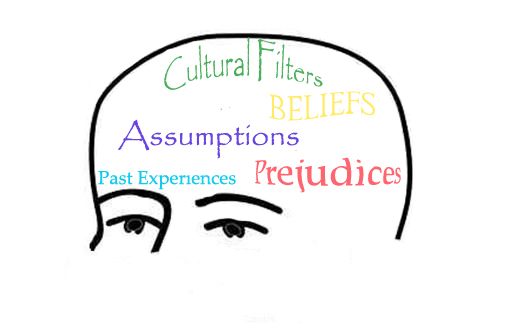
No matter who you are–black, white, Hispanic, French, Executive, Gen X, Retiree–the way you think is wrong.  Oh, I left out Democrat or Republican.  Our brains are truly wonderful things.  They are efficient processors of information.  There are a lot of tools that our brains us to make us more efficient and effective in our daily lives of being human.  I call all of these, generally, being on autopilot.  Being on autopilot is your enemy in terms of controlling your future.  Being on autopilot is also your friend in terms of making you more efficient at all the things you have to do in daily life.  The key is to learn the tricks your mind plays on you and to learn to turn these tools on and off to make better judgements when appropriate.

Let Me Be More Specific

Our brains use a number of tools or shortcuts that help us process information:

  • Halo Affect: assumption that because someone is good at doing one thing, s/he will be good at doing other things
  • Availability Heuristic:   assumption that because you think of something more frequently it is more likely to happen
  • Generalizations:  assumption that people, challenges, mistakes, organizations,  . . . pretty much everything . . . are just like the ones we have already experienced.  We tend to generalize trustworthiness, bad intentions, skills, incompetence, etc. based on other similarities.  Examples:  Asians are smart, Senior executives are bad, old people are degenerating,  Gen X’s are . . . (depending on your view).
  • Illusion of Understanding:  assumption that familiarity with something means you understand it
  • Hindsight bias: the tendency to view things as more predictable than they are
  • Motivated forgetting: re-remembering things to avoid blame
  • Overconfidence bias: the belief that your abilities are greater than they are–80% of drivers believe that they are in the top 30% of drivers
  • Recency bias:  giving more credibility to more recent data–the last presenter, the last candidate, the last answer
  • Clustering illusion:  seeing patterns where none exist

We All Do It

All of us use these tools.  They were developed back in the day when we lived in caves and hunted.  They are tools that help us make instant decisions without a lot of effort.  The problem is that they don’t work as well with today’s problems as when we were outrunning lions and tigers and bears.  The worst part about them is that we are generally unaware of them.  We value eyewitness testimony over other kinds of evidence, even though it is highly defective.  We choose candidates like us because we are generalizing and making assumptions at the subconscious level without really evaluating the basis for our assumptions.  We take risks based on shortcuts our brains make without even being aware of them.

What Can You Do?

The best thing to do is to educate yourself about these “tricks” that your mind plays.  There are several great books that can help:

Then Practice!

Learn to take control of the way you think by practicing.  Ask yourself, “Why do I think this?”  “How do I know this?”  “How can I think of this differently?”

4 Comments

Filed under Books, Career Development, Executive Development, Personal Change, Reframe

The Water You Swim In

Culture is Like Water to a FishUnderstanding Your Organization’s Culture

Organization culture for people is like water is for fish.  It is there.  It is critical to how the organization works.  It shapes people’s interactions.  It guides how work gets done, what is considered success, who is powerful and who is not.  It is also invisible.  People are not consciously aware of it.  It is probably the single most important thing in the organization, and most people know nothing about it.

If you want to be successful in an organization, one of the first things you should do is work on understanding the culture.   You will be able to use the culture to help you be effective.  You will be able to avoid getting into trouble by understanding the rules of engagement, power and territory.  You will be able to use the informal networks to grease your requests and deliverables.

What is Organizational Culture?

The culture is the set of assumptions, beliefs, customs, behaviors, rites, rituals, behaviors and values that exist within an organization.  These sometimes come directly from the founder (think Steve Jobs), then get influenced by subsequent leaders (think John Scully, then Steve Jobs).  The culture is sometimes a creation of combined organization cultures, or an organization culture that has been transplanted into another geographic region—Apple in China, Honda in the US.  The culture is never JUST what the company says it is.  In 2000, Enron’s stated values were:

  • Respect We treat others as we would like to be treated ourselves. We do not tolerate abusive or disrespectful treatment. Ruthlessness, callousness and arrogance don’t belong here.
  •  Integrity We work with customers and prospects openly, honestly, and sincerely. When we say we will do something, we will do it; when we say we cannot or will not do something, then we won’t do it.
  •  Communication We have an obligation to communicate. Here, we take the time to talk with one another and to listen. We believe that information is meant to move and that information moves people.
  • Excellence We are satisfied with nothing less than the very best in everything we do. We will continue to raise the bar for everyone. The great fun here will be for all of us to discover just how good we can really be.

Obviously, there was more at work in the culture than what they said.  There were other things driving behavior.  The culture rewarded conformity and punished dissent.  Individualism was valued over other behaviors (Jeff Skilling’s favorite book was Dawkin’s The Selfish Gene.)  There was a belief that the people who worked at Enron were the “best and the brightest.”  Eighty hour work weeks were the norm.  There was a “rank and yank” performance system.  Cumulatively, these things and lots of others, describe the Enron culture.

Disney has a very different culture.  Google has a differently culture.  Organization cultures are the (organizational) DNA combination of all of kinds of inputs.

How Can You Figure Out Your Organization’s Culture?

 Answers to the following questions can help you begin to understand the culture:

  • Who founded the company and what were his/her beliefs?  About   the organization?  About the way things should be?
  • Is the founder viewed as a hero?  A villain?
  • Is the founder still with the company?
  • If not, what impact have subsequent leaders had?
  • Are any of them considered saviors?  Heros?  Villians?
  • What are the stories that are told about the company?
  • What kind of person(s) seem(s) to be favored?
  • What behaviors are accepted?  Regulated? Discouraged?
  • How does communication flow?
  • What parts of the organization’s history are important?
  • What traumas have happened to the company?  Are there psychic scars from those traumas?  Do people still talk about them years later?  Have behavioral norms been put in place to avoid the same trauma in the future?
  • What is the dress code?  How rigidly is it enforced?
  • What are the social norms?  Do peoples socialize together?  Have  lunch?  Spend time outside of work? Are there cliques?  Does inclusion/exclusion impact your career?
  • Who speaks in meetings?
  • What is the power structure? How do people break into the power structure? What kind of people are in the power structure?
  • What are the performance evaluation norms?
  • How is information shared/not shared?  Who controls it?

Once you’ve thought about these, identify the ways in which you can use/benefit from how the culture works.  Focus specifically on:

Leave a comment

Filed under Career Development, Executive Development, Organization Culture, Uncategorized

How Do You Know If You’re a Good Leader?

How Can You Judge Your Leadership Skills

Let’s start with how you know whether someone else is a good leader?  You just know, right? Yes, you know when someone is a good leader for YOU.  Each of us is looking for something different from a leader, and when we find the right leader for ourselves, we know it.  Or do we?  Sometimes.  There are leaders who make us feel good. They make us want to do better.  They inspire us.  We do our best for them.  Those are the ones we “know” are good leaders.

There are lots of ways to measure a leader, though:

  • How followers ‘feel’
  • The followers’ opinions (head not heart response) of the leader’s performance
  • The results that the leader accomplishes through others
  • How much the followers grow and develop   
  • The leader’s manager’s opinion
  • How the leader evaluates her own performance

Each of these is measuring a different aspect of the leaders’ performance.  How can you know how you are doing on each one?

Use a Feedback Instrument

The absolute best way to tell if you’re doing well as a leader is to take a 360° assessment focused on your leadership.  A 360° assessment captures feedback from you, your followers and your manager.  This provides you will a full view of how you think you’re doing, how your followers think you’re doing and what your manager thinks, and it provides you with information on the disconnects among those opinions.   Your company may regularly assess its leaders with one of these, or it may have one available if you ask.  Ask your manager or your human resources representative. 

There are several, but one of the best is the Leadership Assessment Instrument (LAI™) produced by Linkage.  It evaluates how you’re doing on the tasks of leadership, what your leadership skill level is and what leadership ‘traits’ you have.  Another one that is focused on the behaviors of leadership is the Leadership Practices Inventory, developed by the authors of The Leadership Challenge.  This instrument evaluates your performance against the Kouzes and Posner’s five leadership practices.  I also like the Center for Creative Leadership’s Benchmark assessment.  This last one has the advantage of providing feedback that flags ‘career derailment’ symptoms.  There is also an assessment for Situational Leadership and many others.  Any assessment that focuses on leadership behavior and outcomes would be a good start.

Unfortunately, not everyone has access to feedback instruments through their organization, nor can afford some of the better (and more expensive) ones.  There are other ways to evaluate your leadership effectiveness.

How Can You Evaluate Your Own Performance as a Leader without a 360°?

In order to effectively evaluate your leadership effectiveness, you need to take your blinders off and become an objective detective.  You also need to be willing to ask others for their opinion and support.  Start with your company’s Human Resources department.  Do they provide manager feedback sessions where they ask your followers what they think (outside your presence) and tell you the results?  Would they be willing to do this, even it if is not standard procedure?

If no, then ask yourself the following questions.  Ask others.  Don’t honey-coat it.  Try to see the situation through your followers’ eyes.  Try to see it through your manager’s eyes.

How Your Followers Feel

The way your followers feel about you is semi-obvious. There are always folks who will ‘kiss up’ regardless of how they really feel.   You know who those folks are.  Ignore them.  Ask yourself:

  • Do your people enjoy being around you?
  • Are your people afraid of you?
  • Do your people seek you out to tell you good news?
  • Do they come to you when they need advice or help?
  • Do you find out things about your people through others, or through them directly?
  • Do your people meet your eyes and smile, or do they look at you briefly when they speak to you and then move on?
  • Are your people interested in you as a person?
  • Do your people share personal things with you?

These are all signs of affection, respect, trust and affiliation.  They are signs of how your people feel about you.

Your Followers Opinion

Of course feeling comes into the evaluation of how your people think about you, but your followers’ opinions are also more rational.  This is the one that is the hardest to gauge without getting someone else to ask them.  If you don’t have someone else to ask them (like HR), then consider asking them yourself.  This won’t work very well if they don’t trust you, and you have to take what they say with a grain of salt, but it’s worth a try.  Think about posing questions like:

  • If you were doing this job, what would you do differently?
  • What kind of feedback would the person who is unhappiest in this group/department give me?  How about the one who is happiest? (Thus taking the away the necessity off  of them to tell you what they think directly)
  • What’s working well in this department? (You’ll have to extrapolate here to what they think about you).  What isn’t working as well as it should?
  • What should I be doing that I’m not doing?
  • What should I stop doing?

You could give them a list of questions and ask them to sit together and answer them and then to type up the answers and give them to you.  You could use some of the questions above and include some others:

  • What do you like best about (my) management style?
  • What do you like least about (my) management style?
  • What do you wish someone would tell me?
  • What do you want in a leader?
  • What do you not like in leaders?
  • What is the best kind of leader for you?

How Much Your Followers Grow and Develop

This one is a lot easier to see with the naked eye.  When you start leading people, or when they first join you, take note of their skills, strengths, and weaknesses.  Actively plan on how you will work on developing them.  Evaluate them frequently on those items.  This should be done much more than the usual semi-annual or annual basis.  Make sure that you are giving them assignments specifically designed to grow them in the areas they need to grow.  Your evaluation of their growth is also an evaluation of yourself as a developmental leader.  If they aren’t making enough progress to suit you, what can YOU do to speed it up?

Your Manager’s Opinion of Your Performance

You shouldn’t wait for your performance review to evaluate this.  Remember that managers are not necessarily focused on leadership when they evaluate you, so take some time to understand what you manager believes about leadership.  Ask him/her.  Ask for his/her evaluation of your leadership skills.  Take note of what s/he seems to value.  Ask again after a period of time.  Have you made progress?  Ask what you should be doing differently.  Remember that regardless of whether you agree with your boss or not, his/her opinion of your leadership abilities can make or break your success in this company.

Results

Have you delivered through people?  Take off your rose-colored glasses on this one.  Take away all the things that would have happened anyway, whether you were there or not.  Take away all the luck.  What results did you and your team get?  What of that is attributable to you and your leadership?  What could/should you have done differently to get better results?  Is there someone you should have listened to more?  Someone you should have reigned in more, or managed more closely?  Is there someone who you should have taken risks with?  What will you do based on your learnings here?

Which of These is the Most Important?

It depends.  Which of these is the thing you believe is most important?  Which of these does your organization believe is most important?  Which of these do you need to grow the most?   Which of these comes to you naturally? 

Remember, leadership development is personal development.  Start anywhere and start learning.

Leave a comment

Filed under Career Development, Executive Development, Feedback, Leadership

Just a Paycheck

Just a Paycheck

Just a Paycheck”

If the reason that you’re working at the job that you have is for “just a paycheck,” you’re wasting your time and maybe your life.  I’m not talking about people who are working at a job to fund the things that they like to do, or their family, or the things that are important to them.  I’m talking about the people who really see that they are just working for the money.  I’ve been told this by lots of people.  It’s all I can do not to  get on my high horse when someone says it to me.  If you’re only working ‘for the paycheck’ that radiates from you.  You have no energy.  You have no enthusiasm for the tasks of the job, or even for your co-workers. You aren’t looking for a better way to do things; you’re just doing the bare minimum of what it takes.  It is highly likely that you’ll be among the first to go in a layoff, just because it is easy to put someone on a list who clearly isn’t having fun and who isn’t doing anything extra.

NO, you say.  It doesn’t show.  You’re doing the job; you’re just not enjoying it.  Ask yourself if that is true.  Look around.  Are you seeking to do better?  Are you taking on more without it being foisted on you?  Probably not.  And you probably aren’t taking on more because you don’t have the energy for it.  When you frame your experience in such a negative way, you don’t have energy.  You resent being there.  It’s all you can do to get to the end of the day, and it’s really hard to get there in the morning. 

Reframe!

I’m not saying that your job is fun.  It probably isn’t.  Your boss may be terrible.  Your co-workers may not be worthy of your time.  So what?  Find something that is worth being there for.  It could be as simple as reframing your experience to being about what your paycheck lets you do outside of the job.  It could be what you’re learning from this experience.  Or how it fits into your career path goals.  Or that you are LUCKY to have a job in these tough times.  REFRAME the way you think about it.

If you are able to reframe, it is likely that you will suddenly find that you have more energy.  You may have enough energy to look around the organization for a better job, or a better boss.  You may have the energy to figure out what you really want to do long term.  You may have enough energy to figure out how to get another stream of revenue that will enable you to find another job/career/hobby that will make you happy(ier).

Get A New Job!

If you can’t reframe,  GO FIND ANOTHER JOB—before someone forces you to.  I work with so many people who would be glad to have their old job back—somehow they can see a lot of value/interest/fun in it now that someone has decided they are out.  Find a job that you can do for other reasons than a paycheck.  Find a job that you can/will be good at and that will help you feel better about yourself.

LIFE IS TOO SHORT to work for ‘just a paycheck!’

1 Comment

Filed under Career Goals, Derailment, Executive Development, Job Hunt, Recession Proof, Reframe

What We Can Learn From the Olympics

People who make it to the Olympics are REALLY good at what they do.  Even people who finish LAST at the Olympics are way better than most of us.  How do they get there?  Well, the easy answer is that they work very hard.  It is way beyond that, though.  They start out good.  They are good enough that someone, someplace, gives them positive feedback that motivates to keep going, to keep getting better. They keep getting better.  They make steady (or better) progress.  At some point along the way, they get a coach.  The coach is not better at what they do (usually) than they eventually become, but the coach knows how to motivate them, how to guide them to better performance and how to critique them,  push them, and persuade them. They practice, practice, practice.  According to Malcolm Gladwell in his book, Outliers, the people who are the elite at what they do–sports, music, art, academics–have put in 10,000 hours of practice to get there.  They also have a lot of support–parents, teachers, coaches, other family who set up the environment and resources to help them get there. People in the Olympics understand the importance of visualization and they do it over and over.  Did you see the gymnasts, the divers, the runners, imagining their way through their performance?  You could tell that is what they were doing by the little jerky movements they did as they imagined themselves through the routine.  They didn’t just do it once.  They did it over and over till it was time to perform. They used powerful, positive (and effective) self-talk.  It is not a coincidence that the fastest man in the world says he is. The competitions were full of examples of athletes motivating themselves through positive self talk. The athletes in the Olympics won and lost, learned from it and did it again.  They put ALL of themselves into what they were doing.  They weren’t just sitting there thinking about what they were going to do this weekend or what was for dinner.  (Well, maybe they did think about what was for dinner–they were definitely burning a ton of calories.)  They were focused, though, while they were doing what they were doing.  And you could tell when they weren’t focused.

So, What Can We Learn?

  • Be motivated to be the best
  • Practice, practice, practice what you want to be good at
  • Get a coach
  • Get, use, create, and appreciate a support group
  • Use positive self-talk
  • Visualize
  • Focus

Leave a comment

Filed under Books, Career Development, Executive Development, Success

What Does It Take To Be An Executive In Your Org?

What Does It Take To Be An Executive At Your Org?

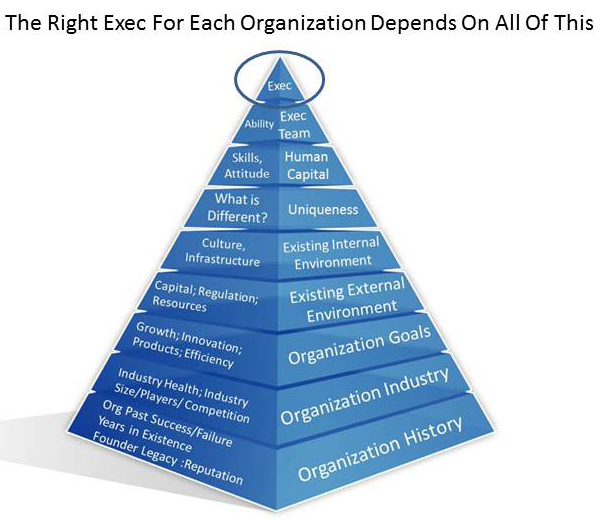
Executives come in all flavors.  Organizations also come in all flavors.  People who want to be Executives come in all flavors.  How do you know what your organization needs from an Executive?  How do you know what you need to work on to be an Executive (in your organization or in another organization?)

Let’s start with the first question.  How do you know what kind of Executive your organization needs?  (You’ll note I didn’t say what kind of Executive your organization is looking for—organizations don’t always look for the right kind of Executive.  It’s a lot like the Church Board that replaces the retiring minister with one who is the total opposite.  The Board is tired of dealing with the current minister’s weaknesses, but forgets that the congregation is there because they LIKE the current minister’s strengths.)

What Does It Take To Be An Executive At Your Org?

Factors to consider when figuring out what kind of Executives your organization needs:

Organizational History

  • Past Success–What successes have the organization had in the past?  What drove those successes?  How long ago was that?  What kind of leadership was in place for those successes?  What kind of management infrastructure was in place?  What lessons did the organization learn from the successes?  What lessons did the Executives learn from the successes?
  • Past Failures–What failures has the organization had in the past?  What caused those failures?  Did the organization learn anything from the failures?  Did leadership learn anything from the failures?  Were there consequences that left scars on the organization–did the organization develop a risk aversion or become overly cautious?
  • Years in Existence— How long has the organization been in existence?  What kinds of trends has it been through?  Did it start centuries/decades/years/months ago?  There are pluses and minuses to an organization that has been around a long time, just as there is for a new organization.  Either way, though, they need different things from Executives.
  • Organizational Maturity— How mature is the organization in its processes and systems?  How sophisticated is it in its relationship with its customers?  Its community?  Its employees?
  • Founder Legacy— Is the founder still in the picture?  What kind of interactions does the founder have with the organization?  Was the founder a charismatic leader who was a tough act to follow?  How many generations of professional management have there been since the organization was founded?
  • Reputation–What is the organization’s reputation?  What is it based on?  How integrated is that reputation with the reputation of the Executive(s)?  How integrated is the reputation with that of the industry, or with the organization’s successes and failures? What things have been done to affect the organization’s reputation?  What has worked/not worked?

Industry

  • Industry Health—Is the industry growing or shrinking?  Are there serious resource or pricing issues?  Are there regulation issues or changes?  Is the industry merging with another one (for instance, phones/computers/music). How is the organization positioned to deal with these issues?
  • Industry Size—Is it a big industry?  Is it a small industry?  Is it a start-up industry?  Does it stretch across/into countries with huge markets?  Or is it a single geographic location industry?
  • Players—Who are the players in the industry?  Big? Small?  How does your company fit?  Is it a player?  Is it a wannabe, a newbie, or is it peripheral?
  • Competition—What is your company’s competition?  Who is your company’s biggest competitor?  Who is its riskiest?  Are there emergent competitors?

Organizational Goals

  • Growth—Is the goal to grow the company?  Is that realistic?  Is there room to grow? Is there opportunity in your existing market or in markets not yet tapped?
  • Innovation—Is the goal based on innovation?  Does the company have a history of being innovative?  Does the company have innovative employees?  Processes that drive innovation?
  • Products—Is the goal based on new product development?  Again, is there a history of new product development?  Are there processes, systems and the discipline to drive new product development?
  • Efficiency— Is the goal based on becoming more efficient?  Has the company done this/been doing this?  Is the purpose to serve customers better, or to cut costs, or both?

What Does Any of This Have To Do With What It Takes to be An Executive?

It has to do with what SKILLS the organization needs.  If the organization needs to deal with a riotous market or industry, then the organization needs someone how handles change well, so is more of a leader than a manager, who is comfortable with ambiguity.  If an organization’s strategy is based on product development, and is young, and has just lost its founder, it needs an executive who can be hands-on enough, who can understand the genealogy of the culture, who can inspire while driving results.  If the organization is targeting a growth strategy, then it needs someone who can execute, who is strategic, ideally who has experience with delivering growth, and who has boundless energy.

One size does not fit all.  A leader/manager for one kind of organization/industry is not likely to be a perfect fit for another.  This is not to say it can’t work, because it depends on what, exactly the organization needs.  If an organization’s industry has suddenly become turbulent after decades of stability, then someone from an industry that has been in white water for a while is likely to be a good fit—although they will be fighting an uphill battle against the existing culture.  So, someone who understands organizational change management would be helpful in that situation.

What Do You Think Your Organization Needs From Its Executives?

Leave a comment

Filed under Career Development, Executive Development, Leadership, Success

My Five Favorite Books on Leadership

So Hard to Pick Just Five!

Boy, this was hard.  I thought about writing several blogs–My First Five Favorite Books on Leadership, My Next Five Favorite Books on Leadership . . .   Then I thought about writing a blog titled My 25 Favorite Books on Leadership.    You’ll notice I didn’t call this “Best Books on Leadership,” mostly because that would be even harder, and I might have to re-read them all before I could come up with the list.  There are SO many books on leadership.  Why is that?  It is because leadership is in the eye of the beholder.  We all believe that we know what leadership is, and that our version is the correct one.  Leadership is not so simple though.  Leadership is as varied as leaders themselves are.  It is a combination of the person who is a leader, the people who are followers, the situation, skills, traits, results and process.  For more on this, see my post Become a Great Leader.  Lots of authors have tried to explain, teach, and communicate about leadership.  Here are my favorites.

This book is more than a book about leadership.  This is actually a textbook on organizational behavior.  It opened the door on the study of organizational behavior, leadership theory and organizational change for me.  The most important (among many) idea in the book for me is Situational Leadership(R).  The theory of Situational Leadership discusses leadership styles in terms of different combinations of task  and relationship focus.  The theory lays out four leadership styles and suggests that different styles are more appropriate for different follower behaviors.  The book is a wealth of powerful ideas on how individuals and organizations work.

I like this book because Cashman really explores the ‘internal’ mental workings of leaders.  He explores the things that give leaders control over their own destiny:  values, presence, purpose, personal mastery, and resilience.  Cashman integrates what is going on in the leader’s mind with effective leader behaviors.  He provides tools and exercises that help you build your ‘inside’ leadership muscles.

This book has been updated recently.  It is a practical ‘how to’ book based on research and comes with an app. (Yep, an app for leadership.)  The authors break leadership into five practices:  Model the Way, Inspire a Shared Vision, Challenge the Process, Enable Others to Act, and Encourage the Heart.  They are able to describe why these are the elements of leadership and provide examples and exercises to build these ‘muscles.’

This one is also a textbook.  It lays out the main theories of leadership:  trait, skills, style, situational, contingency, path-goal, leader-member exchange, transformational, servant and authentic leadership.  It also provides assessments that the reader can take to evaluate his/her own placement for each theory.  I have used this book to teach leadership.  I’ve changed books a couple of times, but I always come back to this one, because I think it is thorough, clear, and, at times, even fun.

I recommend all of Quinn’s books, but this one is my favorite.  This book is directed to leaders and encourages them to evaluate their own thinking with clear eyes.  It argues that leaders need to shift their thinking from ‘victim thinking’ to powerful, change leader thinking.  Quinn argues that leaders can transform their organizations by changing themselves.

Ok, I’ve done it.  I’ve picked (only) five.  These are my favorites today–and some of them have been my favorite for years.  I reserve the right, however, to have new favorites tomorrow or soon thereafter.  I will continue to read books on leadership because, like most other business people, I’m fascinated about what makes great leaders and I’ll keep trying to crack the code.

What are your favorites?

4 Comments

Filed under Books, Career Development, Executive Development, Leadership

Fed Up With Looking For a Job?

Fed Up With Looking For A Job?

Have you been looking for a job for a while?  Have you sent out dozens of resumés and heard NOTHING back?  Have you talked to recruiters who told you that you weren’t qualified even though you had way more education, but you didn’t have an obscure certification that was listed in the job description?  Have you had one conversation with a recruiter or a company HR person who said they’d get right back to you and then NOTHING?  Are you getting mad about it?  Are you feeling discouraged?  Are you beginning to think that you’ll never find anything?

fed up with looking for a job?

All of the above?

The bad news —  you are not alone.  In fact, there are thousands and thousands and thousands and thousands of others.  The good news–there are ways to crack the code of this.  The most important thing is to keep a positive attitude. The hardest thing, and most important,  is keeping up your energy, your determination and your commitment.  The hardest part is to ignore all the ‘NOTHING’s and treat each new attempt as if it is the first one.  It is hard, also, to keep learning from the negative experiences, while you keep approaching each application with as much optimism and energy as you did the first one.

The things that you tell yourself when you get discouraged–that YOU’LL never find something, that there is something wrong with YOU, that it’s hopeless–ARE NOT TRUE.

We have a very difficult confluence of a lot of things happening at once that are making this worse:

  • companies are not hiring
  • recruiters are able to find enough people without being mindful about how they treat people (and I’m really being diplomatic about that!)
  • companies use software to ‘weed’ out resumes that don’t have all the keywords–even when the keywords aren’t relevant
  • older people are not leaving the workforce because their retirement funds evaporated
  • so many jobs are moving around the globe
  • etc., etc., etc.

And so it’s easy not to be optimistic.  I get it.  It’s hard to keep trying.  It’s not fun.  It’s SO frustrating when you hear nothing back.  It’s SO frustrating when you find a job that is just right for you and you apply and NOTHING.  Even though there are people who find a job quickly, most don’t.  Almost everyone gets discouraged before they hit pay dirt.  The lucky ones, though, can get past being discouraged.

You have to figure out how to keep your energy, commitment, optimism, and determination up.  That is way more important than making sure your resumé is perfect.  Because if you have your optimism and your energy, then you can fix your resume over and over.  You can keep getting yourself out there to network. You can ignore how much you hate working with recruiters because of the stupid things they say and talk to THIS one as if she’ll be different.

How Do You Do That?

  • Find someone (or a few someones) to talk to.  You need someone who can pump you up on a regular basis.  When you talk to yourself in the vacuum of your own thoughts, you are not as objective as you need to be.  There are techniques that you need to use to find a job, and you need someone to remind you when you lose sight of them.  There are lessons, strategies and tactics to finding a job and you need to be reminded of them regularly.
  • Remember that the number of rejections that you get is irrelevant–the number of acceptances is what is important.  In order to get acceptances, you have to crack the code.  In order to crack the code, you have to keep learning and refining your tactics.  In order to do that, you have to keep applying.  In order to do that, you have to keep your energy and determination up.
  • Network.  Socializing (even for you introverts) helps you have a different perspective.  It gets you out of your head.  If you’re going to socialize, you might as well network.  I don’t mean going out to a networking event.  I mean going to a social event, or spending some time online on a social networking site, reconnecting/connecting and finding out what people are doing.  And telling people that you’re looking for a job.  And telling people what kind of a job you’re looking for.  And asking people if they know anyone they think would be good for you to approach for an informational interview.
  • Don’t take it personally.  Hard, I know.  It isn’t personal, though.  Chances are really good that your resumé never got in front of anyone who could make a decision about it.   Chances are that the selection software looking for keywords weeded you out, or the recruiter (who rarely understands the industry, company, job or requirements thoroughly) weeded you out, or your resume was #402 and they cut off at #400.  Any of those things are not about you.  You still have to surmount them, though.  You just shouldn’t take it personally, because it isn’t.
  • Think about it like a puzzle.  Is it the resumé?  Is it the cover letter?  Is it that you need to hit it as soon as the job is posted–yes, at 4:14 am?  Is it that you need to find someone in the company?  Is it that need to follow up better?  Keep trying things until you crack the code.

Some Good Books That Might Help:

2 Comments

Filed under Books, Career Development, Career Goals, Executive Development, Goal Setting, Job Hunt, Recession Proof

Keep Up Or Fall Behind

Keep Up or Fall Behind

If You Want To Stay Employed

To stay marketable in today’s workforce, and to be considered for continued promotions, you HAVE to keep up.  Maybe back in the day that wasn’t as necessary–maybe you got to be an expert within your specialty and that was good enough.  No more.  People who make decisions about whether to hire, promote, or fire people take into consideration the prospect’s current-ness, attitude toward change and learning, and awareness of things outside his specific job.  The only way to come out in good stead in this evaluation is to keep up.  You have to keep up with technology, your company’s market, your company’s industry, trends, and language.  I know, I know–how can you do more than you’re doing?  You’re keeping up as much as you need to.  That may be true.  Or you may need to do more.  Let’s explore this a little.

Technology

There are several kinds of technology that you need to keep current with–how current depends on what your job is, where you are in your career, what market you work in and what your goals are.  There is BIG technology–what are the global trends in technology associated with technology companies and services.  Unless you work in the technology industry, just being generally aware of these is enough. There is also what I call SMALL technology (others may call it something else).  This is the systems and tools that you use in your job and that others (competitors, especially) use to do similar jobs.  Things like Salesforce.com or Oracle or Access or Visio or Telepresence or GoToWebinar.  You should take the opportunity to learn to use absolutely every tool that you can.  If you are lucky enough to work in an organization that uses a lot of technical tools—software, systems or hardware–you should take advantage of all the opportunities to at least become familiar with them.  If you can, you should become proficient at all the tools that others use to do the job that you do.  If you find yourself bounced out of your job, you want to be able to put as many of these on your resume that you can.  Learn them while you can.  Then there is what I call PERSONAL technology.  These are all the technical tools and toys that can make your life more productive and fun.  You should also keep up with these, so that you can keep your mind growing and so that you can be relevant in conversations you have with other people.  Yes, I said relevant.

If you find yourself disagreeing with me, think about why that is.  Is it that you think the technology is irrelevant?  If you think it is irrelevant, I would challenge you to research or discuss this view with others.  If you find that you’re right after you do that, I’ll get off your back. Do you disagree because you don’t really like the discomfort of learning these new things?  If you plan to stay in the workforce more than five more years, you’re going to have to learn and keep learning new technology.  It is better for you to jump in and do it willingly—it makes it look like you’re a positive early adapter—and therefore much valued by organizations. 

Market

It is important that you understand the market you work in, no matter what your job.  If you don’t, it is like walking through a thick forest that borders a high cliff in the dark.  You need to know (or at least have opinions about) what is coming.  You want to know that you are working in a buggy whip factory sometime before the auto industry perfects the assembly line.  If you keep your head down and do your job in your company without checking out your market on a regular basis, you’re likely to get caught without a seat when the music stops. 

Set up Google alerts on key components of your market, your competitors and your company.  How does your company stand against the rest of the companies in the market?  How do their products compare?  Their revenue?  Are other companies breaking out of the market?  Why?  How?  Is the market growing?  Shrinking?  What cataclysmic events can you imagine that would affect the market negatively?  What events could cause it to take off?  Is your company doing anything to prevent/accelerate either of these?

Industry

What is happening with the industry?  Think of the extraordinary changes that have happened in the music or the publishing or the telecom industries in the last 10 years.  Who would have imagined the confluence of these three, the new products, and even the amount of money that could be made?  What is happening in your industry?  What extraordinary change might be on the horizon?  Good or bad?  Is there another industry that might be coming your way like an unexpected tsunami?  Does your company’s strategy foresee anything like this?  Should it?  Again, if you haven’t thought about it, you are not likely to be positioned to take advantage of it when it happens.

Trends

The trends you should pay attention to lie someplace between twitter trends and global shifts.  What is going on?  What does it matter to you (personally) or your company?  You should regularly read important blogs (again, which ones depends on your interests, job, company, industry, age, and goals), news (papers, online, whatever works for you), books (you can listen if you prefer).  You should know what is happening in the important aspects of your life.  You should be well read and know what the major new ideas are in the fields  of business, science, health, technology and anything else that is important to you.  How deeply you understand these ideas depends on why you need to understand them—to be well read is one level, to be a thought leader is another. 

Language

Ironically, to be well respected, you have to speak the current language of your audience.  That means that in most organizations you need to know and speak the acronyms of the organization.  To speak to young(er) or old(er) people, you need to use their phrases that convey the message you want to get across. You need to know the technical terms, the terms of art, the phrases.  You can be extremely well educated and speak the language of your specialty, but if you’re not using your audiences’ language, they usually don’t give you the credit you deserve.  Learn the acronyms.  Learn the current expressions.  Learn the cultural terms. 

Who Has The Time?!?

You do.  You have to.  This is the difference between what is important and what is urgent.  For your continued marketability, you have to put the time and effort into keeping up.  Learning how to use Access when you’re out of a job and the job descriptions all require it is much harder than if you’re sitting in an organization that will support your learning it by providing you the software AND the training.  Take advantage.  For you and your organization it is a win/win.  And maybe you’ll never have to learn it when you’re out of a job—because you’re never out of a job.


1 Comment

Filed under Career Development, Career Goals, Executive Development, Goal Setting, Job Hunt, Recession Proof

Getting Things Done Without The Title

How Do You Get Things Done When You’re Not the Boss?

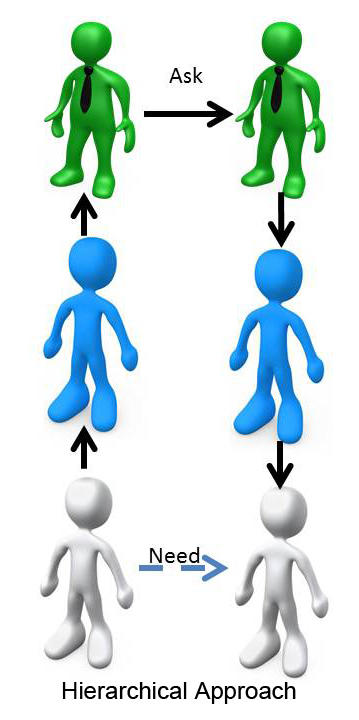
I deal all the time with people in organizations who are trying to get things done without the direct authority to ‘order’ people to do it.  These are people who sit in one organization who need the cooperation of people in another organization.  These are Senior Executives who need their peers’ cooperation to accomplish their own division’s goals.  These are Project Managers who need business leaders or other project leaders to do things before they can deliver their own project goals.  These are entry level people who need the collaboration of more senior people.  Back in the day when we all worked in purely hierarchical organizations, this is the way it worked:

Getting Things Done Through the Hierarchy

The person who needs something from another person in an organization asks his boss, who asks her boss, to asks his peer, who tells her subordinate, who tells his subordinate and it gets done, unless there is a dispute.  If there is a dispute, it reverses and goes back up and back down, then back up and down.  Usually many days, or even weeks have transpired before the original need gets fulfilled.  This is a pretty inefficient way of getting things done, unless everyone is completely committed to moving things fast.

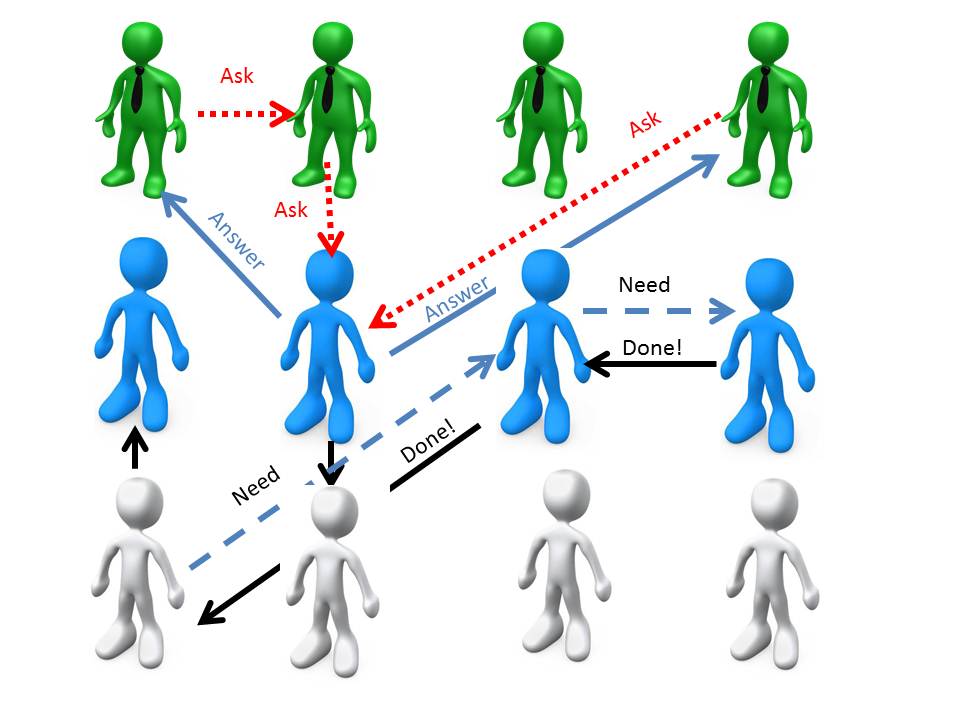
Organizations today are less hierarchical, flatter and more networked.  In an ideal world, this is the way things would work:

Being able to get things done this way depends on RELATIONSHIPS, trust, communication, urgency, political savvy, persuasiveness, and understanding organizational economics.  Being able to do this can make the difference between being stellar standout and being stuck in your position.

RELATIONSHIPS

It is who you know, who knows you and how much they care about you.  You need to have relationships–friendly, bi-directional relationships that are mutually win-win.  It is not about rank and power so much as about knowledge and cooperation.  If you look at the picture above, if the people at the bottom of the organization know how to help you AND ARE WILLING, then you get as much done as if you boss’ boss talks to their boss’ boss.  People will generally do something for you if there is no skin off their nose AND if they see it as beneficial. They generally see it as beneficial if you have at some time in the past done something for them, or if they think that that is likely to happen in the future.  Do things for people throughout the organization without requiring return,and eventually, you will get significant return from it.

Trust

If people trust you, then they are likely to help you whether or not you have the authority to “make” them do something.  People don’t have to trust you with their life, but they have to trust you not to sabotage them in some way, to stand up for them if necessary (after all they may be technically breaking a rule by doing something without appropriate hierarchical authority), and to reciprocate if they need something. For more on creating trust, read Trust Me, Damn It!  Ironically, sometimes asking for something helps improve a relationship and builds trust.  Ask for what you need–don’t be afraid.

Communication

The best way to get help from people who aren’t in your organization is to explain WHY you need what you need.  If they can understand the context of your request, if you can make it real for them, then they are much more likely to go along–especially if there is little to no risk to them.  If there is risk to them–to their own deliverables, to the schedule they’re supposed to hit, to their relationship with their peers or their boss–then your communication needs to be much more compelling.  You need to be clear about what is in it for them to help you that overcomes those risks? 

Unless you have a well established relationship–and even then, think twice–do not make these requests via email.  Email is too easy to ignore, to hard to be clear and too hard to be persuasive.  Talk in person (preferable) or by phone.  It is better to have worked on these relationships before you need them, but even so, be friendly and interested BEFORE you make your request.

Urgency

If people believe that what is needed is needed quickly or else important things will be slowed down or blocked, they are more likely to do it than if they feel no urgency.  Creating a sense of urgency must be done carefully, lest you get a reputation of “crying wolf,” and lose your credibility.  Why do you need what you need quickly?  Be honest, but also believe what you’re saying.  Speak with urgency and you’ll likely convey urgency.

Political savvy

In order to successfully get things done in your organization, you need to understand the politics in the organization.  Who has the power?  What relationships exist across your organization.  What are the rivalries?  Who is the ‘core’ group in each organization that you work in and around?  In other words, who are the three or four people who make the decisions?  Who do they listen to? Who can help you get the decision/resources/help you need go your way?  Are there hidden agendas?  What are they?  How does what you need to do fit into those agendas?  Whose agenda is supported by what you’re trying to do?  Whose agenda isn’t?  Trying to get things done in an organization without understanding these things is like driving on a road you know nothing about–where it goes, whether it dead ends, how fast you can go, whether there are any gas stations along the way.

Persuasiveness

Being persuasive is a critical skill for getting things done in organizations.  There is no tool that is more valuable.  Being persuasive begins with understanding the other person’s issues with regard to your argument, and then finding a way to reduce or overcome them by helping the person see very clearly WIIFM (What’s In It For Me) about what your trying to get done.  Provide a context that helps the person be persuaded.  A great book to help you learn to be more persuasive is Robert Cialdini’s, Influence. the Art of Persuasion.

Secrets

One of the biggest secrets in organizations is that people at all levels of the organization can get things done across the organization.  The most important step is to Do It. Figure out who can help you.  Figure out what is important to them.  Figure out how to approach and persuade them. Then ask.  Don’t give up.  If one way doesn’t work, try another.  Keep taking routes till you find one that works.  Make positive relationships along the way and PAY PEOPLE BACK.  Go for it!

1 Comment

Filed under Career Development, Communication, Executive Development, Networking, Success