Category Archives: Personal Change

Will Your Style Get You To The Next Level?

You have gotten to where you are based on a lot of things, but a key element of your success is your style.  Are you the “expert/straight-forward/opinionated” person?  Are you the “social/make everyone comfortable/cheerful” person?  Or are you the “large/take charge/tell ’em the way it is” person?  Which ever style you have, it has worked for you so far.  What ever success you’ve had, you style has contributed to it.  As you move up organizations, though, your style isn’t necessarily going to be as  helpful at the next level.

Think About It

When you look up the organization chart, do the people have a style like yous?  Or do they have a different style?  What styles do you see?  Are there a range of styles?  Or does it seem that everyone above you has one style. Look closer.  There are two possibilities.

The Top Has The Same Style As You

It is possible that you were hired in the ‘style’ of the organization.  If so, then you need to check out the nuances of the styles of others above you.  It may actually be harder to discern the ways in which you need to work on your style if the top of the organization has the same style as you.  You have to look harder at what is different.  Do they vary their style when they are talking to different people–customers or superiors or subordinates?  Does that work well?  Do they connect with you well?  Are there people in the organization that they don’t connect with?  Can you tell why?

The Top Has A Different Style Than You

This is actually more common, especially in bigger organizations.  There are two aspects to this.  The first is whether or not a different style is actually going to be more effective at a higher level in the organization.  The second (and more important) is whether people making decisions about promoting you perceive that it takes a different style to be successful at the next level.  Either way, you need to figure out whether you can/should adjust your style.

So How Do You Do That?

The first thing you need to do is overcome your reluctance to change your style.  You style is not you.  Think about the way you were in junior high school v. the way you were in high school v. the way you were in college.  You had different styles, right?  Those changes weren’t necessarily voluntary, but over time you learned to present yourself differently to fit in, to be comfortable in the situation, and to get what you wanted.  You are different at work, at church and at home.  A lot of this difference is external, a lot of it is style.  The real you is more like the way you are at home, but you manage to (easily) be different at work.

What we’re talking about here is simply being deliberate about changing your “outside” style to be more effective.  If you’re introverted and you’re a sales person, you figure out how to be more extroverted to be a good sales person.  This is the same.  What do you need to be ‘more’ of or ‘less’ of to be successful at the next level of the organization?

Leave a comment

Filed under Career Development, Executive Development, Personal Change, Uncategorized

The Way You Think Is Wrong

No Matter Who You Are

No matter who you are–black, white, Hispanic, French, Executive, Gen X, Retiree–the way you think is wrong.  Oh, I left out Democrat or Republican.  Our brains are truly wonderful things.  They are efficient processors of information.  There are a lot of tools that our brains us to make us more efficient and effective in our daily lives of being human.  I call all of these, generally, being on autopilot.  Being on autopilot is your enemy in terms of controlling your future.  Being on autopilot is also your friend in terms of making you more efficient at all the things you have to do in daily life.  The key is to learn the tricks your mind plays on you and to learn to turn these tools on and off to make better judgements when appropriate.

Let Me Be More Specific

Our brains use a number of tools or shortcuts that help us process information:

  • Halo Affect: assumption that because someone is good at doing one thing, s/he will be good at doing other things
  • Availability Heuristic:   assumption that because you think of something more frequently it is more likely to happen
  • Generalizations:  assumption that people, challenges, mistakes, organizations,  . . . pretty much everything . . . are just like the ones we have already experienced.  We tend to generalize trustworthiness, bad intentions, skills, incompetence, etc. based on other similarities.  Examples:  Asians are smart, Senior executives are bad, old people are degenerating,  Gen X’s are . . . (depending on your view).
  • Illusion of Understanding:  assumption that familiarity with something means you understand it
  • Hindsight bias: the tendency to view things as more predictable than they are
  • Motivated forgetting: re-remembering things to avoid blame
  • Overconfidence bias: the belief that your abilities are greater than they are–80% of drivers believe that they are in the top 30% of drivers
  • Recency bias:  giving more credibility to more recent data–the last presenter, the last candidate, the last answer
  • Clustering illusion:  seeing patterns where none exist

We All Do It

All of us use these tools.  They were developed back in the day when we lived in caves and hunted.  They are tools that help us make instant decisions without a lot of effort.  The problem is that they don’t work as well with today’s problems as when we were outrunning lions and tigers and bears.  The worst part about them is that we are generally unaware of them.  We value eyewitness testimony over other kinds of evidence, even though it is highly defective.  We choose candidates like us because we are generalizing and making assumptions at the subconscious level without really evaluating the basis for our assumptions.  We take risks based on shortcuts our brains make without even being aware of them.

What Can You Do?

The best thing to do is to educate yourself about these “tricks” that your mind plays.  There are several great books that can help:

Then Practice!

Learn to take control of the way you think by practicing.  Ask yourself, “Why do I think this?”  “How do I know this?”  “How can I think of this differently?”

4 Comments

Filed under Books, Career Development, Executive Development, Personal Change, Reframe

Life, Death and Legacies

Death-Bed Regrets

I bet you have all heard the story about the guy on his death-bed who regretted how much he worked and how little time he spent with his family, or doing what he loved, or making a difference in the world.  This is a lot like the story of the ant and the grasshopper–a reminder not to waste our life away on what is not important. It is really hard, though, when you’re up to your eyeballs in everyday life–work, taking the kids to school, putting food on the table, mowing the grass– to know what will be important enough to you when you die to regret not doing.

Today’s The Day

The thing is, today may be the day you will face what you wish you had done less or more.  Today CAN be the day you face what you wish you were doing more of.  Any day, week, year can be your last.  I don’t say that to freak you out–I really think at some level you know this–but rather to get your attention to spend the time now to figure out what you want you life to be about.

My husband died 21 days after being diagnosed with cancer.  He didn’t have time to think about wishes from his death-bed–in fact, he was 100% focused on figuring out how to fight the disease and he wasn’t being reflective at all.  A little more than a month before he died (before he knew he was sick), however, he wrote the following in our Christmas letter:

As you can see, he knew what was important to him.  He was focused on what was important to him.  Even though he died when he was merely forty-two, he brought this kind of thinking to the life he lived.  The people in his life felt enriched and loved by him.    I learned this lesson from him, that today could be our last and we need to focus on what is important, what will be our legacy, NOW.  We need to live a life we’re proud of today, tomorrow and every day.

Write Your Obituary

One of the best ways to think about this is to write your obituary.  Decide an appropriate death date. Make it 50 or 100 years or so from now. Then, decide what you’ve accomplished. This involves two main steps:

  • First off, decide who you want to be (or  have been, if we’re talking  obituary time).
  • Second, decide what you have accomplished.  When you take an   “accomplishment” view of your life, listing the things you really want to   accomplish, it clarifies where you want to go. Try to make your   “accomplishments” as concrete and possible as you can. Try to  define yourself in terms of what you are  likely to be able to accomplish,  with a little or a lot of stretching.

Now, look at your obituary.  What was important enough to you to be mentioned in your obituary?  When you think about your life now, are you on a path to accomplish what you want to?  Are you on a path to concentrate on what you think is important?  Do you need to make changes to your life, to your priorities, to your behaviors to make the life you want to happen?

Think about it.

Leave a comment

Filed under Career Goals, Executive Development, Personal Change, Success

The Transition From Manager to Leader

manager to leaderLeaders v. Managers

I’m sure you’ve probably heard about the differences between managers and leaders.  Managers do things right and leaders do the right thing–right? I think that this is an interesting discussion, but it isn’t that easy.  Managers do leader things and leaders do manager things. Each of us is naturally oriented toward one or the other–we either are inclined toward structure, processes, policies and systems or toward strategy, inspiration, vision and people.  But we can all learn to be either a manager or a leader or both a manager and a leader.

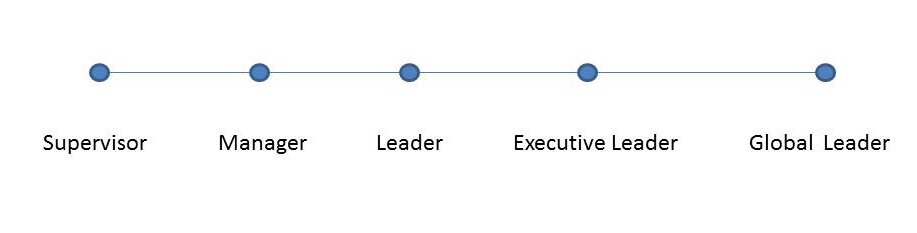
The Leadership Continuum

Many have described this as a dyad–either/or, a choice between two options.  I see it more as a continuum.

Manager to Leader

A continuum that ranges from supervisor to manager to leader to Executive Leader to Global Leader. This is not to say that supervisors can’t be leaders or that Global Leaders (positionally) aren’t managers.  There are cumulative skills, though, across those roles that are needed to deal with increasing complexity as a person accumulates more responsibility.

Moving Along the Continuum

Michael Watkins, whose books I’ve recommended in this blog before (The First 90 Days and Your Next Move) has a recent article in Harvard Business Review that is well worth the read.  He writes How Managers Become Leaders in the June issue of HBR.   Watkins identifies seven “shifts” that are required to grow managers into leaders.  These shifts are:

  • From specialist to generalist
  • From analyst to integrator
  • From tactician to strategist
  • From bricklayer to architect
  • From problem solver to agenda setter
  • From warrior to diplomat
  • From supporting cast member to leading role

These shifts require developmental experiences that change your perspective and force you to step out of your comfort zone.  You also need to be exposed to regular 360º feedback that allows you to understand whether or not your behavior is working for you in the situation.  And finally, you need to be dedicated to continuing to grow your self by challenging your assumptions, habits and behaviors to move along the continuum.

Leave a comment

Filed under Books, Career Development, Executive Development, Feedback, Hi Po, Leadership, Personal Change, Success

Stephen Covey and his Gifts to Business People

All business people owe a lot to Stephen Covey, who died this week at the age of 79.  Covey wrote his book, The 7 Habits of Highly Effective People, in 1989.  There were no earth shatteringly new concepts in it—to be highly effective, people should:

  • Be Proactive
  • Start with the End in Mind
  • Put First Things First
  • Think Win-Win
  • Seek First to Understand, Then to Be Understood
  • Synergize
  • Sharpen the Saw (balance and renew yourself)

At some level, most of us know that these are things to do.  In a way, though, Covey took it a step further.  He seemed to say, these are a good way to BE.  Practice these behaviors until these are a part of who you are.

Covey infused his work, and his speaking and teaching, with what is known as Spiritual Intelligence (SQ).  In his 2004 book, The 8th Habit, Covey defined Spiritual Intelligence :

“Spiritual Intelligence is the central and most fundamental of all the Intelligences because it becomes the source of guidance for the other three . . .  Spiritual Quotient [is] “conscience, ” having the following characteristics:

  • enthusiastic
  • intuitive
  • takes responsibility
  • moral
  • wise
  • integrity
  • servant
  • humble
  • fair
  • ethical
  • abundant
  • compassionate
  • respectful
  • cause-oriented”

Covey was one of the first, and certainly the first popularly available, to bring this kind of thinking into the workplace.  It was Stephen Covey who helped leaders understand that there was something greater than the bottom line, something somewhat intangible—you know it when you see it– to bring to the table when leading organizations.  Covey helped people understand their own personal responsibility for ‘leading’ themselves through self-management and positive interaction with others.  He encouraged people to “find your voice” and inspire others to find theirs.

His writing and teaching encouraged people to be whole, to focus on all the parts of their lives and to do that which was most important, not what was more urgent.  When I read Jim Collin’s later book, Good to Great, I was struck by the description of Level 5 Leadership and how closely these leaders seemed to follow Covey’s 8 Habits:

Level 5 Leaders

  • They are humble and modest.
  • They have “unwavering resolve.”
  • They display a “workmanlike diligence – more plow horse than show horse.”
  • They give credit to others for their success and take full responsibility for poor results. They “attribute much of their success to ‘good luck’ rather than personal greatness.”

One of the most important things that I ever heard Stephen Covey say was his description of how he came to these ideas.  He said that he went through all the theories of leadership, all the writing on leadership and pulled these behaviors on leadership from that research.  At the time, I was envious of the research that he had done, and I took with a grain of salt his conclusions.  I have since done my own research, traveling through many of the same thought leaders and historians that he did, and I now know that his conclusions are pretty right on, and much more coherent and inspiring than anything I could have come up with on my own.

R.I.P.  Stephen R. Covey, October 24, 1932 – July 16, 2012

1 Comment

Filed under Books, Executive Development, Leadership, Personal Change, Success

Promoted to Manage Your Peers? Awkward.

Promoted to Manage Your PeersThey’ll Hate Me!

If you spend enough time climbing the corporate ladder, or if you work in a small organization, eventually you’ll be promoted to manage your peers.  This is one of the toughest developmental experiences there is.  It’s hard for you.  It’s hard for your peers.  It changes things forever.  It doesn’t have to change things in a bad way, though.  If you handle it right, you and they can grow from the experience.

I’ve known people who’ve turned down such a promotion because they don’t want to lose their friends.  This, of course, is an option.  It’s a short sighted one, in my opinion, though.   We’ll get to that.  First, let’s talk about how to handle it if you decide to take the promotion.

Get Your Head Straight

Remember:

  • Think of the best manager you ever had and act like him/her.  Don’t go into super boss mode.  Your peers will be super sensitive to any ‘power play’ and if you start making decisions without input, ordering people around, showing who’s in charge, then you will send off alarms that will be hard to turn off.
  • DO NOT go easy on everyone to keep friends.  First of all, it won’t work.  Second of all, you will fail as a manager.  Third of all, you will lose your subordinates’ respect.  Go back to the advice above:  think of the best manager you ever had and act like him/her.
  • Don’t assume that your friends among your peers will support you.  Don’t assume that your non-friends among your peers will sabotage  you.  You can’t count on anyone’s reaction to be as you expect.  Approach the situation as if you just got hired from the outside.  Look at each subordinate through fresh eyes.  What does s/he bring to the table?  What are his/her strengths?  How can you help him/her grow?  How can you form a real team from these folks?
  • Be trustworthy, and just as important, be trusting. Delegate things that you used to do.  Deal (in private) with the fact that others can’t do things as well as you did them–you didn’t do them as well when you started, either.   Never, ever use anything you know from you friendship to get someone to do something.  Give people the benefit of the doubt. DO  NOT play favorites.
  • Your job is to get results for the organization.  Your job is to understand your boss’ priorities and deliver them.  Your job is not to be ‘one of the gang.’  Do your job.
  • Your boss, your new peers and your subordinates will all be watching how you handle this new situation.

Now Learn From My Experience

  • There are people who will not like your promotion, although which ones might surprise you.  They will get over it (likely) or they will leave.  Either way, the problem won’t last long.  There are people who will not only accept your promotion (again, who these folks are may surprise you), but who will also help you succeed at delivering the results you need to deliver. Appreciate these folks.
  • Doing this right is hard.  You won’t be perfect at it.  All you can do is keep trying.  Treat people with respect and for the most part, they’ll appreciate it.  Everybody has to get used to the new normal of this.  It takes time.  Keep trying.  Act like (you should know where I’m going with this) the best manager you ever had.
  • I am friends, close friends, with people who have been my boss, people who have worked for me and with  people who have been both.  Friendship grows, changes, stalls, ends, and re-emerges (Facebook with anyone from high school lately?).  Work relationships affect friendship, but in and of itself, does not make or break friendship.  Take the promotion.

1 Comment

Filed under Career Development, Executive Development, Leadership, Personal Change, Success

Multiple Intelligences: IQ, EQ, SQ and the other SQ

What kind of intelligence do you have?

We’ve all heard of IQ (Intelligence Quotient) which measures our ‘intelligence.’  Most of us have  heard of EQ (Emotional Intelligence), first mentioned by Wayne Payne in  1985 and made famous by Daniel Goleman in 1995.  A few of us have heard of one of the SQs–Spiritual Intelligence or Social Intelligence.  What do they really mean, though?  How important are they to career development?

IQ:  Intelligence Quotient which measures rational thought abilities,  is  considered a critical ‘trait’ for leadership.  IQ associated learning is step-by-step rule based learning.  To be successful, you don’t have to be the smartest guy in the room, but you have to be smart enough.  What ‘smart enough’ is depends on what kind of organization that you’re leading.  Meredith Belbin, a British researcher who focuses on teams, started his research with the assumptions that if he created a team of the smartest people–“A” players–then it will be a high performance team.  What he found was that intelligence itself was not enough.  A high performing team needs team members with a variety of skills and perspectives.

EQ: Emotional intelligence is the ability to assess, access and  control your emotions, and those of others.  Basically, if you have emotional intelligence, you have the ability to perceive, understand, use, and manage emotions.  There are lots of arguments about whether this is “real” intelligence, but most of us know people who are good at this and can see that there is something to it.  Again, EQ is considered a requisite for success in leadership.

SQ(1): Social intelligence is the ability to understand, manage, and navigate complex social networks.  It is also called ‘interpersonal intelligence.’  Leaders of global organizations and project managers of virtual teams require this SQ to be successful.  Some assert that autistic children have low social intelligence.  As the world has grown more complex, as organizations have grown, changed, evolved, this intelligence has become more important.

SQ(2): Perhaps the most controversial of the ‘Q’s’, spiritual intelligence is defined as  “the adaptive use of spiritual information to facilitate everyday problem solving and goal attainment.”(Robert Emmons (2000) )  Emmons proposed 5 components of spiritual intelligence:

  •    The capacity to transcend the physical and material.
  •     The ability to experience heightened states of consciousness.
  •     The ability to sanctify everyday experience.
  •     The ability to utilize spiritual resources to solve problems.
  •     The capacity to be virtuous.

Increasingly, companies are paying attention to spiritual intelligence among their leaders.

So What?

Each of us has certain strengths and natural styles.  We have all met (and perhaps are) the person who is incredibly book smart, but who has absolutely no common sense.  We all know the incredibly smart arrogant emotional bully.  Being too much of one of these, and not enough of the others makes you a “flat tire.”  You can be successful–up to a point.  Depending on your job (scientist, lawyer, teacher, executive) you need more of one and less of the others.  To be successful in almost any job, however, you need some of all of these.

There are tools for each of these that purport to measure these ‘Q’s.’  There are books on each of them.  Check them out.  Start working on developing some of your ‘flat’ spots.

Books That Will Help

2 Comments

Filed under Personal Change, Reframe, Success

Is That Smoke Smell Your Burnout?

Are You Burned Out?

Burnout Burning From Both Ends

Here are the symptoms:

  • Everything looks bleak
  • You don’t even have enough energy to care
  • Your tolerance of other people is very low
  • You feel unappreciated
  • You feel like you’re going through the motions
  • It doesn’t seem like anything you do makes a difference
  • You’re tired all the time
  • You’re  accident prone/clumsy
  • You have low immunity and are getting lots of colds/illnesses

Burnout happens to everyone at one time or another.  Sometimes you can see it coming.  Usually burnout takes a while to develop.  Sometimes burnout catches you by surprise, when you didn’t notice it coming on.  It is caused by relentless stress.  This is not the same as too much stress.  You can have too much stress, too much work, too much responsibility and not be burned out.  Lots of overworked people still have a positive perspective and feel hope that the work will end/be done/get better.  Burned out people don’t.  “It’s always going to be this way.” “It will never get better.”

The things that cause your burnout are different than the things that cause mine. We’re all different.  If you need to be appreciated and you can’t get any appreciation, that can cause burnout.  If you need to be in control and the situation has you feeling completely without control (different from feeling out of control), that can cause burnout.  If you don’t get to take any time for yourself, and you need some quiet introspection or if you need to be creative and that is missing from your work–burnout.

So What Do You Do?

Curing your burnout is hard.  It is hard not because what you have to do is hard, but because it is hard to find the energy to do it.  So the first thing you do is acknowledge that you’re burned out.  Look at the list above.  Does that describe you?  If so, decide that you’re going to work on curing your burnout.  Think of it as a cold.  If you don’t take care of a cold, it can get worse.  If you don’t do something to stop throwing up when you’ve got the flu, you can get much worse.  The consequences of not fixing your burnout can be that you get stuck.  It can have serious consequences for your career, for your family and for your future.  So, even if you don’t feel like it–force yourself.  It’ll get better.

1)  Try to figure out what’s causing it.  Look at the list above.  Do you feel unappreciated?  Without control? Do you feel like you aren’t good enough?  Whatever it is, just recognize the issue.

2) Try to think of a way to “reframe” the situation.  Appreciate yourself — acknowledge why you deserve to be appreciated.  Know that you are always in control of the way you deal with a situation, even if you aren’t in control of the situation.  If failed perfection is your problem, understand that that is your standard–not others’.  Let up.  Spend the time and effort to try to figure out a way to think of the problem differently.

3)  Do something nice for yourself.  Several somethings.  Be your own best friend.  Go for a walk.  Go to a movie.  Take a Saturday just for doing anything you want.  Read a good book.  Get a massage.  Play handball. See a friend you haven’t seen in a long time.  Break the pattern of not seeing the good in life.  Force yourself.

4)  Exercise.  Eat healthy food.  Yeah, I know, everybody says to do this.  It will help your immune system.  It will make you think of yourself and do something for yourself.

5) Write.  Write about what’s bothering you.  Write about all the things that are good in your life, your gratitudes.  Write about all the nice things you can do for yourself.  Write about your goals and your bucket list.  Write, write, write.

6) Create something.  Woodwork.  Draw.  Sew.  Paint. Fix something. Make music.  Using the part of your brain that does, rather than the part of your brain than thinks, will help.

7)  Talk to someone.  Talk to a friend.  Talk to a therapist.  Getting someone else’s perspective usually helps.

Keep trying things till you break the pattern.  I know it’s really hard to believe because burnout feels so physical, but it is more in your thinking patterns than in your job.  Once you figure out a way to break the pattern–even for a few hours–then keep doing it.  Build your resilience.  The more skilled you get at diagnosing your burnout before it takes hold and turning it around, the more in control you are of your reactions.

Leave a comment

Filed under Executive Development, Personal Change, Reframe

Are You A Wannabe?

Are you an Executive wannabe?  An entrepreneur wannabe?  An artist wannabe? A marathoner wannabe? An author wannabe?  Do you put one of those on your New Year’s Resolutions list?  How about your career goals list?

What Is Stopping You?

Look at last week’s calendar.  Look at last month’s calendar.  Is your ‘wannabe’ goal anywhere on your calendar?  If not, why not?  How can you possibly accomplish your goal if you’re not spending any time on it?  Don’t tell me you don’t have time.  People who really want to do something have time.  Every successful accomplished person who has done what you want to do has EXACTLY the same amount of time that you do.  It comes down to six things:

  • Priority:  If this is your future, then you need to put it sufficiently up your priority list that you are spending time on it
  • Motivation:  Understand what motivates you and put that in your life.
  • Focus: You CANNOT do it all (at once).  Turn off the TV.  Stop surfing the Internet.  Stop texting.  Take yourself to some place quiet and isolated.
  • Determination:  Keep working toward your goal, no matter what gets in the way.
  • Create whatever support infrastructure you need.  If you need training, get it.  If you need a coach, get one.  If you need a place, find one.
  • Action:  I hate to be repetitive, but JUST DO IT

Winning

So, How Do You Do That?

  • Write it down.  Be very specific.  Not ‘Write a book’ but ‘Write a novel, get a book contract, and get it published by this time next year.
  • Once you’ve written the specific goal, work backwards.  In order to write a novel, get a book contract and get it published, what do you have to do?  In order to do those things, what do you have to do?  Ask what you have to do and detail it several times.
  • Once you have a fairly detailed list, decide what you are going to do tomorrow.  What are you going to do this week.  Look at your calendar and put these tasks on it.  Take something off your calendar to make room for it, if you have to.
  • What reward will you give yourself for which accomplishments.  It doesn’t have to be something big–just something that you will associate in your mind with accomplishing the task.
  • What are the big milestones in your plan?  How will you reward yourself for these big milestones?
  • Hold yourself accountable.  Tell someone–that makes it harder to escape the accountability.

Great books to help with this:

1 Comment

Filed under Books, Career Development, Career Goals, Goal Setting, Personal Change, Time Management

Appreciate What You’ve Got

This is all going to end.

I know this doesn’t come as news to most of you, but everything we have is quite transient.  Possessions (think hurricane/fire/tornado), health, and even life itself.  There are two ways to approach this fact.  You can live in fear of losing it all, or you can really appreciate what you’ve got.  Including your job.

I’m a consultant.  I have a lot of jobs (serially).  I really like being a consultant.  I like what I get to do and I like the people I meet.  I love that I learn something every single day that I’m working as a consultant.  I especially like the variety.  Ironically, I don’t like leaving my jobs, though, when they are done.  I miss the routine, the company and especially the people.

I started a new gig this week, and today, on my second day, I walked in resolved to appreciate every single day.   I want to appreciate the ups and downs, the people, the tasks, the challenges, and the things that I learn.  The thing is, I know that this will come to an end.  It might be at the end of the contract time frame established up front, or I might get extended, or it might be earlier.  I know, for sure, however, that it will end.  I want to be aware of that every day so that I can appreciate what I’ve got.  I think it will help with the frustrating parts, but I also think it will help with the end—when I leave I know I will have pushed this experience to its limit.  No matter when that is.

How about you?  You’re not a consultant, so it doesn’t apply to you, you say.  I beg to differ.  The job you’re in now will end.  It might be when you retire.  It might be tomorrow.  It might be when you get a new job or a promotion. You might know the end is coming or you might get called into a meeting and get told.  I know someone who once showed up at work and there was a sign on the door.  It will end.

What Would You Miss?

Do you appreciate what you have?  Do you appreciate the people who you work with and see every day?  Do you appreciate the facilities?  The amenities?  The inside jokes?  The get-togethers?  The things that you learn?  If it ended tomorrow, what would you miss?  If you knew when it was going to end, what would you be doing between now and then?  What is your work ‘bucket list’ to do before you leave?

How about getting started on it? (Just in case:-))

8 Comments

Filed under Personal Change, Reframe, Success