Category Archives: Communication

How Do You Lead From the Middle?

Many people are frustrated by their managers.  We want our managers to live up to our expectations, our hopes, our projections.  We want them to be charismatic, thoughtful, insightful, inspirational, good communicators, etc., etc., etc.  Some managers are good, but few are perfect.  Some are far from even being good.  What if that is your manager?

Do you just stop?  Do you wait for that manager to get moved, fired, or retire?  Do you look for another job?  I vote that you do none of these things.  I vote that you start being a leader.  Get proactive.  Lead from where you are.

How Do You Lead From The Middle?

Figure Out What You Want To Accomplish

What is it that you think your manager should be doing but isn’t?  How can you accomplish that without your leader actually doing it?  Is it something that your manager’s manager has to agree to?  Or his peers?  If so, how can you persuade them?  How can you help them see the problem and the solution?  Maybe they can persuade your manager if his blessing is required.  Or maybe his blessing isn’t really required.  Think about it.  If his boss can bless it, then figure out how to make that happen.  If that is your goal, then you can get creative about how to do it.

What if no one really has to bless it?  What if you and your peers can do it if you are working together to do it.  How can you persuade your peers to do it?

Figure Out What Is In Your Way

So often it is our mind set about how the organization works that stands in our way of getting things done.  We think that the top has to tell the middle who has to tell the bottom to actually get things done.  That actually is not the best way for an organization to run.  Organizations are much more effective and well run if people step up and do what they can and leave the problems/the barriers/the white space to the upper levels.  In other words, your organization will be much better run if you actually step up and do what you know is right for the organization.

Obviously, some organizations don’t work this way.  Some managers get really threatened by this kind of behavior.  Don’t assume that is true of your organization, though, unless you test it out a bit.  I’m sure you’ve heard the expression, “It’s better to ask for forgiveness than for permission.”  It certainly is more practical.  If you have to wait for someone to decide to focus on what you think needs to happen, to then be persuaded, and to then give permission, then you’ve just inserted significant delays into the process.  Take a long hard look at whether you’re deferring because you are conditioned to do that or because it really is not safe to go ahead without permission.

Being Proactive Is Really Career Enhancing

I’ve participated in hundreds of interviews over the course of my career.  When it is obvious that a candidate is likely to be proactive, to seek out ways to make things better without waiting to be told, then that candidate is much more likely to succeed in the process.  I’ve had people tell me that it is possible to tell whether someone has the education or the experience necessary to do the job, but very difficult to tell from the resume whether s/he is likely to be proactive.

Leading from the middle is simply being proactive.  See the problem.  Figure out how to fix it.  Fix it.  So much of it is attitude and confidence.  So next time you’re frustrated with your manager for not getting something done, ask yourself why you aren’t getting it done instead.

 

Leave a comment

Filed under Career Development, Career Goals, Communication, Executive Development, Leadership, Success

Sorry. You Are Not Indispensible.

We all see ourselves as the hub of our own universe.  This is not a bad thing–and it is natural.  It does create blind spots, however. When we evaluate our importance to the organization it is through our own eyes.  We know what we do, did and frequently compare our performance against our peers (and even our managers).  The thing is, everyone is doing the same.  Let me try to be clearer.

My Perspective

When I work late to finish the report that is due tomorrow, I feel virtuous.  I gave up dinner with my friends to make sure the report got done.  I went to the extra effort to talk to all the affected departments and get their input (and that is what took so long and why I had to stay late to finish it before tomorrow).  I am aware that I went over and above, doing special research to make sure all my recommendations were right and would work.  I worked extra hard on the graphs and had to teach myself some new techniques in Excel and PowerPoint (again, that probably contributed to why I had to stay late to get it done).  My intent and goal is for this report to be perfect.  I don’t know exactly what it is to be used for, but whatever that is, I want whoever uses it to be blown away by how good it is.  This organization is very lucky to have someone who cares so much and works so hard.  What would they do without me?

My Boss’s Perspective

The report was on time.  It looked pretty thorough, but it was pretty detailed and there wasn’t a concise Executive summary.  It was a little off point of what I was looking for, but I can use it.

So What Causes This Kind of Disconnect?

What I Should Have Done:

  • Before even starting, I should have been VERY clear on what the purpose of the report was, who the audience was, what the report would be used for, and what its relative importance was.
  • It is completely fine to develop new skills (Excel, Powerpoint) in the process of creating work product, but that is on you–not on your organization, especially if the product of those new skills is not specifically necessary for the product you are creating.  The fact that it caused me to have to work late to create the report is not a reason for the organization to be happy with me.
  • Perfectionism can get you into more trouble than it is worth sometimes.  I should have made the report good enough to satisfy the goal, but I should not have spent a lot of extra time making it perfect–unless there was some reason (outside of my standards) for it to be perfect.
  • I need to appreciate the fact that my standards–working hard, working long hours, learning new skills, making sure I’ve talked to everyone and was inclusive, and that the report was perfect–do not (usually) translate into the organization’s view of my performance (or my indispensability).
  • I need to be understand that my boss is not aware of my intent, my hard work, my learning, or my extra effort unless someone tells him/her.  It is not inherently obvious from my work product.
  • Meeting the goal of the assignment precisely and specifically for the intended audience is WHAT COUNTS.

What My Boss Should Have Done

  • My boss should have been very clear about the goal, purpose and audience for the assignment.
  • My boss should have been clear about any expectations of over and above/extra effort.
  • My boss should have made efforts to understand how hard I worked to meet the goal.
  • My boss should have found ways to give me constructive feedback and to appreciate my effort in order to motivate me to continue to work toward getting better.

Next Time

The next time you notice that you are congratulating yourself on how hard you’re working, on how great your work is and on how indispensable you are, ASK YOURSELF if your boss sees it the same way.  Ask yourself if you DELIVERED what was needed, when it was needed, for the intended goal.  Because when you consistently deliver exactly what is needed, when it is needed, maybe you can become indispensable.

Leave a comment

Filed under Career Development, Communication, Executive Development, Reframe, Success

Getting Things Done Without The Title

How Do You Get Things Done When You’re Not the Boss?

I deal all the time with people in organizations who are trying to get things done without the direct authority to ‘order’ people to do it.  These are people who sit in one organization who need the cooperation of people in another organization.  These are Senior Executives who need their peers’ cooperation to accomplish their own division’s goals.  These are Project Managers who need business leaders or other project leaders to do things before they can deliver their own project goals.  These are entry level people who need the collaboration of more senior people.  Back in the day when we all worked in purely hierarchical organizations, this is the way it worked:

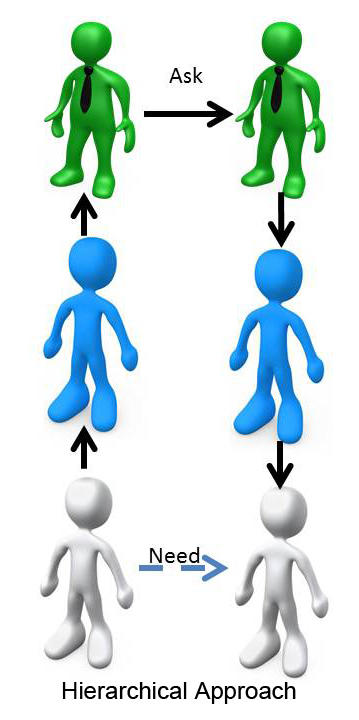
Getting Things Done Through the Hierarchy

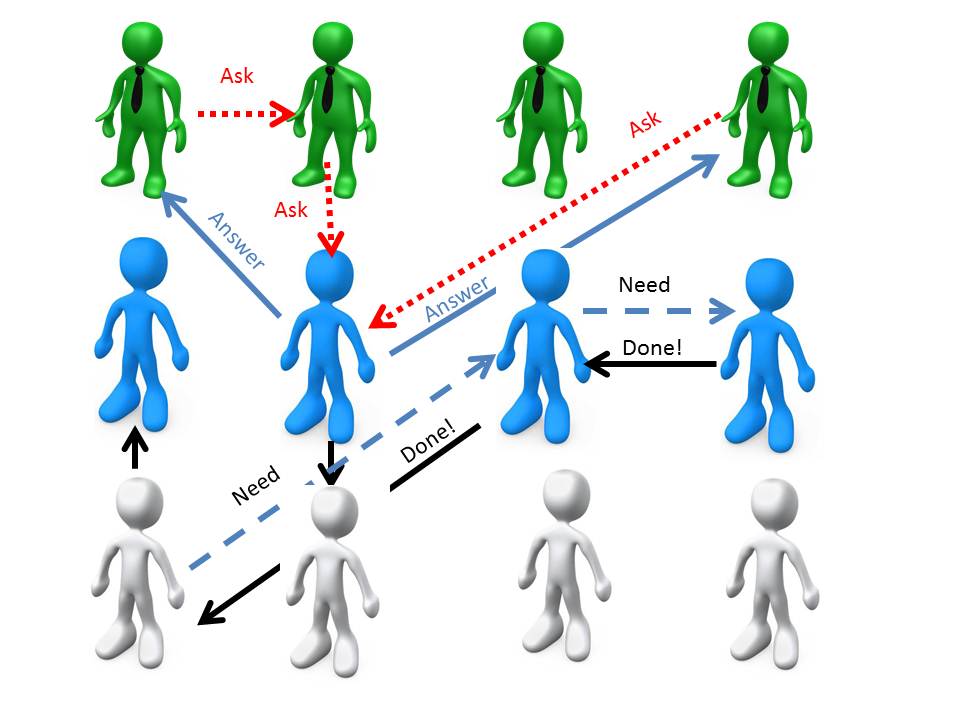
The person who needs something from another person in an organization asks his boss, who asks her boss, to asks his peer, who tells her subordinate, who tells his subordinate and it gets done, unless there is a dispute.  If there is a dispute, it reverses and goes back up and back down, then back up and down.  Usually many days, or even weeks have transpired before the original need gets fulfilled.  This is a pretty inefficient way of getting things done, unless everyone is completely committed to moving things fast.

Organizations today are less hierarchical, flatter and more networked.  In an ideal world, this is the way things would work:

Being able to get things done this way depends on RELATIONSHIPS, trust, communication, urgency, political savvy, persuasiveness, and understanding organizational economics.  Being able to do this can make the difference between being stellar standout and being stuck in your position.

RELATIONSHIPS

It is who you know, who knows you and how much they care about you.  You need to have relationships–friendly, bi-directional relationships that are mutually win-win.  It is not about rank and power so much as about knowledge and cooperation.  If you look at the picture above, if the people at the bottom of the organization know how to help you AND ARE WILLING, then you get as much done as if you boss’ boss talks to their boss’ boss.  People will generally do something for you if there is no skin off their nose AND if they see it as beneficial. They generally see it as beneficial if you have at some time in the past done something for them, or if they think that that is likely to happen in the future.  Do things for people throughout the organization without requiring return,and eventually, you will get significant return from it.

Trust

If people trust you, then they are likely to help you whether or not you have the authority to “make” them do something.  People don’t have to trust you with their life, but they have to trust you not to sabotage them in some way, to stand up for them if necessary (after all they may be technically breaking a rule by doing something without appropriate hierarchical authority), and to reciprocate if they need something. For more on creating trust, read Trust Me, Damn It!  Ironically, sometimes asking for something helps improve a relationship and builds trust.  Ask for what you need–don’t be afraid.

Communication

The best way to get help from people who aren’t in your organization is to explain WHY you need what you need.  If they can understand the context of your request, if you can make it real for them, then they are much more likely to go along–especially if there is little to no risk to them.  If there is risk to them–to their own deliverables, to the schedule they’re supposed to hit, to their relationship with their peers or their boss–then your communication needs to be much more compelling.  You need to be clear about what is in it for them to help you that overcomes those risks? 

Unless you have a well established relationship–and even then, think twice–do not make these requests via email.  Email is too easy to ignore, to hard to be clear and too hard to be persuasive.  Talk in person (preferable) or by phone.  It is better to have worked on these relationships before you need them, but even so, be friendly and interested BEFORE you make your request.

Urgency

If people believe that what is needed is needed quickly or else important things will be slowed down or blocked, they are more likely to do it than if they feel no urgency.  Creating a sense of urgency must be done carefully, lest you get a reputation of “crying wolf,” and lose your credibility.  Why do you need what you need quickly?  Be honest, but also believe what you’re saying.  Speak with urgency and you’ll likely convey urgency.

Political savvy

In order to successfully get things done in your organization, you need to understand the politics in the organization.  Who has the power?  What relationships exist across your organization.  What are the rivalries?  Who is the ‘core’ group in each organization that you work in and around?  In other words, who are the three or four people who make the decisions?  Who do they listen to? Who can help you get the decision/resources/help you need go your way?  Are there hidden agendas?  What are they?  How does what you need to do fit into those agendas?  Whose agenda is supported by what you’re trying to do?  Whose agenda isn’t?  Trying to get things done in an organization without understanding these things is like driving on a road you know nothing about–where it goes, whether it dead ends, how fast you can go, whether there are any gas stations along the way.

Persuasiveness

Being persuasive is a critical skill for getting things done in organizations.  There is no tool that is more valuable.  Being persuasive begins with understanding the other person’s issues with regard to your argument, and then finding a way to reduce or overcome them by helping the person see very clearly WIIFM (What’s In It For Me) about what your trying to get done.  Provide a context that helps the person be persuaded.  A great book to help you learn to be more persuasive is Robert Cialdini’s, Influence. the Art of Persuasion.

Secrets

One of the biggest secrets in organizations is that people at all levels of the organization can get things done across the organization.  The most important step is to Do It. Figure out who can help you.  Figure out what is important to them.  Figure out how to approach and persuade them. Then ask.  Don’t give up.  If one way doesn’t work, try another.  Keep taking routes till you find one that works.  Make positive relationships along the way and PAY PEOPLE BACK.  Go for it!

1 Comment

Filed under Career Development, Communication, Executive Development, Networking, Success

Onboard Yourself

Onboarding

Onboarding is the process that organizations use to get their employees up to speed enough to do their jobs.  Another term for it is “organizational socialization.”  Organizations have informal and formal methods for the knowledge transfer or processes, tools, methods, culture and introductions that is sufficient for the employee to be effective in his/her new job.  I’ve seen really good onboarding and really horrible onboarding.

The best onboarding I ever experienced personally was as a consultant when I was going to work for a group of consultants.   The onboarding was a combination of providing me with detailed “playbooks” of how the organization did its work and of having me spend intense time with each team of consultants to see/understand how they put the playbook into action.  I traveled weekly for my onboarding and in three weeks’ time, I felt that I understood the whole and was fully able to go do it myself.  It was the combination of the intensity, the excellent documentation, and the seeing it all in action—including being given tasks I didn’t know how to do, but being surrounded by people who could/would help me.

I’ve had so many “worst” onboardings that it is hard to pick just one.  They range from putting me in a room with a year’s worth of reading and leaving me to read for two weeks to putting me at a desk and spending less than 10 minutes telling me what to do and walking away, never to return.  I think that I eventually did OK, even at the jobs with these onboardings, but the time it took to get me up to speed and to be productive was vastly different.

I finally decided that I needed to take responsibility for my own onboarding.  As a consultant, it is critical that I hit the ground running and know enough in a week to make a difference.  If I wait for people (who all have other jobs and many of whom are not sure they want me here, anyway) to tell me what/how/when/why in the organization, then I will fail.  These processes can apply for anyone, in any job, including people who have been in the job for a long time.

DIY Onboarding

Steps to Your Own Onboarding:

  • Make a Plan:  Identify what you want to accomplish and how fast.  You have a fairly short period of time before people get over you being new and expect you to “do” something.  They are very open to questions in the early days; they think you’re dumb if you’re still asking questions later (even then, you need to ask questions to learn—deal with what they think).  Who do you need to know?  What do you need to know?  What do you need to be able to do?  Ask people what they think you need to do to be successful.  Then put in place a plan that gets you there.  Fast.
  •  Meet People:  Meet people at every level.  Set up meetings.  Invite people to lunch or breakfast.  Accept all invitations.  Learn the power structures.  Learn the informal networks.  Learn the ‘go to’ people.  Learn the whiners.  Learn who to listen to and who to avoid.  The only way to do that is to throw yourself into meeting people.  (Even introverts need to do this)  Ask people to help you.  Ask people who you should meet.  Ask people who helped them when they started.  Target someone to be a mentor in this process and ask for his/her help.
  •  Figure Out the Tools:  Luckily, today most organizations use the same fundamental tools—the Microsoft Office suite plus SharePoint.  If the organization uses different/other tools, however, learn these as soon as possible.  Learn Oracle, Salesforce.com, EPDM, or whatever other tool your organization uses.  You need to understand it and be conversant in its strengths and weaknesses.  (Every tool you learn makes you more marketable—use the opportunity of being new to dive in and learn new tools).
  •  Understand the Culture:  Every organization has its own culture.  This is like the water the fish swim in—the people inside the organization are not very aware of it consciously, but it shapes all behavior unconsciously.  When you’re new is the only time you can actually “see” the culture.  Don’t make the mistake of assuming it is like the culture you just came from.  Just because engineers are the dominant players in the new culture as they were in the old, there will be huge differences.  Learn these differences with “new eyes.”  Learn what the organization thinks about what makes success, who are the people who seem to “get it.”  What are they like?  How much does the leader shape the organization?  Is the founder still there?  How long since the founder was there?  What are the left over influences from that?  (These are frequently the things that don’t seem to make sense because they started a long time ago but are still there).  Write down your observations of the culture.  Make a mind map.  How does the culture influence the way that you will get your work done?  How can you use the culture to be more effective?
  •  Learn the Product/Customers/Processes:  Become an expert.  Take all the classes you can.  (Organizations frequently have classes for new sales people that are available to others).  Ask people about the processes.  Become best friends with the Intranet.  What’s there and what can you learn from what’s there?  What do others outside the organization say?  What do people in the organization say in reaction?  Everyone in every part of the organization needs to thoroughly understand the Product and the Customers.  You need to at least understand the processes in your own organization and those that take product to market and get money to the bank.  Like I said, BECOME AN EXPERT.
  •  Take Actions:  You have a very short window before people start to see action.  Look for opportunities to take early action.  It is better to be right about these actions, so be careful—but not too careful.  Action is better than no action, even if you make mistakes.  Ask your boss and peers what kinds of actions they are expecting from you and deliver them as soon as possible.

 Good Books That Help With This:

The First 90 Days, Critical Strategies for New Leaders at All Levels  byMichael Watkins

The New Leader’s 100-Day Action Plan by George Bradt, Jamye Check, and Jorge Pedrassa

2 Comments

Filed under Books, Career Development, Communication, Executive Development, Hi Po, Leadership, Networking, Recession Proof, Success, Time Management, Uncategorized

Trust me, damn it!

Demanding Trust Doesn’t Work

I once had a boss demand that I trust her again.  We can talk later about how I made the mistake of letting her know that I didn’t trust her (not a good career move, and no I didn’t TELL her that), but DEMANDING that someone trust you NEVER works.  If you have the kind of relationship where you’re demanding anything, it is a trust-less relationship.

Trust is hard to define.  I knew what she meant.  She wanted me to go back to being willing to do whatever she needed/wanted without doubting her intent or integrity.  She wanted our relationship to be based on mutual “confident expectation.”  I would have liked that too, but she had done something (that I felt was dishonest) that so violated my confidence in her integrity, that I no longer gave her the benefit of the doubt.  When I told her that I might be able to trust her again, but that it would take time, that was unsatisfactory to her.  At least it was all out in the open.  The consequences, however, were not pretty for either of us.

Since then, I’ve had the experience of people not trusting me.  Some didn’t trust me because I outranked them.  Some didn’t trust me because I was a different race, or age, or had a different nationality.  Trust is not an automatic gift, it has to be earned.  Not being trusted, however, is definitely not fun.

Trust MeYou CANNOT Be a Good Leader If They Don’t Trust You

Think about the people who you have trusted.  Have you trusted a boss?  A friend?  A stranger?  Someone from a different generation?  A pastor? A car dealer?  A banker? A lawyer?  See . . . all of these invoke different levels of trust reactions in you—and they are just labels.  What made you trust the people who you trust?  For most of us, it is consistent, persistent behaviors that we can predict and (for the most part) agree with.  It is rare that we trust someone instantly, although it happens.

Excellent leaders are trusted.  It is that trust that enables high performance teams.  All leadership gurus talk about the necessity of trust for great leadership.

So . . . How Do You Get Them To Trust You?

Want people to trust you?  Here are some important prerequisites:

  • Be trustworthy—Well, duh.  You’d be surprised, however, at how many managers bemoan the fact that no one trusts them while they are working secret agendas, regularly mislead co-workers, subordinates, and/or the community.
  • Trust others—It’s amazing how well this works!  The very experience of being trusted generates the willingness to trust in most of us.  When you trust people to do something they haven’t done before, or to speak in front of a group, or to represent you in a meeting with your boss, that makes them more willing to trust you to be telling the truth, to takes risks, or to move forward without all the details.
  • Be real.  Let people know who you are.  Let them understand your motivations.  If you are trying to do something and the motivation isn’t clear—people make it up.  If they trust you, they give you the benefit of the doubt.  Until they trust you, you are better off making your motives clear.  Even if they don’t like what you are doing, they learn to believe that there is nothing hidden.  It’s more important that people understand than that they agree.
  • Listen.  When people believe that you are listening, that you are trying to understand, they begin to trust you.  When you don’t listen, they stop trying to tell you.  When that happens, there is no trust.
  • Treat people with respect.  When people feel respected, they feel whole.  They feel more open to understanding and trusting.
  • Be loyal.  If people know that you are loyal to them, they are much more likely to be loyal to you.  Loyalty is closely related to trust.

These are simple things.  They are not easy to do.  When we are caught up in the day to day tasks of work life, it is hard to remember to do them all.  They are behaviors, though, with huge payoffs.  People who trust you can deliver miracles sometimes, because they are willing to go above and beyond and take the chance that it will be worthwhile.

1 Comment

Filed under Career Development, Communication, Executive Development, Success, Trust

Become a Great Leader

Leaders and Leadership as a Process

Do You Want to Become a Great Leader?

How you think about leadership has a profound affect on your success in becoming a good leader.  We all have our individual idea of what a good leader is.  Then we assume that everyone thinks the same thing.  And that is what gets us into trouble.

There are three parts to this:

  • What do you think makes a good leader?
  • What is leadership?
  • How can you adjust to be a good leader for others?

What Do You Think Makes a Good Leader?

When you think of the best leaders you’ve ever experienced, what were their traits?  Were they organized?  Were they decisive?  Were they fair?  Were they nice? “In charge?” Inspirational? Ambitious?  Smart? Successful? Charismatic?  Make your list.

We idealize leaders.  We want them to be what we think a leader should be.  There is a bit of magical thinking about leaders—they are supposed to be what you want them to be, regardless of who they are or what their style is.

In the United States, we want our leaders to be out there in front—leading the charge.  That kind of leadership is considered  inappropriate behavior in some other cultures.   Leaders actually come in all shapes and sizes.  When you do the above exercise–asking what the traits of good leaders are–in a large group of people, they don’t agree.  Each has his/her own vision of what a leader should be.  This comes as a surprise to the people in the group, because we all assume that what we believe is a great leader is universal.  If you ask the group WHO have been great leaders, they generally agree on a (very) few–Martin Luther King, Ghandi, Lincoln, but can’t come to agreement on others–Jobs, Bush, Welsh, for instance.

So What is Leadership?

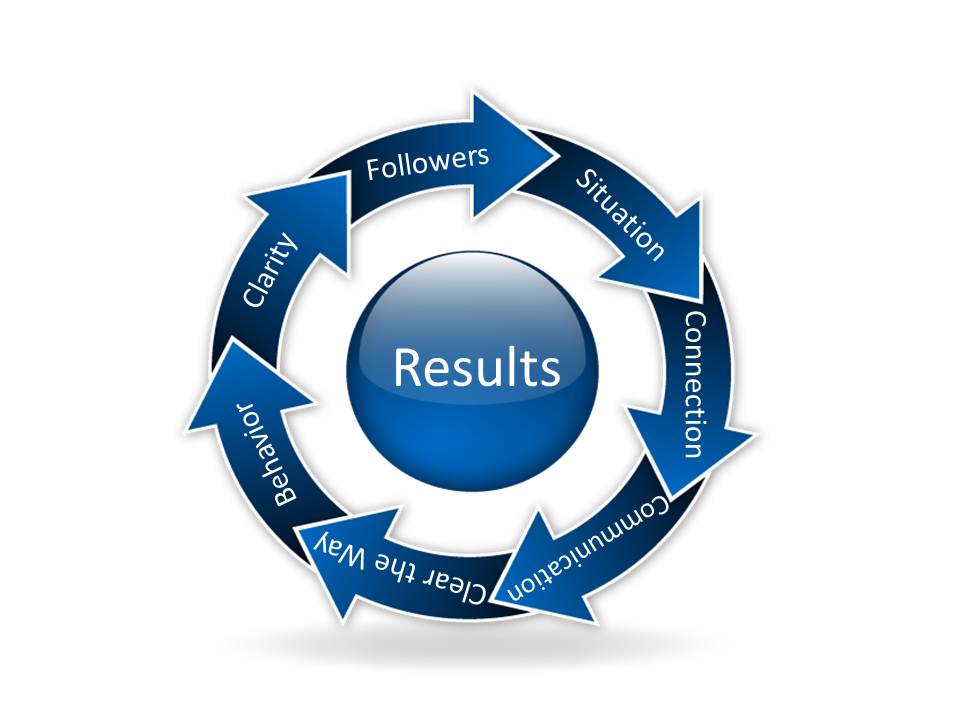
Leadership is more than just a person and who/what/how that person is.  It is results.  It is situational.  It is followers.  It is removing barriers for people.  It is connection. It is behavior.  It is communicating.  It is clarifying.  Leadership is the combination of all of these.  It is a process that combines all of these.

The leader is the instigator of this leadership process.  The leader is the instrument that stimulates and regulates the process.  The leader does not have to be a certain kind of person, but rather has to have the skills to manage this process and to integrate the elements of the process to achieve the results.

Now, rethink the people who you think are the best leaders in your experience.  How did they manage the elements of the leadership process?  Didn’t they do all of these steps well enough to get the results that the organization needed?

How can you adjust to be a good leader for others?

Reframe the way you think of leadership.  Think of it as a process instead of a particular way of being.  When you think of it this way, evaluate your ability to accomplish the skills of the leadership process.  How can you get better.  Depending on the results you need, the followers you have, the situation you are in, you need to remove barriers, communicate, clarify and adjust the integration of the leadership levers until you get results.  By thinking about it this way, it becomes a much more manageable task than if you have to have a personality transplant or develop charisma in order to be a great leader.

This view of leadership allows you to continue to ‘raise your game’ until you are a great leader.  Practice the skills that need development, hone the delivery of these tools, and learn to adjust to the situation and the followers.

4 Comments

Filed under Career Development, Career Goals, Communication, Executive Development, Leadership, Reframe, Success

Diversity Makes Work Work.

Work Has Gotten More Diverse.  No Duh!

Have you noticed how diverse our work lives have gotten lately?  Not so much at the top of organizations–we still have a long way to go there–but in terms of getting actual work done, most of us are dealing with quite a bit of diversity.  Have you worked on a ‘virtual team’ with people in other countries?  Does your company have global customers?  Do you have to deal with other generations in your office?  Is your company part of a global conglomerate?

Age, gender, religion, country, neighborhood, state, region, race.  All of it contributes to the work of work.  We are most comfortable with people like us.  Even those of us who think of ourselves as diversity-gurus are more comfortable with people like us.  Back in the caveman days when we all lived in the same cave for all of our lives, that was OK.  Now it is absolutely necessary that we come out of our comfort zone and learn to work together, learn together, and yes, even enjoy each other.

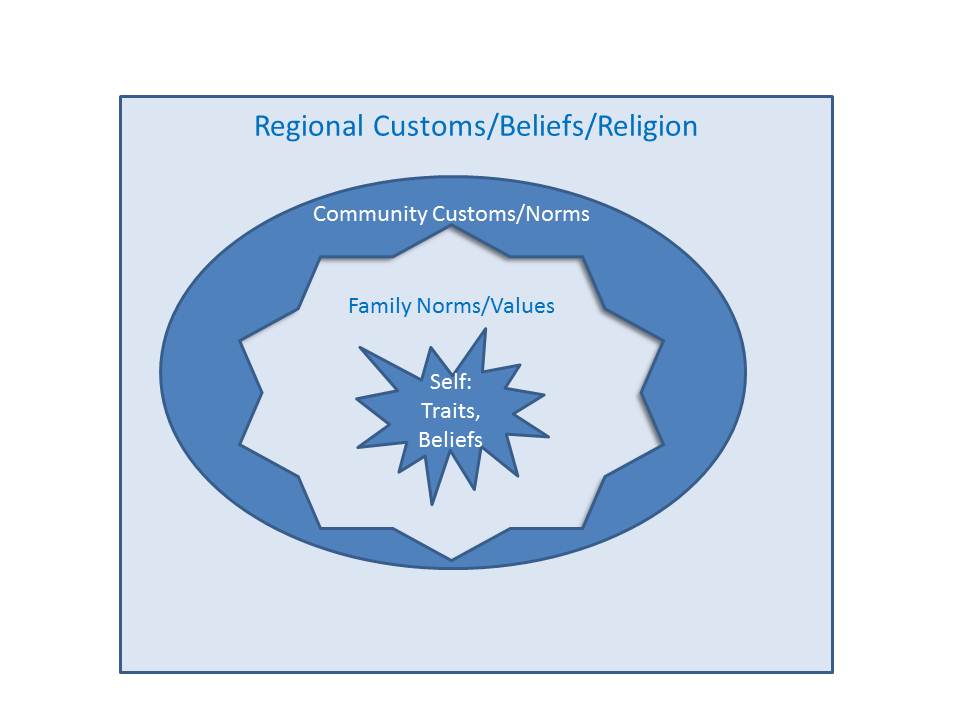
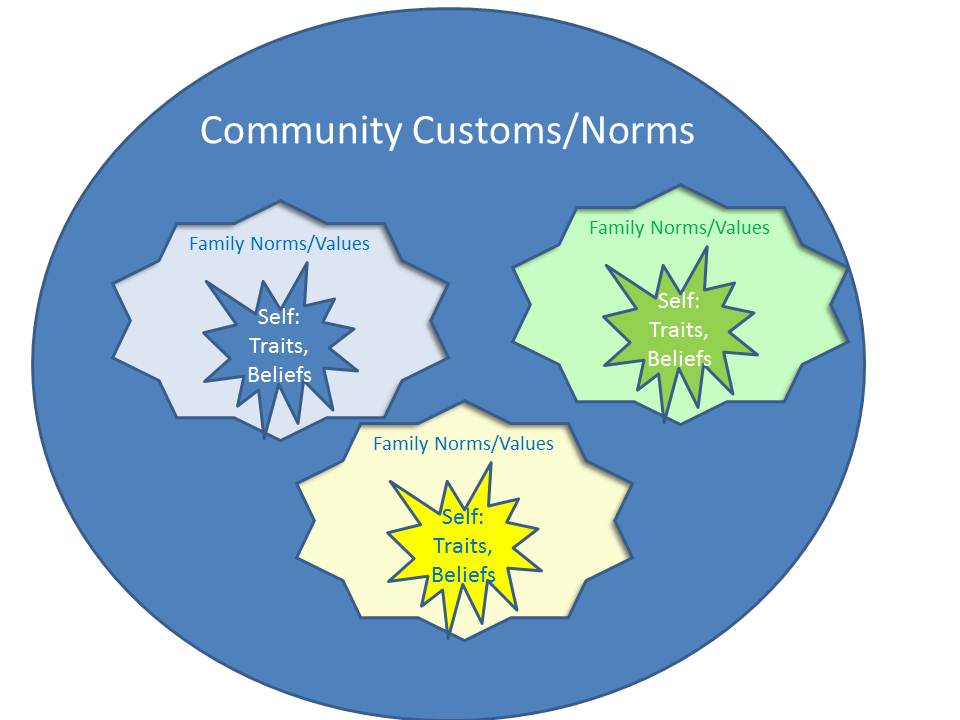
self within culture

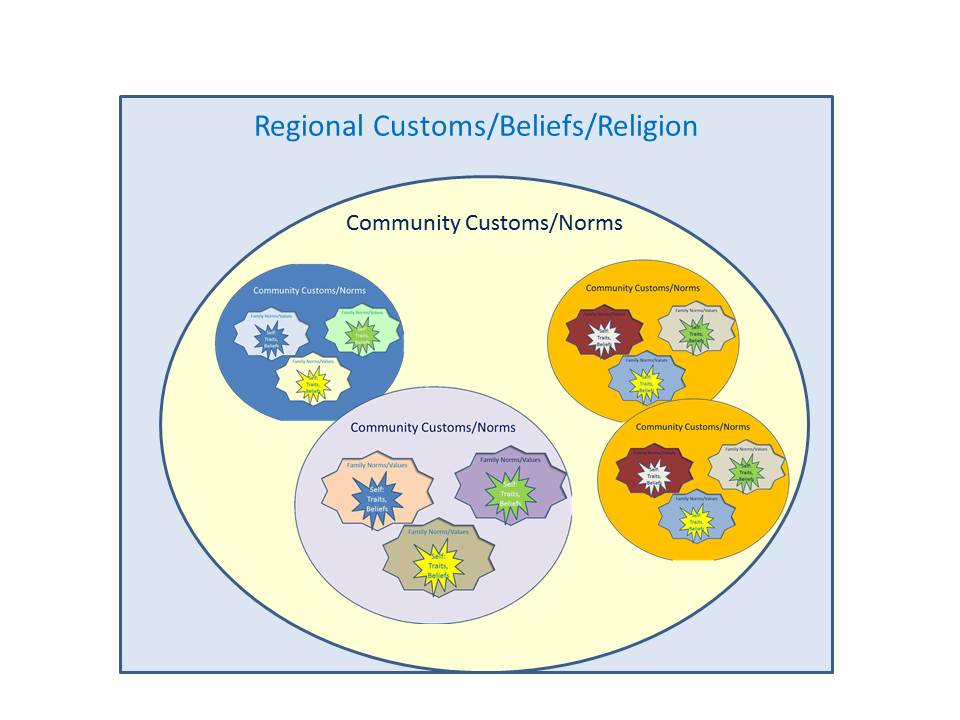
Even when we don’t venture outside of our own groups, there are enough issues that cause problems.  The things that we believe about ‘the way it should be’ come from our own thinking patterns, our values, our family input, the norms within our community, and the regional influences.  When we stay within our own community, we have conflict among each other (think your extended family Thanksgiving or the last family wedding your attended).  We disagree about what is right and how to decide that.  We disagree about what is important, how to raise children, politics, food, neatness.  You name it, we can disagree about it.

family within culture

As you add more individuals, more families, more communities, it gets more and more complex.  The things we care about are the same, but the ways in which we think about them are different.  Different cultures have fundamentally different ways at thinking about:

  • Time
  • Communication (directness v. indirectness)
  • Power
  • Status
  • Individualism v. communitarianism
  • Money
  • Emotional display
  • Ageculture at work

When you throw those complexities into the workplace, we’re all out of our comfort zone.  That’s not going to change.  So, we need to work to get to know each other.  We need to really learn to understand these differences and appreciate them.  We need to come out of the “I’m right and you’re wrong” automatic response that our brains do without our even thinking about it and adopt a more reasoned approach to appreciating the complexity of human interaction.

A Great Book That Will Help

One of the best books to help understand the differences across cultures (and oh, by the way, why you think the way you do) is Riding the Waves of Culture by Fons Trompenaars and Charles Hampden-Turner.

Leave a comment

Filed under Career Development, Communication, Diversity, Executive Development

What If Your Leader Won’t Act?

What if my leader won’t . . .

I get this question all the time.  My leader won’t make a decision; what do I do?  Why won’t the leadership in my company LEAD?  Things go up the chain, but nothing comes back down.  Why won’t they DO anything?  What do you do when you manager won’t . . . ?

These are hard questions.  There are all kinds of reasons why ‘leadership’ won’t act.  Your solution depends a lot on why.  Let’s take a few examples:

Your leader can’t/won’t make a decision.

Just because someone has a ‘leader-type’ title, doesn’t mean s/he is a leader.  Sometimes people are overwhelmed by the responsibility of making a decision.  Sometimes people get stuck making decisions because all the alternatives seem equally bad.  Or equally good.  Sometimes people are waiting for someone else and it isn’t obvious to the people waiting on them.

If this sounds like the situation with your ‘leader,’ then perhaps you can ‘lead’ from below.  Can you present the alternatives in a way that helps the leader choose?  Can you make a recommendation?  Can you help the leader talk it out?  Can you get some other folks to help the leader talk it out?  Can you just make the decision yourself?  (Remember, empowerment is not what others let you do, but rather what you step up to do?)

Don’t get stuck on the fact that the person outranks you and won’t do what you believe is appropriate to his/her role.  The important thing is to get things to the place that the organization can move forward, not WHO decides.

Your leader won’t step in and resolve a conflict.

Why don’t you figure out how to do this yourself?  You shouldn’t need an adult to get things resolved for you.  Figure out a process for resolving the dispute and get the other person to agree to the process.  Then apply it.  In other words, agree that you’ll ask others, or you’ll have a vote, or you’ll agree to disagree, or you’ll take turns.  Then do it.  Don’t let your manager’s conflict aversion cause things to stop.

Your leader won’t resolve a resource issue.

Can you figure out why your manager can’t/won’t resolve it?  Does s/he believe there is a resource issue?  Does s/he believe that the resource issue will really negatively impact the project/organization?  Does s/he believe that the answer will be no from his/her management?

Approach the problem by laying out alternatives.  “We can add these resources OR we can reduce the work OR we can slow things down.”  Sometimes helping the person see all the alternatives helps them pick one (which may not be your first choice, but may resolve/reduce the problem).  Think the problem through thoroughly.  Come up with at least three potential solutions–one of which is add resources.  What if there is no money for the resources you need.  Then what?  What would you do? HELP your manager figure this out.

Your leader won’t do ANYTHING.

First, make sure this is true.  Are you sure that this is reality or your perception–ask others who work for your leader or who have in the past.  Ask what has worked for other people.

If nothing works, then you have a choice.  You can either give up (I STRONGLY don’t recommend this) or you can  go find another leader.  If you allow your leader’s inaction to shut you down, then it will likely derail your career if it becomes a pattern.  If you decide to choose another leader, make sure that the new leader is what you’re looking for in a leader.  Just as there are patterns in the relationships we choose, there are patterns in the situations we get into at work.  There is no point in wasting years of your career in a no-win situation.

Fix it.


Leave a comment

Filed under Career Development, Communication, Executive Development, Leadership, Reframe

Dealing with Feedback You Hate

feedbackIt’s pretty easy to deal with being told that you are great, that you’ve nailed the job, that you are the best thing since sliced bread.  Unfortunately, that isn’t the feedback most of us get most of the time.  We get mixed feedback.  We are told the good things that we do and the not so good things that we do.  Since the former is not difficult how to deal with, let’s talk about dealing with feedback that you hate.

Reacting to Feedback

There are common (normal/human) ways that people react to feedback:

  • Rationalize–“well, she doesn’t know what she’s talking about,” or “they don’t really know how much I care or how hard I work or what a good job I do.”
  • Diminishment–“compared to all the good things I do, this isn’t important.”
  • Disagree–either in your head, or worse, out loud
  • Overreact–hear only the bad feedback, and then not put it in perspective; sometimes, people even leave over negative feedback–a serious overreaction!
  • Accept–agree with the feedback and accept it as valid–this can be good or bad, depending on the feedback
  • Obsessing–not being able to let it go, thinking about it all the time
  • Listen–take it in, hear it objectively.  This is the best reaction, because it gives you the most runway for a reaction.  (Always thank people for feedback.  Despite what you may think, giving tough feedback is hard.  You need to keep that communication open.)

One of the most important things to remember with feedback is that it is correct.  It is an accurate expression of someone’s OPINION of your performance.  You can tell yourself that that person’s opinion isn’t important.  You can tell yourself that that person doesn’t know enough about your performance to be completely correct.  But you can’t say that s/he isn’t right, because s/he has expressed his/her opinion, not a universal truth.  You need to ask yourself, why does the person have that opinion.  Look at the list of normal reactions, above.

When you come up with your response on “why” the person thinks what s/he does, which of the reactions are you having?  Take a “that’s an interesting opinion” approach.  Look at your interactions with the person.  Filter out everything else.  What/when/how does the person see you?  Does the person know you outside of a particular kind of exchange? How did you meet?  Do you listen to the person?  Do you treat the person with respect? Do you make the person’s life easier or harder?

Now, What’cha Gonna Do About It?

The initial reaction is one thing.  Hopefully, you’re able to listen to it and to take it in as an interesting opinion.  Then, you need to figure out what to do about it.

I was once reorganized into a new department.  It was a department completely outside of anything I had ever done.  I also outranked all my peers.  Let me say that again.  My peers were sitting there in that department, doing their job and plotting their career paths and suddenly I was reorganized into the middle of their career paths.  I outranked them (read a step closer to their next step than they were).  From their perspective, I knew NOTHING about the work of their department.  They didn’t ask for me, they didn’t want me, and they didn’t particularly like me.  As a part of my first assignment in that job, I was evaluating executive feedback instruments.  As a part of that assignment, I had them fill out a feedback form on me (within 3 weeks of starting in this job).  I got the WORST feedback that I had ever gotten.  I had had good feedback and not so good feedback in the past, but this time, I was completely blown away by the feedback I received.

I went through all the normal reactions (see list above):

  • I rationalized–they don’t know me.  They don’t like me.  They are jealous.
  • I diminished–their opinion doesn’t count.  My boss’ opinion is the only one that counts. I don’t care what they think.
  • I disagreed–luckily in my head.  Here are the reasons they are wrong: 1), 2), 3), etc.
  • I overreacted–yes, I did.  I could only see the negative in what they said.  If there was any positive, I certainly didn’t see it (and I don’t remember it now).  I thought, “I’ll just leave . . .” I was angry.
  • I obsessed–luckily, I got the feedback on a Friday.  I might have had to call in sick if I hadn’t had a couple of days to cool down.  I thought about it non-stop.

Luckily, I had a lot of knowledge about how you should react to feedback.  Notice that didn’t stop me from the reactions listed above.  It did, however, help me come full circle.  No matter what I thought about their opinion.  No matter how much I understood about why they might have given me the (unfair, I thought) feedback that they did. I understood that their opinion was their opinion and it was right.   After I cooled down, I decided to use the experience to experiment with how to turn the situation around (because I sure had a situation to turn around!).

I put together a response.  I listed all the things that I had heard from the feedback.  I literally put together a presentation that listed the questions and the responses.  I presented it neutrally (as if it was about someone else).  (NOTE:  if it hadn’t been an evaluation of a feedback instrument, I probably would have done this individually, not with all of them together).  I came up with responses to the feedback.  I was rated low in communicating–I came up with a list of the ways I would communicate in the future.  Then I asked them if these would be adequate if I actually did it.  I took the top three most negative (I don’t remember what they were any more), and then I came up with suggested improvements.  It was hard (because I didn’t really agree with the feedback–it didn’t match what I had heard before).  I focused on being objective.  For those things that I really didn’t agree with to the point that I didn’t have any “improvement suggestions,” I just didn’t deal with.

My reaction got their attention.  I think they knew, to a certain extent, that they had vented.  They agreed to my suggested improvements–or backed off some of them.  It defused some of their anger at the situation.  I changed the situation from a them v. me to a “let’s address how to make this situation better.”

Now the Even Harder Part

Once people give you feedback, they expect to see changes.  Small changes, as long as they see them–as long as they perceive that you’re trying–are enough.  That means, somehow or other you need to let them know that you’re trying.  That you want to make the situation better.  That you appreciate, value and respect their feedback.  People give you a lot of benefit of the doubt if they think you are trying, especially in response to something they feel a bit guilty about.  Experiment.  You won’t do it right the first time every time, but once you learn how to do it, you can get good at it.

Managing people’s perceptions, accepting and acting on feedback, are huge tools for a successful career.

2 Comments

Filed under Career Development, Communication, Feedback, Personal Change

Selling Your Brand

Have You Thought About Your Brand?Sell Your Brand

Have you ever thought about how your boss thinks about you?  Not what he thinks, but how he thinks?  What about how the organization thinks about you? How about the top leadership in your organization? What about the folks in your professional organizations? Do you stand out in any way?  Do they think of a certain kind of expertise or talent?  Do they think of a certain kind of results?

When you think of McDonald’s you get a “picture” of what McDonald’s is.  Depending on your age and interests, that image might be different, but it pops into your mind.  The same is true of Coke, or Apple or Sears or Fanta.  You make decisions about those brands based on your values, interests, likes/dislikes, income and other demographics.  You want to be able to control (or at least strongly influence) how people think of you (your brand) when they think of you.  The more you influence your brand and the more aware you are of it, the more likely you are to be able to manage your career successfully.

How I Learned This Lesson–The Hard Way

I worked for many years in a large, rapidly growing organization.  There was a period of time when I was “stuck” in the same position for several years.  The men who had started in the organization with me were moving past me and I was standing still.  I was very confused by this. Rightly or wrongly, I rejected the idea that it was a gender thing.  I thought it was something about me.  I was VERY frustrated.  I was quite angry about it. (Although looking back on it, I’m not sure just how clear I was about what was causing my frustration.)

Our CEO had a leadership meeting and announced the formation of a trilogy of high performance projects.  He announced that the people selected to work on these projects would be those who were identified across the organization as the “best” in each of the areas.  I was thrilled.  I was the “best” at one of them.  (Ok, maybe I wasn’t really, but at the time, I was absolutely, completely, without a doubt sure of it.)  So . . . I waited for the invitation.  It didn’t come.  Someone else in my division got selected.  Someone who not only wasn’t as good at it as me, but who wasn’t even interested.  I went from being angry to being FURIOUS!  How could they announce that the ‘best’ would be selected and then not pick me!?!?!  I couldn’t let it go.  I asked my manager.  I asked the VP of HR.  They didn’t know.  I finally asked my VP.  His reaction was one of the best lessons I ever got–although not at all fun!

He was completely, genuinely surprised that I even thought I should have been selected.  It hadn’t occurred to him.  It was in this very painful way that I realized that he really didn’t know that I was the ‘best.’  The person he had selected was a charming, talented person who regularly delivered results.  He didn’t know anything about the subject matter at hand, but that didn’t really matter that much.  He was easy to get along with.  He was very competent (at other stuff).  He was charming.  He got results.  So he got picked.

I, on the other hand, was pretty much an unknown to the VP who had my career in his control.  He certainly didn’t think of me–at all.  This was completely eye opening.  And when I got over the shock of it, I got over being so mad, too.  I could see how and why he was oblivious to my strengths.  I was pretty much totally responsible for that.  I hadn’t made a point of selling my abilities to the ‘powers-that-be’ in the organization.  I hadn’t made sure that I was thought of as an expert in the organization.  Once I figured this out, I went about building my ‘brand’ in the organization.  And I got ‘unstuck’–promoted within less than a year.  And then I got promoted again.  And then again.

How do you build your brand?

  • Be an expert.  Build your expertise.  Within your organization, become THE expert on something.  Be the ‘go-to’ person for that subject.
  • Help other people.  Create mutually beneficial situations.  Create ‘organizational trade routes.’
  • Act like you’re dating. Remember back to the days when you were dating.  Somehow or other you always managed to be in the right place at the right time to ‘meet’ up with the person of interest.  You managed to ensure that s/he knew how great you were.  You managed to appear to be as smart as possible, as talented, as charming as possible.  Do that again–just in a different context–prove how ‘right’ you are for the organization.
  • Be brave.  Stand out.  Blending in will not do you any good long-term.  What’s different/better/a more perfect fit about you?  How can you get it communicated?
  • Make sure other people are ‘selling’ you.  The theory behind social media marketing is that buzz created among ‘friends’  is more credible than advertising by the company.  I can’t tell you how many times I was in meetings of managers who were deciding who got what job.  The candidates who were known of by more deciders were the ones who got the jobs.  EVEN IF THEY WEREN’T the most qualified on paper.  If you know of someone, you feel more comfortable choosing him than a total unknown.  Imagine how much better someone did who was known of (because they had effectively sold their brand) by all the deciders.
  • Get over any thoughts that ‘selling’ your brand is unseemly. This is your life, your livelihood, your career.  This is the way you do it.

2 Comments

Filed under Brand Yourself, Career Development, Career Goals, Communication, Executive Development, Networking, Recession Proof, Success