Tag Archives: personal change

Career Check-up

Why a Career Check-up?

Those of us who do what we should have annual physical check-ups.  People who practice preventative health care are much healthier.  We take our cars for their regularly scheduled maintenance milestones.  Our cars last longer, drive better and have higher resale values.  Regular house maintenance (how many of us have given our houses great makeovers when we’re selling them?) leads to fewer crises and higher sales prices.  But how many of us do that with our careers?  Most of us get an annual review for our job, but what about our careers? A job is a role that you play, specific functions you perform.  A career is a professional or work life, a broader view, transportable, beyond your current employer, beyong your current job.  Transportable.  In today’s economy, transportable is priceless.

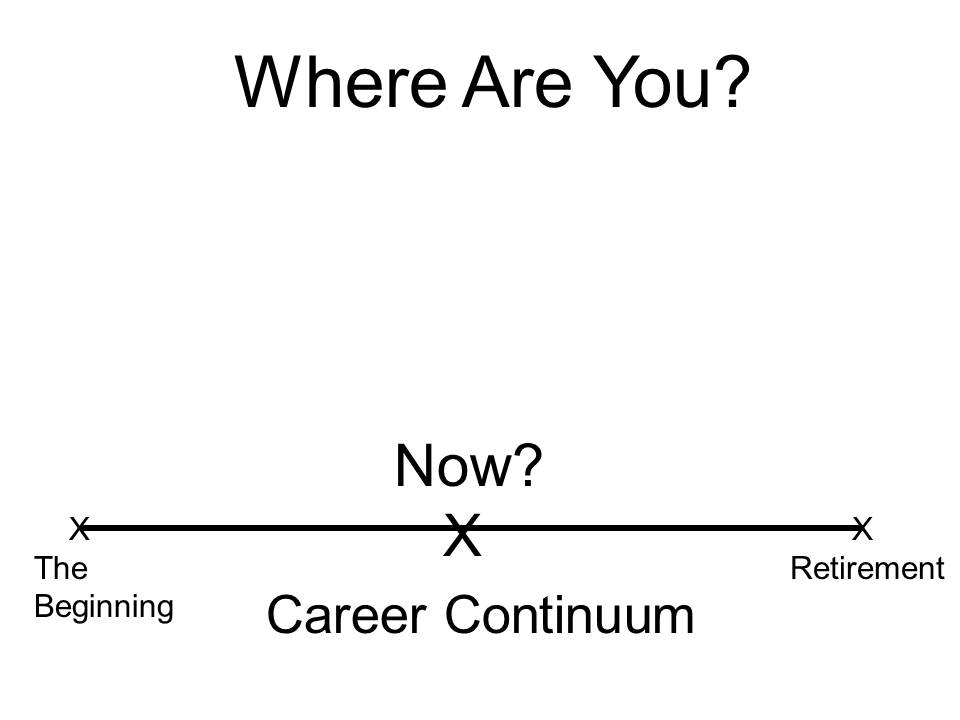
Career Continuum
Career Path

Where are you on the your career continuum?  Where on you compared to where you want to be?  In terms of time–how long have you worked?  How much longer will  you work?  Are you 1/3 done?  Are you 1/2 done?  Between now and what is left, what do you want to accomplish?   As you look at where you are, what do you need to move your career along as fast as you need to in order to get to where you want?

Career Trajectory
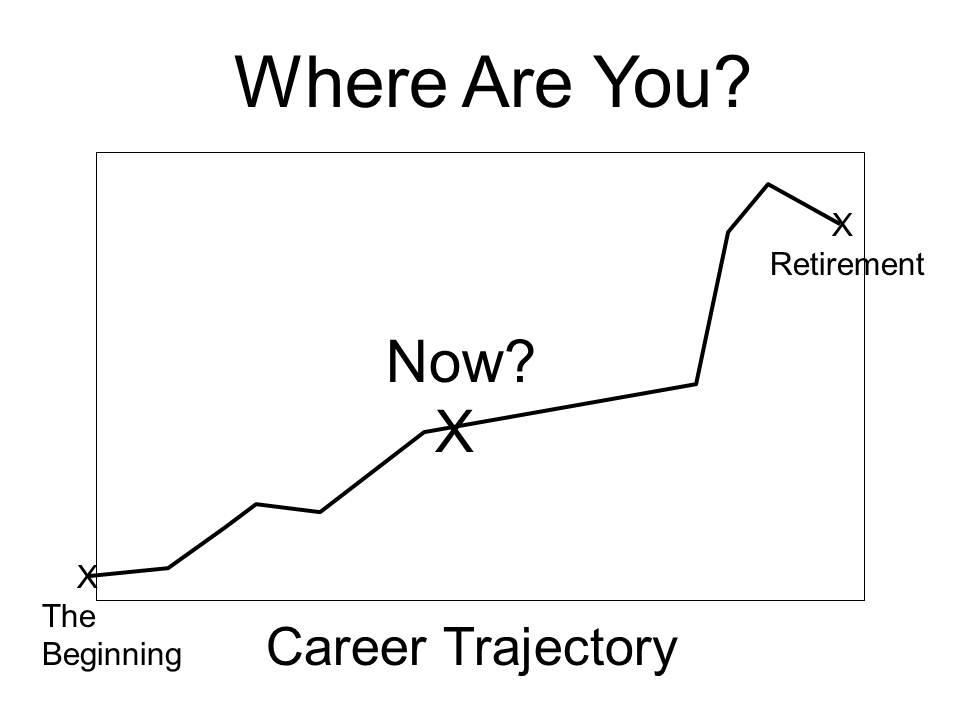
Now look at where you are in terms of what level you want to be?  If you are a Director now, do you want to be C-level?  Do you want to have your own business?  Do you want to move into another field?  Do you want to accelerate how much money you’re making?  Are you moving as fast as you want to? Are you being considered for the types of positions you should be to get to the level you want?

What’s Going On Now?

Look at what’s going on at your current organization WITH CLEAR EYES:

  • Are You Valued?
  • Do You Think Your Company Has the Right  Direction?
  • Do You Trust Your Organization’s Leadership?
  • Are There Growth Opportunities?
  • Is There Enough Challenge?
  • Is This Work What You Thought It Would Be?
  • Do You Fit in the Culture?
  • Is This Meaningful for You?
  • Are You Motivated at Work?
  • Do You Make Enough Money?
  • Is This the Right Work-Life Balance for You?

Depending on the answers, you need to decide whether your current organization is the right place for you to accelerate your trajectory pace.  If not, face it now.  That doesn’t mean you need to move now–it means that you need to get ready to move.  (It took me six years to get ready for my next step beyond an organization I truly loved–but once I saw that I needed to go, my focus changed to the next step rather than continuing to stay in an organization that couldn’t deliver my end-state for me).

Start Working on What it Will Take
Skills Traits Knowledge

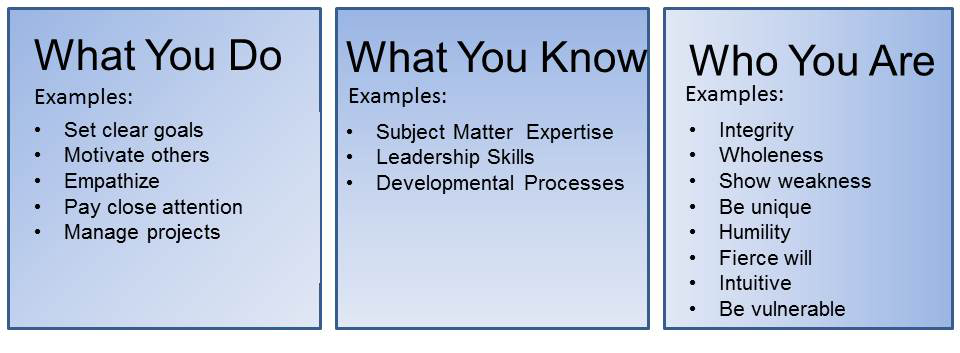
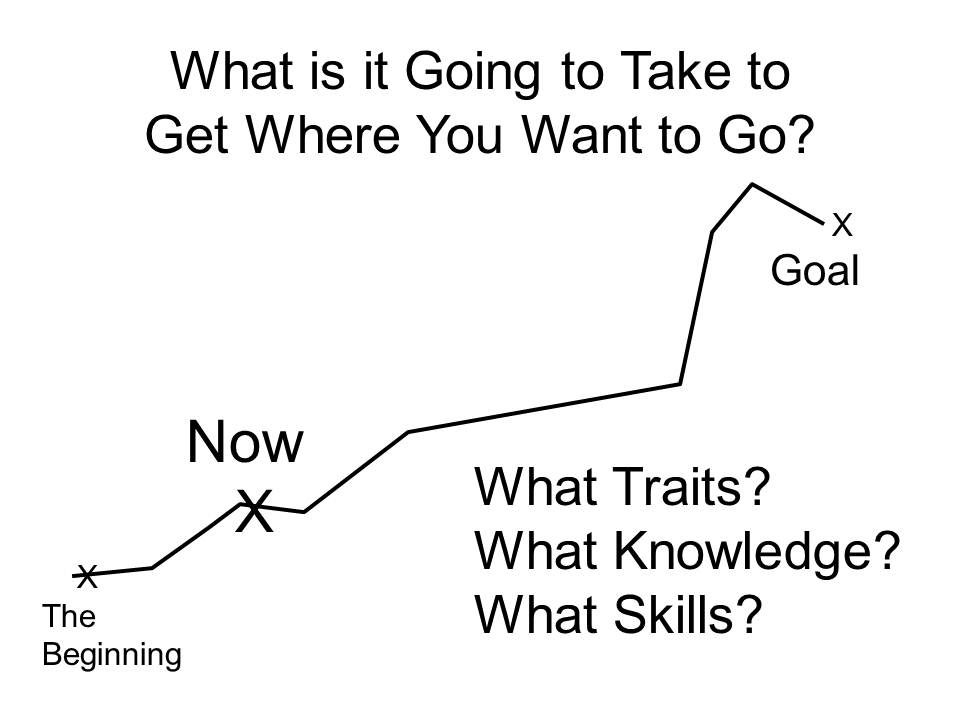
The more specific you can be in understanding what you need to know, do and be in order to reach your goal, the better you can prepare to do it.  If, for example, you are a Director and you want to be C-level, you may need to be much more financially literate than you are now.  You may have to be able to see the big picture better and pull yourself out of your detail focus.  If you are a Project Manger and you want to be a Program Manager, you may need to know how to understand enterprise-level governance of projects and programs.

How Do You Figure This Out?

Look at People Who Do What You Want to Do:

  • What Do They KNOW?
  • What Can They Do?
  • What Are They Like?
  • What is Their “Brand?”

I can rarely persuade people to actually do informational interviews until they are looking for jobs, and usually even then, they are out of a job before they’ll do it.  It is an incredibly helpful tool for a career check-up.  It helps you to understand what it takes to get to the level you want when you talk to people who’ve done it.

  • What do they wish they had known when they were at your level?
  • What is the most important skill at their level?
  • What was hardest to learn/do?
  • What would they do differently?
  • What advice do they have for you?

You walk away with a perspective on what you need to know/do/be.  You are also likely to walk away with an advocate who may start looking out for you.

Create a Project Plan

You know how to do this:

  • Set your goals
  • Identify your critical path tasks
  • Identify the resources
  • Set your timeline
  • Do a kick-off
  • Git-ur-done!

Leave a comment

Filed under Brand Yourself, Career Development, Career Goals, Executive Development, Goal Setting, Personal Change, Success

Get Off Your Butt! DIY Executive Development

I’m going to rant a little

l talk to people all the time who are sitting around waiting for their company to “do something” about their development.  They know that they are talented (and for the most part, the company agrees), they know that they are “hi po” (high potential–recognized by the company as having potential to move up), and they know that they do a good job.  So, why doesn’t the company send them to Executive Development programs, or provide them with developmental opportunities, or generally take an interest and develop them?

There are all kinds of reasons

Maybe the company doesn’t have a well-developed Executive Development system.  Maybe the company doesn’t classify these people as “hi po” enough.  (Lots of companies, maybe most companies, take the view that only the most “hi po” gets developed).  When I ran an Executive Development Program for a company, I found that the “hi po”s who were selected by the ‘deciders’ were all over the place.  Potential is in the eye of the beholder.  You may not fit the profile for hi potential for the person in YOUR management chain who makes the decision.  The company may be trying to develop a certain skill (like innovation) at this time and are picking people who they think have the most potential in that area.  Someone up there may not like you.  There are all kinds of reasons why it is not you, not this year, not at this company.

So What?

So why am I going to rant?  Because I think it’s totally nuts for ANYONE to sit around and wait for your company to develop YOU.  Who cares more about your career and your abilities more than you?  Who wants you to succeed  than you?  How long will you stay at THIS company?  They will develop you for their organizational profile and needs.  Will that make you a fully rounded Executive candidate? Maybe, but probably not.  What one organization believes are the key attributes of leadership is another organization’s rejection list.

Get Off Your Butt and Develop You

Most well run organizations have well thought out Executive Development plans and programs (just because it doesn’t focus on you doesn’t mean that there isn’t a plan).  These programs look at what the organization needs, what it has, and puts in place a plan to hire or develop the necessary skills to take the organization to the next level.  You can do the same thing, with you, and only you, as the hi po being developed.  (this applies to you hi pos who are already “being developed” by your organization—make if faster, or develop skills that are outside the organization’s focus that you know you need).  If you do this right, it could have more impact than an MBA (although it is possible that an MBA is a necessary part of your personal development plan).

After years of helping organizations develop Executive Development programs and of coaching all kinds of individuals, I’ve come up with an outline of what needs to be addressed in Do-It-Yourself Executive Development.

DIY Executive Development

Do-It-Yourself Executive Development

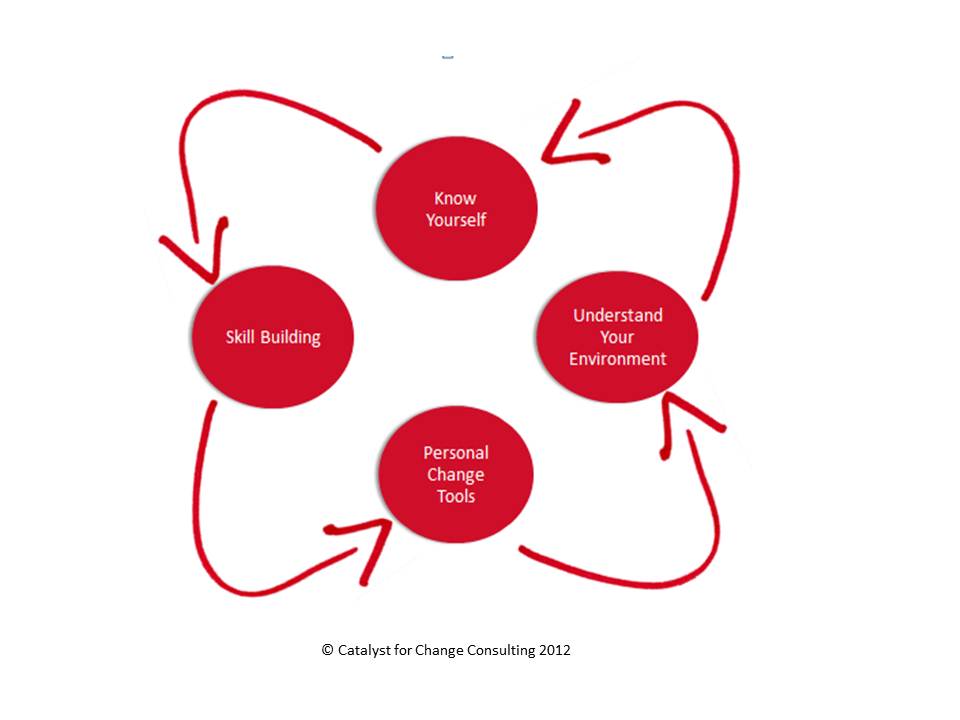
I know the print on the diagram is too small to read, but I wanted you to see how it all fit together.  There are four areas of developmental concentration:  1) Know Yourself, 2) Understand Your Environment, 3) Personal Change Tools and 4) Skill Building.   You can start anywhere—they all support each other.

4 Essentials for Do-It-Yourself Executive Development

The Recipe for DIY Executive Development:

Know Yourself–Understand Your:

  • Motivation
  • Habits
  • Personality
  • Beliefs About How Things Work
  • Strengths/Weaknesses
  • Temperament
  • Flaws (aka Derailers)

Understand Your Environment:

  • What is the Culture?
  • What is Your Fit in that Culture?
  • What is the Power Structure?
  • What Gets Rewarded?
  • What is the Organization Life Cycle Stage?

Personal Change Tools–Understand:

  • Reframing
  • Habits
  • Feedback

Skill Building–Develop:

  • Execution Skills
  • Leadership
  • Financial Acumen
  • Organization Assessment
  • Organizational Political Saavy
  • Personal Brand Management
  • Emotional Intelligence
  • Organizational Change Management

The well-rounded, and highly successful Executive has all of these.  No one is born with all of them; they need to be developed.  If you want to be a successful Executive, stop waiting for your organization to do it.  Get off your butt and start working on developing yourself.  You’ll do a much better job than any organization if you focus on it.

Leave a comment

Filed under Brand Yourself, Career Development, Career Goals, Derailment, Executive Development, Hi Po, Leadership, Personal Change, Recession Proof, Reframe, Success

Take Feedback, Especially Bad Feedback, As a Gift

My “Bad” Feedback

I remember the first time that feedback got my attention.  It didn’t get enough attention, but I kept thinking about it—for a really long time.  My mentor told me, “Well, you didn’t get where you are on your looks or your charm, but on your hard work.”  I took it as a compliment.  And it was, but there was a message underneath that I ignored.  The next time that I got feedback that I should have paid more attention to was a couple of years later, when my CEO said, “You should smile more.”  My reaction was that smiling or not smiling didn’t affect the quality of my work—which in my opinion was quite good.    Let me run that by you again.  My CEO told me that I should smile more and I felt completely justified in totally ignoring his feedback.   Not only could I not see the connection between the quality of my work and how I came across to people (by not smiling), I didn’t even get how ridiculous it was that I was ignoring feedback from my CEO!  Looking back on it, I’m surprised he didn’t fire me on the spot.

Even More “Bad” Feedback

My company had a process that it called “New Manager Assimilation,” that was an onboarding process for new managers.  I moved around the organization quite a bit (usually being selected to go “fix” an organization with process redesign and continuous improvement), and therefore, I went through new Manager Assimilation several times.  I got the same feedback, over and over.  My new employees had difficulty reading me and wanted to know more of what was going through my head.  Again, my reaction was that it wasn’t necessary for them to “read” me.  From my perspective, what they saw was what they got.  I told them that I had 2 speeds: neutral or pissed.  It was clear when I pissed, so they could assume if I wasn’t then everything was OK.  I really thought I was providing them helpful information about me.  In one of my organizations, my direct reports got together and gave me the top knob on a gear shift and told me that they wanted more speeds.  I FINALLY got it.  My failure to be openly expressive made it difficult to work for me.  What was going on in my head was so different from that.  Everything was OK.  I wasn’t mad or unhappy unless I expressed that.  What was in my head didn’t count AT ALL.  People needed me to smile and have open expressions to be comfortable around me.   People assumed the worse when they couldn’t read me.

I heard variations on a theme—lack of charm, smile more, unreadable—repeatedly.  I discounted it.  I didn’t believe it.  I looked at it from inside my head—from my perspective—rather than from the perspective of the people who were giving it.  So I didn’t act on it, until they got my attention with a symbol.  Once I “got” it,  I started acting on it immediately.  It took me a long time, but I finally figured out how to be more openly expressive.  And my job got a lot easier.  I became much more effective.  I got promotions (and raises  :-)).

Feedback is a GiftFeedback as a Gift

Chances are really good that you’ve gotten feedback that is equally important.  Chances are that you discounted it the way I did.  “It doesn’t really matter.”  “It isn’t important in getting my job done.”  OR “I couldn’t get my job done if I weren’t like that/didn’t do that.  You may think that the people who count don’t think that or that the good things you do outweigh the negatives.  This last is probably true.  Until it isn’t true.  At a certain point in your career, the things that have been tolerated become too important/irritating/in-the-way to be tolerated any longer.

This feedback is a gift.  Do yourself a favor.  “Get” that it is a gift earlier than I did.  Remember that the perception of others regarding your performance is probably more important (and probably more accurate) than your own opinion.  Sure you have to be confident and believe in yourself.  BUT you also have to be open to feedback and able to change your behavior to be more effective.

What Do You Do?

First, think about the patterns.  What have you heard repeatedly?  Think about why it keeps coming up.  Think also about what your reaction is to the feedback.  If you blow it off or make excuses about it, pay especially close attention to that.

Second, think about what you would do if it is accurate and you need to change.  Even if you don’t think it’s important or accurate—what would you do.  What would you change? How would you change?  Try little changes (they’re easier).  Experiment.

Finally, get more feedback.  Ask people you trust about their opinion.  Don’t ask them if it’s important or right; ask them if they can see why people say what they do.  Have them explain it to you.  DO NOT ARGUE!!! Feedback is a GIFT!   When someone gives you a gift you don’t tell them why blue is the wrong color.  You thank them.  Ask questions.  Make yourself pay attention and stop thinking about why it’s wrong.

Then go away and think about it.  Repeat the second step above.  Then repeat again.

2 Comments

Filed under Career Development, Communication, Derailment, Personal Change

Don’t Take Your Needs to Work

Basics/Needs/Wants

My first exposure to the idea of how my needs impacted my career came from Laura Berman Fortgang’s book, Take Yourself to the Top. Fortgang divides things into basics/needs/wants.  Most of us can tell what the basics are–enough food, housing, warmth, safety.  Most of us also can tell the “wants”–house at the beach, Thunder season tickets, designer wardrobe, fill-in-the-blanks.  It gets tricky when we are dealing with needs.  Needs are sometimes disguised wants, but more often, they are buried in our subconscious–we don’t even recognize them when they are running our lives.

Examples

The kind of needs I’m talking about are those that start in early childhood–usually because of deprivation or mistreatment–and drive our behavior for the rest of our lives.  Someone very close to me grew up incredibly poor and without things that practically everyone has–things like soap, combs, jelly, sufficient clothes, or coats.  Her need was to never feel deprived again.  She accumulated stuff to prevent the feeling of deprivation.  It drove her whole life.

Some have the need to be appreciated.  Some have the need to be respected.  Some have the need to be treated fairly.  Some need to be right.  You get the idea.  These needs are all wrapped up in our self-worth.  If you don’t respect me, then you have shaken the very foundations of my belief in myself.  When this happens at work, then you are behaving like the same five-year-old who initially developed this need.  You probably aren’t aware that you are acting like a five-year-old.  You probably feel completely righteous in your reaction.  You won’t stop talking about it.  You tell your co-workers how wronged you are, and they probably are somewhat intimidated by your level of emotion.  They may or may not agree with you, but they are reluctant to challenge you because of how you are coming across about it.

This happens all the time.  It happens to pretty much everyone.  The way you can recognize it is by how upset you are.  How driven you are to fix it.  How much you talk about it.  How much you think about it. These needs are legitimate.  You came by them legitimately.  My friend who was so deprived in her childhood was trying to protect herself from ever feeling that horrible again.  But you need to get your needs out of your work.  They will do much more damage than it is worth.  People will think you’re completely irrational about weird stuff.  They will not be able to connect the dots between your behavior that they see and your need that you are trying to address and whatever happened to you that created that need.

What Do You Do?

So, what do you do?  Think back.  Think of times when even you could tell you were being irrational.  What was driving it?  Are there patterns?  Same reaction to similar situations?  Same reaction to similar people?  Figure out which needs are driving you (literally) crazy.  Try to reason with yourself (this isn’t usually all that successful).  Point out to yourself that that was then (when you were 5) and this is now (when you are an adult who really shouldn’t care if your GenY employee isn’t respecting you as much as you think she should).  If trying to talk yourself out of it doesn’t work, don’t give up, but there is a Plan B.

irrational at workWhen you feel yourself getting irrational (ok, not irrational–incredibly irritated), try to think of another way that you can get this need met OUTSIDE OF WORK.  Where can you be respected that matters more?  Church?  Home? Professional group?  Who appreciates you who matters more than people at work?  Can’t you go tell someone else you were right without rubbing your peer’s face in it?

Why Should You Go To That Much Trouble?

Because it really does have a negative impact on your career.  When you are being driven by things that are outside your conscious awareness, then you aren’t really in control.  When you aren’t in control, then you will do something that looks stupid to people who can make decisions about your future.  So, get your needs away from your work.

Leave a comment

Filed under Books, Career Development, Executive Development, Personal Change, Reframe, Success, Uncategorized

Dealing with A**holes

For some reason I’ve talked to a lot of people in the last couple of weeks who were having problems with people in their lives—mostly at work.  The problem when you have to deal with people who are difficult is that you have to keep dealing with them.  It is the rare workplace that offers the perk of being able to trade out your coworkers on a whim.  So how do you deal with the jerks?

It’s a Relationship

First of all, hard as it is, you’ve got to stop blaming the other person (EVEN IF IT IS ALL HIS FAULT).  You can’t make real progress at making the situation better if you think it is all the other person’s fault.  It is a relationship.  A relationship by definition is between (at least) two people.   If you are one of those people, you can do things that will affect the interactions between the two of you.   As long as you are in the frame of mind that it is entirely the other person, you are unlikely to be open to trying some of the things that I suggest.   A good book on the subject is Barry Duncan and Joe Rock’s  Overcoming Relationship ImpassesDuncan and Rock’s premise is that if you stop reacting in the same pattern to the same situation, you will disrupt the normal interactions and allow a new interaction/reaction to happen that can make things better.  For example, when the person starts once again with  the list of all the things you do wrong, if, instead of defending, you say something like, “you’re right, it must be difficult to deal with someone who you think can’t do anything right,” the other person has no place to go next. He shuts up or says something like, “I don’t think you do EVERYTHING wrong.”

The Relationship is Half You

Ask yourself what you are doing to contribute to what is wrong with the relationship.  What are you doing to improve the relationship?  Before you get all exasperated with me (because it is all the other person’s fault), remember that you only have one tool to make this better—your behavior.  You can’t directly control the other person’s thoughts or behaviors, so you can only use your own behavior to make a change.  You are the instrument of change here.   

Why Does This Person Drive You Crazy?

So, let’s start with trying to figure out with why this person drives you so batty.  Ok, yeah, I know he’s an a**hole, but I know that you’ve dealt with other a**holes in your life.  What is it about this one that is so bad?

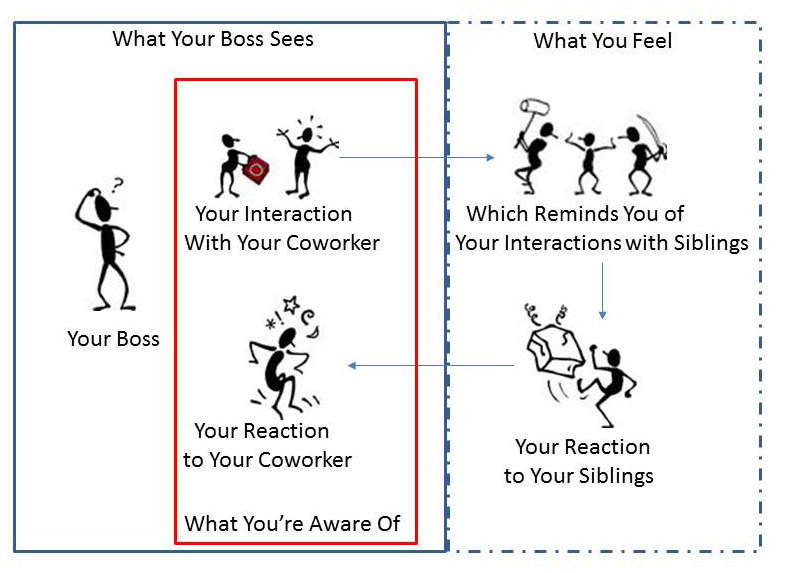
  1. Who does this person remind you of?  Your brother?  Your father?  Your ex?
  2. Which of this person’s behaviors is so bad?  His micro-managing?  His criticism?  His inability to make a decision?
  3. Is there a time or a place that is worse?  In meetings?  In one-on-ones? When so-and-so is present?
  4. Are there things that happen first, before you get the urge to run screaming from the room?

If you look at the answers to these questions, can you see anything that you can change to reduce the angst that you encounter in dealing with this person?  Can you not have one-on-one meetings? Can you not have meetings that include the person who makes it worse?  Can you talk yourself out of the insight that this person is just like your big brother who made your life a living hell for eleven years?  What change(s) can you make, either to the circumstances of spending time with this person or to your thinking that makes this person easier to deal with?

Why Do You Drive Him Nuts?

Let’s look at it the other way.  What is it about you that drives him nuts?  Can you spot a specific situation that seems to make it worse for him?  Do you remind him of someone?  Can you spot a particular behavior of yours that seems to set things off?  Can you do something to change any of this?

What is he trying to accomplish?  There is a great book, Dealing with People You Can’t Stand, by Brinkman and Kirschner,  that describes common difficult people as

  1. The Tank (pushy, ruthless, loud and forceful)
  2. The Sniper (identifies your weaknesses and uses them against you)
  3. The Know-It-All (knows 98% of anything)
  4. The Grenade (when they blow their top, shrapnel hits everyone in range)
  5. The Yes Person (quick to agree, slow to deliver)
  6. The Maybe Person (keep putting off crucial decisions until it’s too late)
  7. The Nothing Person (no verbal feedback)
  8. The No Person (doleful and discouraging)
  9. The Whiner (there’s a plan for their lives and they’re not in it)

Recognize your a**hole in any of these? Each of these types of people is trying to accomplish something with their behavior.  In other words, there is a REASON they are the way they are.  The authors say that this is what these types are trying to accomplish:

  1. GET IT DONE:  The Tank, The Sniper, and The Know-It-All
  2. GET APPRECIATED:  The Grenade, Sniper, The Know-It-All
  3. GET ALONG: The Yes Person, The Maybe Person, The Nothing Person
  4. DO IT RIGHT: The No Person, The Whiner, The Nothing Person

(for quick description of this, see http://www.rickbrinkman.com/dealingwithpeople/ftp/dr_brinkman-color-lens.pdf )

If you help them with what they’re trying to accomplish, then they don’t have to use so much of their “difficult behaviors” to accomplish it.  I know that this is hard to do.  If it were easy, then none of us would experience the “a**hole people in our lives.  Just because they are there, though, doesn’t mean that YOU can’t deal with them.

REFRAME

Finally, use my most reliable tactic—reframe the situation.  Figure out a way to “see” the a**hole in a different way that allows you to interact differently with him.  He’s a customer, or she’s someone’s grandmother, or he’s an alien. The effort that it takes to deal with these folks can help distract you from the difficulty.   Whatever it takes.

4 Comments

Filed under Books, Career Development, Communication, Executive Development, Personal Change, Reframe

Can You Really Earn a Living Doing What You Love?

Do What You Love The Money Will FollowDo What You Love, The Money Will Follow

You hear it all the time.  “Do what you love and the money will follow?” But is it true?  I’d have to say, “Kind of.”  When you are working doing things you love, then it really isn’t work.  It all flows.  You forget what time it is.  You have all the energy you need.  The problems are interesting instead of overwhelming.  At the same time, there are lots of things that people love to do that aren’t easy to earn a living doing.  Golf.  Reading.  Collecting.  Gardening.  Eating.

If you’re like me, as you read the above list, you can think of ways to make a living doing those things.  If you extend these things beyond to related things, there are even  more ways to make a living from them. Lots of ways.  The thing is that we want to make LOTS of money doing things we love.  We want to just do what we love and have a business magically sprout around us.  It doesn’t work that way.  So, if you’re thinking about it that way, then, no, you can’t.

You Have to Work to Do What You Love

It still takes work to do what you love and earn a living from it.  Take me, for instance.  I do what I love.  I coach people to achieve their dreams.  I consult with companies to improve their performance.  I LOVE doing these things.  BUT . . .  I also have to do marketing, proposals, hustle for business.  I don’t particularly enjoy those things.  They are necessary in order for me to be able to do the things that I love.  And because they enable the things that I love, they aren’t as bad as they would be otherwise.

I had to do a lot of work to be able to know how to do the things that I love.  I had to learn, practice and deliver while working for companies–a.k.a. jobs.  I worked at jobs like all the other people who supposedly are earning a living not doing what they love.  A major difference was that I was learning in order to do what I wanted.  I thought of it that way.  That made it easier.  I was working toward doing what I loved.  And because it was going to enable the things that I loved, it wasn’t as bad as it would be otherwise.  Knowing that I was working toward doing what I loved gave me a lot of energy to keep doing it.

Figure Out What You Love

Maybe the hardest thing is to figure out what you love, and then to figure out how to make a living doing it.  If you love quilting, for instance, you can quilt (to earn a living doing this, you either have to make very good quilts that people will pay a lot for, or you need to make lots of quilts (get a quilting machine)).  Or you could have a online quilting auction service.  Or you could have a business that sells quilting tools or supplies.  Or you could design fabric.  Or you could write about quilts.  Or you could take quilt pictures.  Or you could develop  and deliver quilt training.   Or . . . you get the point.

You can love working for a company.  Lots of people do.  You don’t necessarily love working for all companies, but working for some can prepare you to work for the one you love.  It may be a certain kind of company that you love–a restaurant or a trading company– or it may be a particular role in a company that you love.  Whatever works for you.

The way I figured out what I loved was to evaluate all the parts of the jobs that I had really enjoyed–in my case, teaching, figuring out how to fix parts of organizations, presenting, advising–and to figure out what “job” that was.  I had never thought of being a consultant until I went through this process. Once I figured it out, though, the rest was easy.  What skills did I need to be able to do it?  How could I learn them? What was my timeframe?

Not Magic, But Worth It

There was nothing magic about it.  Money didn’t instantly appear.  I had so much fun, though, that it didn’t really matter.  The problems were interesting, not insurmountable.  Doing what I loved helped me pick myself up after setbacks and keep going.  The more I learned, the more fun I was having.

So, yes, you can earn a living doing what you love.  You just have to work at it.

Leave a comment

Filed under Career Development, Career Goals, Executive Development, Goal Setting, Personal Change, Success

Keeping Up

Why Should I Care?

I talk to people who want to get promoted.  I talk to people who just lost their job.  I talk to people who want to go work for a cool company they know about.  I talk to people who want to start their own company.  If you are one of these people, or if you might become one of these people, then you need to keep up.

WinningKeep Up With What?

You need to focus on staying on top of the latest:

  • technology
  • social media
  • trends in your (and other adjacent) industry(ies)
  • issues in the market place
  • political undercurrent in your own organization
  • gurus in your field
  • books in your industry/field

It absolutely isn’t enough to show up and do your job.  The way things work now, that makes you vulnerable to the next layoff, the next new boss, your company going out of business.  The fact that you did your job just fine for 5, 10, 15, 20 years does not put you in good stead for the next step.  And it is highly unlikely that your next step isn’t the one you expect.  Without the most current skills, you are likely to have to take a demotion for the next position.

For example, if you think you are proficient at Microsoft Office, you aren’t if you don’t know your way around Sharepoint (and not just as an occasional end-user).  If you are a Project Manager, if you’re not conversant with Organization Change Management, Lean Methodologies and Scrum, then you aren’t competitive.  If you are a second level manager and you don’t know how to use social media (at your company) to lead your people, or how to develop and implement a strategy, how to measure and analyze your processes and implement changes, then you’re not keeping up.  If you are a Director, you need to know how to think like a V.P., how to dismantle and start up an organization, and how to manage your peers.  If you are a V.P., you need to understand the dynamics of managing a Board, how to analyze business opportunities, including whether to purchase a company or compete with it.  You need to think and learn beyond your job, your role and your company.

Look at job postings in your field.  Do you exceed what they are looking for?  On paper?  If you don’t, you will not even get an interview.  You won’t have the opportunity to tell them how great you are, because they will put you in the ‘delete’ file.   Be honest with yourself.  Don’t fudge.  If you don’t EXCEED the qualifications they are looking for, you will have a long job search and you will probably have to take a demotion in your next position.

Of the people I talk to, the biggest failure to keep up is technology-related.  People tend to stick with what they’ve learned to use and not push themselves beyond to the new technologies.  For instance, lots of companies are now using iPads for providing their sales people with training, marketing materials and sales tools.  Could you do that?  I’m not talking about the programming, but about creating the materials that work on the iPad (they’re not the same that work on paper). The way that sales training and interactions are done are frequently the harbinger for the rest of the organization.  Are you listening HR? IT? Manufacturing?  Are you comfortable with (and continuing to be current with) all the tools that facilitate virtual team management.  If you had to do it on your own tomorrow, could you?

#Winning

If you have ‘bleeding edge’ skills in your field, then you are an asset to your company.  If you use your company’s problems and tools to develop your ‘bleeding edge’ skills, then you benefit.  It is a symbiotic relationship.  It is win/win. Don’t be vulnerable.  Start “keeping up” before you need it.  It’s hard to do at that point.

2 Comments

Filed under Career Development, Executive Development, Personal Change, Recession Proof, Success, Uncategorized

Lead from where you are

Tops, Middles, Bottoms

Are you the same kind of leader at work that you are at home? at church? with your friends?  If you’re like most people, probably not.  Why is that?  Most people have a picture of the “power structure” at work that influences the way they behave.  This picture is remarkably the same for almost everyone.

Our picture:  The people at the “top” tell everyone what to do, the people in the “middle” try to get the people at the “bottom” to do what the “top”wants, while struggling to get the “top” be clear about what it is that they want.

Sound familiar?  There is a interactive exercise developed by Barry Oshry and documented in his book, Seeing Systems, Understanding the Mysteries of Organizational Life, in which people at all levels of the organization, when assigned to be a “top,” “middle” or “bottom,” play out this power structure role–even though they have a different role (and behave differently) in their own organization.  It’s as if you put a group of people in a room and told them all that they were 5th graders–and they started acting like it!

This  “picture” of the way things (should) work  exists in most organizations, across organization boundaries, global cultures, and all organization sizes.  The behaviors that go with these unconscious roles hold us all back.  It makes the organization slow.  If we accept these roles, it’s hard to get be excellent–organizationally or PERSONALLY.

Step Up, Step Out

LeadFfrom Where You Are

If you don’t step up and step out, if you go along with the “way they do it,” then you aren’t standing out.  People frequently err on the side of getting along and not challenging the status quo.  How does that help the organization?  How does it help your career?  (It’s easier for managers to lay off the ones who’ve never been exceptional–solid and steady doesn’t get you very far for very long any more.)

I realize that I’m saying that you should take risks.  Yep.  And it’s really hard to take risks.  Yep. So start with little risks.  Instead of waiting till someone tells you what to do, figure out what you think should happen?  If you were “king” of the company, what would you have happen?  Just figure it out.   What’s the worst thing that can happen if you did it?  What would you do if that happened.  What’s the best that could happen? Start with thinking it out.  Turn off your “going-along” thinking and be proactive about solutions.

Just Do It

There is a reason that “It’s better to ask forgiveness than to ask permission,” is so popular in organizations.  It’s mostly true.  My first, and for me, probably the most important, Executive, used to say over and over, “Make a decision.  It is easier to fix a bad decision than to fix the damage from not doing anything.  There are almost always several “right” decisions for every business problem–pick one and DECIDE.”  I had already heard this mantra several times in the first three months that I worked for this guy before my first one-on-one with him.  I had spent these first three months researching the details of a very serious problem and I was presenting the results of my research to him in this meeting.  Looking back, I can’t believe how naive and unaware of organizational politics I was.  My boss sent me to this meeting, fully knowing how bad it was, alone.  I was about 15 minutes into the details when he stood up, looked at me and said, “You’ve made me sick at my stomach,” and he walked out.   I was shocked.  I sat there.  I thought he was coming back.  He didn’t.  I waited probably 20 minutes and got up and left.  I didn’t know what to do.

I waited about a week.  I tried to figure out what to do.  My boss was on vacation.  I thought about the Exec’s  mantra, “Make a decision.”  This one wasn’t mine to make–it was his (or above).  But I needed to figure out how to get him to make it.  I walked into his office and asked when he wanted to finish our meeting.  He looked at me, and said, “I don’t want to, but I guess we better.”  We rescheduled and he listened to me all the way through.  At the end of the meeting, he told me to figure out how much money it would take to fix it.  When I did, he had me present to the entire Executive team and he persuaded them to fund it (it was several million dollars).  I had a leadership role in implementing the fixes–way beyond my original job.  I’m pretty sure that I wouldn’t have had a role in it if I hadn’t walked into his office and pushed him for another meeting.  I am sure the project would have happened eventually,  later and without me.

It was a powerful lesson.  I think if I had been in the organization longer, I would have adopted the “power structure picture,” and wouldn’t have done it.  I would have waited for my boss to do it.  Or whoever.  I wouldn’t have learned the lesson that helped shape my career.

2 Comments

Filed under Books, Career Development, Executive Development, Leadership, Personal Change, Reframe

Fail. Fail. Fail.

Failing Isn’t Fun.

I really, really to hate to fail.  In fact, I hate it so much that I rarely admit that I failed when I do–it’s not that I lie about it–I just don’t even admit to myself.  So why does every guru on leadership say that failing is good?  I had the opportunity to watch lots of kids this weekend–kids of all ages.  They “fail” all the time.  They try something, it doesn’t work, they try again, or they walk away and try something else.  Sometimes they get upset, sometimes they get hurt, but they pretty much pick themselves up and keep trying.  They don’t usually see it as “failure.”  They just see it as a part of living.

Imagine if they were so afraid of failure that they didn’t try.  What if they didn’t learn to walk because they would fall down.  What if they didn’t learn to read because they wouldn’t be able to figure out all the words.  The way they keep going in the face of what we adults would see as “failure” is an important lesson for us.  Some time around late elementary school or middle school, kids start to stress about failing and start to be afraid of trying.  By the time we’re adults, we’ve got that lesson well-learned.

Failure Is A Step

The flip side of failure, though, is that without it, you don’t get better.  Even if we succeed we don’t do it as well as if we fail first and try again.  If I spend my time obsessing about how I failed at something, rather than treating it like a baby treats a fall–that way didn’t work, maybe the next way will–then my forward movement becomes a loop at best.  One of my favorite quotes is from Thomas Edison, “I have not failed. I’ve just found 10,000 ways that won’t work.”

There are LOTS of books on the benefits of failure:  Fail Forward; Celebrating Failure, The Power of Failure, Great Failures of the Extremely Successful Adapt: Why Success Always Starts With Failure, to name just the ones I’ve read in the last two years.  So, I  get why failure is critical.  The problem is the way we look at it.  Failure isn’t an event.  To quote Edison again,  “I am not discouraged, because every wrong attempt discarded is another step forward.”  Failure is a step.

Try, Try, Try

So, remember the way a kid thinks: Try. Try. Try.

4 Comments

Filed under Books, Executive Development, Leadership, Personal Change, Reframe, Success

It’s the End of First Quarter. How Are Your Resolutions?

Most of Us Make Resolutions

The website, The Statistical Brain, says that 45% of us make New Year’s Resolutions and 8% of us succeed with them.  Thirty nine percent of folks in their twenties succeed, compared to fourteen percent of folks over age fifty.  (Now what is that about?)  The bottom line, lots of us make resolutions and few of us manage to succeed at them.  I’m not going to go into all the reasons this is true, but I will give you some tips on how to keep working on them (if you still are), or how to start again if you’ve already given up.

New Years Resolutions

Pick One

Look at your resolutions.  If you have more than one, pick the MOST important one.  If you only did one this year, which should it be?  If you’re anything like me, then many of your resolutions are inter-related.  That’s ok–one is still more important, or more foundational than the rest.   Now, in order to accomplish that resolution, what is the first step?  The VERY first step?  When are you going to do that?  Be specific.  VERY specific.

Write It Down

Use a journal.  Write down the goal.  Write down the steps.  Write down the dates.  Now, write down what it’s going to be like when you have accomplished it.  Specifically.  VERY specifically.  How will you feel?  Who will be happy?  How will things be better?  When will you be able to start on your next resolution because you finished the first one?  Write it all again.  And again.  Write it till it isn’t writing about the future, but it feels like the present.  Write it till you are so familiar with it that it feels uncomfortable because what you’re writing hasn’t happened yet. Write it.  Write it. Write it.  Write it every day.

Change

In his new book, The Power of Habit, Charles Duhigg says that about two-thirds of our behaviors are based on habit.  Our morning routine, our drive to work, our morning email, internet usage, our interactions with our co-workers, and on and on and on.  There is a good reason for this.  It is how our brain economizes–it routinizes what it knows and can then use the brain power on other things.  I do my best thinking when I’m driving.  Just think–if I had to pay as much attention to driving as I did when I was sixteen–what tremendous thinking would be lost:-)  The bad news is that in order to acquire a new habit (and succeed with a resolution), you have to overwrite the old habit, one that the brain has efficiently and effectively turned into rote behavior.

In order to create a new habit, you need a cue–a signal to your subconscious that you’re about to perform the new habit.  Example:  Resolution is exercise; running is exercise of choice; cue is putting on running clothes as soon as you get up; new habit is run first thing in the morning.  Then you need a reward.  It actually doesn’t have to be much, just something that feels good after you perform the new habit.  Listening to your favorite song.  A small glass of your favorite juice.  Something.  Every time.

Dubigg says that when a habit is formed, the brain stops participating fully in the decision-making.  So, you need to put the brain back into the decision-making as you extinguish the old habit and take it back out when the new habit is established.  There is evidence via MRIs that different parts of the brain fire as old habits (and brain patterns) are replaced with new.

The Power of Habit is the best book I’ve read so far this year.  I highly recommend it.

Get to work on those resolutions!

4 Comments

Filed under Books, Career Development, Career Goals, Executive Development, Goal Setting, Personal Change, Success