Tag Archives: personal change

Are You A Wannabe?

Are you an Executive wannabe?  An entrepreneur wannabe?  An artist wannabe? A marathoner wannabe? An author wannabe?  Do you put one of those on your New Year’s Resolutions list?  How about your career goals list?

What Is Stopping You?

Look at last week’s calendar.  Look at last month’s calendar.  Is your ‘wannabe’ goal anywhere on your calendar?  If not, why not?  How can you possibly accomplish your goal if you’re not spending any time on it?  Don’t tell me you don’t have time.  People who really want to do something have time.  Every successful accomplished person who has done what you want to do has EXACTLY the same amount of time that you do.  It comes down to six things:

  • Priority:  If this is your future, then you need to put it sufficiently up your priority list that you are spending time on it
  • Motivation:  Understand what motivates you and put that in your life.
  • Focus: You CANNOT do it all (at once).  Turn off the TV.  Stop surfing the Internet.  Stop texting.  Take yourself to some place quiet and isolated.
  • Determination:  Keep working toward your goal, no matter what gets in the way.
  • Create whatever support infrastructure you need.  If you need training, get it.  If you need a coach, get one.  If you need a place, find one.
  • Action:  I hate to be repetitive, but JUST DO IT

Winning

So, How Do You Do That?

  • Write it down.  Be very specific.  Not ‘Write a book’ but ‘Write a novel, get a book contract, and get it published by this time next year.
  • Once you’ve written the specific goal, work backwards.  In order to write a novel, get a book contract and get it published, what do you have to do?  In order to do those things, what do you have to do?  Ask what you have to do and detail it several times.
  • Once you have a fairly detailed list, decide what you are going to do tomorrow.  What are you going to do this week.  Look at your calendar and put these tasks on it.  Take something off your calendar to make room for it, if you have to.
  • What reward will you give yourself for which accomplishments.  It doesn’t have to be something big–just something that you will associate in your mind with accomplishing the task.
  • What are the big milestones in your plan?  How will you reward yourself for these big milestones?
  • Hold yourself accountable.  Tell someone–that makes it harder to escape the accountability.

Great books to help with this:

1 Comment

Filed under Books, Career Development, Career Goals, Goal Setting, Personal Change, Time Management

Not Your Mad Men Career Ladder

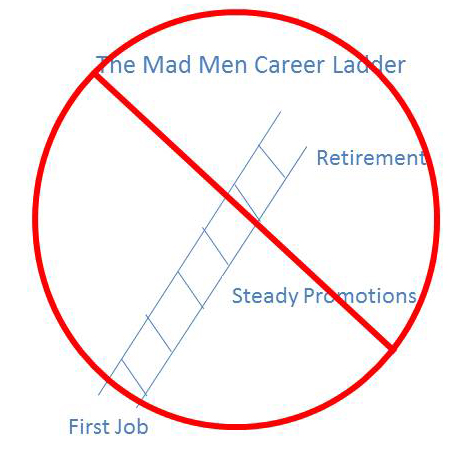
Way back, before most of us were working, you got a job with a company and you stayed with that company–making steady progression–until you retired.  You were, of course, a man.  If you got fired, you had done something pretty bad.  Layoffs didn’t happen very often.  There were career ladders that you took all the way from your first position to your last position.

traditional career ladder is no more

This is so long ago that many people reading this don’t get it, don’t know why we still talk about it, and think this is a no-brainer.  We still talk about it because this model still shapes our expectations in many ways.  Our infrastructure is not set up to support the current reality–if so, we’d have portable health insurance and retirement plans.  We’d also be much more focused on taking care of ourselves in our careers rather than leaving it to companies.  It is time for our mental models to catch up with reality.

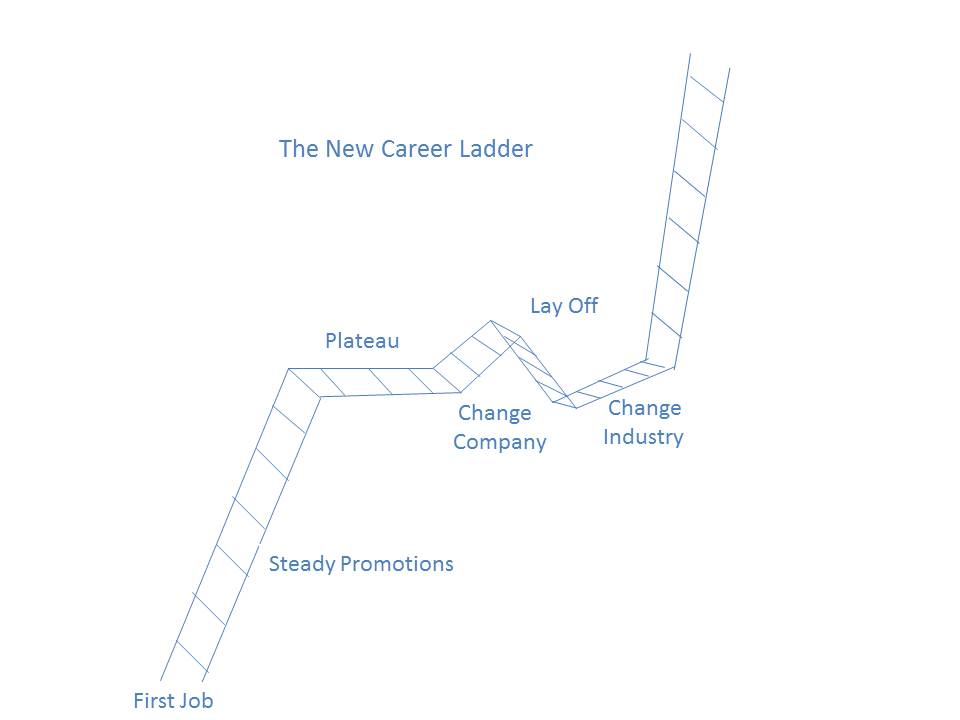
The current ‘career ladder’ looks a lot more like those cool folding ladders that can be shaped over obstructions and can bend in several directions as necessary to do the job.

todays career ladder

The current ‘career ladder’ takes you up when that is possible and helps you deal with the plateaus, job losses, industry and functional changes that are necessary to remain resilient and successful in today’s economy.  Today’s ‘career ladder’ needs to focus on skills and trends rather than specific roles in specific companies in specific industries.  Find ways to “Genericize Yourself,” that enable you to move across industries.  Find ways to specialize (I know, those sound like opposite pieces of advice, but they aren’t), so that your value (brand) is obvious.  Build your resilience for all kinds of shifts in the economy–think of the shifts that have happened in publishing, electronics, e-marketing, and are happening in health care and communications now.  You can’t know what is coming, but you can be ready.

Leave a comment

Filed under Brand Yourself, Career Development, Executive Development, Job Hunt, Recession Proof, Success

Manage Your Resistance

Manage Your Resistance

Put Your Leader Hat On

Who would you rather work with if you’re implementing a new change in your organization?  Would you rather work with someone who has been there for ten years–who knows his/her way around the organization, who knows how to make things happen in the organization?  Or would you rather have someone who has been there a couple of months, who has begun to know where the bathroom is and where important people sit?

The ten-year guy, right?

Wrong!

Why is that? Because the ten-year person is really committed to the way things are–‘the way we do it.’  Even if s/he doesn’t like it.  Even if s/he complains about it.  The ten-year person has been through all the ‘we tried that and it didn’t works,’ all the times s/he had to be reorganized or was left to do the work of those who left, who had to learn new systems, and who may or may not remember the good parts (results) of those changes, but who does remember the problems.  The ten-year person doesn’t want any more change (unless s/he gets to direct it).

The new person not only doesn’t have that history, or those scars, but also EXPECTS to have to go through those kinds of changes and challenges.  The new person follows directions and tries to please whoever is in charge.

Now, Which Are You?

Are you the new person who is emotionally and intellectually ready to not only participate, but also to help?  Or are you the long-term employee who isn’t?  You may be telling yourself that you are change-ready.  And maybe you are.  But change burnout, or change immunity, happens to all of us.  Yes . . . even me.

I’ve been doing change management for a long time.  I really know how to spot resistance and how to deal with it.  I got a new boss one time, after having changed bosses 3 times in the past 12 months.  I didn’t even realize how done with new bosses I was.  That is, I didn’t realize it until one of my employees said to me, “For someone who knows so much about change, you sure don’t handle it very well.”  She was right.  I wasn’t handling it well.  My capacity to deal with change had been used up and I was on the resistance end of the continuum.  My employee did me a favor.  I didn’t really realize how much my fed-up-ness was showing until she said that.

Wouldn’t it be a good idea to put yourself in that new employee mindset?  Wouldn’t it be a good idea to try to think like someone new to the organization (while at the same time bringing all your organization skill, knowledge and abilities to the table)?  Whenever I become aware that I’m in ‘resisting’ mode, I remind myself–if I had just started today, I wouldn’t think about all the reasons this is a stupid idea–I would just accept it and do it.

Try it.  It helps.

Note:  I am not saying that you should blindly follow without contributing opinions and constructive criticism.  Just be sure that that is what you’re doing though, and not resistance.  Resistance is a normal reaction, but it isn’t helpful to your career, so learn to manage it.

2 Comments

Filed under Career Development, Executive Development, Leadership, Success

Promoted! Now What?

success at work

Congratulations!  You just got promoted.  Or you just got reorganized into a new department.  Or you just got a new boss.  How do you make this a step in the right direction and keep from crashing and burning.  Ok, crashing and burning is unlikely–you did persuade someone that you deserved the promotion.  Getting stuck is a possibility.  Looking like you weren’t ready is a possibility.  Not making a great impression is definitely a possibility.  So, what do you do?

It’s a New Job

One of the most important things to do is to understand that this is a NEW job.  Treat it as if you just got to a new company.  Look at the experience through new eyes.  Who are the people?  What is the power structure?  What does the company need to be successful.  What does the department need to accomplish in the short term?  In the long term? What does the department need from you to be successful?  Go talk to people as if you’re meeting them for the first time.  What is important to them? What are their goals? How can you hit the ground running?  How can you quickly show that choosing you was the right choice?

There is a subtle difference for most of us when we change jobs within the company and when we change companies.  When we go to a new organization, we are completely aware that we don’t know everything.  We have our hyper-alert antenna out.  We are in the “conscious unconscious” state of learning.  We are aware of all the things that are different from our last experience (although we frequently miss things because of our ‘old company’ mindset).  When we change jobs within the same organization, we think we know how it is.  We know a lot of the people (although through the eyes of the last group we were in), we know the business (ditto), we know the problems, challenges, opportunities (ditto, ditto, ditto).  The problem is, the new job within the same organization is just as new as the other.  If you put yourself in the same hyper-alert state, you are much more likely to be highly successful.  You are much more likely to impress, because people will see you differently (than they had before) too.

First Impressions

Remember that although people may know you (some may even have been your peers before your promotion), you still have the opportunity to make a ‘new’ first impression.  If you are really trying to make a good impression, you’re likely to get attention again.  Make sure it’s the right impression.  Make sure you don’t come across as arrogant or smug (especially to your former peers).  Make sure you come across as smart and interested and capable and willing.  Make sure that people see results QUICKLY.  The best way to do all of this is to treat the promotion as if it were a new job at a new company.

Helpful Books

Congratulations!  And good luck.

2 Comments

Filed under Books, Career Development, Executive Development, Leadership, Reframe, Success

Appreciate What You’ve Got

This is all going to end.

I know this doesn’t come as news to most of you, but everything we have is quite transient.  Possessions (think hurricane/fire/tornado), health, and even life itself.  There are two ways to approach this fact.  You can live in fear of losing it all, or you can really appreciate what you’ve got.  Including your job.

I’m a consultant.  I have a lot of jobs (serially).  I really like being a consultant.  I like what I get to do and I like the people I meet.  I love that I learn something every single day that I’m working as a consultant.  I especially like the variety.  Ironically, I don’t like leaving my jobs, though, when they are done.  I miss the routine, the company and especially the people.

I started a new gig this week, and today, on my second day, I walked in resolved to appreciate every single day.   I want to appreciate the ups and downs, the people, the tasks, the challenges, and the things that I learn.  The thing is, I know that this will come to an end.  It might be at the end of the contract time frame established up front, or I might get extended, or it might be earlier.  I know, for sure, however, that it will end.  I want to be aware of that every day so that I can appreciate what I’ve got.  I think it will help with the frustrating parts, but I also think it will help with the end—when I leave I know I will have pushed this experience to its limit.  No matter when that is.

How about you?  You’re not a consultant, so it doesn’t apply to you, you say.  I beg to differ.  The job you’re in now will end.  It might be when you retire.  It might be tomorrow.  It might be when you get a new job or a promotion. You might know the end is coming or you might get called into a meeting and get told.  I know someone who once showed up at work and there was a sign on the door.  It will end.

What Would You Miss?

Do you appreciate what you have?  Do you appreciate the people who you work with and see every day?  Do you appreciate the facilities?  The amenities?  The inside jokes?  The get-togethers?  The things that you learn?  If it ended tomorrow, what would you miss?  If you knew when it was going to end, what would you be doing between now and then?  What is your work ‘bucket list’ to do before you leave?

How about getting started on it? (Just in case:-))

8 Comments

Filed under Personal Change, Reframe, Success

Get Your ‘Get Up and Go’

motivate yourself

I spent much of Sunday morning watching a few hundred people participate in their first triathlon.  It was sixty-something degrees and drizzling.  What would possess these people—all ages, shapes and sizes—to come out in the rain to inflict discomfort on themselves?  They swam a quarter of a mile in a lake, biked 12 miles on rain slick country roads and ran 3.1 miles over hilly trails.  At the beginning and end of each portion of this event, each person had a small cheering section, but for the most part, each participant swam/biked/ran alone, competing against the elements and motivated by him/herself.  How did each person motivate him/herself?  How can you motivate yourself to do whatever your goal is?

Well, the good news AND the bad news is that motivation is individual.  Every person is motivated differently.  Some people need praise to be motivated.  Some people need to feel like they’re contributing.  Some people need to be able to tick off the boxes of their goals to be motivated.  Some people like public recognition, some hate it.  Few people, believe it or not, are motivated solely by money.  In fact, money can be a demotivater–it’s not enough or it’s less than so and so got–you spend more time thinking about the negative than the positive of money rewards.  Anyway, the way you are motivated is unique to you.  You need to figure out how that is and then put it to work for you.  You need to NOT wait for someone else to motivate you.  Others can help (like the individual cheering sections at the triathlon), but you need to take the responsibility and develop the skill to motivate yourself.

There are two types of motivation:  external and internal motivation. External motivation is in play when you are thinking that you “should” or you “want” to do something.  You’ve got internal motivation when you “love” something or you “gotta do it.”

There is a motivational continuum between external motivation and internal motivation.

Motivate yourself

If you are all the way at the external motivation end of the continuum, then your motivation comes not only from outside yourself, but actually from other people—people who tell you what to do.  You’re not doing it for yourself, but rather for others.  If you are at the internal motivation end of the continuum, then you do it because you feel whole when you do it.  You do it despite all the excuses/distractions/opportunities not to do it.  You REALLY do it.

The question is, how do you push yourself toward the internal motivation end of the spectrum?  First you need to understand what motivates you.

  • Are you a planner?  A list person?
  • Do you need to be encouraged by others? Recognized by others?
  • Do you need to feel like you accomplished something? Made a difference?

Think about times when you were most motivated.  What made that happen?  Was it that someone was proud of you?  (External motivation)  Was it that you could look at what was happening and you were proud of yourself? (Internal motivation). Whatever it is that pushes you, figure out a way to put that in your life.  Create a situation that provides the reward(s) that work for you.  They don’t have to be big rewards.  Frequently people are just as motivated by any reward–that they care about–as a big reward.

The key is that you have to take charge of your own motivation.  You will see your performance rocket significantly.  Steve Chandler’s book. 100 Ways to Motivate Yourself, will give you lots (100 to be precise) of ideas on how to motivate yourself.

Start experimenting.

3 Comments

Filed under Career Development, Career Goals, Executive Development, Goal Setting, Success

Face What’s Holding You Back

Career Roadblock

What Do You Think is Holding You Back?

What do you tell yourself about what is holding you back?  You need another degree? Your boss doesn’t like you?  You have to relocate for the next step? You’re too old?  Too young? You’ve been out of work too long? Your technical skills aren’t current? You’re overweight/a minority/gay/a woman? You don’t fit into the culture?  They don’t think you’re a ‘hi-po’?

Two Questions:

Whatever it is, I have two questions for you:

1)  How do you know you’re right?

Are you sure that you aren’t looking at it through ‘victim’ eyes?  What is your evidence that you are right?  Are you the only one with this problem? Are you fully engaged, working as hard as you can, delivering results and this is still happening?  Or have you checked out?  Have you talked to anyone about what is going on?  Have you asked for feedback? Has this been a pattern at other organizations/with other bosses/in other jobs? Are you on an emotional roller coaster or on an even keel?

If you are right in your assessment of what is holding you back, I have another question:

2)  What are you going to do about it?

If you need another degree, why don’t you get one?  No, really, why not?  No money? No time? Look at it through business case eyes–will it get you a better job, with more money, with a higher quality of life?  If so, tell me again why not?

If you are ‘too’ old, find someplace that appreciates your wisdom.  Why not?  There are places that do.  Just because your present organization doesn’t DOES not mean they all don’t.  Go FIND a better place.

Whatever the thing is that is holding you back, it is possible to overcome it.  It is possible to find a solution.  Set an audacious goal to fix/solve/overcome it and then do it.  Maybe it is the way you’re looking at it that is really what is holding you back?

Who can fix THAT?

(Did you notice that I asked more than two questions?:-))

1 Comment

Filed under Career Development, Career Goals, Derailment, Executive Development, Feedback, Hi Po, Personal Change

Work As We Know It Is Changing–Get Ready!

That Was Then

My maternal grandmother went to work when she was thirteen years old at a china factory that made dishes for hotels and restaurants and, eventually, naval ships.  She stayed in a rental room with her two-year-older sister during the week and went home on the weekends.  She got married when she was seventeen and continued to work at the factory sporadically.  She was very good at what she did.  She was a Master Painter and she supported her family of eight during the Depression by painting.  It never occurred to her that that factory wouldn’t always be there, but when she was forty-seven the plant went out of business, taking hundreds of jobs with it.

Carr China Grafton WV

China from Carr China

My paternal grandfather spent his entire professional life at the Baltimore & Ohio Railroad, most of it as engineer driving passenger trains.  He told my father not to go to work for the railroad, because it wasn’t going to last.  The Baltimore & Ohio Railroad went out of business three years after my grandfather retired–taking hundreds of jobs with it.

Baltimore & Ohio Passenger Train

B&O Passenger Train

My mother’s cousin was forced to retire from the steel mill when he was fifty years old.  He wrote about it in an article published in the Beaver County (Pa) Times, “Now time has changed again, old friend [the steel mill] and now times are not certainly in your favor.  I am reasonably certain that my sons will never know you as I have but you can be sure I will tell them your story and how finally you were befallen by so many uncontrollable factors, and how you, who meant so much to so many, now sit mostly idle as wind whistles through your empty buildings; your coke batteries, your blast furnaces and continuous caster are now cold, dark, and silent.”  And hundreds of jobs gone.

Steel Mill in Pennsylvania

Steel Mill in Aliqiuppa, Pa

You may have similar stories from your grandparents, parents and even from your own experience.  This is happening to us.  Companies and work as we know it are changing irrevocably.  It’s sad.  There is a lot to grieve.  There are things you can do about it, though, so when YOUR company and YOUR job change, you land on your feet.

This Is Now

I read a couple of things over the weekend that discuss something that I’m seeing in the workforce among my coaching  and organizational clients. It is the next way that work will be.  The longer you don’t believe it, the louder you rail against it, the longer it will be before you are ready for the next “way we work.”  The first thing I read was  The Rise of the Supertemp by Jody Greenstone Miller and Matt Miller in Harvard Business Review.  They describe a phenomenon that many of us have seen.  Companies are going to contract workers.  According to a McKinsey  2011 study cited in the article, 58%  of US companies surveyed are planning to increase use of temporary employees AT ALL LEVELS.   Not only are they using project, technical and finance contract workers, they are starting to hire contract Executive talent–business development, marketing, lawyers, CFOs, and even CEOs.  BOTH companies and Executives need to adjust to this new reality.

Companies need to learn how to organize work so that these Supertemps can come in and make a difference. Mostly this means that work needs to be organized into project-type work.   Executives need to package and sell themselves for this work.  The most telling thing in the Harvard article, however, is that those who have done this work DO NOT want to return to the ‘old way.’  This is true of the people I know who have done this kind of work as well.  They really like it.

Think about how you make yourself a well qualified candidate for these positions.  There are some ideas for that in the second thing I read this weekend–The Finch Effect by Nacie Carson.  Carson suggests that like Darwin’s finches, today’s workers need to evolve to adapt to the current work environment.   She points out that unlike the time it takes other species to evolve, humans can evolve their behaviors to adapt as they choose.  Her suggested strategies for adapting to the new work environment:

  • Adopt a ‘gig’ mindset: piece together a combination of contracting, consulting, and free lance work that gives you a income equal to or more than your ‘full time’ job
  • Identify your value:  this is your professional brand–it communicates intangibles like values, personality and mission
  • Cultivate your skills: you (not your company) take responsibility for growing your skills
  • Nurture your social network: use appropriate sites for appropriate messages, rebrand as necessary, communicate your brand
  • Harness your entrepreneurial energy: look at your job and skills from a position of personal responsibility, initiative and personal direction

AND you can apply all of these to you ‘real’ job.  They will help you stay in it and succeed.  And they will help you be ready for the next ‘way we work.’

5 Comments

Filed under Books, Career Development, Career Goals, Job Hunt, Leadership, Networking, Reframe, Success

Are You a Good Fit For Your Organization?

What is the Culture of Your Organization?

Two key components of managing your career to success are to know yourself well and to understand your organizational environment.  The next step is to evaluate your fit within your organizational culture.  All organizations have cultures–like personalites.  The culture of an organization is like the water that fish swim in. The people who work in the organization are pretty much unaware of the culture on a daily basis.  It surrounds them and drives a lot of the behavior, it includes the unwritten rules and the things that are important, the values, the rituals and the history.   It is very likely that you know a lot about the culture without really realizing that you do.  This exercise will help you see your behavior within the context of the organization.

Evaluate Your Behaviors

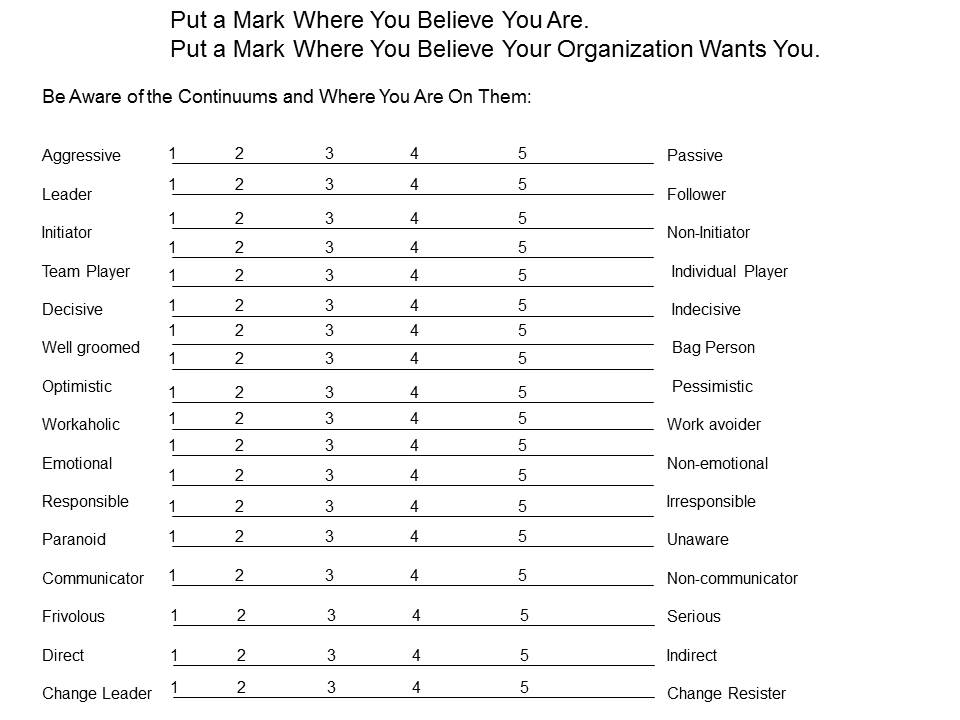
One good way to evaluate your fit in the organization is to first assess your behaviors, like decisiveness or leadership, on a continuum and then to do the same assessment looking through the lens of what the organization rewards in that behavior.  Take a list of behaviors like those below and first mark where you believe that you are on the continuum between the two extremes of the behavior.  Go with your gut.  Try not to answer according to where you “should” be, but rather where you believe you are.  Then make a mark on the same continua according to where you believe your organization wants you to be.  Think about what you’ve heard from managers, in 360 assessments, in reviews.  Think about the people in your organization who are obviously successful and highly thought of–where does their behavior fit? Even if you aren’t completely right about what your organization wants, you will be able to identify the biggest discrepancies.

Behavior continuum analysis

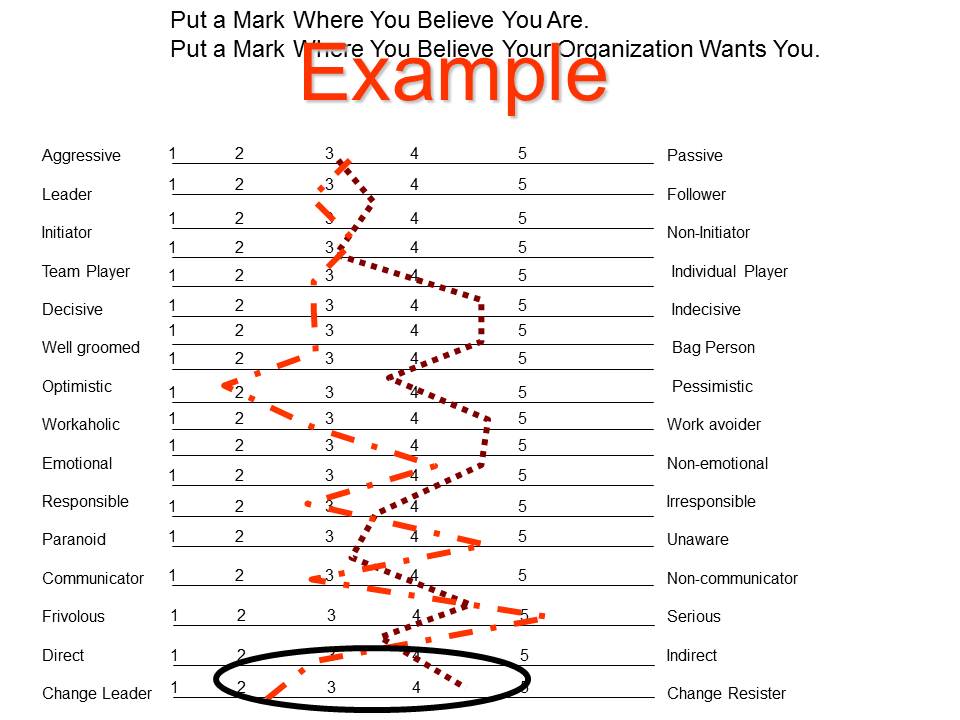
Once you have marked where you think you are and where you think the organization wants to you to be, connect each set of marks like in the example below.  This will provide you with a graphic that shows you where the gaps are between where your behavior is and what the organization’s norm is.  For example, if you look at the continuum Optimistic . . . Pessimistic or at the bottom, Change Leader . . . Change Resister, you see that there is a gap.

Example of behavior continuum evaluation

PDF Version of Worksheet

Address The Gaps Between Your Behaviors and the Cultural Norms

Once you are aware of the gaps, then you can decide what you want to do about them.  You have several choices:

  1. You can do nothing.  You can decide this is who you are and you aren’t willing to change to fit better in your organization.
  2. You can decide to change your behaviors (remember, behavior is not WHO you are).  Think about the way you are different at your boss’ staff meeting than at home, or how you are different at church than you are at girls-night-out.  You can change your behavior without changing who you are.  When you learn to change your behavior, you have more control over your career.
  3. You can be selective about which behaviors you want to change.  Which behavior have you heard the most about?  Which one do you think would be the easiest to work on (it is always best to start with baby steps)?

If you decide that you want to change a behavior, here are some steps that will help:

  • Observe others who have the behavior you would like to have.  Imitate them. Try it out.
  • Share with someone that you’re trying to change and ask him to give you feedback on how you’re doing.  Just knowing that someone is watching you will help you be more aware and will push you to try harder.
  • Practice “being” different in your mind.  Imagine what you look like, what you say, how you sound.
  • If the behavior you’re trying to change is something you’ve heard about in your reviews, make sure that you demonstrate the new behavior in front of your boss.

It’s normal to be uncomfortable as you go through this process.  Keep trying.  Don’t expect others to notice at first. It will take a while.  That makes it easier, though, because it gives you some time to practice and get more comfortable.

1 Comment

Filed under Career Development, Executive Development, Feedback, Personal Change, Success

Dealing with Feedback You Hate

feedbackIt’s pretty easy to deal with being told that you are great, that you’ve nailed the job, that you are the best thing since sliced bread.  Unfortunately, that isn’t the feedback most of us get most of the time.  We get mixed feedback.  We are told the good things that we do and the not so good things that we do.  Since the former is not difficult how to deal with, let’s talk about dealing with feedback that you hate.

Reacting to Feedback

There are common (normal/human) ways that people react to feedback:

  • Rationalize–“well, she doesn’t know what she’s talking about,” or “they don’t really know how much I care or how hard I work or what a good job I do.”
  • Diminishment–“compared to all the good things I do, this isn’t important.”
  • Disagree–either in your head, or worse, out loud
  • Overreact–hear only the bad feedback, and then not put it in perspective; sometimes, people even leave over negative feedback–a serious overreaction!
  • Accept–agree with the feedback and accept it as valid–this can be good or bad, depending on the feedback
  • Obsessing–not being able to let it go, thinking about it all the time
  • Listen–take it in, hear it objectively.  This is the best reaction, because it gives you the most runway for a reaction.  (Always thank people for feedback.  Despite what you may think, giving tough feedback is hard.  You need to keep that communication open.)

One of the most important things to remember with feedback is that it is correct.  It is an accurate expression of someone’s OPINION of your performance.  You can tell yourself that that person’s opinion isn’t important.  You can tell yourself that that person doesn’t know enough about your performance to be completely correct.  But you can’t say that s/he isn’t right, because s/he has expressed his/her opinion, not a universal truth.  You need to ask yourself, why does the person have that opinion.  Look at the list of normal reactions, above.

When you come up with your response on “why” the person thinks what s/he does, which of the reactions are you having?  Take a “that’s an interesting opinion” approach.  Look at your interactions with the person.  Filter out everything else.  What/when/how does the person see you?  Does the person know you outside of a particular kind of exchange? How did you meet?  Do you listen to the person?  Do you treat the person with respect? Do you make the person’s life easier or harder?

Now, What’cha Gonna Do About It?

The initial reaction is one thing.  Hopefully, you’re able to listen to it and to take it in as an interesting opinion.  Then, you need to figure out what to do about it.

I was once reorganized into a new department.  It was a department completely outside of anything I had ever done.  I also outranked all my peers.  Let me say that again.  My peers were sitting there in that department, doing their job and plotting their career paths and suddenly I was reorganized into the middle of their career paths.  I outranked them (read a step closer to their next step than they were).  From their perspective, I knew NOTHING about the work of their department.  They didn’t ask for me, they didn’t want me, and they didn’t particularly like me.  As a part of my first assignment in that job, I was evaluating executive feedback instruments.  As a part of that assignment, I had them fill out a feedback form on me (within 3 weeks of starting in this job).  I got the WORST feedback that I had ever gotten.  I had had good feedback and not so good feedback in the past, but this time, I was completely blown away by the feedback I received.

I went through all the normal reactions (see list above):

  • I rationalized–they don’t know me.  They don’t like me.  They are jealous.
  • I diminished–their opinion doesn’t count.  My boss’ opinion is the only one that counts. I don’t care what they think.
  • I disagreed–luckily in my head.  Here are the reasons they are wrong: 1), 2), 3), etc.
  • I overreacted–yes, I did.  I could only see the negative in what they said.  If there was any positive, I certainly didn’t see it (and I don’t remember it now).  I thought, “I’ll just leave . . .” I was angry.
  • I obsessed–luckily, I got the feedback on a Friday.  I might have had to call in sick if I hadn’t had a couple of days to cool down.  I thought about it non-stop.

Luckily, I had a lot of knowledge about how you should react to feedback.  Notice that didn’t stop me from the reactions listed above.  It did, however, help me come full circle.  No matter what I thought about their opinion.  No matter how much I understood about why they might have given me the (unfair, I thought) feedback that they did. I understood that their opinion was their opinion and it was right.   After I cooled down, I decided to use the experience to experiment with how to turn the situation around (because I sure had a situation to turn around!).

I put together a response.  I listed all the things that I had heard from the feedback.  I literally put together a presentation that listed the questions and the responses.  I presented it neutrally (as if it was about someone else).  (NOTE:  if it hadn’t been an evaluation of a feedback instrument, I probably would have done this individually, not with all of them together).  I came up with responses to the feedback.  I was rated low in communicating–I came up with a list of the ways I would communicate in the future.  Then I asked them if these would be adequate if I actually did it.  I took the top three most negative (I don’t remember what they were any more), and then I came up with suggested improvements.  It was hard (because I didn’t really agree with the feedback–it didn’t match what I had heard before).  I focused on being objective.  For those things that I really didn’t agree with to the point that I didn’t have any “improvement suggestions,” I just didn’t deal with.

My reaction got their attention.  I think they knew, to a certain extent, that they had vented.  They agreed to my suggested improvements–or backed off some of them.  It defused some of their anger at the situation.  I changed the situation from a them v. me to a “let’s address how to make this situation better.”

Now the Even Harder Part

Once people give you feedback, they expect to see changes.  Small changes, as long as they see them–as long as they perceive that you’re trying–are enough.  That means, somehow or other you need to let them know that you’re trying.  That you want to make the situation better.  That you appreciate, value and respect their feedback.  People give you a lot of benefit of the doubt if they think you are trying, especially in response to something they feel a bit guilty about.  Experiment.  You won’t do it right the first time every time, but once you learn how to do it, you can get good at it.

Managing people’s perceptions, accepting and acting on feedback, are huge tools for a successful career.


2 Comments

Filed under Career Development, Communication, Feedback, Personal Change