Tag Archives: executive development

How to Increase Your Visibility in Your Organization

Who Knows Who You Are?

One of the most important things to realize as you work your way up the ladder at your organization is that other people are rarely as aware of you as you think.  You work hard.  You deliver great results.  You deliver more projects/faster/better than anyone else.  The Powers-That-Be rarely are aware of the nitty gritty detail of who does what to get the results.  Your manager may not even be as aware of what you’re doing/delivering as you think.  Your peers may think they had as much to do with what you delivered as you do.  This is not malicious–it’s human nature.  We live in our own little world and we filter out that which is not most important.  Other people’s accomplishments are rarely as important to us as our own.

Stand Out In Your Organization

How Do You Do It?

Tell people what you’ve done.  Find a way that is comfortable for you to tell what you’ve accomplished.  You know how to do this with friends and family.  Use the techniques you used when you were dating–figure out how to make it interesting and not narcissistic.  Leaders find out who is doing well through being told.  It has to start with you.

Seek out and volunteer for projects. Make sure your leadership knows you are willing and capable when the organization needs someone to step up and make things happen.

Figure out how to get your manager and your peers to be advocates for you.  The best way to do this is to be advocates for them. They will likely mirror your behavior.  Don’t be afraid to ask for support from your boss or peers to advocate for you being on a project or recommending you.

Make sure key executives (not just your own) know who you are.  Figure out a way for them to know your work.  One of the best ways to do this is to volunteer for projects in other executives’ areas of responsibility.  In other words, be your department’s representative on cross-departmental projects.

Be involved outside your job, especially in organizations where  senior leaders participate. Attend and volunteer in professional organizations.  Make sure your organizational leadership knows about your successes in these outside organizations.

Speak up.  If you don’t contribute to the conversation, people think you can’t/don’t know anything.  They don’t make any more thorough analysis than that. If you aren’t speaking up because you don’t think you have anything clever to contribute, the good news is that people don’t judge what you say too closely.  So, they do judge when you don’t talk, and they don’t judge the quality of what you say very harshly.  Go figure.  But speak up.

Become an expert.

Build your expertise.  Within your organization, become THE expert on something.  Be the ‘go-to’ person for that subject. Stay current in your expertise so people know you are the one who will know when something changes.

Leave a comment

Filed under Career Development, Executive Development, Networking, Success

Face What’s Holding You Back

Career Roadblock

What Do You Think is Holding You Back?

What do you tell yourself about what is holding you back?  You need another degree? Your boss doesn’t like you?  You have to relocate for the next step? You’re too old?  Too young? You’ve been out of work too long? Your technical skills aren’t current? You’re overweight/a minority/gay/a woman? You don’t fit into the culture?  They don’t think you’re a ‘hi-po’?

Two Questions:

Whatever it is, I have two questions for you:

1)  How do you know you’re right?

Are you sure that you aren’t looking at it through ‘victim’ eyes?  What is your evidence that you are right?  Are you the only one with this problem? Are you fully engaged, working as hard as you can, delivering results and this is still happening?  Or have you checked out?  Have you talked to anyone about what is going on?  Have you asked for feedback? Has this been a pattern at other organizations/with other bosses/in other jobs? Are you on an emotional roller coaster or on an even keel?

If you are right in your assessment of what is holding you back, I have another question:

2)  What are you going to do about it?

If you need another degree, why don’t you get one?  No, really, why not?  No money? No time? Look at it through business case eyes–will it get you a better job, with more money, with a higher quality of life?  If so, tell me again why not?

If you are ‘too’ old, find someplace that appreciates your wisdom.  Why not?  There are places that do.  Just because your present organization doesn’t DOES not mean they all don’t.  Go FIND a better place.

Whatever the thing is that is holding you back, it is possible to overcome it.  It is possible to find a solution.  Set an audacious goal to fix/solve/overcome it and then do it.  Maybe it is the way you’re looking at it that is really what is holding you back?

Who can fix THAT?

(Did you notice that I asked more than two questions?:-))

1 Comment

Filed under Career Development, Career Goals, Derailment, Executive Development, Feedback, Hi Po, Personal Change

Career Accelerants

Win the Career Race

Do are you know people who are about your age, have about the same experience, and aren’t more talented/smart/capable than you, but who are more successful in their career than you?  Are you puzzled about what they have that you don’t?  What do they do/who do they know/how do they do it? Do you want to go faster, too?

There are some tools that can help you accelerate your career success.  I call them career accelerants.

Mindset.

How you think.  What you think.  When you think.  All make a huge difference in how fast and how well your career progresses.  Mind set includes:

  • Your Attitude–“I can.  I will.”
  • Being Positive
  • Constantly Learning
  • Being committed

Adaptability.

There is an old Chinese proverb that says that the wise adapt themselves to circumstances, as water molds itself to the pitcher.  The second you get stuck with “this is the way it is” or “I’m not going to do this,” is the beginning of the end of your upward trajectory in that organization.  The way I think of it is, “If I had started at this organization today, I wouldn’t object to this. I would just do it.”  This can apply to systems, processes, organizations, etc.  It doesn’t occur to us to ‘resist’ when we’re new to an organization.  Try to adopt that way of looking at things.

Tools.

Use whatever tools you can to help you learn/understand/experience faster.  Some of the best tools are:

  • Books
  • Feedback
  • Goals/Measures
  • Training

Energy.

You need a high level of energy to speed up your career.  You are more in control of your energy level than you might think.  For high energy you need:

  • Good Health
  • Fitness
  • Mindset

Infrastructure.

Successful careers need an infrastructure too.  Set up your life so that it supports your career.  To do this, you need:

  • A Support System
  • De-clutter your life–get rid of the things that you ‘tolerate,’ but which weigh you down–anything from messy desks to people who suck you dry
  • Balance–whatever this means for you (not what others think).  Keep adjusting this, it is a work in progress.

You are in control of your career.  If it isn’t moving the way you want it to, look at this list and start experimenting with changing the way you’re doing things.

Leave a comment

Filed under Career Development, Career Goals, Executive Development, Feedback, Goal Setting, Personal Change

Are You a Good Fit For Your Organization?

What is the Culture of Your Organization?

Two key components of managing your career to success are to know yourself well and to understand your organizational environment.  The next step is to evaluate your fit within your organizational culture.  All organizations have cultures–like personalites.  The culture of an organization is like the water that fish swim in. The people who work in the organization are pretty much unaware of the culture on a daily basis.  It surrounds them and drives a lot of the behavior, it includes the unwritten rules and the things that are important, the values, the rituals and the history.   It is very likely that you know a lot about the culture without really realizing that you do.  This exercise will help you see your behavior within the context of the organization.

Evaluate Your Behaviors

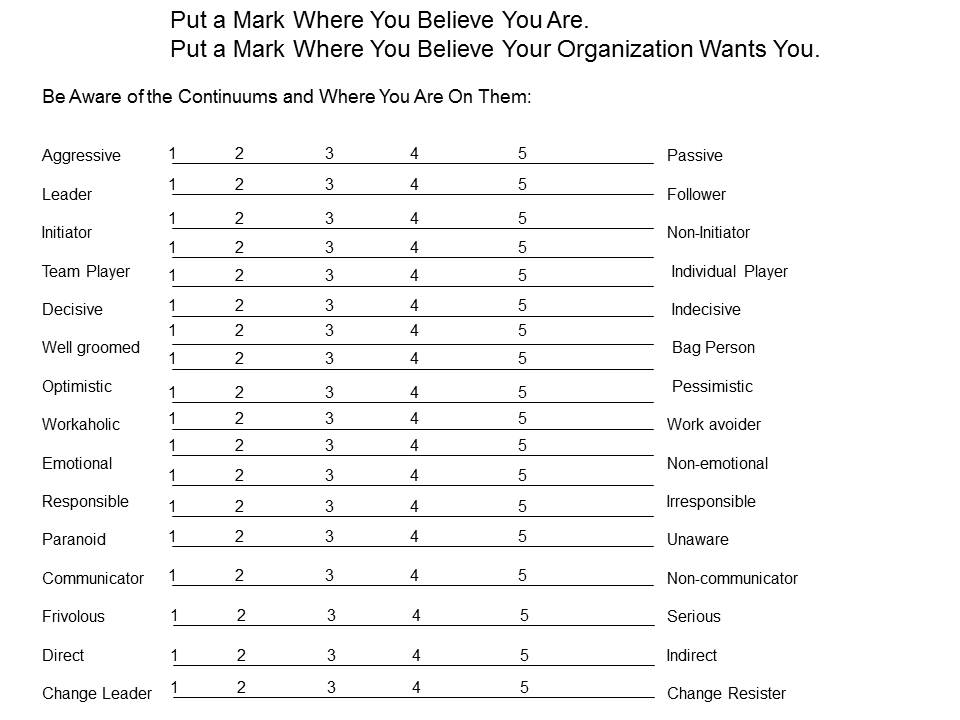
One good way to evaluate your fit in the organization is to first assess your behaviors, like decisiveness or leadership, on a continuum and then to do the same assessment looking through the lens of what the organization rewards in that behavior.  Take a list of behaviors like those below and first mark where you believe that you are on the continuum between the two extremes of the behavior.  Go with your gut.  Try not to answer according to where you “should” be, but rather where you believe you are.  Then make a mark on the same continua according to where you believe your organization wants you to be.  Think about what you’ve heard from managers, in 360 assessments, in reviews.  Think about the people in your organization who are obviously successful and highly thought of–where does their behavior fit? Even if you aren’t completely right about what your organization wants, you will be able to identify the biggest discrepancies.

Behavior continuum analysis

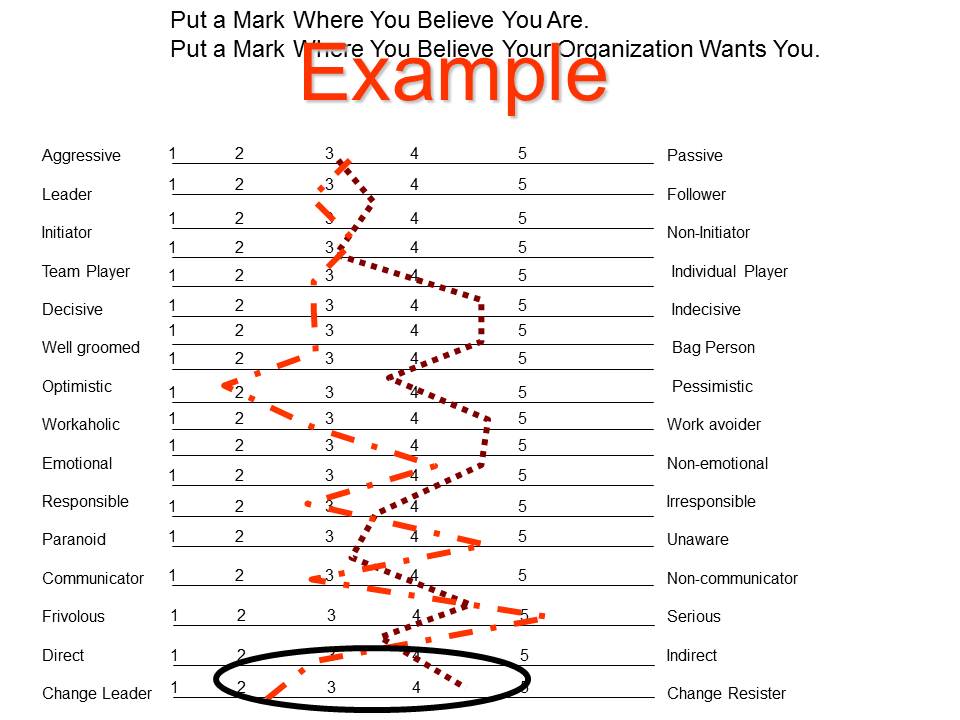
Once you have marked where you think you are and where you think the organization wants to you to be, connect each set of marks like in the example below.  This will provide you with a graphic that shows you where the gaps are between where your behavior is and what the organization’s norm is.  For example, if you look at the continuum Optimistic . . . Pessimistic or at the bottom, Change Leader . . . Change Resister, you see that there is a gap.

Example of behavior continuum evaluation

PDF Version of Worksheet

Address The Gaps Between Your Behaviors and the Cultural Norms

Once you are aware of the gaps, then you can decide what you want to do about them.  You have several choices:

  1. You can do nothing.  You can decide this is who you are and you aren’t willing to change to fit better in your organization.
  2. You can decide to change your behaviors (remember, behavior is not WHO you are).  Think about the way you are different at your boss’ staff meeting than at home, or how you are different at church than you are at girls-night-out.  You can change your behavior without changing who you are.  When you learn to change your behavior, you have more control over your career.
  3. You can be selective about which behaviors you want to change.  Which behavior have you heard the most about?  Which one do you think would be the easiest to work on (it is always best to start with baby steps)?

If you decide that you want to change a behavior, here are some steps that will help:

  • Observe others who have the behavior you would like to have.  Imitate them. Try it out.
  • Share with someone that you’re trying to change and ask him to give you feedback on how you’re doing.  Just knowing that someone is watching you will help you be more aware and will push you to try harder.
  • Practice “being” different in your mind.  Imagine what you look like, what you say, how you sound.
  • If the behavior you’re trying to change is something you’ve heard about in your reviews, make sure that you demonstrate the new behavior in front of your boss.

It’s normal to be uncomfortable as you go through this process.  Keep trying.  Don’t expect others to notice at first. It will take a while.  That makes it easier, though, because it gives you some time to practice and get more comfortable.

1 Comment

Filed under Career Development, Executive Development, Feedback, Personal Change, Success

Dealing with Feedback You Hate

feedbackIt’s pretty easy to deal with being told that you are great, that you’ve nailed the job, that you are the best thing since sliced bread.  Unfortunately, that isn’t the feedback most of us get most of the time.  We get mixed feedback.  We are told the good things that we do and the not so good things that we do.  Since the former is not difficult how to deal with, let’s talk about dealing with feedback that you hate.

Reacting to Feedback

There are common (normal/human) ways that people react to feedback:

  • Rationalize–“well, she doesn’t know what she’s talking about,” or “they don’t really know how much I care or how hard I work or what a good job I do.”
  • Diminishment–“compared to all the good things I do, this isn’t important.”
  • Disagree–either in your head, or worse, out loud
  • Overreact–hear only the bad feedback, and then not put it in perspective; sometimes, people even leave over negative feedback–a serious overreaction!
  • Accept–agree with the feedback and accept it as valid–this can be good or bad, depending on the feedback
  • Obsessing–not being able to let it go, thinking about it all the time
  • Listen–take it in, hear it objectively.  This is the best reaction, because it gives you the most runway for a reaction.  (Always thank people for feedback.  Despite what you may think, giving tough feedback is hard.  You need to keep that communication open.)

One of the most important things to remember with feedback is that it is correct.  It is an accurate expression of someone’s OPINION of your performance.  You can tell yourself that that person’s opinion isn’t important.  You can tell yourself that that person doesn’t know enough about your performance to be completely correct.  But you can’t say that s/he isn’t right, because s/he has expressed his/her opinion, not a universal truth.  You need to ask yourself, why does the person have that opinion.  Look at the list of normal reactions, above.

When you come up with your response on “why” the person thinks what s/he does, which of the reactions are you having?  Take a “that’s an interesting opinion” approach.  Look at your interactions with the person.  Filter out everything else.  What/when/how does the person see you?  Does the person know you outside of a particular kind of exchange? How did you meet?  Do you listen to the person?  Do you treat the person with respect? Do you make the person’s life easier or harder?

Now, What’cha Gonna Do About It?

The initial reaction is one thing.  Hopefully, you’re able to listen to it and to take it in as an interesting opinion.  Then, you need to figure out what to do about it.

I was once reorganized into a new department.  It was a department completely outside of anything I had ever done.  I also outranked all my peers.  Let me say that again.  My peers were sitting there in that department, doing their job and plotting their career paths and suddenly I was reorganized into the middle of their career paths.  I outranked them (read a step closer to their next step than they were).  From their perspective, I knew NOTHING about the work of their department.  They didn’t ask for me, they didn’t want me, and they didn’t particularly like me.  As a part of my first assignment in that job, I was evaluating executive feedback instruments.  As a part of that assignment, I had them fill out a feedback form on me (within 3 weeks of starting in this job).  I got the WORST feedback that I had ever gotten.  I had had good feedback and not so good feedback in the past, but this time, I was completely blown away by the feedback I received.

I went through all the normal reactions (see list above):

  • I rationalized–they don’t know me.  They don’t like me.  They are jealous.
  • I diminished–their opinion doesn’t count.  My boss’ opinion is the only one that counts. I don’t care what they think.
  • I disagreed–luckily in my head.  Here are the reasons they are wrong: 1), 2), 3), etc.
  • I overreacted–yes, I did.  I could only see the negative in what they said.  If there was any positive, I certainly didn’t see it (and I don’t remember it now).  I thought, “I’ll just leave . . .” I was angry.
  • I obsessed–luckily, I got the feedback on a Friday.  I might have had to call in sick if I hadn’t had a couple of days to cool down.  I thought about it non-stop.

Luckily, I had a lot of knowledge about how you should react to feedback.  Notice that didn’t stop me from the reactions listed above.  It did, however, help me come full circle.  No matter what I thought about their opinion.  No matter how much I understood about why they might have given me the (unfair, I thought) feedback that they did. I understood that their opinion was their opinion and it was right.   After I cooled down, I decided to use the experience to experiment with how to turn the situation around (because I sure had a situation to turn around!).

I put together a response.  I listed all the things that I had heard from the feedback.  I literally put together a presentation that listed the questions and the responses.  I presented it neutrally (as if it was about someone else).  (NOTE:  if it hadn’t been an evaluation of a feedback instrument, I probably would have done this individually, not with all of them together).  I came up with responses to the feedback.  I was rated low in communicating–I came up with a list of the ways I would communicate in the future.  Then I asked them if these would be adequate if I actually did it.  I took the top three most negative (I don’t remember what they were any more), and then I came up with suggested improvements.  It was hard (because I didn’t really agree with the feedback–it didn’t match what I had heard before).  I focused on being objective.  For those things that I really didn’t agree with to the point that I didn’t have any “improvement suggestions,” I just didn’t deal with.

My reaction got their attention.  I think they knew, to a certain extent, that they had vented.  They agreed to my suggested improvements–or backed off some of them.  It defused some of their anger at the situation.  I changed the situation from a them v. me to a “let’s address how to make this situation better.”

Now the Even Harder Part

Once people give you feedback, they expect to see changes.  Small changes, as long as they see them–as long as they perceive that you’re trying–are enough.  That means, somehow or other you need to let them know that you’re trying.  That you want to make the situation better.  That you appreciate, value and respect their feedback.  People give you a lot of benefit of the doubt if they think you are trying, especially in response to something they feel a bit guilty about.  Experiment.  You won’t do it right the first time every time, but once you learn how to do it, you can get good at it.

Managing people’s perceptions, accepting and acting on feedback, are huge tools for a successful career.

2 Comments

Filed under Career Development, Communication, Feedback, Personal Change

Selling Your Brand

Have You Thought About Your Brand?Sell Your Brand

Have you ever thought about how your boss thinks about you?  Not what he thinks, but how he thinks?  What about how the organization thinks about you? How about the top leadership in your organization? What about the folks in your professional organizations? Do you stand out in any way?  Do they think of a certain kind of expertise or talent?  Do they think of a certain kind of results?

When you think of McDonald’s you get a “picture” of what McDonald’s is.  Depending on your age and interests, that image might be different, but it pops into your mind.  The same is true of Coke, or Apple or Sears or Fanta.  You make decisions about those brands based on your values, interests, likes/dislikes, income and other demographics.  You want to be able to control (or at least strongly influence) how people think of you (your brand) when they think of you.  The more you influence your brand and the more aware you are of it, the more likely you are to be able to manage your career successfully.

How I Learned This Lesson–The Hard Way

I worked for many years in a large, rapidly growing organization.  There was a period of time when I was “stuck” in the same position for several years.  The men who had started in the organization with me were moving past me and I was standing still.  I was very confused by this. Rightly or wrongly, I rejected the idea that it was a gender thing.  I thought it was something about me.  I was VERY frustrated.  I was quite angry about it. (Although looking back on it, I’m not sure just how clear I was about what was causing my frustration.)

Our CEO had a leadership meeting and announced the formation of a trilogy of high performance projects.  He announced that the people selected to work on these projects would be those who were identified across the organization as the “best” in each of the areas.  I was thrilled.  I was the “best” at one of them.  (Ok, maybe I wasn’t really, but at the time, I was absolutely, completely, without a doubt sure of it.)  So . . . I waited for the invitation.  It didn’t come.  Someone else in my division got selected.  Someone who not only wasn’t as good at it as me, but who wasn’t even interested.  I went from being angry to being FURIOUS!  How could they announce that the ‘best’ would be selected and then not pick me!?!?!  I couldn’t let it go.  I asked my manager.  I asked the VP of HR.  They didn’t know.  I finally asked my VP.  His reaction was one of the best lessons I ever got–although not at all fun!

He was completely, genuinely surprised that I even thought I should have been selected.  It hadn’t occurred to him.  It was in this very painful way that I realized that he really didn’t know that I was the ‘best.’  The person he had selected was a charming, talented person who regularly delivered results.  He didn’t know anything about the subject matter at hand, but that didn’t really matter that much.  He was easy to get along with.  He was very competent (at other stuff).  He was charming.  He got results.  So he got picked.

I, on the other hand, was pretty much an unknown to the VP who had my career in his control.  He certainly didn’t think of me–at all.  This was completely eye opening.  And when I got over the shock of it, I got over being so mad, too.  I could see how and why he was oblivious to my strengths.  I was pretty much totally responsible for that.  I hadn’t made a point of selling my abilities to the ‘powers-that-be’ in the organization.  I hadn’t made sure that I was thought of as an expert in the organization.  Once I figured this out, I went about building my ‘brand’ in the organization.  And I got ‘unstuck’–promoted within less than a year.  And then I got promoted again.  And then again.

How do you build your brand?

  • Be an expert.  Build your expertise.  Within your organization, become THE expert on something.  Be the ‘go-to’ person for that subject.
  • Help other people.  Create mutually beneficial situations.  Create ‘organizational trade routes.’
  • Act like you’re dating. Remember back to the days when you were dating.  Somehow or other you always managed to be in the right place at the right time to ‘meet’ up with the person of interest.  You managed to ensure that s/he knew how great you were.  You managed to appear to be as smart as possible, as talented, as charming as possible.  Do that again–just in a different context–prove how ‘right’ you are for the organization.
  • Be brave.  Stand out.  Blending in will not do you any good long-term.  What’s different/better/a more perfect fit about you?  How can you get it communicated?
  • Make sure other people are ‘selling’ you.  The theory behind social media marketing is that buzz created among ‘friends’  is more credible than advertising by the company.  I can’t tell you how many times I was in meetings of managers who were deciding who got what job.  The candidates who were known of by more deciders were the ones who got the jobs.  EVEN IF THEY WEREN’T the most qualified on paper.  If you know of someone, you feel more comfortable choosing him than a total unknown.  Imagine how much better someone did who was known of (because they had effectively sold their brand) by all the deciders.
  • Get over any thoughts that ‘selling’ your brand is unseemly. This is your life, your livelihood, your career.  This is the way you do it.

2 Comments

Filed under Brand Yourself, Career Development, Career Goals, Communication, Executive Development, Networking, Recession Proof, Success

Career Check-up

Why a Career Check-up?

Those of us who do what we should have annual physical check-ups.  People who practice preventative health care are much healthier.  We take our cars for their regularly scheduled maintenance milestones.  Our cars last longer, drive better and have higher resale values.  Regular house maintenance (how many of us have given our houses great makeovers when we’re selling them?) leads to fewer crises and higher sales prices.  But how many of us do that with our careers?  Most of us get an annual review for our job, but what about our careers? A job is a role that you play, specific functions you perform.  A career is a professional or work life, a broader view, transportable, beyond your current employer, beyong your current job.  Transportable.  In today’s economy, transportable is priceless.

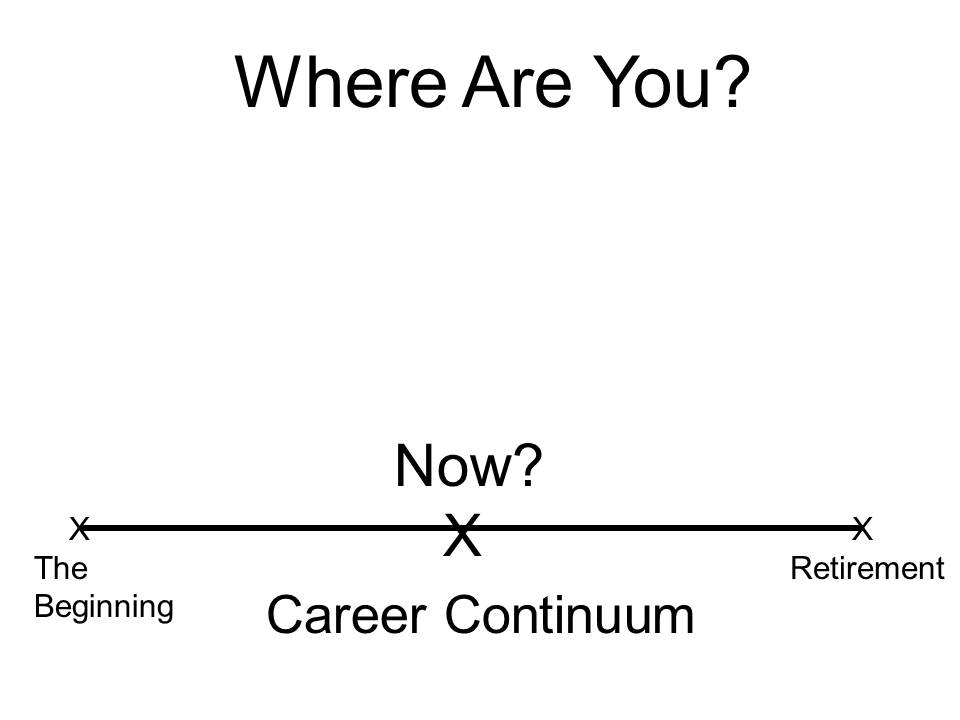
Career Continuum

Career Path

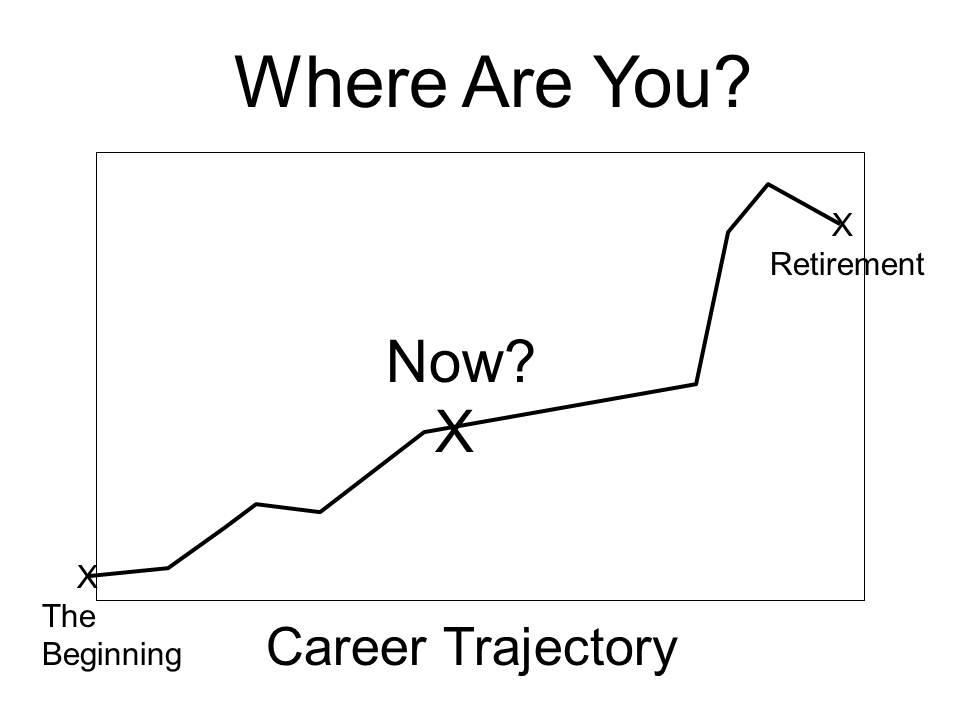
Where are you on the your career continuum?  Where on you compared to where you want to be?  In terms of time–how long have you worked?  How much longer will  you work?  Are you 1/3 done?  Are you 1/2 done?  Between now and what is left, what do you want to accomplish?   As you look at where you are, what do you need to move your career along as fast as you need to in order to get to where you want?

Career Trajectory

Now look at where you are in terms of what level you want to be?  If you are a Director now, do you want to be C-level?  Do you want to have your own business?  Do you want to move into another field?  Do you want to accelerate how much money you’re making?  Are you moving as fast as you want to? Are you being considered for the types of positions you should be to get to the level you want?

What’s Going On Now?

Look at what’s going on at your current organization WITH CLEAR EYES:

  • Are You Valued?
  • Do You Think Your Company Has the Right  Direction?
  • Do You Trust Your Organization’s Leadership?
  • Are There Growth Opportunities?
  • Is There Enough Challenge?
  • Is This Work What You Thought It Would Be?
  • Do You Fit in the Culture?
  • Is This Meaningful for You?
  • Are You Motivated at Work?
  • Do You Make Enough Money?
  • Is This the Right Work-Life Balance for You?

Depending on the answers, you need to decide whether your current organization is the right place for you to accelerate your trajectory pace.  If not, face it now.  That doesn’t mean you need to move now–it means that you need to get ready to move.  (It took me six years to get ready for my next step beyond an organization I truly loved–but once I saw that I needed to go, my focus changed to the next step rather than continuing to stay in an organization that couldn’t deliver my end-state for me).

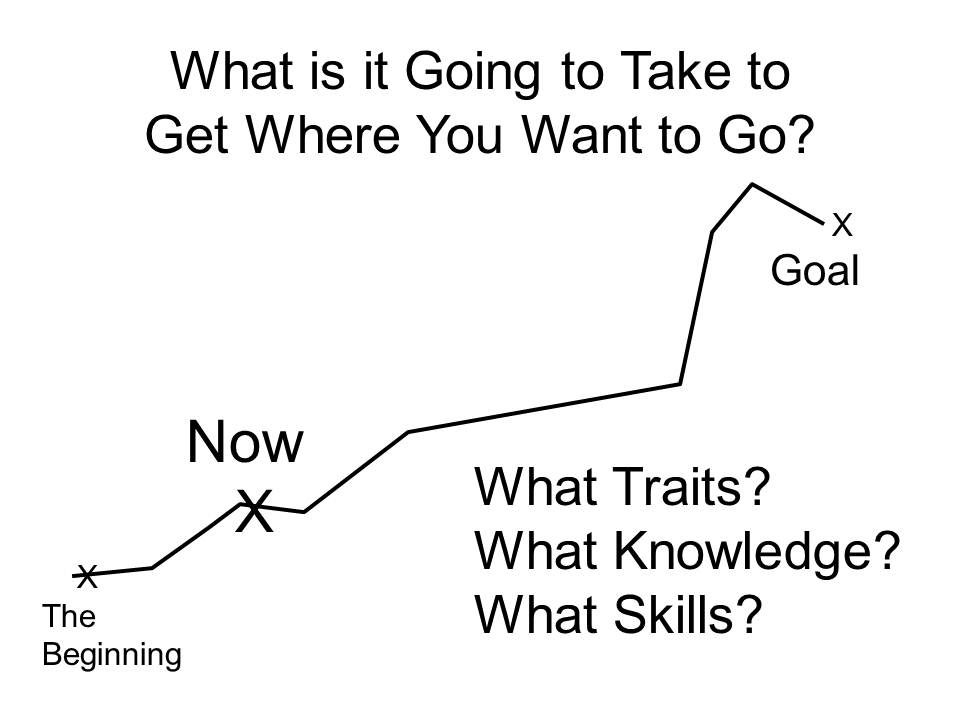
Start Working on What it Will Take

Skills Traits Knowledge

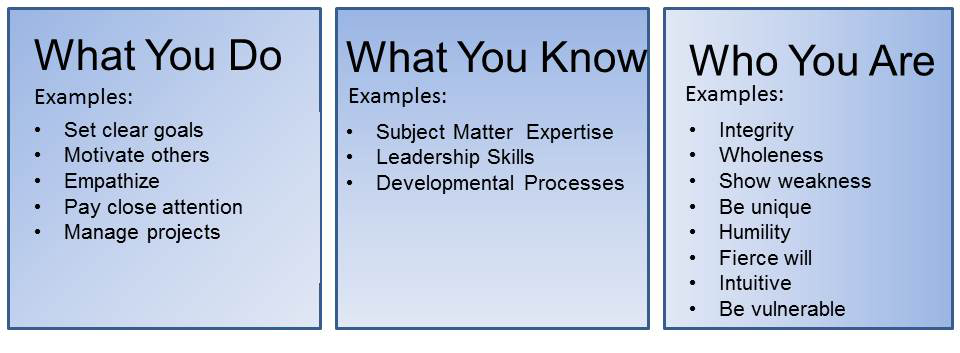
The more specific you can be in understanding what you need to know, do and be in order to reach your goal, the better you can prepare to do it.  If, for example, you are a Director and you want to be C-level, you may need to be much more financially literate than you are now.  You may have to be able to see the big picture better and pull yourself out of your detail focus.  If you are a Project Manger and you want to be a Program Manager, you may need to know how to understand enterprise-level governance of projects and programs.

How Do You Figure This Out?

Look at People Who Do What You Want to Do:

  • What Do They KNOW?
  • What Can They Do?
  • What Are They Like?
  • What is Their “Brand?”

I can rarely persuade people to actually do informational interviews until they are looking for jobs, and usually even then, they are out of a job before they’ll do it.  It is an incredibly helpful tool for a career check-up.  It helps you to understand what it takes to get to the level you want when you talk to people who’ve done it.

  • What do they wish they had known when they were at your level?
  • What is the most important skill at their level?
  • What was hardest to learn/do?
  • What would they do differently?
  • What advice do they have for you?

You walk away with a perspective on what you need to know/do/be.  You are also likely to walk away with an advocate who may start looking out for you.

Create a Project Plan

You know how to do this:

  • Set your goals
  • Identify your critical path tasks
  • Identify the resources
  • Set your timeline
  • Do a kick-off
  • Git-ur-done!

Leave a comment

Filed under Brand Yourself, Career Development, Career Goals, Executive Development, Goal Setting, Personal Change, Success

Let’s talk about the most marketable skill of all

Which Skill is So Marketable?

What is that, you ask?  What could possibly be the MOST marketable skill?  EXECUTION.  Execution comes in all flavors–marketing, IT, Project Management, Human Resources, strategy, operations, software, finance and on and on.

Organizations spend tons of time in developing a strategy and planning.  This work is usually done by the leaders of organizations.  They then communicate the strategy and the plan to the next several levels of the organization for execution.  The problem is, the strategy and the execution of that strategy are rarely aligned.  According to Professor  Marco Iansit  of Harvard  Business School, “Strategy  becomes the product of the firm’s incentives, structures, and patterns of behavior, not the other way around,” in his book,   One Strategy: Organization, Planning, and Decision Making.  In other words, the clarity that those who develop the strategy and the plan believe that they have gets lost quickly through the lenses of the “way things work” in the organization.

Why Organizations Need Execution Experts So Badly

Research says that more than seventy percent of large projects FAIL!  Depending on who you ask, between 75% and 95% of new product launches fail.   Email marketing campaigns have a four percent success rate.  This makes it sound like we’re all incompetent.  But we aren’t.  We (most of us) work very hard trying to accomplish what the company needs/wants.  We just aren’t working on the right things.

Those people who figure out how to execute–to actually deliver what the company needs–are highly valuable and very marketable, both within the organization and outside.  To actually execute the tasks that need to happen for the organization to thrive takes everyone.  It takes fully engaged, fully empowered employees who understand what needs to happen and are willing to do it–so they have to agree enough, believe in it enough, do enough to make it happen.

What Does It Take To Execute?

So what does this have to do with you?  YOU have to engage.  YOU have to be empowered.  YOU have to do it.  This is not about “them.”  This is about you.  If you want to have the most marketable skill, and the career security that goes with that, YOU have to learn how to execute.  And how to get other people to execute.  And you have to learn how to understand the strategy well enough to execute THE strategy, as opposed to some watered down version of it.

It doesn’t matter if you are at the top of the organization, in the middle, or if you just started yesterday.  You need to learn how to understand clearly what needs to happen and then to do it WITH the other folks who you work with.

I’ve recently gotten to work on a string of successful projects.  The difference between them and the ones that are late/over budget/don’t happen/completely fail is:

  • They have a team of people who are committed to getting it done–no matter what gets in the way
  • They have people who challenge things that are wrong–the way people are acting, the lack of resources, the lack of commitment, the inadequacy of the technology
  • No one is on autopilot
  • They have incredibly difficult deadlines
  • Leaders are deeply involved in what is going on

Remember, when you can execute consistently and persistently, you pretty much don’t have to worry about where your next job is coming from.  Companies will want you.

Good Books on Execution

Leave a comment

Filed under Books, Career Development, Executive Development, Goal Setting, Success

Moms At Work

Happy Mother’s Day

On this Mother’s Day, I thought would I write about women at work. I grew up not only with a mother who worked outside the home, but with a grandmother who always had as well (starting when she was thirteen).  It never occurred to me not to work.  And while I knew I would work, it didn’t occur to me to take what was considered a “woman’s” job at the time–nurse, teacher, secretary.  My best friend, who wanted to be an art or music historian became a teacher (and a good one) because her parents would only support her going to college if she went into a career that was “suitable for a woman.” When I started working in a corporation, I could look all the way to the top and see women only one level above me.

What’s Holding You Back?

Twenty years after I started (10 years ago–so this is old data), a Harvard Business Review article, What’s Holding Women Back, by Sheila Wellington, Marcia, Brumit Kropf, and Paulette R. Gerkovich published a discussion of a survey citing reasons for women’s slowness to reach top positions:

Female executives believed it was caused by:

  • Lack of line management experience (79%)
  • Exclusion from informal networks (77%)
  • Stereotypes about women (72%)
  • Failure of top leaders to assume responsibility for women’s advancement (68%)
  • Lack of role model (68%)
  • Commitment to personal or family responsibilities (67%)
  • Lack of mentoring (63%)
  • Lack of awareness of organization politics (57%)
  • Different behavior style from organization’s norm (51%)
  • Lack of opportunity for visibility (51%)
  • Inhospitable corporate culture (50%)

CEOs believed it was caused by:

  • Lack of line management experience (90%)
  • Failure of top leaders to assume responsibility for women’s advancement (58%)
  • Stereotypes about women (51%)
  • Lack of role model (49%)
  • Lack of mentoring (49%)

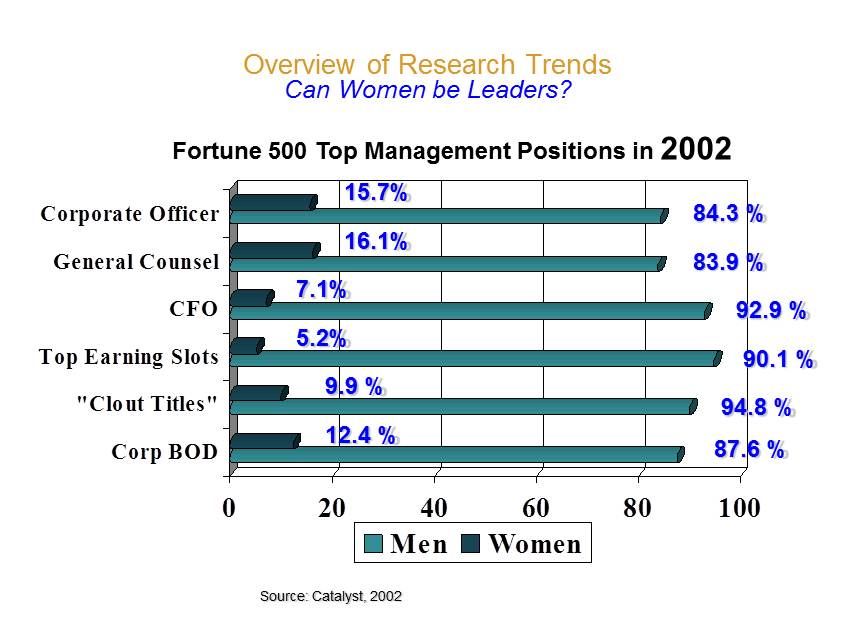
Obviously looking through different lenses!  Before I talk about the relevance/importance of these findings, let me tell you why I think that data this old is still relevant.  Look at the numbers for women in leadership roles in 2002 (when the above survey was done):
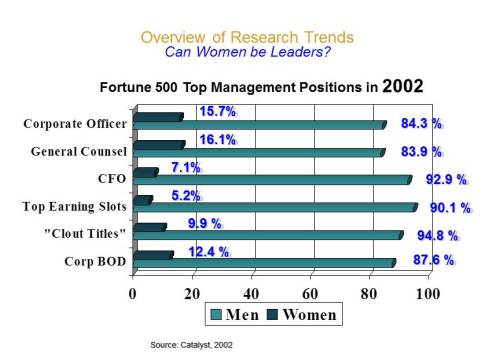
Statistics on women in leadership 2002

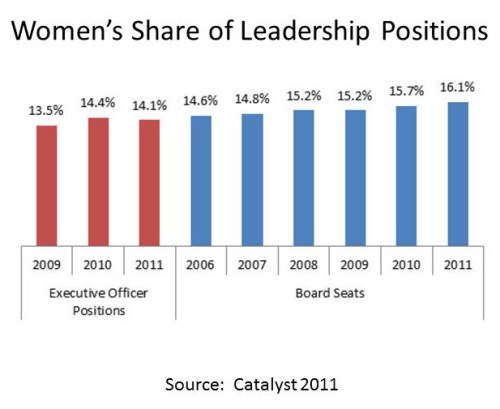
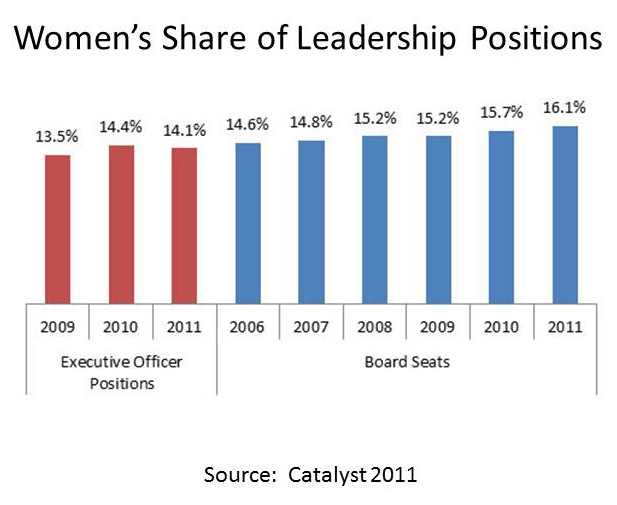
Similar statistics from 2009-2011:

Statistics for women in leadership 2009-2011

Not quite an apples to apples comparison, but close.  The big news here is that the numbers haven’t moved very much, especially when you factor in that women represent 53% of entry-level workers.  The question is why?  Really, the question is WHY!!!?!!!?!!!?!!!?!!!?

Why?

I don’t believe that it is because women aren’t every bit as capable as running corporations (or governments) as men.  Obviously, though, there are things in the way.  A recent Wall Street Journal article, The XX Factor: What’s Holding Women Back? by Sue Shellenbarger, lists pretty much the same reasons (from the CEOs perspective) that appeared in the 2002 survey (above).  From an organizational perspective it is tremendously wasteful–look at all the talent that is left on the table until they take themselves away!

From my perspective, the ways leaders of organizations and the ways women think about women in the work place, in particular– in other words, the mental mind sets and stereotypes they have about women, are the biggest barriers to women reaching the top positions in organizations.

How much does motherhood have to do with this?  Lots.  Eighty three percent of the successful senior leaders documented in the Wall Street Journal article above are mothers–so it can be done.  On the other hand, Facebook’s Sheryl Sandberg in a Ted Ideas Worth on Spreading video Why Few Women at Top discusses the phenomenon of women dialing back on their career intensity even when they start thinking about having children.  There are two sides of that:  CEOs say–“see, they aren’t committed.”  Women say–“it isn’t fair to get more involved and then leave the organization high and dry.”  You can see how both mind sets are in the way of women breaking the glass ceiling barriers that are just as real today as when I started.  The reality is that mothers work, whether by choice or not, and are good, talented, capable employees.  That is true whether they are entry-level or CEOs.  Perceptions about the impact of being a mother on a women’s ability to be a successful senior leader have a huge impact on women’s promotability.  Perceptions.  Mental models.  Not reality.  It isn’t reasonable to blame this continuing glass ceiling on that fact that women become mothers.  It is much more complicated than that.  Single, childless mothers aren’t finding it any easier to get to the top, or else all the ones identified as successful would be childless.  That isn’t the case.

There is a new, HUGE difference, though, with the young women entering the workforce now.  These women have very different expectations.  The women joining the workforce today fully expect to be treated as an equal.  Their development experiences include a whole lot more time of being treated as an equal.  They played sports.  They got into grueling college programs.  They don’t see any reason that they shouldn’t be treated equally–as entry-level employees and as directors and as CEOs.  They are waiting to have children until their career is on track.  They have not had any exposure to the “reasons” that women aren’t at the top (listed in the survey above).  They will not sit still for this.  They will leave the organizations and start their own.  There needs to be a wake up call across organizations.  This is HALF of the talent in the workforce.

I have recently dealt with young women who have been exposed not just to subtle discrimination, but to out-and-out double standards.  Women who have been told that their “legs” are a problem.  That is crazy.  What man’s legs have ever been a “problem” in an organization????  Women who have been sidelined for doing EXACTLY what their male peers and superiors have done.  They are being held to different standards than their male counterparts.  This isn’t something new.  The difference is that I expected it.  These young women don’t.  They don’t have any of the baggage that exists in both senior leader’s minds and in the minds of women who’ve risen through the ranks.  They are used to being equal.

It is Time!

And they are right.  It is time.  So . . . look at that list again.  Which of the beliefs that senior women believe in the survey —lack of line management experience, lack of role model,  exclusion from informal networks, lack of awareness of organizational politics–do you believe?  What are you going to do about it.  For yourself?  For young women in your organization?

Male leaders–what are you going to do about it?  What stereotypes do you believe that it is time to rethink?  What are you doing — being a mentor, role model, advocating for talented women in your organization, including women in your informal networks, hiring women into line management–to begin to build the leadership pipeline in your organization to include and support women?    It is time.

Do it in honor of your mother.  Do it for your daughter. Do it for all of us.

Leave a comment

Filed under Career Development, Diversity, Executive Development, Success

Do a Personal SWOT

Career Strengths Weaknesses Opportunities Threats

Most of us have done a SWOT (Strengths, Weaknesses, Opportunities, Threats) for our organization at one time or another.  It is a part of most strategy development efforts.   Try doing a personal SWOT as a part of your career development plan.  It is an excellent, and pretty quick, way to look at where you are and what is in your way of getting to where you want to be.

Strengths–Guiding Questions

  • What makes you unique in the world of work and your  personal life.
  • What have you been trained to do?
  • What unique skills have you developed throughout your career?
  • What are your significant accomplishments?
  • What are you most proud of in your career?
  • What difficult challenges have you overcome?
  • What would your bosses say about your successes throughout  your career?
  • What makes you different?

Weaknesses–Guiding Questions

  • What have you heard (and maybe ignored) on performance reviews.
  • What skills do you need to develop?
  • Do you have the requisite education for where you want to be?
  • Who do you not know in the organization power structure?
  • Are your skills out of date?
  • Do you have a robust network?
  • Are you seen as an up-and-comer?
  • Are you motivated?
  • Remember, your strengths are frequently your weakness

Opportunities–Guiding Questions

  • What have you always wanted to do?
  • Look at  career goals since childhood, extracurricular activities,hobbies, beyond-work-activities, areas of interest, learning.
  • What trends/patterns do you see in these that offer ideas for your future?
  • If you could re-invent yourself, who/what would you be?
  • What are your interests that could be made into a career path?
  •  Can you do some damage control where you are?
  • What would it take to motivate you?
  •  Can you turn what you do into a career that crosses into other industries ?
  • Are there other industries that interest you?

Threats–Guiding Questions

  • Have you overstayed your welcome?
  • What is the financial stability of your organization?
  • Are there downsizings, leader changes, mergers on the horizon?
  • Are you getting along with your boss? Your boss’ boss?
  • Are you getting along with your peers?
  • Are you getting the “plum” assignments?
  • Have you felt a “shift” in relationships lately?
  • Do you FIT in the organization?
So, What Do You Do?

Pick anything.  Work on leveraging your strengths.  Work on eliminating or reducing or “plan b-ing” your threats.  Take advantage of your opportunities.  Work on improving your weaknesses.  Just start.

Leave a comment

Filed under Career Development, Career Goals, Executive Development