Tag Archives: diy executive development

My Five Favorite Books on Leadership

So Hard to Pick Just Five!

Boy, this was hard.  I thought about writing several blogs–My First Five Favorite Books on Leadership, My Next Five Favorite Books on Leadership . . .   Then I thought about writing a blog titled My 25 Favorite Books on Leadership.    You’ll notice I didn’t call this “Best Books on Leadership,” mostly because that would be even harder, and I might have to re-read them all before I could come up with the list.  There are SO many books on leadership.  Why is that?  It is because leadership is in the eye of the beholder.  We all believe that we know what leadership is, and that our version is the correct one.  Leadership is not so simple though.  Leadership is as varied as leaders themselves are.  It is a combination of the person who is a leader, the people who are followers, the situation, skills, traits, results and process.  For more on this, see my post Become a Great Leader.  Lots of authors have tried to explain, teach, and communicate about leadership.  Here are my favorites.

This book is more than a book about leadership.  This is actually a textbook on organizational behavior.  It opened the door on the study of organizational behavior, leadership theory and organizational change for me.  The most important (among many) idea in the book for me is Situational Leadership(R).  The theory of Situational Leadership discusses leadership styles in terms of different combinations of task  and relationship focus.  The theory lays out four leadership styles and suggests that different styles are more appropriate for different follower behaviors.  The book is a wealth of powerful ideas on how individuals and organizations work.

I like this book because Cashman really explores the ‘internal’ mental workings of leaders.  He explores the things that give leaders control over their own destiny:  values, presence, purpose, personal mastery, and resilience.  Cashman integrates what is going on in the leader’s mind with effective leader behaviors.  He provides tools and exercises that help you build your ‘inside’ leadership muscles.

This book has been updated recently.  It is a practical ‘how to’ book based on research and comes with an app. (Yep, an app for leadership.)  The authors break leadership into five practices:  Model the Way, Inspire a Shared Vision, Challenge the Process, Enable Others to Act, and Encourage the Heart.  They are able to describe why these are the elements of leadership and provide examples and exercises to build these ‘muscles.’

This one is also a textbook.  It lays out the main theories of leadership:  trait, skills, style, situational, contingency, path-goal, leader-member exchange, transformational, servant and authentic leadership.  It also provides assessments that the reader can take to evaluate his/her own placement for each theory.  I have used this book to teach leadership.  I’ve changed books a couple of times, but I always come back to this one, because I think it is thorough, clear, and, at times, even fun.

I recommend all of Quinn’s books, but this one is my favorite.  This book is directed to leaders and encourages them to evaluate their own thinking with clear eyes.  It argues that leaders need to shift their thinking from ‘victim thinking’ to powerful, change leader thinking.  Quinn argues that leaders can transform their organizations by changing themselves.

Ok, I’ve done it.  I’ve picked (only) five.  These are my favorites today–and some of them have been my favorite for years.  I reserve the right, however, to have new favorites tomorrow or soon thereafter.  I will continue to read books on leadership because, like most other business people, I’m fascinated about what makes great leaders and I’ll keep trying to crack the code.

What are your favorites?

4 Comments

Filed under Books, Career Development, Executive Development, Leadership

Fed Up With Looking For a Job?

Fed Up With Looking For A Job?

Have you been looking for a job for a while?  Have you sent out dozens of resumés and heard NOTHING back?  Have you talked to recruiters who told you that you weren’t qualified even though you had way more education, but you didn’t have an obscure certification that was listed in the job description?  Have you had one conversation with a recruiter or a company HR person who said they’d get right back to you and then NOTHING?  Are you getting mad about it?  Are you feeling discouraged?  Are you beginning to think that you’ll never find anything?

fed up with looking for a job?

All of the above?

The bad news —  you are not alone.  In fact, there are thousands and thousands and thousands and thousands of others.  The good news–there are ways to crack the code of this.  The most important thing is to keep a positive attitude. The hardest thing, and most important,  is keeping up your energy, your determination and your commitment.  The hardest part is to ignore all the ‘NOTHING’s and treat each new attempt as if it is the first one.  It is hard, also, to keep learning from the negative experiences, while you keep approaching each application with as much optimism and energy as you did the first one.

The things that you tell yourself when you get discouraged–that YOU’LL never find something, that there is something wrong with YOU, that it’s hopeless–ARE NOT TRUE.

We have a very difficult confluence of a lot of things happening at once that are making this worse:

  • companies are not hiring
  • recruiters are able to find enough people without being mindful about how they treat people (and I’m really being diplomatic about that!)
  • companies use software to ‘weed’ out resumes that don’t have all the keywords–even when the keywords aren’t relevant
  • older people are not leaving the workforce because their retirement funds evaporated
  • so many jobs are moving around the globe
  • etc., etc., etc.

And so it’s easy not to be optimistic.  I get it.  It’s hard to keep trying.  It’s not fun.  It’s SO frustrating when you hear nothing back.  It’s SO frustrating when you find a job that is just right for you and you apply and NOTHING.  Even though there are people who find a job quickly, most don’t.  Almost everyone gets discouraged before they hit pay dirt.  The lucky ones, though, can get past being discouraged.

You have to figure out how to keep your energy, commitment, optimism, and determination up.  That is way more important than making sure your resumé is perfect.  Because if you have your optimism and your energy, then you can fix your resume over and over.  You can keep getting yourself out there to network. You can ignore how much you hate working with recruiters because of the stupid things they say and talk to THIS one as if she’ll be different.

How Do You Do That?

  • Find someone (or a few someones) to talk to.  You need someone who can pump you up on a regular basis.  When you talk to yourself in the vacuum of your own thoughts, you are not as objective as you need to be.  There are techniques that you need to use to find a job, and you need someone to remind you when you lose sight of them.  There are lessons, strategies and tactics to finding a job and you need to be reminded of them regularly.
  • Remember that the number of rejections that you get is irrelevant–the number of acceptances is what is important.  In order to get acceptances, you have to crack the code.  In order to crack the code, you have to keep learning and refining your tactics.  In order to do that, you have to keep applying.  In order to do that, you have to keep your energy and determination up.
  • Network.  Socializing (even for you introverts) helps you have a different perspective.  It gets you out of your head.  If you’re going to socialize, you might as well network.  I don’t mean going out to a networking event.  I mean going to a social event, or spending some time online on a social networking site, reconnecting/connecting and finding out what people are doing.  And telling people that you’re looking for a job.  And telling people what kind of a job you’re looking for.  And asking people if they know anyone they think would be good for you to approach for an informational interview.
  • Don’t take it personally.  Hard, I know.  It isn’t personal, though.  Chances are really good that your resumé never got in front of anyone who could make a decision about it.   Chances are that the selection software looking for keywords weeded you out, or the recruiter (who rarely understands the industry, company, job or requirements thoroughly) weeded you out, or your resume was #402 and they cut off at #400.  Any of those things are not about you.  You still have to surmount them, though.  You just shouldn’t take it personally, because it isn’t.
  • Think about it like a puzzle.  Is it the resumé?  Is it the cover letter?  Is it that you need to hit it as soon as the job is posted–yes, at 4:14 am?  Is it that you need to find someone in the company?  Is it that need to follow up better?  Keep trying things until you crack the code.

Some Good Books That Might Help:

2 Comments

Filed under Books, Career Development, Career Goals, Executive Development, Goal Setting, Job Hunt, Recession Proof

Keep Up Or Fall Behind

Keep Up or Fall Behind

If You Want To Stay Employed

To stay marketable in today’s workforce, and to be considered for continued promotions, you HAVE to keep up.  Maybe back in the day that wasn’t as necessary–maybe you got to be an expert within your specialty and that was good enough.  No more.  People who make decisions about whether to hire, promote, or fire people take into consideration the prospect’s current-ness, attitude toward change and learning, and awareness of things outside his specific job.  The only way to come out in good stead in this evaluation is to keep up.  You have to keep up with technology, your company’s market, your company’s industry, trends, and language.  I know, I know–how can you do more than you’re doing?  You’re keeping up as much as you need to.  That may be true.  Or you may need to do more.  Let’s explore this a little.

Technology

There are several kinds of technology that you need to keep current with–how current depends on what your job is, where you are in your career, what market you work in and what your goals are.  There is BIG technology–what are the global trends in technology associated with technology companies and services.  Unless you work in the technology industry, just being generally aware of these is enough. There is also what I call SMALL technology (others may call it something else).  This is the systems and tools that you use in your job and that others (competitors, especially) use to do similar jobs.  Things like Salesforce.com or Oracle or Access or Visio or Telepresence or GoToWebinar.  You should take the opportunity to learn to use absolutely every tool that you can.  If you are lucky enough to work in an organization that uses a lot of technical tools—software, systems or hardware–you should take advantage of all the opportunities to at least become familiar with them.  If you can, you should become proficient at all the tools that others use to do the job that you do.  If you find yourself bounced out of your job, you want to be able to put as many of these on your resume that you can.  Learn them while you can.  Then there is what I call PERSONAL technology.  These are all the technical tools and toys that can make your life more productive and fun.  You should also keep up with these, so that you can keep your mind growing and so that you can be relevant in conversations you have with other people.  Yes, I said relevant.

If you find yourself disagreeing with me, think about why that is.  Is it that you think the technology is irrelevant?  If you think it is irrelevant, I would challenge you to research or discuss this view with others.  If you find that you’re right after you do that, I’ll get off your back. Do you disagree because you don’t really like the discomfort of learning these new things?  If you plan to stay in the workforce more than five more years, you’re going to have to learn and keep learning new technology.  It is better for you to jump in and do it willingly—it makes it look like you’re a positive early adapter—and therefore much valued by organizations. 

Market

It is important that you understand the market you work in, no matter what your job.  If you don’t, it is like walking through a thick forest that borders a high cliff in the dark.  You need to know (or at least have opinions about) what is coming.  You want to know that you are working in a buggy whip factory sometime before the auto industry perfects the assembly line.  If you keep your head down and do your job in your company without checking out your market on a regular basis, you’re likely to get caught without a seat when the music stops. 

Set up Google alerts on key components of your market, your competitors and your company.  How does your company stand against the rest of the companies in the market?  How do their products compare?  Their revenue?  Are other companies breaking out of the market?  Why?  How?  Is the market growing?  Shrinking?  What cataclysmic events can you imagine that would affect the market negatively?  What events could cause it to take off?  Is your company doing anything to prevent/accelerate either of these?

Industry

What is happening with the industry?  Think of the extraordinary changes that have happened in the music or the publishing or the telecom industries in the last 10 years.  Who would have imagined the confluence of these three, the new products, and even the amount of money that could be made?  What is happening in your industry?  What extraordinary change might be on the horizon?  Good or bad?  Is there another industry that might be coming your way like an unexpected tsunami?  Does your company’s strategy foresee anything like this?  Should it?  Again, if you haven’t thought about it, you are not likely to be positioned to take advantage of it when it happens.

Trends

The trends you should pay attention to lie someplace between twitter trends and global shifts.  What is going on?  What does it matter to you (personally) or your company?  You should regularly read important blogs (again, which ones depends on your interests, job, company, industry, age, and goals), news (papers, online, whatever works for you), books (you can listen if you prefer).  You should know what is happening in the important aspects of your life.  You should be well read and know what the major new ideas are in the fields  of business, science, health, technology and anything else that is important to you.  How deeply you understand these ideas depends on why you need to understand them—to be well read is one level, to be a thought leader is another. 

Language

Ironically, to be well respected, you have to speak the current language of your audience.  That means that in most organizations you need to know and speak the acronyms of the organization.  To speak to young(er) or old(er) people, you need to use their phrases that convey the message you want to get across. You need to know the technical terms, the terms of art, the phrases.  You can be extremely well educated and speak the language of your specialty, but if you’re not using your audiences’ language, they usually don’t give you the credit you deserve.  Learn the acronyms.  Learn the current expressions.  Learn the cultural terms. 

Who Has The Time?!?

You do.  You have to.  This is the difference between what is important and what is urgent.  For your continued marketability, you have to put the time and effort into keeping up.  Learning how to use Access when you’re out of a job and the job descriptions all require it is much harder than if you’re sitting in an organization that will support your learning it by providing you the software AND the training.  Take advantage.  For you and your organization it is a win/win.  And maybe you’ll never have to learn it when you’re out of a job—because you’re never out of a job.


1 Comment

Filed under Career Development, Career Goals, Executive Development, Goal Setting, Job Hunt, Recession Proof

Life, Death and Legacies

Death-Bed Regrets

I bet you have all heard the story about the guy on his death-bed who regretted how much he worked and how little time he spent with his family, or doing what he loved, or making a difference in the world.  This is a lot like the story of the ant and the grasshopper–a reminder not to waste our life away on what is not important. It is really hard, though, when you’re up to your eyeballs in everyday life–work, taking the kids to school, putting food on the table, mowing the grass– to know what will be important enough to you when you die to regret not doing.

Today’s The Day

The thing is, today may be the day you will face what you wish you had done less or more.  Today CAN be the day you face what you wish you were doing more of.  Any day, week, year can be your last.  I don’t say that to freak you out–I really think at some level you know this–but rather to get your attention to spend the time now to figure out what you want you life to be about.

My husband died 21 days after being diagnosed with cancer.  He didn’t have time to think about wishes from his death-bed–in fact, he was 100% focused on figuring out how to fight the disease and he wasn’t being reflective at all.  A little more than a month before he died (before he knew he was sick), however, he wrote the following in our Christmas letter:

As you can see, he knew what was important to him.  He was focused on what was important to him.  Even though he died when he was merely forty-two, he brought this kind of thinking to the life he lived.  The people in his life felt enriched and loved by him.    I learned this lesson from him, that today could be our last and we need to focus on what is important, what will be our legacy, NOW.  We need to live a life we’re proud of today, tomorrow and every day.

Write Your Obituary

One of the best ways to think about this is to write your obituary.  Decide an appropriate death date. Make it 50 or 100 years or so from now. Then, decide what you’ve accomplished. This involves two main steps:

  • First off, decide who you want to be (or  have been, if we’re talking  obituary time).
  • Second, decide what you have accomplished.  When you take an   “accomplishment” view of your life, listing the things you really want to   accomplish, it clarifies where you want to go. Try to make your   “accomplishments” as concrete and possible as you can. Try to  define yourself in terms of what you are  likely to be able to accomplish,  with a little or a lot of stretching.

Now, look at your obituary.  What was important enough to you to be mentioned in your obituary?  When you think about your life now, are you on a path to accomplish what you want to?  Are you on a path to concentrate on what you think is important?  Do you need to make changes to your life, to your priorities, to your behaviors to make the life you want to happen?

Think about it.

Leave a comment

Filed under Career Goals, Executive Development, Personal Change, Success

Getting Things Done Without The Title

How Do You Get Things Done When You’re Not the Boss?

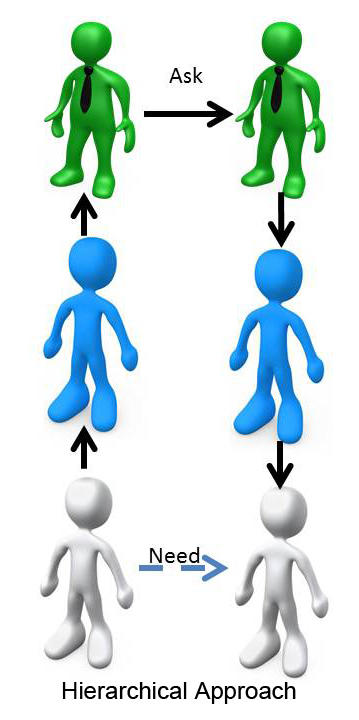
I deal all the time with people in organizations who are trying to get things done without the direct authority to ‘order’ people to do it.  These are people who sit in one organization who need the cooperation of people in another organization.  These are Senior Executives who need their peers’ cooperation to accomplish their own division’s goals.  These are Project Managers who need business leaders or other project leaders to do things before they can deliver their own project goals.  These are entry level people who need the collaboration of more senior people.  Back in the day when we all worked in purely hierarchical organizations, this is the way it worked:

Getting Things Done Through the Hierarchy

The person who needs something from another person in an organization asks his boss, who asks her boss, to asks his peer, who tells her subordinate, who tells his subordinate and it gets done, unless there is a dispute.  If there is a dispute, it reverses and goes back up and back down, then back up and down.  Usually many days, or even weeks have transpired before the original need gets fulfilled.  This is a pretty inefficient way of getting things done, unless everyone is completely committed to moving things fast.

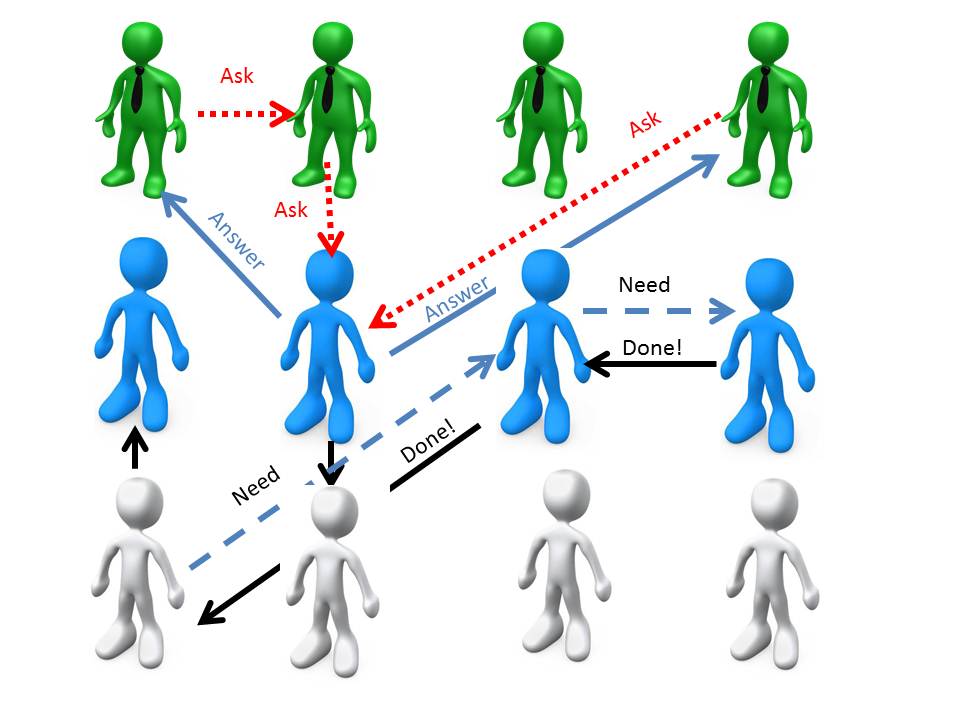
Organizations today are less hierarchical, flatter and more networked.  In an ideal world, this is the way things would work:

Being able to get things done this way depends on RELATIONSHIPS, trust, communication, urgency, political savvy, persuasiveness, and understanding organizational economics.  Being able to do this can make the difference between being stellar standout and being stuck in your position.

RELATIONSHIPS

It is who you know, who knows you and how much they care about you.  You need to have relationships–friendly, bi-directional relationships that are mutually win-win.  It is not about rank and power so much as about knowledge and cooperation.  If you look at the picture above, if the people at the bottom of the organization know how to help you AND ARE WILLING, then you get as much done as if you boss’ boss talks to their boss’ boss.  People will generally do something for you if there is no skin off their nose AND if they see it as beneficial. They generally see it as beneficial if you have at some time in the past done something for them, or if they think that that is likely to happen in the future.  Do things for people throughout the organization without requiring return,and eventually, you will get significant return from it.

Trust

If people trust you, then they are likely to help you whether or not you have the authority to “make” them do something.  People don’t have to trust you with their life, but they have to trust you not to sabotage them in some way, to stand up for them if necessary (after all they may be technically breaking a rule by doing something without appropriate hierarchical authority), and to reciprocate if they need something. For more on creating trust, read Trust Me, Damn It!  Ironically, sometimes asking for something helps improve a relationship and builds trust.  Ask for what you need–don’t be afraid.

Communication

The best way to get help from people who aren’t in your organization is to explain WHY you need what you need.  If they can understand the context of your request, if you can make it real for them, then they are much more likely to go along–especially if there is little to no risk to them.  If there is risk to them–to their own deliverables, to the schedule they’re supposed to hit, to their relationship with their peers or their boss–then your communication needs to be much more compelling.  You need to be clear about what is in it for them to help you that overcomes those risks? 

Unless you have a well established relationship–and even then, think twice–do not make these requests via email.  Email is too easy to ignore, to hard to be clear and too hard to be persuasive.  Talk in person (preferable) or by phone.  It is better to have worked on these relationships before you need them, but even so, be friendly and interested BEFORE you make your request.

Urgency

If people believe that what is needed is needed quickly or else important things will be slowed down or blocked, they are more likely to do it than if they feel no urgency.  Creating a sense of urgency must be done carefully, lest you get a reputation of “crying wolf,” and lose your credibility.  Why do you need what you need quickly?  Be honest, but also believe what you’re saying.  Speak with urgency and you’ll likely convey urgency.

Political savvy

In order to successfully get things done in your organization, you need to understand the politics in the organization.  Who has the power?  What relationships exist across your organization.  What are the rivalries?  Who is the ‘core’ group in each organization that you work in and around?  In other words, who are the three or four people who make the decisions?  Who do they listen to? Who can help you get the decision/resources/help you need go your way?  Are there hidden agendas?  What are they?  How does what you need to do fit into those agendas?  Whose agenda is supported by what you’re trying to do?  Whose agenda isn’t?  Trying to get things done in an organization without understanding these things is like driving on a road you know nothing about–where it goes, whether it dead ends, how fast you can go, whether there are any gas stations along the way.

Persuasiveness

Being persuasive is a critical skill for getting things done in organizations.  There is no tool that is more valuable.  Being persuasive begins with understanding the other person’s issues with regard to your argument, and then finding a way to reduce or overcome them by helping the person see very clearly WIIFM (What’s In It For Me) about what your trying to get done.  Provide a context that helps the person be persuaded.  A great book to help you learn to be more persuasive is Robert Cialdini’s, Influence. the Art of Persuasion.

Secrets

One of the biggest secrets in organizations is that people at all levels of the organization can get things done across the organization.  The most important step is to Do It. Figure out who can help you.  Figure out what is important to them.  Figure out how to approach and persuade them. Then ask.  Don’t give up.  If one way doesn’t work, try another.  Keep taking routes till you find one that works.  Make positive relationships along the way and PAY PEOPLE BACK.  Go for it!

1 Comment

Filed under Career Development, Communication, Executive Development, Networking, Success

The Transition From Manager to Leader

manager to leaderLeaders v. Managers

I’m sure you’ve probably heard about the differences between managers and leaders.  Managers do things right and leaders do the right thing–right? I think that this is an interesting discussion, but it isn’t that easy.  Managers do leader things and leaders do manager things. Each of us is naturally oriented toward one or the other–we either are inclined toward structure, processes, policies and systems or toward strategy, inspiration, vision and people.  But we can all learn to be either a manager or a leader or both a manager and a leader.

The Leadership Continuum

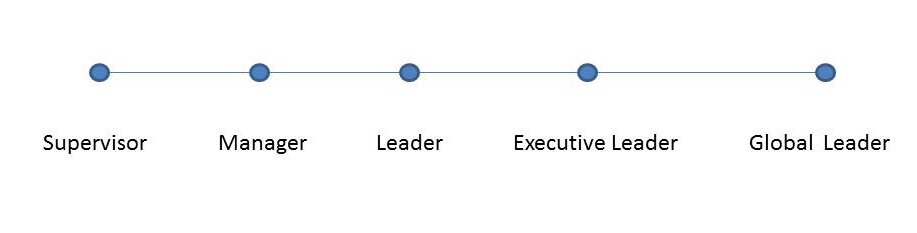
Many have described this as a dyad–either/or, a choice between two options.  I see it more as a continuum.

Manager to Leader

A continuum that ranges from supervisor to manager to leader to Executive Leader to Global Leader. This is not to say that supervisors can’t be leaders or that Global Leaders (positionally) aren’t managers.  There are cumulative skills, though, across those roles that are needed to deal with increasing complexity as a person accumulates more responsibility.

Moving Along the Continuum

Michael Watkins, whose books I’ve recommended in this blog before (The First 90 Days and Your Next Move) has a recent article in Harvard Business Review that is well worth the read.  He writes How Managers Become Leaders in the June issue of HBR.   Watkins identifies seven “shifts” that are required to grow managers into leaders.  These shifts are:

  • From specialist to generalist
  • From analyst to integrator
  • From tactician to strategist
  • From bricklayer to architect
  • From problem solver to agenda setter
  • From warrior to diplomat
  • From supporting cast member to leading role

These shifts require developmental experiences that change your perspective and force you to step out of your comfort zone.  You also need to be exposed to regular 360º feedback that allows you to understand whether or not your behavior is working for you in the situation.  And finally, you need to be dedicated to continuing to grow your self by challenging your assumptions, habits and behaviors to move along the continuum.

Leave a comment

Filed under Books, Career Development, Executive Development, Feedback, Hi Po, Leadership, Personal Change, Success

Break the Rules? Only After Careful Consideration.

Breaking the Rules

Rules Have Reasons

Rules in organizations are there for a reason.  Someone at some time figured out that there needed to be guidelines in place to govern the situation.  These rules can be formal–procedures written in manuals that have multiple levels of approvals–or they can be informal–all employees start at 7:30, even though work hours are published as starting at 8:00.  Rules are completely fine until they interfere with getting things done.  In some organizations, that rarely happens.  In other organizations, it happens often.  How do you know when you should ignore the rules to get something done, and when do you sacrifice getting things done to follow the rules?

There are 3 factors that can help you make the decision:

  • Risk Management
  • Ethics
  • ROI

Risk Management

What are the consequences of not following the rules?  Remember, the rule is there for a reason.  It is not there to annoy you or to keep you from doing what you’re trying to do.  That may be a consequence of the rule, but there is a bigger reason.  What is that?  What is the rule trying to ensure?  Quality? Safety?  Adherence to law or regulation?  Don’t short circuit this analysis.  Really understand why the rule is in place.  Does not following the rule put the organization at some risk?  What if doing it faster, or short-cutting some steps, risks creating a product with flaws or alienating customers?

What benefit is there to not following the rule?  Does something need to get done in time in order to meet YOUR personal performance goal?  Your group’s goal? Does the organization save money?  Does something get to market in time to generate significant revenue? Making dates is rarely a sufficient reason to break important rules–especially if they are your personal performance dates.  Revenue might be a sufficient reason if there are ways to mitigate the risk.

Who is for and who is against breaking the rule?  Just your organization?  The top of the organization?  This tells you a lot about the significance of the risk and whether you’re in it alone or not.  Try to identify ways to mitigate the risk.  Can you put more resources on following the rule?  Can you fix the issues later?  Will you?

Ethics

It goes without saying that you shouldn’t break the rules when it is unethical.  Unfortunately, knowing when this line has been crossed can be hard to see when you are in the heat of the moment.  We all like to think that we are really clear on what is ethical and what is not.  The problem with that assessment is that we have different ways of determining what is ethical–

  • What is the balance between bad and good?  What is ethical provides the greatest benefit to the most.
  • What is just?  Is it ‘fair’ to break the rules for the identified purpose?
  • What is best for the common good?

Most of us have problems putting decisions about dates or procedures in these categories.  But what about cost overruns?  Who is the loser?  The shareholder?  The employees?  The customers?  What about short cuts with potential safety issues?  What about doing these things just to ‘make your numbers?’

ROI

What is the cost of following the rule v. the cost of breaking the rule?  We tend to make this analysis too shallow.  What if everything that the rule is in place to protect against happens?  What about that cost?  Think about the recent JP Morgan losses?  JP Morgan itself had rules in place that were broken.  The consequences far outweighed the reason for breaking the rules.  Remember the Firestone tire crisis?  Replacement workers manufactured most of the tires that later were identified as defective.  One ROI analysis (labor cost) was done without a thorough view of another ROI (losing customers/potentially causing accidents).

Bottom line

Don’t break the rules lightly.  If they are stupid rules, give them the benefit of the doubt and try to figure out why they were created.  Do a thorough analysis of all consequences before breaking the rules.  Try to figure out how to mitigate the risks.  Try to get buy in all the way up the organization.  The higher up the agreement to break the rules comes from, the more likely that it is truly best for the organization.  This isn’t a guarantee, of course.  It was the top of the organization that made the decisions at Enron.  Don’t make short cuts for short term reasons.

Leave a comment

Filed under Career Development, Executive Development

Get a Mentor. Use a Mentor.

Get a Mentor

I know you’ve heard it.  If you’ve been reading this blog, you’ve heard it from me.  You need a mentor to help your career.  Easier said than done, right?

How Do I Get a Mentor?

Typical questions about mentors and mentoring are:

  • What is mentoring?
  • How do I find a good mentor for me?
  • How do I ask someone to be my mentor?
  • How does having a mentor work to help my career?
  • What if my mentor and I don’t get along?
  • What if my mentor won’t meet with me?
  • How do I end the mentor relationship?

What Is Mentoring?

Mentoring, first and foremost, is a LEARNING relationship.  The old-school model of mentoring was that the senior, experienced successful mentor took the junior, inexperienced mentee under his wing (yes, it was always a ‘he’).  Today’s mentoring is much more complex, but much more productive.  It is different depending on the people involved.  It could be a senior person helping a junior person succeed in an organization.  It could be an expert helping a novice speed up the process of learning.  It could be a junior person helping an executive understand social media.  The key parts to a mentor/mentee effort are LEARNING and RELATIONSHIP.  It is a collaboration, not a one-way relationship.  Both parties, but most importantly the mentee, take responsibility for the success of the relationship.  The mentee must have a plan, goals and the willingness to step up and reach out for the mentoring to be maximally successful.

How Do You Find A Mentor?

You start with what you need.  When you think about your career, what is it that you need?  Do you need to learn how to navigate the organization’s politics?  Do you need to learn how to be an effective executive?  Do you need Executive presence? Do you need to learn how to manage technical people?  Do you need to learn to manage your peers?  Think strategically?  Present your ideas better?  Whatever it is (and don’t focus on everything at once–pick the biggest/most important thing), think about who you know, or know of, who can do it well.  If there is more than one person who fits that description, who do you think has the best ‘chemistry’ with you.  Who do you most want to learn from?  Who might have more time? Who do you think might be the better teacher?  Based on these questions, pick someone who could mentor you in what you need.

How Do You Ask Someone To Be A Mentor?

Once you’ve identified someone, make a plan.  What do you want to learn from the person?  Over what time period?  What format would work best for you?  Informal–like over coffee?  Formally scheduled meetings?  Asking questions?  Your mentor talking and telling stories?  Once you’ve thought through these, what kind of proposal can you make to your mentor?  Something like:

I’ve admired how well you navigate this organization to get things done for your organization for a while now.  I was wondering if you’d be willing to mentor me on how to do that?  I was thinking maybe we could have coffee some morning and you could share with me some of the things you wish someone had told you?

Imagine if someone approached you this way.  It’s likely that you would be flattered.  If you had the time, it is likely that you would be willing to do this.  You’re not asking for a long term commitment in this situation.  You’re testing the waters.  If you have the first meeting (which, if it is more comfortable for you, you could formally schedule a meeting), and the chemistry seems good and the mentor seemed to enjoy it as much as you did, then you can ask for another meeting.  In the second meeting, you can ask the person about him/herself.

  • How did you get to where you are in the organization?
  • What have been your biggest career learnings?
  • What do you wish you had known that you know now?
  • Are there things you would have done differently?
  • Which jobs have taught you the most?  Which bosses?

If this conversation goes well, then it is time to suggest that the person be a mentor.  Ask if he is willing to be your mentor.  Tell him what kinds of things you’d like to learn from him.  Over what period of time?  How often would you like to meet with him?  (Be very reasonable here).  Show him that you will take responsibility for learning with him as your guide.  If he agrees, ask him how he wants you to be prepared before your conversations?  What kind of follow-up and follow-through does he want?  Get clear on your goals.

If you approach it in these stages, you get to feel out the relationship element of the mentoring–do you think it will work?  Push yourself to ask if the relationship works for you, because it will be worth it.  If s/he says no, don’t take it personally.  It is probably about time commitment or, just as likely, about the mentor feeling inadequate to the task.

How Does Having A Mentor Work?

The mentoring relationship is about learning–usually both the mentor and the mentee learn.  Sometimes the mentor is able to open doors for opportunities, but almost always the mentor opens minds.  The mentor helps the mentee see the world through different eyes (usually higher ranking eyes).  The mentor helps the mentee have a new perspective–thinking strategically instead of tactically, thinking like a sales person instead of an HR person, understanding how decisions get made at the top of the organization.  These new perspectives are JUST AS IMPORTANT as if the mentor helps the mentee land a new job.  It is these new perspectives that enable the mentee to succeed at the new job.

What If We Don’t Get Along?

Sometimes mentors and mentees don’t get along.  Having a couple of exchanges before you ask for a more formal mentoring relationship can sometimes help avoid this, but not always.  If you don’t get along with your mentor, ask yourself why.  Is it because she is speaking truth to you and you don’t like it?  If that is the reason, it is probably very worth hanging in there.  It is really hard to get people to tell you the truth–it is easier to learn to deal with it than to find someone else who will tell it.  Is it because the mentor reminds you of someone who you haven’t gotten along with in the past?  Your father?  Your older sister?  Your first boss?  Again, it’s really better to work through these issues than to find someone else–this is the kind of issue that will continue to bit you until you learn to deal with it.  Is it because the person is a bully or abusive?  If so, then it is best to end the relationship.  Don’t end it by stomping out.  Just thank the person for all the help s/he has provided (this is VERY important) and tell him/her to be sure to let you know if you can return the favor.  Then don’t schedule any more appointments.

What If My Mentor Won’t Meet With Me?

It is highly that anyone you want to mentor you is a very busy person.  When you have the conversation requesting that she become your mentor, you need to agree how often you will meet.  The more you can talk it out–what to do if one of you has to cancel, what to do if scheduling becomes a problem, what are the expectations, what to do if this becomes too burdensome–the less likely this is to be a problem.  After a number of cancels–this number should be different if it is a CEO v. a manager–then it is appropriate to ask whether it would be better to take a break till a time that is better.  Then go find someone else.  The biggest risk here, though, is that you will interpret normal scheduling problems as the mentor not wanting to do this.  It is likely that the mentor just has a busy schedule.  Don’t read too much into it.

How Do I End The Mentor Relationship?

It is best that you make some kind of arrangement for the end of the mentoring relationship (not the end of the relationship) in the initial agreement that establishes the relationship.    You can make it time specific or task specific–get through your next performance review, or do an Executive level presentation, but you do need to identify what the goal and timing of the mentoring relationship should be.

Many, many mentor relationships end and friendship remains.  That is ok, but be careful to make the shift in your mental model.  Be sure to thank your mentor in a meaningful way.    It’s great to keep notes as the mentoring proceeds and to write a summary of what you learned over time for your mentor.  It will help cement the learning in both your minds.  This could be one of the most important relationships of your working life.

A Good Book That Will Help

1 Comment

Filed under Books, Career Development, Career Goals, Executive Development, Feedback, Success, Trust

Stephen Covey and his Gifts to Business People

All business people owe a lot to Stephen Covey, who died this week at the age of 79.  Covey wrote his book, The 7 Habits of Highly Effective People, in 1989.  There were no earth shatteringly new concepts in it—to be highly effective, people should:

  • Be Proactive
  • Start with the End in Mind
  • Put First Things First
  • Think Win-Win
  • Seek First to Understand, Then to Be Understood
  • Synergize
  • Sharpen the Saw (balance and renew yourself)

At some level, most of us know that these are things to do.  In a way, though, Covey took it a step further.  He seemed to say, these are a good way to BE.  Practice these behaviors until these are a part of who you are.

Covey infused his work, and his speaking and teaching, with what is known as Spiritual Intelligence (SQ).  In his 2004 book, The 8th Habit, Covey defined Spiritual Intelligence :

“Spiritual Intelligence is the central and most fundamental of all the Intelligences because it becomes the source of guidance for the other three . . .  Spiritual Quotient [is] “conscience, ” having the following characteristics:

  • enthusiastic
  • intuitive
  • takes responsibility
  • moral
  • wise
  • integrity
  • servant
  • humble
  • fair
  • ethical
  • abundant
  • compassionate
  • respectful
  • cause-oriented”

Covey was one of the first, and certainly the first popularly available, to bring this kind of thinking into the workplace.  It was Stephen Covey who helped leaders understand that there was something greater than the bottom line, something somewhat intangible—you know it when you see it– to bring to the table when leading organizations.  Covey helped people understand their own personal responsibility for ‘leading’ themselves through self-management and positive interaction with others.  He encouraged people to “find your voice” and inspire others to find theirs.

His writing and teaching encouraged people to be whole, to focus on all the parts of their lives and to do that which was most important, not what was more urgent.  When I read Jim Collin’s later book, Good to Great, I was struck by the description of Level 5 Leadership and how closely these leaders seemed to follow Covey’s 8 Habits:

Level 5 Leaders

  • They are humble and modest.
  • They have “unwavering resolve.”
  • They display a “workmanlike diligence – more plow horse than show horse.”
  • They give credit to others for their success and take full responsibility for poor results. They “attribute much of their success to ‘good luck’ rather than personal greatness.”

One of the most important things that I ever heard Stephen Covey say was his description of how he came to these ideas.  He said that he went through all the theories of leadership, all the writing on leadership and pulled these behaviors on leadership from that research.  At the time, I was envious of the research that he had done, and I took with a grain of salt his conclusions.  I have since done my own research, traveling through many of the same thought leaders and historians that he did, and I now know that his conclusions are pretty right on, and much more coherent and inspiring than anything I could have come up with on my own.

R.I.P.  Stephen R. Covey, October 24, 1932 – July 16, 2012

1 Comment

Filed under Books, Executive Development, Leadership, Personal Change, Success

Onboard Yourself

Onboarding

Onboarding is the process that organizations use to get their employees up to speed enough to do their jobs.  Another term for it is “organizational socialization.”  Organizations have informal and formal methods for the knowledge transfer or processes, tools, methods, culture and introductions that is sufficient for the employee to be effective in his/her new job.  I’ve seen really good onboarding and really horrible onboarding.

The best onboarding I ever experienced personally was as a consultant when I was going to work for a group of consultants.   The onboarding was a combination of providing me with detailed “playbooks” of how the organization did its work and of having me spend intense time with each team of consultants to see/understand how they put the playbook into action.  I traveled weekly for my onboarding and in three weeks’ time, I felt that I understood the whole and was fully able to go do it myself.  It was the combination of the intensity, the excellent documentation, and the seeing it all in action—including being given tasks I didn’t know how to do, but being surrounded by people who could/would help me.

I’ve had so many “worst” onboardings that it is hard to pick just one.  They range from putting me in a room with a year’s worth of reading and leaving me to read for two weeks to putting me at a desk and spending less than 10 minutes telling me what to do and walking away, never to return.  I think that I eventually did OK, even at the jobs with these onboardings, but the time it took to get me up to speed and to be productive was vastly different.

I finally decided that I needed to take responsibility for my own onboarding.  As a consultant, it is critical that I hit the ground running and know enough in a week to make a difference.  If I wait for people (who all have other jobs and many of whom are not sure they want me here, anyway) to tell me what/how/when/why in the organization, then I will fail.  These processes can apply for anyone, in any job, including people who have been in the job for a long time.

DIY Onboarding

Steps to Your Own Onboarding:

  • Make a Plan:  Identify what you want to accomplish and how fast.  You have a fairly short period of time before people get over you being new and expect you to “do” something.  They are very open to questions in the early days; they think you’re dumb if you’re still asking questions later (even then, you need to ask questions to learn—deal with what they think).  Who do you need to know?  What do you need to know?  What do you need to be able to do?  Ask people what they think you need to do to be successful.  Then put in place a plan that gets you there.  Fast.
  •  Meet People:  Meet people at every level.  Set up meetings.  Invite people to lunch or breakfast.  Accept all invitations.  Learn the power structures.  Learn the informal networks.  Learn the ‘go to’ people.  Learn the whiners.  Learn who to listen to and who to avoid.  The only way to do that is to throw yourself into meeting people.  (Even introverts need to do this)  Ask people to help you.  Ask people who you should meet.  Ask people who helped them when they started.  Target someone to be a mentor in this process and ask for his/her help.
  •  Figure Out the Tools:  Luckily, today most organizations use the same fundamental tools—the Microsoft Office suite plus SharePoint.  If the organization uses different/other tools, however, learn these as soon as possible.  Learn Oracle, Salesforce.com, EPDM, or whatever other tool your organization uses.  You need to understand it and be conversant in its strengths and weaknesses.  (Every tool you learn makes you more marketable—use the opportunity of being new to dive in and learn new tools).
  •  Understand the Culture:  Every organization has its own culture.  This is like the water the fish swim in—the people inside the organization are not very aware of it consciously, but it shapes all behavior unconsciously.  When you’re new is the only time you can actually “see” the culture.  Don’t make the mistake of assuming it is like the culture you just came from.  Just because engineers are the dominant players in the new culture as they were in the old, there will be huge differences.  Learn these differences with “new eyes.”  Learn what the organization thinks about what makes success, who are the people who seem to “get it.”  What are they like?  How much does the leader shape the organization?  Is the founder still there?  How long since the founder was there?  What are the left over influences from that?  (These are frequently the things that don’t seem to make sense because they started a long time ago but are still there).  Write down your observations of the culture.  Make a mind map.  How does the culture influence the way that you will get your work done?  How can you use the culture to be more effective?
  •  Learn the Product/Customers/Processes:  Become an expert.  Take all the classes you can.  (Organizations frequently have classes for new sales people that are available to others).  Ask people about the processes.  Become best friends with the Intranet.  What’s there and what can you learn from what’s there?  What do others outside the organization say?  What do people in the organization say in reaction?  Everyone in every part of the organization needs to thoroughly understand the Product and the Customers.  You need to at least understand the processes in your own organization and those that take product to market and get money to the bank.  Like I said, BECOME AN EXPERT.
  •  Take Actions:  You have a very short window before people start to see action.  Look for opportunities to take early action.  It is better to be right about these actions, so be careful—but not too careful.  Action is better than no action, even if you make mistakes.  Ask your boss and peers what kinds of actions they are expecting from you and deliver them as soon as possible.

 Good Books That Help With This:

The First 90 Days, Critical Strategies for New Leaders at All Levels  byMichael Watkins

The New Leader’s 100-Day Action Plan by George Bradt, Jamye Check, and Jorge Pedrassa

2 Comments

Filed under Books, Career Development, Communication, Executive Development, Hi Po, Leadership, Networking, Recession Proof, Success, Time Management, Uncategorized