Tag Archives: Career development

What If Your Leader Won’t Act?

What if my leader won’t . . .

I get this question all the time.  My leader won’t make a decision; what do I do?  Why won’t the leadership in my company LEAD?  Things go up the chain, but nothing comes back down.  Why won’t they DO anything?  What do you do when you manager won’t . . . ?

These are hard questions.  There are all kinds of reasons why ‘leadership’ won’t act.  Your solution depends a lot on why.  Let’s take a few examples:

Your leader can’t/won’t make a decision.

Just because someone has a ‘leader-type’ title, doesn’t mean s/he is a leader.  Sometimes people are overwhelmed by the responsibility of making a decision.  Sometimes people get stuck making decisions because all the alternatives seem equally bad.  Or equally good.  Sometimes people are waiting for someone else and it isn’t obvious to the people waiting on them.

If this sounds like the situation with your ‘leader,’ then perhaps you can ‘lead’ from below.  Can you present the alternatives in a way that helps the leader choose?  Can you make a recommendation?  Can you help the leader talk it out?  Can you get some other folks to help the leader talk it out?  Can you just make the decision yourself?  (Remember, empowerment is not what others let you do, but rather what you step up to do?)

Don’t get stuck on the fact that the person outranks you and won’t do what you believe is appropriate to his/her role.  The important thing is to get things to the place that the organization can move forward, not WHO decides.

Your leader won’t step in and resolve a conflict.

Why don’t you figure out how to do this yourself?  You shouldn’t need an adult to get things resolved for you.  Figure out a process for resolving the dispute and get the other person to agree to the process.  Then apply it.  In other words, agree that you’ll ask others, or you’ll have a vote, or you’ll agree to disagree, or you’ll take turns.  Then do it.  Don’t let your manager’s conflict aversion cause things to stop.

Your leader won’t resolve a resource issue.

Can you figure out why your manager can’t/won’t resolve it?  Does s/he believe there is a resource issue?  Does s/he believe that the resource issue will really negatively impact the project/organization?  Does s/he believe that the answer will be no from his/her management?

Approach the problem by laying out alternatives.  “We can add these resources OR we can reduce the work OR we can slow things down.”  Sometimes helping the person see all the alternatives helps them pick one (which may not be your first choice, but may resolve/reduce the problem).  Think the problem through thoroughly.  Come up with at least three potential solutions–one of which is add resources.  What if there is no money for the resources you need.  Then what?  What would you do? HELP your manager figure this out.

Your leader won’t do ANYTHING.

First, make sure this is true.  Are you sure that this is reality or your perception–ask others who work for your leader or who have in the past.  Ask what has worked for other people.

If nothing works, then you have a choice.  You can either give up (I STRONGLY don’t recommend this) or you can  go find another leader.  If you allow your leader’s inaction to shut you down, then it will likely derail your career if it becomes a pattern.  If you decide to choose another leader, make sure that the new leader is what you’re looking for in a leader.  Just as there are patterns in the relationships we choose, there are patterns in the situations we get into at work.  There is no point in wasting years of your career in a no-win situation.

Fix it.

 

Leave a comment

Filed under Career Development, Communication, Executive Development, Leadership, Reframe

Are You A Wannabe?

Are you an Executive wannabe?  An entrepreneur wannabe?  An artist wannabe? A marathoner wannabe? An author wannabe?  Do you put one of those on your New Year’s Resolutions list?  How about your career goals list?

What Is Stopping You?

Look at last week’s calendar.  Look at last month’s calendar.  Is your ‘wannabe’ goal anywhere on your calendar?  If not, why not?  How can you possibly accomplish your goal if you’re not spending any time on it?  Don’t tell me you don’t have time.  People who really want to do something have time.  Every successful accomplished person who has done what you want to do has EXACTLY the same amount of time that you do.  It comes down to six things:

  • Priority:  If this is your future, then you need to put it sufficiently up your priority list that you are spending time on it
  • Motivation:  Understand what motivates you and put that in your life.
  • Focus: You CANNOT do it all (at once).  Turn off the TV.  Stop surfing the Internet.  Stop texting.  Take yourself to some place quiet and isolated.
  • Determination:  Keep working toward your goal, no matter what gets in the way.
  • Create whatever support infrastructure you need.  If you need training, get it.  If you need a coach, get one.  If you need a place, find one.
  • Action:  I hate to be repetitive, but JUST DO IT

Winning

So, How Do You Do That?

  • Write it down.  Be very specific.  Not ‘Write a book’ but ‘Write a novel, get a book contract, and get it published by this time next year.
  • Once you’ve written the specific goal, work backwards.  In order to write a novel, get a book contract and get it published, what do you have to do?  In order to do those things, what do you have to do?  Ask what you have to do and detail it several times.
  • Once you have a fairly detailed list, decide what you are going to do tomorrow.  What are you going to do this week.  Look at your calendar and put these tasks on it.  Take something off your calendar to make room for it, if you have to.
  • What reward will you give yourself for which accomplishments.  It doesn’t have to be something big–just something that you will associate in your mind with accomplishing the task.
  • What are the big milestones in your plan?  How will you reward yourself for these big milestones?
  • Hold yourself accountable.  Tell someone–that makes it harder to escape the accountability.

Great books to help with this:

1 Comment

Filed under Books, Career Development, Career Goals, Goal Setting, Personal Change, Time Management

Not Your Mad Men Career Ladder

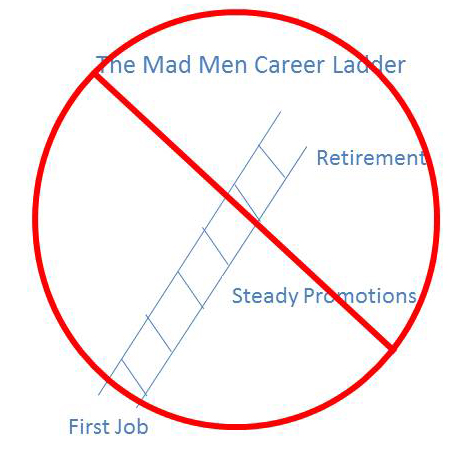
Way back, before most of us were working, you got a job with a company and you stayed with that company–making steady progression–until you retired.  You were, of course, a man.  If you got fired, you had done something pretty bad.  Layoffs didn’t happen very often.  There were career ladders that you took all the way from your first position to your last position.

traditional career ladder is no more

This is so long ago that many people reading this don’t get it, don’t know why we still talk about it, and think this is a no-brainer.  We still talk about it because this model still shapes our expectations in many ways.  Our infrastructure is not set up to support the current reality–if so, we’d have portable health insurance and retirement plans.  We’d also be much more focused on taking care of ourselves in our careers rather than leaving it to companies.  It is time for our mental models to catch up with reality.

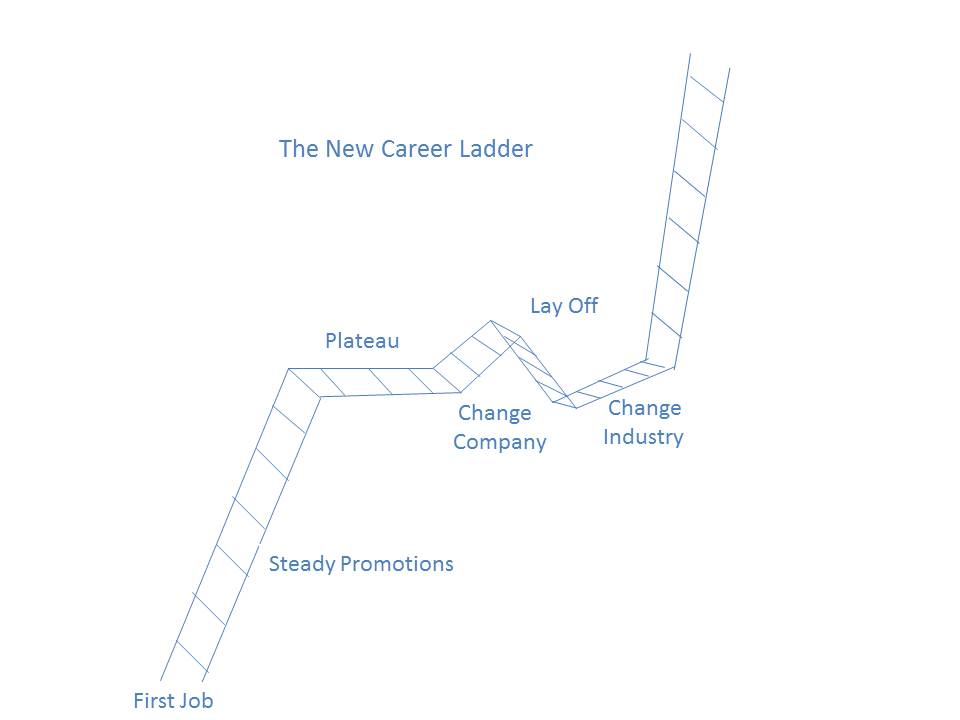
The current ‘career ladder’ looks a lot more like those cool folding ladders that can be shaped over obstructions and can bend in several directions as necessary to do the job.

todays career ladder

The current ‘career ladder’ takes you up when that is possible and helps you deal with the plateaus, job losses, industry and functional changes that are necessary to remain resilient and successful in today’s economy.  Today’s ‘career ladder’ needs to focus on skills and trends rather than specific roles in specific companies in specific industries.  Find ways to “Genericize Yourself,” that enable you to move across industries.  Find ways to specialize (I know, those sound like opposite pieces of advice, but they aren’t), so that your value (brand) is obvious.  Build your resilience for all kinds of shifts in the economy–think of the shifts that have happened in publishing, electronics, e-marketing, and are happening in health care and communications now.  You can’t know what is coming, but you can be ready.

Leave a comment

Filed under Brand Yourself, Career Development, Executive Development, Job Hunt, Recession Proof, Success

Manage Your Resistance

Manage Your Resistance

Put Your Leader Hat On

Who would you rather work with if you’re implementing a new change in your organization?  Would you rather work with someone who has been there for ten years–who knows his/her way around the organization, who knows how to make things happen in the organization?  Or would you rather have someone who has been there a couple of months, who has begun to know where the bathroom is and where important people sit?

The ten-year guy, right?

Wrong!

Why is that? Because the ten-year person is really committed to the way things are–‘the way we do it.’  Even if s/he doesn’t like it.  Even if s/he complains about it.  The ten-year person has been through all the ‘we tried that and it didn’t works,’ all the times s/he had to be reorganized or was left to do the work of those who left, who had to learn new systems, and who may or may not remember the good parts (results) of those changes, but who does remember the problems.  The ten-year person doesn’t want any more change (unless s/he gets to direct it).

The new person not only doesn’t have that history, or those scars, but also EXPECTS to have to go through those kinds of changes and challenges.  The new person follows directions and tries to please whoever is in charge.

Now, Which Are You?

Are you the new person who is emotionally and intellectually ready to not only participate, but also to help?  Or are you the long-term employee who isn’t?  You may be telling yourself that you are change-ready.  And maybe you are.  But change burnout, or change immunity, happens to all of us.  Yes . . . even me.

I’ve been doing change management for a long time.  I really know how to spot resistance and how to deal with it.  I got a new boss one time, after having changed bosses 3 times in the past 12 months.  I didn’t even realize how done with new bosses I was.  That is, I didn’t realize it until one of my employees said to me, “For someone who knows so much about change, you sure don’t handle it very well.”  She was right.  I wasn’t handling it well.  My capacity to deal with change had been used up and I was on the resistance end of the continuum.  My employee did me a favor.  I didn’t really realize how much my fed-up-ness was showing until she said that.

Wouldn’t it be a good idea to put yourself in that new employee mindset?  Wouldn’t it be a good idea to try to think like someone new to the organization (while at the same time bringing all your organization skill, knowledge and abilities to the table)?  Whenever I become aware that I’m in ‘resisting’ mode, I remind myself–if I had just started today, I wouldn’t think about all the reasons this is a stupid idea–I would just accept it and do it.

Try it.  It helps.

Note:  I am not saying that you should blindly follow without contributing opinions and constructive criticism.  Just be sure that that is what you’re doing though, and not resistance.  Resistance is a normal reaction, but it isn’t helpful to your career, so learn to manage it.

2 Comments

Filed under Career Development, Executive Development, Leadership, Success

Create a Stakeholder Plan For Your Career

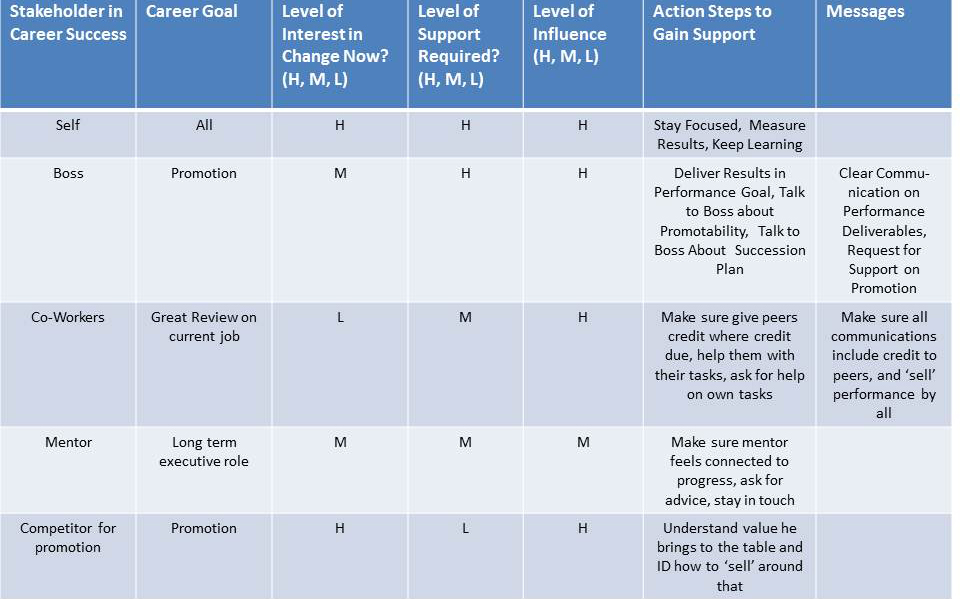
I’ve been working a lot with Stakeholder Plans for large organization change lately, and I was thinking that it would be a good idea to create one for a career plan.  For those who haven’t had the pleasure of creating a stakeholder plan yet, it is a way of identifying who has a vested interest (in this case, in your career success) and creating a plan to get their help in achieving your goals.

Who Are Your Stakeholders?

For example, identify who has any kind of an interest in your career success:  your boss, your peers, your mentor, your former bosses, your family, your future boss. Anyone, whether they are supportive, neutral or hostile to what you want to accomplish, should go on the list.

Stakeholder Assessment for your Career

Come Up With a Plan

Then identify which career goal each has an interest in and what that level of interest  is–your boss may have a high level of interest in your successful delivery of your current performance goals, but no interest at all in your promotion to a position outside his organization.  Understanding this, and creating a plan to mitigate your boss’ ambivalence may be essential to getting that promotion.  S/he may sabotage your promotion in order to keep you.  A stakeholder assessment–that requires you to think through all the players and come up with both an action plan and a communication plan for each, is likely to crystallize your thinking of next steps, and to speed your career on its way.

Categorize Them

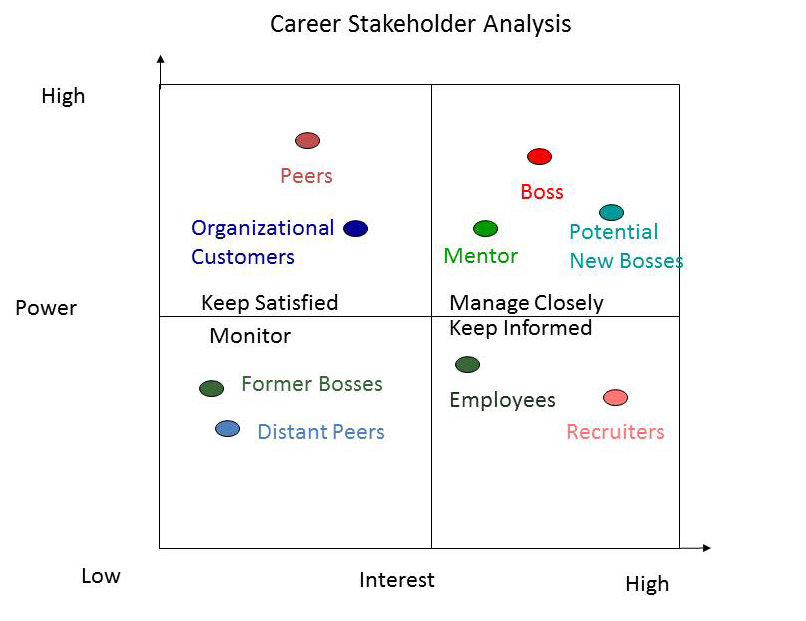
Once you’ve created a grid similar to the one above, you can create a graphic that divides your stakeholders into categories:

  • High Power/High Interest:  Manage Closely (like current boss/potential new boss)
  • High Power/Low Interest:  Keep Satisfied (like peers/organizational customers)
  • Low Power /Low Interest:  Monitor (like former bosses/distant peers)
  • Low Power/High Interest: Keep Informed (like employees/recruiters

Career Stakeholder Grid

Manage Them

Depending on your goals, your organizational situation and your timing, these stakeholders and their position on the grid will be different.  The most important part of this is to think it out–where are your key stakeholders on the support continuum, what is in the way of their full support and what can you do about it?  People feel threatened by other people’s career success and the more you’re aware of what people are thinking, the better you will be able to manage it.  Stakeholders who could be powerful supporters for your career goals may not know what they are–this exercise can help you identify that issue and come up with a great plan to solve it.

Leave a comment

Filed under Career Development, Career Goals, Executive Development, Goal Setting, Job Hunt, Recession Proof

Promoted! Now What?

success at work

Congratulations!  You just got promoted.  Or you just got reorganized into a new department.  Or you just got a new boss.  How do you make this a step in the right direction and keep from crashing and burning.  Ok, crashing and burning is unlikely–you did persuade someone that you deserved the promotion.  Getting stuck is a possibility.  Looking like you weren’t ready is a possibility.  Not making a great impression is definitely a possibility.  So, what do you do?

It’s a New Job

One of the most important things to do is to understand that this is a NEW job.  Treat it as if you just got to a new company.  Look at the experience through new eyes.  Who are the people?  What is the power structure?  What does the company need to be successful.  What does the department need to accomplish in the short term?  In the long term? What does the department need from you to be successful?  Go talk to people as if you’re meeting them for the first time.  What is important to them? What are their goals? How can you hit the ground running?  How can you quickly show that choosing you was the right choice?

There is a subtle difference for most of us when we change jobs within the company and when we change companies.  When we go to a new organization, we are completely aware that we don’t know everything.  We have our hyper-alert antenna out.  We are in the “conscious unconscious” state of learning.  We are aware of all the things that are different from our last experience (although we frequently miss things because of our ‘old company’ mindset).  When we change jobs within the same organization, we think we know how it is.  We know a lot of the people (although through the eyes of the last group we were in), we know the business (ditto), we know the problems, challenges, opportunities (ditto, ditto, ditto).  The problem is, the new job within the same organization is just as new as the other.  If you put yourself in the same hyper-alert state, you are much more likely to be highly successful.  You are much more likely to impress, because people will see you differently (than they had before) too.

First Impressions

Remember that although people may know you (some may even have been your peers before your promotion), you still have the opportunity to make a ‘new’ first impression.  If you are really trying to make a good impression, you’re likely to get attention again.  Make sure it’s the right impression.  Make sure you don’t come across as arrogant or smug (especially to your former peers).  Make sure you come across as smart and interested and capable and willing.  Make sure that people see results QUICKLY.  The best way to do all of this is to treat the promotion as if it were a new job at a new company.

Helpful Books

Congratulations!  And good luck.

2 Comments

Filed under Books, Career Development, Executive Development, Leadership, Reframe, Success

Get Your ‘Get Up and Go’

motivate yourself

I spent much of Sunday morning watching a few hundred people participate in their first triathlon.  It was sixty-something degrees and drizzling.  What would possess these people—all ages, shapes and sizes—to come out in the rain to inflict discomfort on themselves?  They swam a quarter of a mile in a lake, biked 12 miles on rain slick country roads and ran 3.1 miles over hilly trails.  At the beginning and end of each portion of this event, each person had a small cheering section, but for the most part, each participant swam/biked/ran alone, competing against the elements and motivated by him/herself.  How did each person motivate him/herself?  How can you motivate yourself to do whatever your goal is?

Well, the good news AND the bad news is that motivation is individual.  Every person is motivated differently.  Some people need praise to be motivated.  Some people need to feel like they’re contributing.  Some people need to be able to tick off the boxes of their goals to be motivated.  Some people like public recognition, some hate it.  Few people, believe it or not, are motivated solely by money.  In fact, money can be a demotivater–it’s not enough or it’s less than so and so got–you spend more time thinking about the negative than the positive of money rewards.  Anyway, the way you are motivated is unique to you.  You need to figure out how that is and then put it to work for you.  You need to NOT wait for someone else to motivate you.  Others can help (like the individual cheering sections at the triathlon), but you need to take the responsibility and develop the skill to motivate yourself.

There are two types of motivation:  external and internal motivation. External motivation is in play when you are thinking that you “should” or you “want” to do something.  You’ve got internal motivation when you “love” something or you “gotta do it.”

There is a motivational continuum between external motivation and internal motivation.

Motivate yourself

If you are all the way at the external motivation end of the continuum, then your motivation comes not only from outside yourself, but actually from other people—people who tell you what to do.  You’re not doing it for yourself, but rather for others.  If you are at the internal motivation end of the continuum, then you do it because you feel whole when you do it.  You do it despite all the excuses/distractions/opportunities not to do it.  You REALLY do it.

The question is, how do you push yourself toward the internal motivation end of the spectrum?  First you need to understand what motivates you.

  • Are you a planner?  A list person?
  • Do you need to be encouraged by others? Recognized by others?
  • Do you need to feel like you accomplished something? Made a difference?

Think about times when you were most motivated.  What made that happen?  Was it that someone was proud of you?  (External motivation)  Was it that you could look at what was happening and you were proud of yourself? (Internal motivation). Whatever it is that pushes you, figure out a way to put that in your life.  Create a situation that provides the reward(s) that work for you.  They don’t have to be big rewards.  Frequently people are just as motivated by any reward–that they care about–as a big reward.

The key is that you have to take charge of your own motivation.  You will see your performance rocket significantly.  Steve Chandler’s book. 100 Ways to Motivate Yourself, will give you lots (100 to be precise) of ideas on how to motivate yourself.

Start experimenting.

3 Comments

Filed under Career Development, Career Goals, Executive Development, Goal Setting, Success

How to Increase Your Visibility in Your Organization

Who Knows Who You Are?

One of the most important things to realize as you work your way up the ladder at your organization is that other people are rarely as aware of you as you think.  You work hard.  You deliver great results.  You deliver more projects/faster/better than anyone else.  The Powers-That-Be rarely are aware of the nitty gritty detail of who does what to get the results.  Your manager may not even be as aware of what you’re doing/delivering as you think.  Your peers may think they had as much to do with what you delivered as you do.  This is not malicious–it’s human nature.  We live in our own little world and we filter out that which is not most important.  Other people’s accomplishments are rarely as important to us as our own.

Stand Out In Your Organization

How Do You Do It?

Tell people what you’ve done.  Find a way that is comfortable for you to tell what you’ve accomplished.  You know how to do this with friends and family.  Use the techniques you used when you were dating–figure out how to make it interesting and not narcissistic.  Leaders find out who is doing well through being told.  It has to start with you.

Seek out and volunteer for projects. Make sure your leadership knows you are willing and capable when the organization needs someone to step up and make things happen.

Figure out how to get your manager and your peers to be advocates for you.  The best way to do this is to be advocates for them. They will likely mirror your behavior.  Don’t be afraid to ask for support from your boss or peers to advocate for you being on a project or recommending you.

Make sure key executives (not just your own) know who you are.  Figure out a way for them to know your work.  One of the best ways to do this is to volunteer for projects in other executives’ areas of responsibility.  In other words, be your department’s representative on cross-departmental projects.

Be involved outside your job, especially in organizations where  senior leaders participate. Attend and volunteer in professional organizations.  Make sure your organizational leadership knows about your successes in these outside organizations.

Speak up.  If you don’t contribute to the conversation, people think you can’t/don’t know anything.  They don’t make any more thorough analysis than that. If you aren’t speaking up because you don’t think you have anything clever to contribute, the good news is that people don’t judge what you say too closely.  So, they do judge when you don’t talk, and they don’t judge the quality of what you say very harshly.  Go figure.  But speak up.

Become an expert.

Build your expertise.  Within your organization, become THE expert on something.  Be the ‘go-to’ person for that subject. Stay current in your expertise so people know you are the one who will know when something changes.

Leave a comment

Filed under Career Development, Executive Development, Networking, Success

Face What’s Holding You Back

Career Roadblock

What Do You Think is Holding You Back?

What do you tell yourself about what is holding you back?  You need another degree? Your boss doesn’t like you?  You have to relocate for the next step? You’re too old?  Too young? You’ve been out of work too long? Your technical skills aren’t current? You’re overweight/a minority/gay/a woman? You don’t fit into the culture?  They don’t think you’re a ‘hi-po’?

Two Questions:

Whatever it is, I have two questions for you:

1)  How do you know you’re right?

Are you sure that you aren’t looking at it through ‘victim’ eyes?  What is your evidence that you are right?  Are you the only one with this problem? Are you fully engaged, working as hard as you can, delivering results and this is still happening?  Or have you checked out?  Have you talked to anyone about what is going on?  Have you asked for feedback? Has this been a pattern at other organizations/with other bosses/in other jobs? Are you on an emotional roller coaster or on an even keel?

If you are right in your assessment of what is holding you back, I have another question:

2)  What are you going to do about it?

If you need another degree, why don’t you get one?  No, really, why not?  No money? No time? Look at it through business case eyes–will it get you a better job, with more money, with a higher quality of life?  If so, tell me again why not?

If you are ‘too’ old, find someplace that appreciates your wisdom.  Why not?  There are places that do.  Just because your present organization doesn’t DOES not mean they all don’t.  Go FIND a better place.

Whatever the thing is that is holding you back, it is possible to overcome it.  It is possible to find a solution.  Set an audacious goal to fix/solve/overcome it and then do it.  Maybe it is the way you’re looking at it that is really what is holding you back?

Who can fix THAT?

(Did you notice that I asked more than two questions?:-))

1 Comment

Filed under Career Development, Career Goals, Derailment, Executive Development, Feedback, Hi Po, Personal Change

Career Accelerants

Win the Career Race

Do are you know people who are about your age, have about the same experience, and aren’t more talented/smart/capable than you, but who are more successful in their career than you?  Are you puzzled about what they have that you don’t?  What do they do/who do they know/how do they do it? Do you want to go faster, too?

There are some tools that can help you accelerate your career success.  I call them career accelerants.

Mindset.

How you think.  What you think.  When you think.  All make a huge difference in how fast and how well your career progresses.  Mind set includes:

  • Your Attitude–“I can.  I will.”
  • Being Positive
  • Constantly Learning
  • Being committed

Adaptability.

There is an old Chinese proverb that says that the wise adapt themselves to circumstances, as water molds itself to the pitcher.  The second you get stuck with “this is the way it is” or “I’m not going to do this,” is the beginning of the end of your upward trajectory in that organization.  The way I think of it is, “If I had started at this organization today, I wouldn’t object to this. I would just do it.”  This can apply to systems, processes, organizations, etc.  It doesn’t occur to us to ‘resist’ when we’re new to an organization.  Try to adopt that way of looking at things.

Tools.

Use whatever tools you can to help you learn/understand/experience faster.  Some of the best tools are:

  • Books
  • Feedback
  • Goals/Measures
  • Training

Energy.

You need a high level of energy to speed up your career.  You are more in control of your energy level than you might think.  For high energy you need:

  • Good Health
  • Fitness
  • Mindset

Infrastructure.

Successful careers need an infrastructure too.  Set up your life so that it supports your career.  To do this, you need:

  • A Support System
  • De-clutter your life–get rid of the things that you ‘tolerate,’ but which weigh you down–anything from messy desks to people who suck you dry
  • Balance–whatever this means for you (not what others think).  Keep adjusting this, it is a work in progress.

You are in control of your career.  If it isn’t moving the way you want it to, look at this list and start experimenting with changing the way you’re doing things.

Leave a comment

Filed under Career Development, Career Goals, Executive Development, Feedback, Goal Setting, Personal Change