Tag Archives: Books

It’s the End of First Quarter. How Are Your Resolutions?

Most of Us Make Resolutions

The website, The Statistical Brain, says that 45% of us make New Year’s Resolutions and 8% of us succeed with them.  Thirty nine percent of folks in their twenties succeed, compared to fourteen percent of folks over age fifty.  (Now what is that about?)  The bottom line, lots of us make resolutions and few of us manage to succeed at them.  I’m not going to go into all the reasons this is true, but I will give you some tips on how to keep working on them (if you still are), or how to start again if you’ve already given up.

New Years Resolutions

Pick One

Look at your resolutions.  If you have more than one, pick the MOST important one.  If you only did one this year, which should it be?  If you’re anything like me, then many of your resolutions are inter-related.  That’s ok–one is still more important, or more foundational than the rest.   Now, in order to accomplish that resolution, what is the first step?  The VERY first step?  When are you going to do that?  Be specific.  VERY specific.

Write It Down

Use a journal.  Write down the goal.  Write down the steps.  Write down the dates.  Now, write down what it’s going to be like when you have accomplished it.  Specifically.  VERY specifically.  How will you feel?  Who will be happy?  How will things be better?  When will you be able to start on your next resolution because you finished the first one?  Write it all again.  And again.  Write it till it isn’t writing about the future, but it feels like the present.  Write it till you are so familiar with it that it feels uncomfortable because what you’re writing hasn’t happened yet. Write it.  Write it. Write it.  Write it every day.

Change

In his new book, The Power of Habit, Charles Duhigg says that about two-thirds of our behaviors are based on habit.  Our morning routine, our drive to work, our morning email, internet usage, our interactions with our co-workers, and on and on and on.  There is a good reason for this.  It is how our brain economizes–it routinizes what it knows and can then use the brain power on other things.  I do my best thinking when I’m driving.  Just think–if I had to pay as much attention to driving as I did when I was sixteen–what tremendous thinking would be lost:-)  The bad news is that in order to acquire a new habit (and succeed with a resolution), you have to overwrite the old habit, one that the brain has efficiently and effectively turned into rote behavior.

In order to create a new habit, you need a cue–a signal to your subconscious that you’re about to perform the new habit.  Example:  Resolution is exercise; running is exercise of choice; cue is putting on running clothes as soon as you get up; new habit is run first thing in the morning.  Then you need a reward.  It actually doesn’t have to be much, just something that feels good after you perform the new habit.  Listening to your favorite song.  A small glass of your favorite juice.  Something.  Every time.

Dubigg says that when a habit is formed, the brain stops participating fully in the decision-making.  So, you need to put the brain back into the decision-making as you extinguish the old habit and take it back out when the new habit is established.  There is evidence via MRIs that different parts of the brain fire as old habits (and brain patterns) are replaced with new.

The Power of Habit is the best book I’ve read so far this year.  I highly recommend it.

Get to work on those resolutions!

4 Comments

Filed under Books, Career Development, Career Goals, Executive Development, Goal Setting, Personal Change, Success

So you want to start your own business . . .

get ready to start businessGet Ready!

I talk to a lot of people whose life goal is to start their own business.  For most of them, it’s a “some day . . . ” kind of dream.  You can’t start too soon. There are tremendous opportunities to use your jobs between now and when you’re ready to learn things that will help you.  There are lots of skills that you need to develop to be able to hit the ground running with your business.  Why not be ready to succeed when you start your business?

To start your business, you need at a minimum (and not necessarily in this order):

  • Confidence
  • Money
  • A Product or Service
  • Customers
  • Marketing skills
  • Management skills
  • Finance knowledge

You can buy some of these, but most of them you had better have enough to be able to oversee the basics until you can hire it in.

I know lots of people who have had their own business.  Some were successful executives who bought or created a business after many years running large corporations.  Some were middle managers who bailed on the big corporation either by choice or through layoff.  Some were entry level employees who just couldn’t take the structure and lack of autonomy in the company they joined.  Some were young people who never joined an organization, but went out on their own immediately.

Get Set!

The ones who succeeded had tons of confidence and drive.  This doesn’t mean that they didn’t have doubts, but they continued to believe it would work out or they would figure it out way past where many of the rest of us would have walked away.  (Of course there are always people who are lucky and come up with an idea that is a killer idea that people swarm to, but that is pretty rare–like winning the lottery).

There is a great book, Effectuation: Elements of Entrepreneurial Expertise, by Saras D. Sarasvathy, which explores the ways that entrepreneurs think differently than corporate leaders.  The researchers asked successful entrepreneurs to help them develop a entrepreneurial game that would provide a simulation of creating a business.  They compared the way the entrepreneurs thought about creating a business–including ideas, product development, financing, overcoming problems–with the ways corporate leaders did.  They found that entrepreneurs do not close down the options in the same say as those who are successful in corporations.  They approach the problem looking for how to make it all work, rather than how to pick some of it and make that work.    The author, who did her research at Carnegie Mellon and is presently a professor at the University of Virginia, believes that people can be taught to think this way–just as people can be taught leadership.    Thinking like an entrepreneur is only part of the battle, though.

From a practical stand point, no matter how well you think like an entrepreneur, and no matter how great the idea for the business is, you also have to be able to manage the business well enough to get it on its feet.  Once on its feet, you can hire people to help you.  From the time you start the business until it is producing enough revenue to hire the help you need, you have to be able to get the product produced or deliver the service, market it and manage the finances.  You also have to be able to provide the necessary cash–either your own, or you have to figure out how to persuade someone else (usually through a business case) to give you the money that is necessary.

It is easiest to accumulate this cash and to develop the marketing, managing and financial acumen while sitting in an organization and using the resources of that organization to develop your skills.  I don’t think this is cheating your current organization.  As long as you are there, every skill set you develop benefits them.  The book that really helped me understand this and was the blueprint that I used to get ready to start my business was Soloing, Realizing Your Life’s Ambition, by Harriet Rubin.  I wanted to start a coaching and consulting practice.  This book may not work for you if you’re starting some other kind of business–but find the book that does work for you!

Go!

There may be specific skills that you need for the kind of business that you’re getting ready to start.  Take the classes, get a job in the kind of business you want to build, do whatever it takes.  When you are ready–take that first step.  The nice thing is that you can start your business while you are still earning a living in another organization.  You don’t have to dump one to do the other, until you are ready.

Go for it!

Leave a comment

Filed under Books, Career Development, Career Goals, Executive Development, Goal Setting, Success

Who’s Looking Out For You?

Are you a “High Po?”

A ‘High Po’ is a high potential employee.  Organizations identify employees as high potential and invest in those employees.  Companies identify and invest in high potentials (HPs) because they believe that the HPs have the qualities necessary to be future leaders of the organization.  Companies send HPs to training, give them developmental assignments, provide them with mentors, and monitor them throughout their careers.

There is nothing scientific about how organizations choose these people.  Some organizations do formalized evaluations that includes an evaluation of the traits, skills, and behaviors of employees who have succeeded, other organizations simply ask managers. Sometimes organizations are right in who they choose.  Sometimes they are wrong.  Sometimes they leave people who are just as much a HP sitting on the sidelines.

So What?

If you haven’t been picked as a High Po, does that mean that you can’t/won’t be a leader in your organization?  Absolutely not.  Organizations need great leaders with skills that will help the organization deliver the strategic goals.  If you show the organization that you have the ability, skills, and energy to lead, they will completely forget that they didn’t identify you earlier.

So, What Do You Do?

Treat yourself like a High Po.  Create your own Executive Development program focused on growing your own skills.  Provide yourself with the training, developmental assignments, get yourself a mentor and measure your progress. Don’t wait for your  organization to do it for you (and, by the way, a lot of organizations don’t do it for anyone). Who cares as much about your career as you do?  Who wants you to succeed as much as you do?

So, How Do You Do It?

Here’s a list to start:

  1. What skills does the organization need to be able to deliver on its strategic goals?  From people at your level?  From leaders?  From Executives?  What’s missing? (This is important because this is the way the organization thinks).
  2. What is the  (yours/your organization’s )assessment of you? What strengths do you have? What gaps are there in your skill set/experience?
  3. Looking at your skills/strengths and the org’s needs–where do you fit?  Where do you want to fit?.  What can you do to start to fill in skill gaps?  What kind of class/reading/experience can you give yourself to start developing your skills?

Here are three books that might help:

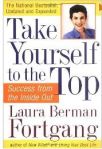
Take Yourself to the Top by Laura Berman Fortgang

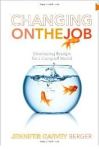
  Changing on the Job by Jennifer Garvey Berger

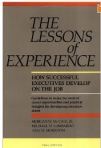
   Lessons of Experience by Morgan McCall

Leave a comment

Filed under Books, Career Development, Executive Development, Personal Change

5 Books That REALLY Changed My Career

Here She Goes Again

I suggest books all the time to my friends and clients.  I’m sure some people hide the eye rolling from me while they think: “here she goes again.”  I learn best from books, so I want to share my love of learning and my love of books.  I got to wondering this week, if I had to pick just five books to recommend, what would they be?

The Books

The books that I selected are the ones that made the most difference for me at the time in my life when I read them. Each of them provided a major “Ah Ha” moment that moved my career to another level.  These are the books that changed the trajectory of my career in one way or another.

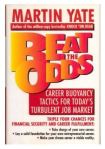
Beat the Odds by Martin Yate

The big idea that I got from this book is the concept of having three careers that you’re working on at the same time–your core career (the one that makes you money), an entrepreneurial career (where you’re learning skills and beginning to make money in a different way) and your dream career.   This approach forced me to really figure out what my goals were, and, more importantly, it took my focus off the day to day stuff and let me take all that more in stride.  I became happier and more productive all in one.  This book is out of print, but Yate has a new book, Knock ‘Em Dead Secrets and Strategies for Success in an Uncertain World, that includes all the same concepts.

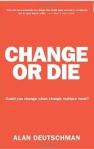
Change or Die by Alan Deutschman

change or die by alan Deutschman asks the question, “If someone told you that you were going to die if you didn’t change, would you?”  Of course the answer is “yes!”  But is it?  Don’t we all know how we should eat?  How we should exercise? We know that we should stop smoking or drinking too much.  We know if we don’t, it will adversely affect us and that the consequences may be that we will die earlier.  So, even though we know that we will die earlier if we don’t change, we don’t.  He  analyzes why some people actually do effectively change.  It helped me begin to make personal changes that I had “resolved” to for years.

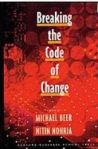
Breaking the Code of Change edited by Beer and Nohria  

This book was the product of a research conference of the same name in 1998.  This was the first time that I encountered the concepts of  “Theory E” (economic value) change and “Theory O” (organizational capability) change.  Suddenly I understood why most organizational change failed–people were either doing Theory E (and as soon as they stopped, the organizational amoeba went back into place) or Theory O (which gets people on board but takes way too long to provide the organization leadership the results in the time they need).  I suddenly understood that as a change manager, I had to figure out how to do both Theory E and Theory O to make a change happen and stick.  It completely changed the way I did my work.

Management of Organizational Behavior by Blanchard and Hersey

When I became a manager, I went searching for a book to tell me how to be a good manager.  Scores of books later, I came across this book.  This is actually a textbook.  It opened the door on the study of organizational behavior, leadership theory and organizational change for me.  The most important (among many) idea in the book for me is Situational Leadership(R).  The theory of Situational Leadership discusses leadership styles in terms of different combinations of task  and relationship focus.  The theory lays out four leadership styles and suggests that different styles are more appropriate for different follower behaviors.  The book is a wealth of powerful ideas on how individuals and organizations work.

Success and Betrayal by Hardesty Bray and Jacobs 

This book, now out of print, was published in 1986.  The book discusses women in corporations.  Although the book describes women’s beliefs about the way things work in organizations, these ideas apply to men, too.  We all believe certain things about the way organizations work–if we work hard, we will succeed; if you do a good job, you will be rewarded; we’re all a family in an organization, etc.  You come by the things you believe about organizations through your experiences in childhood, in your family, in school, in your social and athletic experiences. The problem is, unless you are in charge of the organization, these aren’t necessarily the “real” rules of the organization.  This book taught me to identify my own “myths” and to understand  the “real” rules.  If you understand, then you have the option to decide whether you want to “play the game” or not.  If you don’t even know that you aren’t playing by the rules, then you don’t know why you never win.  Once I understood the rules, I began to win.

This last book was so important to me that I sought out and met both authors.  (I think they thought I was stalking them:-)

What books have had the biggest impact on you?

Leave a comment

Filed under Books, Executive Development, Personal Change