Tag Archives: Books

Are You A Wannabe?

Are you an Executive wannabe?  An entrepreneur wannabe?  An artist wannabe? A marathoner wannabe? An author wannabe?  Do you put one of those on your New Year’s Resolutions list?  How about your career goals list?

What Is Stopping You?

Look at last week’s calendar.  Look at last month’s calendar.  Is your ‘wannabe’ goal anywhere on your calendar?  If not, why not?  How can you possibly accomplish your goal if you’re not spending any time on it?  Don’t tell me you don’t have time.  People who really want to do something have time.  Every successful accomplished person who has done what you want to do has EXACTLY the same amount of time that you do.  It comes down to six things:

  • Priority:  If this is your future, then you need to put it sufficiently up your priority list that you are spending time on it
  • Motivation:  Understand what motivates you and put that in your life.
  • Focus: You CANNOT do it all (at once).  Turn off the TV.  Stop surfing the Internet.  Stop texting.  Take yourself to some place quiet and isolated.
  • Determination:  Keep working toward your goal, no matter what gets in the way.
  • Create whatever support infrastructure you need.  If you need training, get it.  If you need a coach, get one.  If you need a place, find one.
  • Action:  I hate to be repetitive, but JUST DO IT

Winning

So, How Do You Do That?

  • Write it down.  Be very specific.  Not ‘Write a book’ but ‘Write a novel, get a book contract, and get it published by this time next year.
  • Once you’ve written the specific goal, work backwards.  In order to write a novel, get a book contract and get it published, what do you have to do?  In order to do those things, what do you have to do?  Ask what you have to do and detail it several times.
  • Once you have a fairly detailed list, decide what you are going to do tomorrow.  What are you going to do this week.  Look at your calendar and put these tasks on it.  Take something off your calendar to make room for it, if you have to.
  • What reward will you give yourself for which accomplishments.  It doesn’t have to be something big–just something that you will associate in your mind with accomplishing the task.
  • What are the big milestones in your plan?  How will you reward yourself for these big milestones?
  • Hold yourself accountable.  Tell someone–that makes it harder to escape the accountability.

Great books to help with this:

1 Comment

Filed under Books, Career Development, Career Goals, Goal Setting, Personal Change, Time Management

Promoted! Now What?

success at work

Congratulations!  You just got promoted.  Or you just got reorganized into a new department.  Or you just got a new boss.  How do you make this a step in the right direction and keep from crashing and burning.  Ok, crashing and burning is unlikely–you did persuade someone that you deserved the promotion.  Getting stuck is a possibility.  Looking like you weren’t ready is a possibility.  Not making a great impression is definitely a possibility.  So, what do you do?

It’s a New Job

One of the most important things to do is to understand that this is a NEW job.  Treat it as if you just got to a new company.  Look at the experience through new eyes.  Who are the people?  What is the power structure?  What does the company need to be successful.  What does the department need to accomplish in the short term?  In the long term? What does the department need from you to be successful?  Go talk to people as if you’re meeting them for the first time.  What is important to them? What are their goals? How can you hit the ground running?  How can you quickly show that choosing you was the right choice?

There is a subtle difference for most of us when we change jobs within the company and when we change companies.  When we go to a new organization, we are completely aware that we don’t know everything.  We have our hyper-alert antenna out.  We are in the “conscious unconscious” state of learning.  We are aware of all the things that are different from our last experience (although we frequently miss things because of our ‘old company’ mindset).  When we change jobs within the same organization, we think we know how it is.  We know a lot of the people (although through the eyes of the last group we were in), we know the business (ditto), we know the problems, challenges, opportunities (ditto, ditto, ditto).  The problem is, the new job within the same organization is just as new as the other.  If you put yourself in the same hyper-alert state, you are much more likely to be highly successful.  You are much more likely to impress, because people will see you differently (than they had before) too.

First Impressions

Remember that although people may know you (some may even have been your peers before your promotion), you still have the opportunity to make a ‘new’ first impression.  If you are really trying to make a good impression, you’re likely to get attention again.  Make sure it’s the right impression.  Make sure you don’t come across as arrogant or smug (especially to your former peers).  Make sure you come across as smart and interested and capable and willing.  Make sure that people see results QUICKLY.  The best way to do all of this is to treat the promotion as if it were a new job at a new company.

Helpful Books

Congratulations!  And good luck.

2 Comments

Filed under Books, Career Development, Executive Development, Leadership, Reframe, Success

Get Your ‘Get Up and Go’

motivate yourself

I spent much of Sunday morning watching a few hundred people participate in their first triathlon.  It was sixty-something degrees and drizzling.  What would possess these people—all ages, shapes and sizes—to come out in the rain to inflict discomfort on themselves?  They swam a quarter of a mile in a lake, biked 12 miles on rain slick country roads and ran 3.1 miles over hilly trails.  At the beginning and end of each portion of this event, each person had a small cheering section, but for the most part, each participant swam/biked/ran alone, competing against the elements and motivated by him/herself.  How did each person motivate him/herself?  How can you motivate yourself to do whatever your goal is?

Well, the good news AND the bad news is that motivation is individual.  Every person is motivated differently.  Some people need praise to be motivated.  Some people need to feel like they’re contributing.  Some people need to be able to tick off the boxes of their goals to be motivated.  Some people like public recognition, some hate it.  Few people, believe it or not, are motivated solely by money.  In fact, money can be a demotivater–it’s not enough or it’s less than so and so got–you spend more time thinking about the negative than the positive of money rewards.  Anyway, the way you are motivated is unique to you.  You need to figure out how that is and then put it to work for you.  You need to NOT wait for someone else to motivate you.  Others can help (like the individual cheering sections at the triathlon), but you need to take the responsibility and develop the skill to motivate yourself.

There are two types of motivation:  external and internal motivation. External motivation is in play when you are thinking that you “should” or you “want” to do something.  You’ve got internal motivation when you “love” something or you “gotta do it.”

There is a motivational continuum between external motivation and internal motivation.

Motivate yourself

If you are all the way at the external motivation end of the continuum, then your motivation comes not only from outside yourself, but actually from other people—people who tell you what to do.  You’re not doing it for yourself, but rather for others.  If you are at the internal motivation end of the continuum, then you do it because you feel whole when you do it.  You do it despite all the excuses/distractions/opportunities not to do it.  You REALLY do it.

The question is, how do you push yourself toward the internal motivation end of the spectrum?  First you need to understand what motivates you.

  • Are you a planner?  A list person?
  • Do you need to be encouraged by others? Recognized by others?
  • Do you need to feel like you accomplished something? Made a difference?

Think about times when you were most motivated.  What made that happen?  Was it that someone was proud of you?  (External motivation)  Was it that you could look at what was happening and you were proud of yourself? (Internal motivation). Whatever it is that pushes you, figure out a way to put that in your life.  Create a situation that provides the reward(s) that work for you.  They don’t have to be big rewards.  Frequently people are just as motivated by any reward–that they care about–as a big reward.

The key is that you have to take charge of your own motivation.  You will see your performance rocket significantly.  Steve Chandler’s book. 100 Ways to Motivate Yourself, will give you lots (100 to be precise) of ideas on how to motivate yourself.

Start experimenting.

3 Comments

Filed under Career Development, Career Goals, Executive Development, Goal Setting, Success

Work As We Know It Is Changing–Get Ready!

That Was Then

My maternal grandmother went to work when she was thirteen years old at a china factory that made dishes for hotels and restaurants and, eventually, naval ships.  She stayed in a rental room with her two-year-older sister during the week and went home on the weekends.  She got married when she was seventeen and continued to work at the factory sporadically.  She was very good at what she did.  She was a Master Painter and she supported her family of eight during the Depression by painting.  It never occurred to her that that factory wouldn’t always be there, but when she was forty-seven the plant went out of business, taking hundreds of jobs with it.

Carr China Grafton WV

China from Carr China

My paternal grandfather spent his entire professional life at the Baltimore & Ohio Railroad, most of it as engineer driving passenger trains.  He told my father not to go to work for the railroad, because it wasn’t going to last.  The Baltimore & Ohio Railroad went out of business three years after my grandfather retired–taking hundreds of jobs with it.

Baltimore & Ohio Passenger Train

B&O Passenger Train

My mother’s cousin was forced to retire from the steel mill when he was fifty years old.  He wrote about it in an article published in the Beaver County (Pa) Times, “Now time has changed again, old friend [the steel mill] and now times are not certainly in your favor.  I am reasonably certain that my sons will never know you as I have but you can be sure I will tell them your story and how finally you were befallen by so many uncontrollable factors, and how you, who meant so much to so many, now sit mostly idle as wind whistles through your empty buildings; your coke batteries, your blast furnaces and continuous caster are now cold, dark, and silent.”  And hundreds of jobs gone.

Steel Mill in Pennsylvania

Steel Mill in Aliqiuppa, Pa

You may have similar stories from your grandparents, parents and even from your own experience.  This is happening to us.  Companies and work as we know it are changing irrevocably.  It’s sad.  There is a lot to grieve.  There are things you can do about it, though, so when YOUR company and YOUR job change, you land on your feet.

This Is Now

I read a couple of things over the weekend that discuss something that I’m seeing in the workforce among my coaching  and organizational clients. It is the next way that work will be.  The longer you don’t believe it, the louder you rail against it, the longer it will be before you are ready for the next “way we work.”  The first thing I read was  The Rise of the Supertemp by Jody Greenstone Miller and Matt Miller in Harvard Business Review.  They describe a phenomenon that many of us have seen.  Companies are going to contract workers.  According to a McKinsey  2011 study cited in the article, 58%  of US companies surveyed are planning to increase use of temporary employees AT ALL LEVELS.   Not only are they using project, technical and finance contract workers, they are starting to hire contract Executive talent–business development, marketing, lawyers, CFOs, and even CEOs.  BOTH companies and Executives need to adjust to this new reality.

Companies need to learn how to organize work so that these Supertemps can come in and make a difference. Mostly this means that work needs to be organized into project-type work.   Executives need to package and sell themselves for this work.  The most telling thing in the Harvard article, however, is that those who have done this work DO NOT want to return to the ‘old way.’  This is true of the people I know who have done this kind of work as well.  They really like it.

Think about how you make yourself a well qualified candidate for these positions.  There are some ideas for that in the second thing I read this weekend–The Finch Effect by Nacie Carson.  Carson suggests that like Darwin’s finches, today’s workers need to evolve to adapt to the current work environment.   She points out that unlike the time it takes other species to evolve, humans can evolve their behaviors to adapt as they choose.  Her suggested strategies for adapting to the new work environment:

  • Adopt a ‘gig’ mindset: piece together a combination of contracting, consulting, and free lance work that gives you a income equal to or more than your ‘full time’ job
  • Identify your value:  this is your professional brand–it communicates intangibles like values, personality and mission
  • Cultivate your skills: you (not your company) take responsibility for growing your skills
  • Nurture your social network: use appropriate sites for appropriate messages, rebrand as necessary, communicate your brand
  • Harness your entrepreneurial energy: look at your job and skills from a position of personal responsibility, initiative and personal direction

AND you can apply all of these to you ‘real’ job.  They will help you stay in it and succeed.  And they will help you be ready for the next ‘way we work.’

5 Comments

Filed under Books, Career Development, Career Goals, Job Hunt, Leadership, Networking, Reframe, Success

There’s Networking, and Then There’s NETWORKING

Do It Before You Need It

I started this blog out of frustration.  I had just talked to my umpteenth client/friend/student/colleague who found him/herself out of a job with a stone cold network and a total freak out about what to do.  (See my first blog post–Get Ready to Lose Your Job)  Networking definitely helps when you need to find a job.  In fact, it is probably the best tool to have in your arsenal for finding a job.  These days, a powerful network can make the difference between finding a job in weeks or months and it taking more than a year.

Networking also helps with just about everything else you might need–getting promoted, finding business opportunities, selling products, building your reputation/brand, getting answers to tough questions, staying in touch, and even finding someone to date (I’ll leave this last one to other blog writers).  You can build your network purposefully, or you can build it serendipitously, but be sure to keep building it. Remember, though, networks are about RELATIONSHIPS, not about numbers or names or tools or connections.

Serendipity

Let’s talk first about building it serendipitously.  There are marvelous tools available now that make it easy and fun.  Facebook, Linkedin, and Google+ are the top tools right now, but there are many more–Plaxo, Twitter, MyLife, etc. Not being involved in a social network these days is like not having a resume or appropriate business attire.  To function in today’s business world–no matter your age or organizational position–you have to be saavy enough to be using social networks.  If you participate in these social networks–let’s say Facebook or Linkedin–and just reach out to people you know and accept invitations from people who reach out to you, you will build your network.  If you particpate in LinkedIn Groups discussions, answer questions and comment on people’s status, you will strengthen the connections/relationships.  If you share a little of who you are on Facebook and comment on friends’ posts, you will build the relationships.  It starts at one level and grows to other levels.  It has to be real.  Superficial interactions are obvious and quickly shunned.  If you do it gradually  over time, then it doesn’t take a lot of time and you have the beginnings of what you need when you need to look for a job or a promotion or business opportunities.

This serendipitous network building also has the benefit of creating a network of strong connections–you know all these people pretty well.  When you need something from these folks, you are more likely to be comfortable asking, and they are likely to respond.  Not much work/lots of potential benefit.  Why not?

Purposeful

The other way to build your network is purposefully.  This is what I recommend.  Take a look at your networks.

On Facebook using myfnetwork :

Visualize your facebook network using myfnetwork

On Linkedin using LinkedIn Maps

Visualize your network using LinkedIn Maps

What do you see?  If your networks are anything like mine (and they may not be–every network is unique), you will see people who are “hubs,” and you will see clusters.  For me, one of the interesting things about these two pictures is that some of the “hubs” of my Facebook network are on the edges of my “clusters” on LinkedIn.  This makes sense to me, because I see these as two different networks.  One is more friends and family and one is more professional.  There is strong overlap between the two, but there are lots of people on one and not the other.  The LinkedIn Maps feature allows you to label the colored clusters.  This provides you with the ability to see the relationships among the groups in your network.

Now, pull up.  Look again.  What do you see?  What is there?  What is missing?

What Do You Want From Your Network?

Do you want a job?  Do you want to make a career change?  Do you want a promotion?  Do you want to make sales?  Do you want business opportunities? Do you want venture capital money? Do you want to build your brand?

Now, based on what you want, look at your network again.  Can it get you what you want today?  What’s missing?  Professional connections in a particular field?  Venture capitalists? Senior executives at other companies?  Senior executives at your company? Are there people at all levels in organizations?  Are there people at all generations in companies?  What about geography?  Do you have a strong network in all the locations you need?

What Are You Going to Do About It?

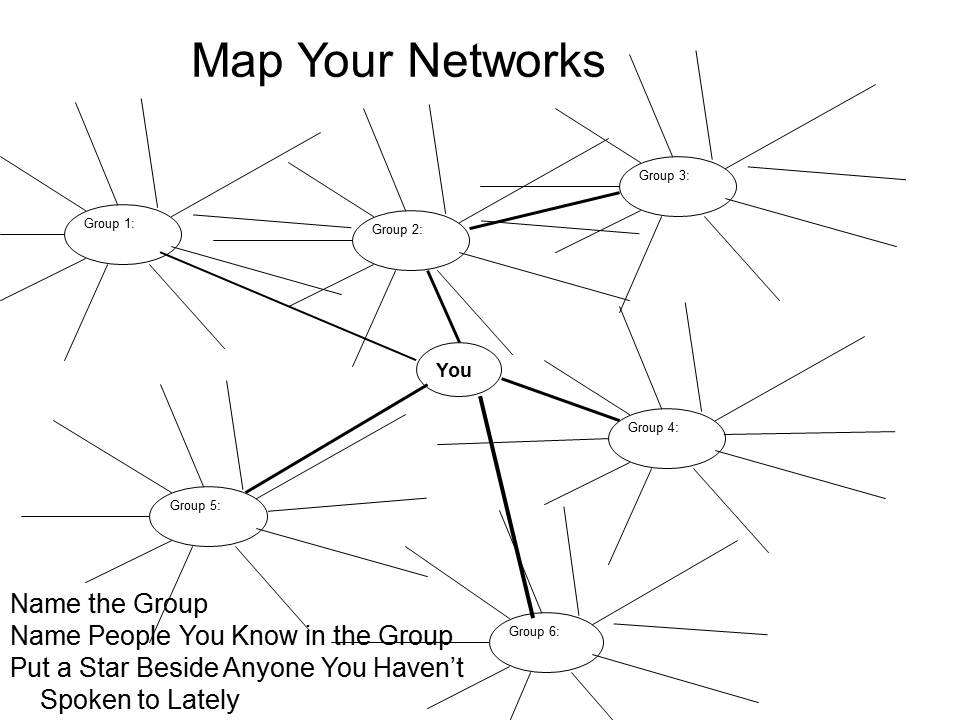
First, let’s go old school.  On paper, or using mind mapping software, do a brain storm of who you know.  Start with the groups you belong to or are associated with.  Once you’ve listed the groups, start listing the people associated with the groups.  Who are the key players in those groups?  Who are the best connected?  Who have you talked to lately?  If you haven’t talked/connected with people, then reach out to them.  Do it via email, phone or one of the social networking sites.  Prioritize people according to the purpose of your network.

Map Your Network Worksheet

Address what is missing.  How can you reach out to people you need to be connected to in those areas that you need to grow?  Get introductions through your existing connections.  Use the helpful tools that LinkedIn provides.  Attend professional functions, follow thought leaders’ blogs and make comments.  Participate in Linkedin Groups discussions.

Create a plan on how you’re going to keep up with your network.  Do regular (but not obsessive) work to stay in touch with your existing network and to grow it.

Some Myths About Networking

  • It’s  about the numbers. IIt’s really about quality connections.
  • It’s about your connections’ job title.  Looking at the visualization of your network should show you that the ‘most’ connected people are not necessarily (and not even likely) the highest ranking.

Some Truths About Networking

  • It has to be real.
  • It takes time.
  • It’s about mutual win/win.
  • It works.

Some Books

10 Comments

Filed under Books, Career Development, Career Goals, Executive Development, Goal Setting, Networking, Recession Proof, Success

Looking for a job? Look in the HJM!

Looking for a job?

Soooooo many people are looking for jobs these days.  People who have been laid off are looking.  People who are dissatisfied are looking.  People who have been underemployed for a while are finally feeling like things are moving enough that they can look.  Maybe it’s just the people I know, but it seems like everyone is looking in the wrong places.

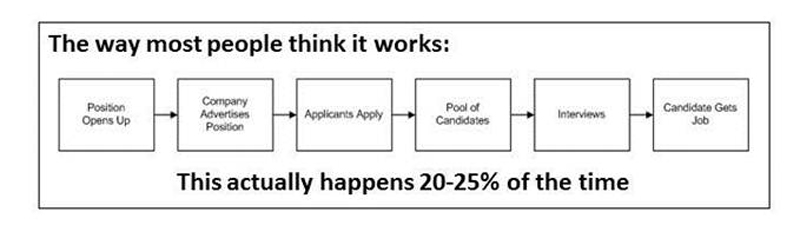
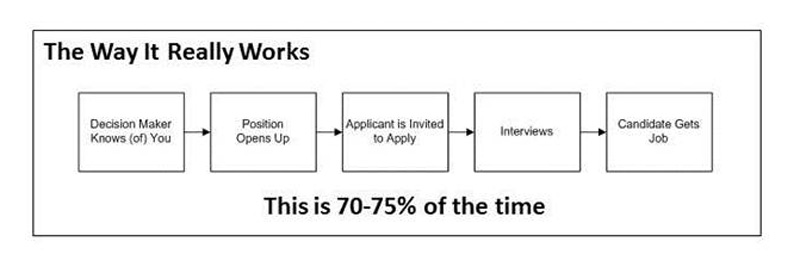
Seventy five to eighty percent of all jobs are NOT advertised.

And remember, this type of hiring (20-25%) includes  the McDonald’s and other entry-level jobs. This also includes all the internet job postings, newspaper job postings, and LinkedIn job postings.

Seventy five to eighty percent of the jobs are in the HIDDEN JOB MARKET.

 The other 5% of hiring happens when the candidate persuades the decider to create a specific job for him.  (Not common, but it happens).

Don Asher in his book Cracking the Hidden Job Market says that you get a job by talking to people.  He’s not talking about interviewing.  He means talking to pretty much everyone who will listen about your job search.  He recommends using every technique available:  face to face, email, phone, LinkedIn, Facebook, and even snail mail.  People are much more comfortable hiring you–or even considering you–when they know you, or when someone close to them knows you.  It’s a lot like dating.

You also need to know what kind of job you want–what industry, function, role, company type.  Then you need to TARGET those jobs.  It is like deciding you want to marry a millionaire.  That is more focused than if you want to marry someone or if you just want to date.  Where do you find millionaires?  How do you know which ones would fit with you?  How do you have to come across to marry a millionaire.  You get the point–it isn’t just throwing your resume at recruiters who have posted jobs.

There are a few  books that I recommend:

Now the Excuses

  • It’s way more work to do it this way.
  • I don’t want people to know I’m out of a job.
  • No one I know knows of any jobs–they would tell me if they did.
  • And on and on and on

Yeah, it is more work.  You want a job, you do the work.  People who know how to work these systems and find the hidden jobs control their careers.  The rest of us are flotsam floating on the river of chance.  EVERYONE knows about jobs or knows someone who does.  It isn’t top of mind.  By talking to people about your job search, you help them remember you when they hear about jobs.

Oh, and don’t wait till you need a job to do this.  Start building the network and targeting the organizations now so that you are ready.  Get ready to lose your job!

1 Comment

Filed under Books, Career Development, Career Goals, Executive Development, Job Hunt, Networking, Recession Proof

Don’t Take Your Needs to Work

Basics/Needs/Wants

My first exposure to the idea of how my needs impacted my career came from Laura Berman Fortgang’s book, Take Yourself to the Top. Fortgang divides things into basics/needs/wants.  Most of us can tell what the basics are–enough food, housing, warmth, safety.  Most of us also can tell the “wants”–house at the beach, Thunder season tickets, designer wardrobe, fill-in-the-blanks.  It gets tricky when we are dealing with needs.  Needs are sometimes disguised wants, but more often, they are buried in our subconscious–we don’t even recognize them when they are running our lives.

Examples

The kind of needs I’m talking about are those that start in early childhood–usually because of deprivation or mistreatment–and drive our behavior for the rest of our lives.  Someone very close to me grew up incredibly poor and without things that practically everyone has–things like soap, combs, jelly, sufficient clothes, or coats.  Her need was to never feel deprived again.  She accumulated stuff to prevent the feeling of deprivation.  It drove her whole life.

Some have the need to be appreciated.  Some have the need to be respected.  Some have the need to be treated fairly.  Some need to be right.  You get the idea.  These needs are all wrapped up in our self-worth.  If you don’t respect me, then you have shaken the very foundations of my belief in myself.  When this happens at work, then you are behaving like the same five-year-old who initially developed this need.  You probably aren’t aware that you are acting like a five-year-old.  You probably feel completely righteous in your reaction.  You won’t stop talking about it.  You tell your co-workers how wronged you are, and they probably are somewhat intimidated by your level of emotion.  They may or may not agree with you, but they are reluctant to challenge you because of how you are coming across about it.

This happens all the time.  It happens to pretty much everyone.  The way you can recognize it is by how upset you are.  How driven you are to fix it.  How much you talk about it.  How much you think about it. These needs are legitimate.  You came by them legitimately.  My friend who was so deprived in her childhood was trying to protect herself from ever feeling that horrible again.  But you need to get your needs out of your work.  They will do much more damage than it is worth.  People will think you’re completely irrational about weird stuff.  They will not be able to connect the dots between your behavior that they see and your need that you are trying to address and whatever happened to you that created that need.

What Do You Do?

So, what do you do?  Think back.  Think of times when even you could tell you were being irrational.  What was driving it?  Are there patterns?  Same reaction to similar situations?  Same reaction to similar people?  Figure out which needs are driving you (literally) crazy.  Try to reason with yourself (this isn’t usually all that successful).  Point out to yourself that that was then (when you were 5) and this is now (when you are an adult who really shouldn’t care if your GenY employee isn’t respecting you as much as you think she should).  If trying to talk yourself out of it doesn’t work, don’t give up, but there is a Plan B.

irrational at workWhen you feel yourself getting irrational (ok, not irrational–incredibly irritated), try to think of another way that you can get this need met OUTSIDE OF WORK.  Where can you be respected that matters more?  Church?  Home? Professional group?  Who appreciates you who matters more than people at work?  Can’t you go tell someone else you were right without rubbing your peer’s face in it?

Why Should You Go To That Much Trouble?

Because it really does have a negative impact on your career.  When you are being driven by things that are outside your conscious awareness, then you aren’t really in control.  When you aren’t in control, then you will do something that looks stupid to people who can make decisions about your future.  So, get your needs away from your work.

Leave a comment

Filed under Books, Career Development, Executive Development, Personal Change, Reframe, Success, Uncategorized

Dealing with A**holes

For some reason I’ve talked to a lot of people in the last couple of weeks who were having problems with people in their lives—mostly at work.  The problem when you have to deal with people who are difficult is that you have to keep dealing with them.  It is the rare workplace that offers the perk of being able to trade out your coworkers on a whim.  So how do you deal with the jerks?

It’s a Relationship

First of all, hard as it is, you’ve got to stop blaming the other person (EVEN IF IT IS ALL HIS FAULT).  You can’t make real progress at making the situation better if you think it is all the other person’s fault.  It is a relationship.  A relationship by definition is between (at least) two people.   If you are one of those people, you can do things that will affect the interactions between the two of you.   As long as you are in the frame of mind that it is entirely the other person, you are unlikely to be open to trying some of the things that I suggest.   A good book on the subject is Barry Duncan and Joe Rock’s  Overcoming Relationship ImpassesDuncan and Rock’s premise is that if you stop reacting in the same pattern to the same situation, you will disrupt the normal interactions and allow a new interaction/reaction to happen that can make things better.  For example, when the person starts once again with  the list of all the things you do wrong, if, instead of defending, you say something like, “you’re right, it must be difficult to deal with someone who you think can’t do anything right,” the other person has no place to go next. He shuts up or says something like, “I don’t think you do EVERYTHING wrong.”

The Relationship is Half You

Ask yourself what you are doing to contribute to what is wrong with the relationship.  What are you doing to improve the relationship?  Before you get all exasperated with me (because it is all the other person’s fault), remember that you only have one tool to make this better—your behavior.  You can’t directly control the other person’s thoughts or behaviors, so you can only use your own behavior to make a change.  You are the instrument of change here.   

Why Does This Person Drive You Crazy?

So, let’s start with trying to figure out with why this person drives you so batty.  Ok, yeah, I know he’s an a**hole, but I know that you’ve dealt with other a**holes in your life.  What is it about this one that is so bad?

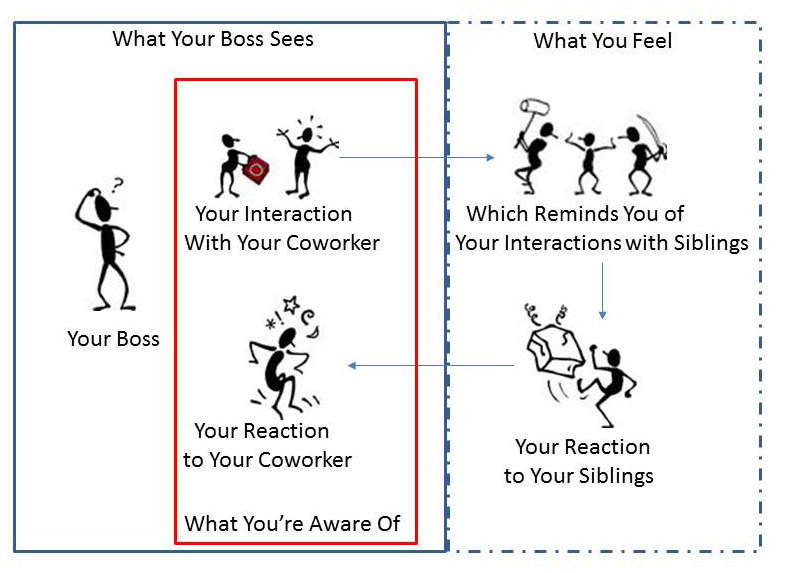
  1. Who does this person remind you of?  Your brother?  Your father?  Your ex?
  2. Which of this person’s behaviors is so bad?  His micro-managing?  His criticism?  His inability to make a decision?
  3. Is there a time or a place that is worse?  In meetings?  In one-on-ones? When so-and-so is present?
  4. Are there things that happen first, before you get the urge to run screaming from the room?

If you look at the answers to these questions, can you see anything that you can change to reduce the angst that you encounter in dealing with this person?  Can you not have one-on-one meetings? Can you not have meetings that include the person who makes it worse?  Can you talk yourself out of the insight that this person is just like your big brother who made your life a living hell for eleven years?  What change(s) can you make, either to the circumstances of spending time with this person or to your thinking that makes this person easier to deal with?

Why Do You Drive Him Nuts?

Let’s look at it the other way.  What is it about you that drives him nuts?  Can you spot a specific situation that seems to make it worse for him?  Do you remind him of someone?  Can you spot a particular behavior of yours that seems to set things off?  Can you do something to change any of this?

What is he trying to accomplish?  There is a great book, Dealing with People You Can’t Stand, by Brinkman and Kirschner,  that describes common difficult people as

  1. The Tank (pushy, ruthless, loud and forceful)
  2. The Sniper (identifies your weaknesses and uses them against you)
  3. The Know-It-All (knows 98% of anything)
  4. The Grenade (when they blow their top, shrapnel hits everyone in range)
  5. The Yes Person (quick to agree, slow to deliver)
  6. The Maybe Person (keep putting off crucial decisions until it’s too late)
  7. The Nothing Person (no verbal feedback)
  8. The No Person (doleful and discouraging)
  9. The Whiner (there’s a plan for their lives and they’re not in it)

Recognize your a**hole in any of these? Each of these types of people is trying to accomplish something with their behavior.  In other words, there is a REASON they are the way they are.  The authors say that this is what these types are trying to accomplish:

  1. GET IT DONE:  The Tank, The Sniper, and The Know-It-All
  2. GET APPRECIATED:  The Grenade, Sniper, The Know-It-All
  3. GET ALONG: The Yes Person, The Maybe Person, The Nothing Person
  4. DO IT RIGHT: The No Person, The Whiner, The Nothing Person

(for quick description of this, see http://www.rickbrinkman.com/dealingwithpeople/ftp/dr_brinkman-color-lens.pdf )

If you help them with what they’re trying to accomplish, then they don’t have to use so much of their “difficult behaviors” to accomplish it.  I know that this is hard to do.  If it were easy, then none of us would experience the “a**hole people in our lives.  Just because they are there, though, doesn’t mean that YOU can’t deal with them.

REFRAME

Finally, use my most reliable tactic—reframe the situation.  Figure out a way to “see” the a**hole in a different way that allows you to interact differently with him.  He’s a customer, or she’s someone’s grandmother, or he’s an alien. The effort that it takes to deal with these folks can help distract you from the difficulty.   Whatever it takes.

4 Comments

Filed under Books, Career Development, Communication, Executive Development, Personal Change, Reframe

New Job? Here’s What You Do:

First Thing

The first thing you do is remember that you don’t know what you don’t know.  Be very careful about your assumptions.  If you had the same job in a different organization, remember it might not be the same job in this one–just the same title.  If Directors act/do/are a certain way in your old organization, they might act/do/be different in this one.  If you get promoted in your (same) organization, it is a NEW job, not just more of the same.  Treat it as a new job.  If you manage a new group, move to a different location, get a new boss (yeah, I said if you get a new boss), it is a new job.  Just like all jobs, this job will have good things and bad things.  If you get off to a good start, it will have more good than bad.  Move on to the second thing:

Second Thing

Become hyper-sensitive to your surroundings.  Pay attention.  Listen.  Watch.  Notice.  Who are the power players?  What is the informal network?  Who are the formal and informal leaders?  What is the culture?  Put your antenna up and start to feel out the unwritten rules.  Ask questions.  At the beginning, you have a window of opportunity where people expect you to ask questions and you feel comfortable doing it.  Learn the language (every organization has its own set of acronyms).

Put on a consultant’s hat–do an organization assessment.  What works, what doesn’t work?  What are the opportunities for quick hits?  Talk to lots of people!  Ask them what they do.  Ask them about themselves.  Learn their names.  Learn as much as fast as you can.  Work on putting together your own picture of how it all works together. If you do this right, you will very quickly know more about the organization, or at least have a different view, than many who work there because you will be actively investigating it.  Not very many people do this about their own organizations.

Third Thing

Make a good impression.  Get there early and stay late.  Come across friendly, confident and interested. Dress not only to look good, but to feel good.  It will come across.  Take the initiative–even when it is uncomfortable.  Commit and deliver on your commitments.  Don’t over commit–it’s really easy to do in the early days, when you want to impress.  It’s better to surprise by delivering beyond your commitment than by failing to land your promised deliverables–remember you’re still in the impression-making days.  Work on making a good impression on all levels of the organization.  You never know who listens to whom.

The Fourth Thing

Work on your networks and alliances.  The Center for Creative Leadership has done research that the most successful leaders have what is called “Manager Trade Routes,” informal networks of reciprocal exchanges.(Trade Routes: The Manager’s Network of Relationships (Technical Report) by Robert E. Kaplan and  Mignon Mazique)  It’s best to get started on this early.  Figure out your peers–who are they, what motivates them, what are they trying to accomplish.  Begin to work on developing powerful relationships with them.  My experience is that more Executives fail because of their failed interactions with their peers than with their bosses.

And Finally, The Fifth Thing

Figure out and stay on top of what your boss wants from you.  Learn how your boss asks for things.   Learn how s/he wants things communicated back.  Ask for reports or presentations that will clue you in about what your boss values.  Don’t assume s/he knows what you’re doing in your first weeks.  Ask how s/he wants to be updated.  Over-communicate at first.  Be enthusiastic, energetic and positive in your interactions with your boss.  Make him/her glad s/he hired you.

Check out the book,    The First 90 Days: Critical Success Strategies for New Leaders by Michael Watkins, for some good tips.

Good Luck!

2 Comments

Filed under Books, Career Development, Communication, Executive Development, Leadership, Success, Uncategorized

Lead from where you are

Tops, Middles, Bottoms

Are you the same kind of leader at work that you are at home? at church? with your friends?  If you’re like most people, probably not.  Why is that?  Most people have a picture of the “power structure” at work that influences the way they behave.  This picture is remarkably the same for almost everyone.

Our picture:  The people at the “top” tell everyone what to do, the people in the “middle” try to get the people at the “bottom” to do what the “top”wants, while struggling to get the “top” be clear about what it is that they want.

Sound familiar?  There is a interactive exercise developed by Barry Oshry and documented in his book, Seeing Systems, Understanding the Mysteries of Organizational Life, in which people at all levels of the organization, when assigned to be a “top,” “middle” or “bottom,” play out this power structure role–even though they have a different role (and behave differently) in their own organization.  It’s as if you put a group of people in a room and told them all that they were 5th graders–and they started acting like it!

This  “picture” of the way things (should) work  exists in most organizations, across organization boundaries, global cultures, and all organization sizes.  The behaviors that go with these unconscious roles hold us all back.  It makes the organization slow.  If we accept these roles, it’s hard to get be excellent–organizationally or PERSONALLY.

Step Up, Step Out

LeadFfrom Where You Are

If you don’t step up and step out, if you go along with the “way they do it,” then you aren’t standing out.  People frequently err on the side of getting along and not challenging the status quo.  How does that help the organization?  How does it help your career?  (It’s easier for managers to lay off the ones who’ve never been exceptional–solid and steady doesn’t get you very far for very long any more.)

I realize that I’m saying that you should take risks.  Yep.  And it’s really hard to take risks.  Yep. So start with little risks.  Instead of waiting till someone tells you what to do, figure out what you think should happen?  If you were “king” of the company, what would you have happen?  Just figure it out.   What’s the worst thing that can happen if you did it?  What would you do if that happened.  What’s the best that could happen? Start with thinking it out.  Turn off your “going-along” thinking and be proactive about solutions.

Just Do It

There is a reason that “It’s better to ask forgiveness than to ask permission,” is so popular in organizations.  It’s mostly true.  My first, and for me, probably the most important, Executive, used to say over and over, “Make a decision.  It is easier to fix a bad decision than to fix the damage from not doing anything.  There are almost always several “right” decisions for every business problem–pick one and DECIDE.”  I had already heard this mantra several times in the first three months that I worked for this guy before my first one-on-one with him.  I had spent these first three months researching the details of a very serious problem and I was presenting the results of my research to him in this meeting.  Looking back, I can’t believe how naive and unaware of organizational politics I was.  My boss sent me to this meeting, fully knowing how bad it was, alone.  I was about 15 minutes into the details when he stood up, looked at me and said, “You’ve made me sick at my stomach,” and he walked out.   I was shocked.  I sat there.  I thought he was coming back.  He didn’t.  I waited probably 20 minutes and got up and left.  I didn’t know what to do.

I waited about a week.  I tried to figure out what to do.  My boss was on vacation.  I thought about the Exec’s  mantra, “Make a decision.”  This one wasn’t mine to make–it was his (or above).  But I needed to figure out how to get him to make it.  I walked into his office and asked when he wanted to finish our meeting.  He looked at me, and said, “I don’t want to, but I guess we better.”  We rescheduled and he listened to me all the way through.  At the end of the meeting, he told me to figure out how much money it would take to fix it.  When I did, he had me present to the entire Executive team and he persuaded them to fund it (it was several million dollars).  I had a leadership role in implementing the fixes–way beyond my original job.  I’m pretty sure that I wouldn’t have had a role in it if I hadn’t walked into his office and pushed him for another meeting.  I am sure the project would have happened eventually,  later and without me.

It was a powerful lesson.  I think if I had been in the organization longer, I would have adopted the “power structure picture,” and wouldn’t have done it.  I would have waited for my boss to do it.  Or whoever.  I wouldn’t have learned the lesson that helped shape my career.

2 Comments

Filed under Books, Career Development, Executive Development, Leadership, Personal Change, Reframe