Category Archives: Reframe

Multiple Intelligences: IQ, EQ, SQ and the other SQ

What kind of intelligence do you have?

We’ve all heard of IQ (Intelligence Quotient) which measures our ‘intelligence.’  Most of us have  heard of EQ (Emotional Intelligence), first mentioned by Wayne Payne in  1985 and made famous by Daniel Goleman in 1995.  A few of us have heard of one of the SQs–Spiritual Intelligence or Social Intelligence.  What do they really mean, though?  How important are they to career development?

IQ:  Intelligence Quotient which measures rational thought abilities,  is  considered a critical ‘trait’ for leadership.  IQ associated learning is step-by-step rule based learning.  To be successful, you don’t have to be the smartest guy in the room, but you have to be smart enough.  What ‘smart enough’ is depends on what kind of organization that you’re leading.  Meredith Belbin, a British researcher who focuses on teams, started his research with the assumptions that if he created a team of the smartest people–“A” players–then it will be a high performance team.  What he found was that intelligence itself was not enough.  A high performing team needs team members with a variety of skills and perspectives.

EQ: Emotional intelligence is the ability to assess, access and  control your emotions, and those of others.  Basically, if you have emotional intelligence, you have the ability to perceive, understand, use, and manage emotions.  There are lots of arguments about whether this is “real” intelligence, but most of us know people who are good at this and can see that there is something to it.  Again, EQ is considered a requisite for success in leadership.

SQ(1): Social intelligence is the ability to understand, manage, and navigate complex social networks.  It is also called ‘interpersonal intelligence.’  Leaders of global organizations and project managers of virtual teams require this SQ to be successful.  Some assert that autistic children have low social intelligence.  As the world has grown more complex, as organizations have grown, changed, evolved, this intelligence has become more important.

SQ(2): Perhaps the most controversial of the ‘Q’s’, spiritual intelligence is defined as  “the adaptive use of spiritual information to facilitate everyday problem solving and goal attainment.”(Robert Emmons (2000) )  Emmons proposed 5 components of spiritual intelligence:

  •    The capacity to transcend the physical and material.
  •     The ability to experience heightened states of consciousness.
  •     The ability to sanctify everyday experience.
  •     The ability to utilize spiritual resources to solve problems.
  •     The capacity to be virtuous.

Increasingly, companies are paying attention to spiritual intelligence among their leaders.

So What?

Each of us has certain strengths and natural styles.  We have all met (and perhaps are) the person who is incredibly book smart, but who has absolutely no common sense.  We all know the incredibly smart arrogant emotional bully.  Being too much of one of these, and not enough of the others makes you a “flat tire.”  You can be successful–up to a point.  Depending on your job (scientist, lawyer, teacher, executive) you need more of one and less of the others.  To be successful in almost any job, however, you need some of all of these.

There are tools for each of these that purport to measure these ‘Q’s.’  There are books on each of them.  Check them out.  Start working on developing some of your ‘flat’ spots.

Books That Will Help

2 Comments

Filed under Personal Change, Reframe, Success

Become a Great Leader

Leaders and Leadership as a Process

Do You Want to Become a Great Leader?

How you think about leadership has a profound affect on your success in becoming a good leader.  We all have our individual idea of what a good leader is.  Then we assume that everyone thinks the same thing.  And that is what gets us into trouble.

There are three parts to this:

  • What do you think makes a good leader?
  • What is leadership?
  • How can you adjust to be a good leader for others?

What Do You Think Makes a Good Leader?

When you think of the best leaders you’ve ever experienced, what were their traits?  Were they organized?  Were they decisive?  Were they fair?  Were they nice? “In charge?” Inspirational? Ambitious?  Smart? Successful? Charismatic?  Make your list.

We idealize leaders.  We want them to be what we think a leader should be.  There is a bit of magical thinking about leaders—they are supposed to be what you want them to be, regardless of who they are or what their style is.

In the United States, we want our leaders to be out there in front—leading the charge.  That kind of leadership is considered  inappropriate behavior in some other cultures.   Leaders actually come in all shapes and sizes.  When you do the above exercise–asking what the traits of good leaders are–in a large group of people, they don’t agree.  Each has his/her own vision of what a leader should be.  This comes as a surprise to the people in the group, because we all assume that what we believe is a great leader is universal.  If you ask the group WHO have been great leaders, they generally agree on a (very) few–Martin Luther King, Ghandi, Lincoln, but can’t come to agreement on others–Jobs, Bush, Welsh, for instance.

So What is Leadership?

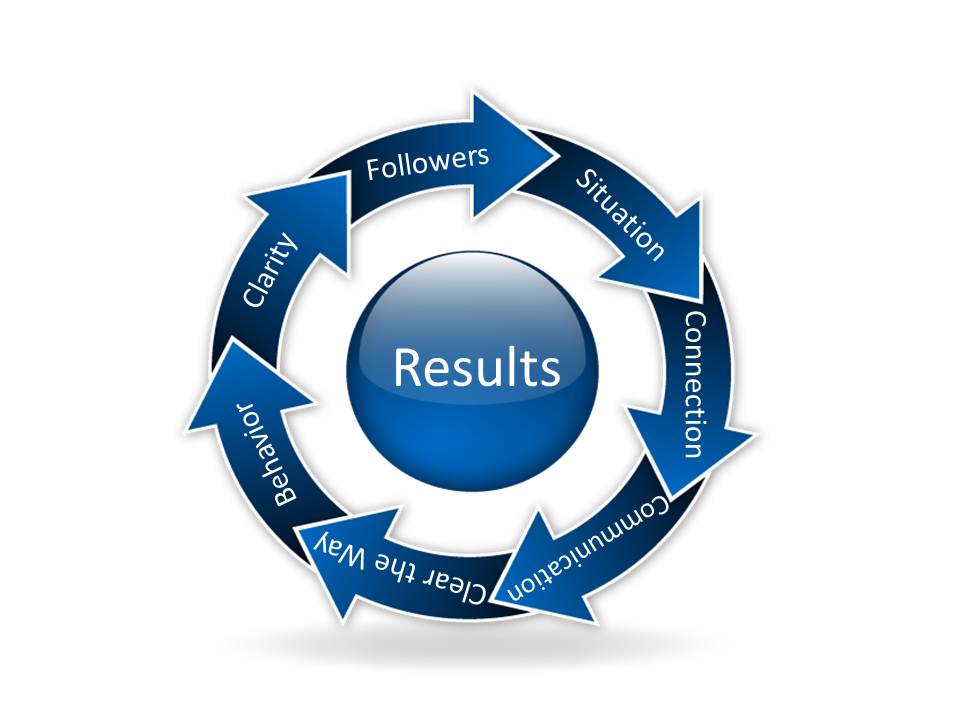
Leadership is more than just a person and who/what/how that person is.  It is results.  It is situational.  It is followers.  It is removing barriers for people.  It is connection. It is behavior.  It is communicating.  It is clarifying.  Leadership is the combination of all of these.  It is a process that combines all of these.

The leader is the instigator of this leadership process.  The leader is the instrument that stimulates and regulates the process.  The leader does not have to be a certain kind of person, but rather has to have the skills to manage this process and to integrate the elements of the process to achieve the results.

Now, rethink the people who you think are the best leaders in your experience.  How did they manage the elements of the leadership process?  Didn’t they do all of these steps well enough to get the results that the organization needed?

How can you adjust to be a good leader for others?

Reframe the way you think of leadership.  Think of it as a process instead of a particular way of being.  When you think of it this way, evaluate your ability to accomplish the skills of the leadership process.  How can you get better.  Depending on the results you need, the followers you have, the situation you are in, you need to remove barriers, communicate, clarify and adjust the integration of the leadership levers until you get results.  By thinking about it this way, it becomes a much more manageable task than if you have to have a personality transplant or develop charisma in order to be a great leader.

This view of leadership allows you to continue to ‘raise your game’ until you are a great leader.  Practice the skills that need development, hone the delivery of these tools, and learn to adjust to the situation and the followers.

4 Comments

Filed under Career Development, Career Goals, Communication, Executive Development, Leadership, Reframe, Success

Flip the Switch

Reframe by thinking differently

A Story

I’m going to tell you a story so that you can learn an important lesson without having to go through what I went through to learn it.  How’s that for a deal?  Then you’ll be able to do something that is incredibly easy and you won’t suffer through the lesson on how to do it.

A few years ago, I woke up to the news that there had been an ice storm and school was delayed by a couple of hours.  I was a single Mom and I did what most single Moms do when they learn they have a little extra time.   I decided to do something that I should have done and that I had been putting off.  I decided to go check on my empty house that I had for sale.  Now, why I thought it was a good idea to do that on icy roads, I don’t know, but I did.  As I drove across town to my house, my mind was full of all the things that I needed to do for work, things that wouldn’t happen because I was starting two hours late, and all the people who I  wouldn’t get to talk to because of the weather, etc.  You know how that is—work, work, work.

It was still dark outside when I arrived at the house.  I walked up on the porch and looked through the diamond window in the door.  I made my first discovery of this adventure—ice on the inside of the window.  Just so you know, that is a bad sign.  I opened the door and was astonished to find water pouring from the ceiling.  I reached over to turn on the light (bad idea, just so you know, when you’re standing in water).  The light didn’t come on, so I felt my way across the room and down the stairs to the basement where I felt my way along the wall to the water shut-off.  I came back upstairs and saw that the water had been turning to steam as it came through the ceiling (because the air was so much colder than the water) and then was forming ice on the walls and the floors.  The wind on an outside wall had apparently frozen the pipe, the pipe had burst, causing water to flow down to the basement and put out the furnace, which reduced the temperature in the house thereby freezing more pipes that then burst.  It was a mess!

What do you think happened to the thoughts of work?  Right.  Shoved aside.  Now I was thinking, OMG what do I do?  Is this insured?  How do I clean this mess up?  I called a plumber who came over.  He said, “Lady, we’re going to have to figure out what to do once we figure out if this house can be saved!”  SAVED?!  It’s a house!  It’s just water!

I spent the day dry vac’ing and mopping, calling insurance agents, and trying to get the mess cleaned up.  The house made the newspaper being described as “the ice house.”  (There was a spectacular ice flow that had made its way out the bricks and draped itself down the back wall of the house!)

The next morning was a Saturday.  Soccer practice and kid errands.  Before the kids got up, I decided to go check the house.   On my drive to the house, I was thinking about the house—how was it? What would happen?  What would happen to the floors?  The walls?  When I arrived at the house, I was relieved to see that the downpour had slowed to drip drip drips that were being caught by buckets.  The floors and walls looked ok (that was before I understood what happened to wood floors and paint when it dried out after a coating of ice).
I headed home much relieved.

I got out of the car and my feet slipped out from under me on the ice. The back of my head hit hard on the driveway.  As I was losing consciousness, I realized that I was going to be laying outside in way below freezing temperatures for potentially a long time (it was, after all, a Saturday morning and my house was full of teenagers—they wouldn’t even miss me for hours).  The neighbors would just think we left something in the driveway again and wouldn’t come to investigate.  I also realized that I couldn’t move—at all.  It really is true that all of these thoughts can happen very quickly.  I don’t think it was as much as a minute between the time my head hit the concrete and I lost consciousness.

Where do you think the thoughts of the house went?  Right.  Gone.  I was worried—in this order—about moving ever again and about living. I didn’t have a single thought about the house and work was so far removed that it probably wasn’t even in my brain anywhere.  I came to after a while—don’t know how long it was, but my fingers were frost bitten.  I could move when I came to and I crawled to the house and woke up a kid to take me to the hospital.  My brain didn’t work right for a while, but I learned a huge lesson.

And The Lesson

There is switch in your brain that you can flip. You can change your perspective on what is important, how you’re approaching a problem, how you think about things.  You can do it instantly.  Obviously it was forced on me.  But after I thought about it for a while, I experimented with it.  I would try to “flip the switch” about how I was approaching a problem.  Or a person.

I had a problem with my boss.  I “flipped the switch” and decided to think of her as a customer—customer is always right, right?  Once I started doing that, she didn’t get to me as much.  I started “flipping the switch” to look at problems from the other person’s perspective.  When I did it with work problems, it created more energy—it helped get me “unstuck.”

Try it.  Let me know how it works for you.

1 Comment

Filed under Career Development, Executive Development, Reframe, Success

Is That Smoke Smell Your Burnout?

Are You Burned Out?

Burnout Burning From Both Ends

Here are the symptoms:

  • Everything looks bleak
  • You don’t even have enough energy to care
  • Your tolerance of other people is very low
  • You feel unappreciated
  • You feel like you’re going through the motions
  • It doesn’t seem like anything you do makes a difference
  • You’re tired all the time
  • You’re  accident prone/clumsy
  • You have low immunity and are getting lots of colds/illnesses

Burnout happens to everyone at one time or another.  Sometimes you can see it coming.  Usually burnout takes a while to develop.  Sometimes burnout catches you by surprise, when you didn’t notice it coming on.  It is caused by relentless stress.  This is not the same as too much stress.  You can have too much stress, too much work, too much responsibility and not be burned out.  Lots of overworked people still have a positive perspective and feel hope that the work will end/be done/get better.  Burned out people don’t.  “It’s always going to be this way.” “It will never get better.”

The things that cause your burnout are different than the things that cause mine. We’re all different.  If you need to be appreciated and you can’t get any appreciation, that can cause burnout.  If you need to be in control and the situation has you feeling completely without control (different from feeling out of control), that can cause burnout.  If you don’t get to take any time for yourself, and you need some quiet introspection or if you need to be creative and that is missing from your work–burnout.

So What Do You Do?

Curing your burnout is hard.  It is hard not because what you have to do is hard, but because it is hard to find the energy to do it.  So the first thing you do is acknowledge that you’re burned out.  Look at the list above.  Does that describe you?  If so, decide that you’re going to work on curing your burnout.  Think of it as a cold.  If you don’t take care of a cold, it can get worse.  If you don’t do something to stop throwing up when you’ve got the flu, you can get much worse.  The consequences of not fixing your burnout can be that you get stuck.  It can have serious consequences for your career, for your family and for your future.  So, even if you don’t feel like it–force yourself.  It’ll get better.

1)  Try to figure out what’s causing it.  Look at the list above.  Do you feel unappreciated?  Without control? Do you feel like you aren’t good enough?  Whatever it is, just recognize the issue.

2) Try to think of a way to “reframe” the situation.  Appreciate yourself — acknowledge why you deserve to be appreciated.  Know that you are always in control of the way you deal with a situation, even if you aren’t in control of the situation.  If failed perfection is your problem, understand that that is your standard–not others’.  Let up.  Spend the time and effort to try to figure out a way to think of the problem differently.

3)  Do something nice for yourself.  Several somethings.  Be your own best friend.  Go for a walk.  Go to a movie.  Take a Saturday just for doing anything you want.  Read a good book.  Get a massage.  Play handball. See a friend you haven’t seen in a long time.  Break the pattern of not seeing the good in life.  Force yourself.

4)  Exercise.  Eat healthy food.  Yeah, I know, everybody says to do this.  It will help your immune system.  It will make you think of yourself and do something for yourself.

5) Write.  Write about what’s bothering you.  Write about all the things that are good in your life, your gratitudes.  Write about all the nice things you can do for yourself.  Write about your goals and your bucket list.  Write, write, write.

6) Create something.  Woodwork.  Draw.  Sew.  Paint. Fix something. Make music.  Using the part of your brain that does, rather than the part of your brain than thinks, will help.

7)  Talk to someone.  Talk to a friend.  Talk to a therapist.  Getting someone else’s perspective usually helps.

Keep trying things till you break the pattern.  I know it’s really hard to believe because burnout feels so physical, but it is more in your thinking patterns than in your job.  Once you figure out a way to break the pattern–even for a few hours–then keep doing it.  Build your resilience.  The more skilled you get at diagnosing your burnout before it takes hold and turning it around, the more in control you are of your reactions.

Leave a comment

Filed under Executive Development, Personal Change, Reframe

What If Your Leader Won’t Act?

What if my leader won’t . . .

I get this question all the time.  My leader won’t make a decision; what do I do?  Why won’t the leadership in my company LEAD?  Things go up the chain, but nothing comes back down.  Why won’t they DO anything?  What do you do when you manager won’t . . . ?

These are hard questions.  There are all kinds of reasons why ‘leadership’ won’t act.  Your solution depends a lot on why.  Let’s take a few examples:

Your leader can’t/won’t make a decision.

Just because someone has a ‘leader-type’ title, doesn’t mean s/he is a leader.  Sometimes people are overwhelmed by the responsibility of making a decision.  Sometimes people get stuck making decisions because all the alternatives seem equally bad.  Or equally good.  Sometimes people are waiting for someone else and it isn’t obvious to the people waiting on them.

If this sounds like the situation with your ‘leader,’ then perhaps you can ‘lead’ from below.  Can you present the alternatives in a way that helps the leader choose?  Can you make a recommendation?  Can you help the leader talk it out?  Can you get some other folks to help the leader talk it out?  Can you just make the decision yourself?  (Remember, empowerment is not what others let you do, but rather what you step up to do?)

Don’t get stuck on the fact that the person outranks you and won’t do what you believe is appropriate to his/her role.  The important thing is to get things to the place that the organization can move forward, not WHO decides.

Your leader won’t step in and resolve a conflict.

Why don’t you figure out how to do this yourself?  You shouldn’t need an adult to get things resolved for you.  Figure out a process for resolving the dispute and get the other person to agree to the process.  Then apply it.  In other words, agree that you’ll ask others, or you’ll have a vote, or you’ll agree to disagree, or you’ll take turns.  Then do it.  Don’t let your manager’s conflict aversion cause things to stop.

Your leader won’t resolve a resource issue.

Can you figure out why your manager can’t/won’t resolve it?  Does s/he believe there is a resource issue?  Does s/he believe that the resource issue will really negatively impact the project/organization?  Does s/he believe that the answer will be no from his/her management?

Approach the problem by laying out alternatives.  “We can add these resources OR we can reduce the work OR we can slow things down.”  Sometimes helping the person see all the alternatives helps them pick one (which may not be your first choice, but may resolve/reduce the problem).  Think the problem through thoroughly.  Come up with at least three potential solutions–one of which is add resources.  What if there is no money for the resources you need.  Then what?  What would you do? HELP your manager figure this out.

Your leader won’t do ANYTHING.

First, make sure this is true.  Are you sure that this is reality or your perception–ask others who work for your leader or who have in the past.  Ask what has worked for other people.

If nothing works, then you have a choice.  You can either give up (I STRONGLY don’t recommend this) or you can  go find another leader.  If you allow your leader’s inaction to shut you down, then it will likely derail your career if it becomes a pattern.  If you decide to choose another leader, make sure that the new leader is what you’re looking for in a leader.  Just as there are patterns in the relationships we choose, there are patterns in the situations we get into at work.  There is no point in wasting years of your career in a no-win situation.

Fix it.


Leave a comment

Filed under Career Development, Communication, Executive Development, Leadership, Reframe

Promoted! Now What?

success at work

Congratulations!  You just got promoted.  Or you just got reorganized into a new department.  Or you just got a new boss.  How do you make this a step in the right direction and keep from crashing and burning.  Ok, crashing and burning is unlikely–you did persuade someone that you deserved the promotion.  Getting stuck is a possibility.  Looking like you weren’t ready is a possibility.  Not making a great impression is definitely a possibility.  So, what do you do?

It’s a New Job

One of the most important things to do is to understand that this is a NEW job.  Treat it as if you just got to a new company.  Look at the experience through new eyes.  Who are the people?  What is the power structure?  What does the company need to be successful.  What does the department need to accomplish in the short term?  In the long term? What does the department need from you to be successful?  Go talk to people as if you’re meeting them for the first time.  What is important to them? What are their goals? How can you hit the ground running?  How can you quickly show that choosing you was the right choice?

There is a subtle difference for most of us when we change jobs within the company and when we change companies.  When we go to a new organization, we are completely aware that we don’t know everything.  We have our hyper-alert antenna out.  We are in the “conscious unconscious” state of learning.  We are aware of all the things that are different from our last experience (although we frequently miss things because of our ‘old company’ mindset).  When we change jobs within the same organization, we think we know how it is.  We know a lot of the people (although through the eyes of the last group we were in), we know the business (ditto), we know the problems, challenges, opportunities (ditto, ditto, ditto).  The problem is, the new job within the same organization is just as new as the other.  If you put yourself in the same hyper-alert state, you are much more likely to be highly successful.  You are much more likely to impress, because people will see you differently (than they had before) too.

First Impressions

Remember that although people may know you (some may even have been your peers before your promotion), you still have the opportunity to make a ‘new’ first impression.  If you are really trying to make a good impression, you’re likely to get attention again.  Make sure it’s the right impression.  Make sure you don’t come across as arrogant or smug (especially to your former peers).  Make sure you come across as smart and interested and capable and willing.  Make sure that people see results QUICKLY.  The best way to do all of this is to treat the promotion as if it were a new job at a new company.

Helpful Books

Congratulations!  And good luck.

2 Comments

Filed under Books, Career Development, Executive Development, Leadership, Reframe, Success

Appreciate What You’ve Got

This is all going to end.

I know this doesn’t come as news to most of you, but everything we have is quite transient.  Possessions (think hurricane/fire/tornado), health, and even life itself.  There are two ways to approach this fact.  You can live in fear of losing it all, or you can really appreciate what you’ve got.  Including your job.

I’m a consultant.  I have a lot of jobs (serially).  I really like being a consultant.  I like what I get to do and I like the people I meet.  I love that I learn something every single day that I’m working as a consultant.  I especially like the variety.  Ironically, I don’t like leaving my jobs, though, when they are done.  I miss the routine, the company and especially the people.

I started a new gig this week, and today, on my second day, I walked in resolved to appreciate every single day.   I want to appreciate the ups and downs, the people, the tasks, the challenges, and the things that I learn.  The thing is, I know that this will come to an end.  It might be at the end of the contract time frame established up front, or I might get extended, or it might be earlier.  I know, for sure, however, that it will end.  I want to be aware of that every day so that I can appreciate what I’ve got.  I think it will help with the frustrating parts, but I also think it will help with the end—when I leave I know I will have pushed this experience to its limit.  No matter when that is.

How about you?  You’re not a consultant, so it doesn’t apply to you, you say.  I beg to differ.  The job you’re in now will end.  It might be when you retire.  It might be tomorrow.  It might be when you get a new job or a promotion. You might know the end is coming or you might get called into a meeting and get told.  I know someone who once showed up at work and there was a sign on the door.  It will end.

What Would You Miss?

Do you appreciate what you have?  Do you appreciate the people who you work with and see every day?  Do you appreciate the facilities?  The amenities?  The inside jokes?  The get-togethers?  The things that you learn?  If it ended tomorrow, what would you miss?  If you knew when it was going to end, what would you be doing between now and then?  What is your work ‘bucket list’ to do before you leave?

How about getting started on it? (Just in case:-))

8 Comments

Filed under Personal Change, Reframe, Success

Work As We Know It Is Changing–Get Ready!

That Was Then

My maternal grandmother went to work when she was thirteen years old at a china factory that made dishes for hotels and restaurants and, eventually, naval ships.  She stayed in a rental room with her two-year-older sister during the week and went home on the weekends.  She got married when she was seventeen and continued to work at the factory sporadically.  She was very good at what she did.  She was a Master Painter and she supported her family of eight during the Depression by painting.  It never occurred to her that that factory wouldn’t always be there, but when she was forty-seven the plant went out of business, taking hundreds of jobs with it.

Carr China Grafton WV

China from Carr China

My paternal grandfather spent his entire professional life at the Baltimore & Ohio Railroad, most of it as engineer driving passenger trains.  He told my father not to go to work for the railroad, because it wasn’t going to last.  The Baltimore & Ohio Railroad went out of business three years after my grandfather retired–taking hundreds of jobs with it.

Baltimore & Ohio Passenger Train

B&O Passenger Train

My mother’s cousin was forced to retire from the steel mill when he was fifty years old.  He wrote about it in an article published in the Beaver County (Pa) Times, “Now time has changed again, old friend [the steel mill] and now times are not certainly in your favor.  I am reasonably certain that my sons will never know you as I have but you can be sure I will tell them your story and how finally you were befallen by so many uncontrollable factors, and how you, who meant so much to so many, now sit mostly idle as wind whistles through your empty buildings; your coke batteries, your blast furnaces and continuous caster are now cold, dark, and silent.”  And hundreds of jobs gone.

Steel Mill in Pennsylvania

Steel Mill in Aliqiuppa, Pa

You may have similar stories from your grandparents, parents and even from your own experience.  This is happening to us.  Companies and work as we know it are changing irrevocably.  It’s sad.  There is a lot to grieve.  There are things you can do about it, though, so when YOUR company and YOUR job change, you land on your feet.

This Is Now

I read a couple of things over the weekend that discuss something that I’m seeing in the workforce among my coaching  and organizational clients. It is the next way that work will be.  The longer you don’t believe it, the louder you rail against it, the longer it will be before you are ready for the next “way we work.”  The first thing I read was  The Rise of the Supertemp by Jody Greenstone Miller and Matt Miller in Harvard Business Review.  They describe a phenomenon that many of us have seen.  Companies are going to contract workers.  According to a McKinsey  2011 study cited in the article, 58%  of US companies surveyed are planning to increase use of temporary employees AT ALL LEVELS.   Not only are they using project, technical and finance contract workers, they are starting to hire contract Executive talent–business development, marketing, lawyers, CFOs, and even CEOs.  BOTH companies and Executives need to adjust to this new reality.

Companies need to learn how to organize work so that these Supertemps can come in and make a difference. Mostly this means that work needs to be organized into project-type work.   Executives need to package and sell themselves for this work.  The most telling thing in the Harvard article, however, is that those who have done this work DO NOT want to return to the ‘old way.’  This is true of the people I know who have done this kind of work as well.  They really like it.

Think about how you make yourself a well qualified candidate for these positions.  There are some ideas for that in the second thing I read this weekend–The Finch Effect by Nacie Carson.  Carson suggests that like Darwin’s finches, today’s workers need to evolve to adapt to the current work environment.   She points out that unlike the time it takes other species to evolve, humans can evolve their behaviors to adapt as they choose.  Her suggested strategies for adapting to the new work environment:

  • Adopt a ‘gig’ mindset: piece together a combination of contracting, consulting, and free lance work that gives you a income equal to or more than your ‘full time’ job
  • Identify your value:  this is your professional brand–it communicates intangibles like values, personality and mission
  • Cultivate your skills: you (not your company) take responsibility for growing your skills
  • Nurture your social network: use appropriate sites for appropriate messages, rebrand as necessary, communicate your brand
  • Harness your entrepreneurial energy: look at your job and skills from a position of personal responsibility, initiative and personal direction

AND you can apply all of these to you ‘real’ job.  They will help you stay in it and succeed.  And they will help you be ready for the next ‘way we work.’

5 Comments

Filed under Books, Career Development, Career Goals, Job Hunt, Leadership, Networking, Reframe, Success

Get Off Your Butt! DIY Executive Development

I’m going to rant a little

l talk to people all the time who are sitting around waiting for their company to “do something” about their development.  They know that they are talented (and for the most part, the company agrees), they know that they are “hi po” (high potential–recognized by the company as having potential to move up), and they know that they do a good job.  So, why doesn’t the company send them to Executive Development programs, or provide them with developmental opportunities, or generally take an interest and develop them?

There are all kinds of reasons

Maybe the company doesn’t have a well-developed Executive Development system.  Maybe the company doesn’t classify these people as “hi po” enough.  (Lots of companies, maybe most companies, take the view that only the most “hi po” gets developed).  When I ran an Executive Development Program for a company, I found that the “hi po”s who were selected by the ‘deciders’ were all over the place.  Potential is in the eye of the beholder.  You may not fit the profile for hi potential for the person in YOUR management chain who makes the decision.  The company may be trying to develop a certain skill (like innovation) at this time and are picking people who they think have the most potential in that area.  Someone up there may not like you.  There are all kinds of reasons why it is not you, not this year, not at this company.

So What?

So why am I going to rant?  Because I think it’s totally nuts for ANYONE to sit around and wait for your company to develop YOU.  Who cares more about your career and your abilities more than you?  Who wants you to succeed  than you?  How long will you stay at THIS company?  They will develop you for their organizational profile and needs.  Will that make you a fully rounded Executive candidate? Maybe, but probably not.  What one organization believes are the key attributes of leadership is another organization’s rejection list.

Get Off Your Butt and Develop You

Most well run organizations have well thought out Executive Development plans and programs (just because it doesn’t focus on you doesn’t mean that there isn’t a plan).  These programs look at what the organization needs, what it has, and puts in place a plan to hire or develop the necessary skills to take the organization to the next level.  You can do the same thing, with you, and only you, as the hi po being developed.  (this applies to you hi pos who are already “being developed” by your organization—make if faster, or develop skills that are outside the organization’s focus that you know you need).  If you do this right, it could have more impact than an MBA (although it is possible that an MBA is a necessary part of your personal development plan).

After years of helping organizations develop Executive Development programs and of coaching all kinds of individuals, I’ve come up with an outline of what needs to be addressed in Do-It-Yourself Executive Development.

DIY Executive Development

Do-It-Yourself Executive Development

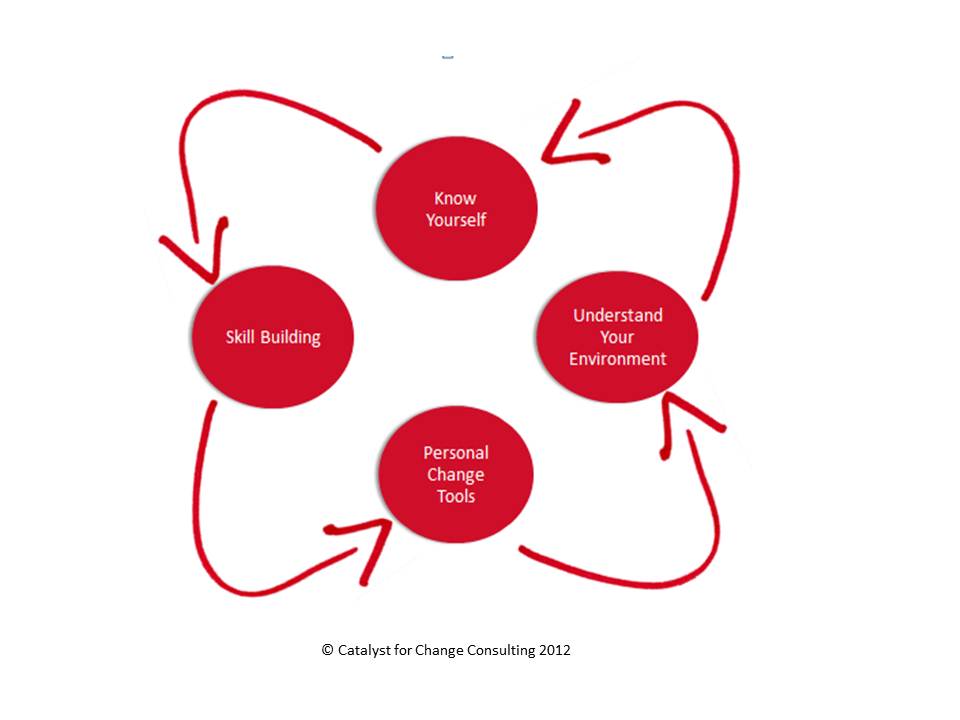
I know the print on the diagram is too small to read, but I wanted you to see how it all fit together.  There are four areas of developmental concentration:  1) Know Yourself, 2) Understand Your Environment, 3) Personal Change Tools and 4) Skill Building.   You can start anywhere—they all support each other.

4 Essentials for Do-It-Yourself Executive Development

The Recipe for DIY Executive Development:

Know Yourself–Understand Your:

  • Motivation
  • Habits
  • Personality
  • Beliefs About How Things Work
  • Strengths/Weaknesses
  • Temperament
  • Flaws (aka Derailers)

Understand Your Environment:

  • What is the Culture?
  • What is Your Fit in that Culture?
  • What is the Power Structure?
  • What Gets Rewarded?
  • What is the Organization Life Cycle Stage?

Personal Change Tools–Understand:

  • Reframing
  • Habits
  • Feedback

Skill Building–Develop:

  • Execution Skills
  • Leadership
  • Financial Acumen
  • Organization Assessment
  • Organizational Political Saavy
  • Personal Brand Management
  • Emotional Intelligence
  • Organizational Change Management

The well-rounded, and highly successful Executive has all of these.  No one is born with all of them; they need to be developed.  If you want to be a successful Executive, stop waiting for your organization to do it.  Get off your butt and start working on developing yourself.  You’ll do a much better job than any organization if you focus on it.

Leave a comment

Filed under Brand Yourself, Career Development, Career Goals, Derailment, Executive Development, Hi Po, Leadership, Personal Change, Recession Proof, Reframe, Success

Don’t Take Your Needs to Work

Basics/Needs/Wants

My first exposure to the idea of how my needs impacted my career came from Laura Berman Fortgang’s book, Take Yourself to the Top. Fortgang divides things into basics/needs/wants.  Most of us can tell what the basics are–enough food, housing, warmth, safety.  Most of us also can tell the “wants”–house at the beach, Thunder season tickets, designer wardrobe, fill-in-the-blanks.  It gets tricky when we are dealing with needs.  Needs are sometimes disguised wants, but more often, they are buried in our subconscious–we don’t even recognize them when they are running our lives.

Examples

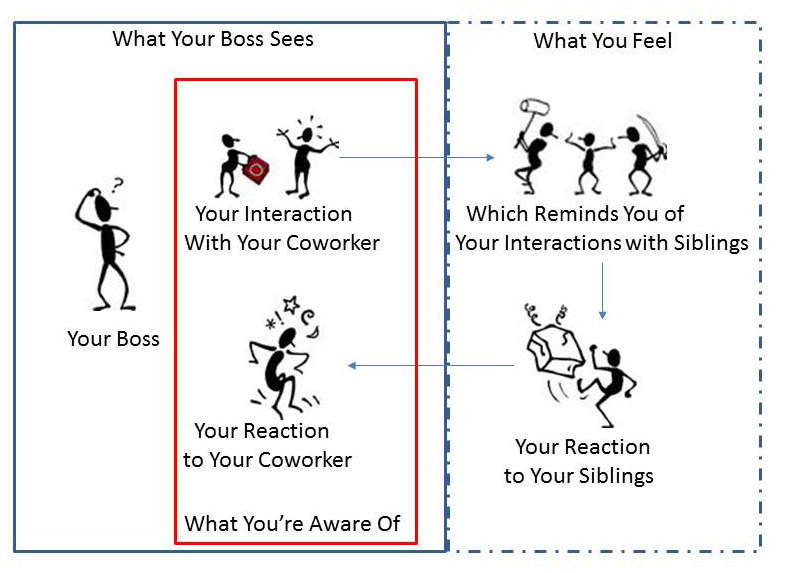
The kind of needs I’m talking about are those that start in early childhood–usually because of deprivation or mistreatment–and drive our behavior for the rest of our lives.  Someone very close to me grew up incredibly poor and without things that practically everyone has–things like soap, combs, jelly, sufficient clothes, or coats.  Her need was to never feel deprived again.  She accumulated stuff to prevent the feeling of deprivation.  It drove her whole life.

Some have the need to be appreciated.  Some have the need to be respected.  Some have the need to be treated fairly.  Some need to be right.  You get the idea.  These needs are all wrapped up in our self-worth.  If you don’t respect me, then you have shaken the very foundations of my belief in myself.  When this happens at work, then you are behaving like the same five-year-old who initially developed this need.  You probably aren’t aware that you are acting like a five-year-old.  You probably feel completely righteous in your reaction.  You won’t stop talking about it.  You tell your co-workers how wronged you are, and they probably are somewhat intimidated by your level of emotion.  They may or may not agree with you, but they are reluctant to challenge you because of how you are coming across about it.

This happens all the time.  It happens to pretty much everyone.  The way you can recognize it is by how upset you are.  How driven you are to fix it.  How much you talk about it.  How much you think about it. These needs are legitimate.  You came by them legitimately.  My friend who was so deprived in her childhood was trying to protect herself from ever feeling that horrible again.  But you need to get your needs out of your work.  They will do much more damage than it is worth.  People will think you’re completely irrational about weird stuff.  They will not be able to connect the dots between your behavior that they see and your need that you are trying to address and whatever happened to you that created that need.

What Do You Do?

So, what do you do?  Think back.  Think of times when even you could tell you were being irrational.  What was driving it?  Are there patterns?  Same reaction to similar situations?  Same reaction to similar people?  Figure out which needs are driving you (literally) crazy.  Try to reason with yourself (this isn’t usually all that successful).  Point out to yourself that that was then (when you were 5) and this is now (when you are an adult who really shouldn’t care if your GenY employee isn’t respecting you as much as you think she should).  If trying to talk yourself out of it doesn’t work, don’t give up, but there is a Plan B.

irrational at workWhen you feel yourself getting irrational (ok, not irrational–incredibly irritated), try to think of another way that you can get this need met OUTSIDE OF WORK.  Where can you be respected that matters more?  Church?  Home? Professional group?  Who appreciates you who matters more than people at work?  Can’t you go tell someone else you were right without rubbing your peer’s face in it?

Why Should You Go To That Much Trouble?

Because it really does have a negative impact on your career.  When you are being driven by things that are outside your conscious awareness, then you aren’t really in control.  When you aren’t in control, then you will do something that looks stupid to people who can make decisions about your future.  So, get your needs away from your work.

Leave a comment

Filed under Books, Career Development, Executive Development, Personal Change, Reframe, Success, Uncategorized