Category Archives: Job Hunt

Work As We Know It Is Changing–Get Ready!

That Was Then

My maternal grandmother went to work when she was thirteen years old at a china factory that made dishes for hotels and restaurants and, eventually, naval ships.  She stayed in a rental room with her two-year-older sister during the week and went home on the weekends.  She got married when she was seventeen and continued to work at the factory sporadically.  She was very good at what she did.  She was a Master Painter and she supported her family of eight during the Depression by painting.  It never occurred to her that that factory wouldn’t always be there, but when she was forty-seven the plant went out of business, taking hundreds of jobs with it.

Carr China Grafton WV

China from Carr China

My paternal grandfather spent his entire professional life at the Baltimore & Ohio Railroad, most of it as engineer driving passenger trains.  He told my father not to go to work for the railroad, because it wasn’t going to last.  The Baltimore & Ohio Railroad went out of business three years after my grandfather retired–taking hundreds of jobs with it.

Baltimore & Ohio Passenger Train

B&O Passenger Train

My mother’s cousin was forced to retire from the steel mill when he was fifty years old.  He wrote about it in an article published in the Beaver County (Pa) Times, “Now time has changed again, old friend [the steel mill] and now times are not certainly in your favor.  I am reasonably certain that my sons will never know you as I have but you can be sure I will tell them your story and how finally you were befallen by so many uncontrollable factors, and how you, who meant so much to so many, now sit mostly idle as wind whistles through your empty buildings; your coke batteries, your blast furnaces and continuous caster are now cold, dark, and silent.”  And hundreds of jobs gone.

Steel Mill in Pennsylvania

Steel Mill in Aliqiuppa, Pa

You may have similar stories from your grandparents, parents and even from your own experience.  This is happening to us.  Companies and work as we know it are changing irrevocably.  It’s sad.  There is a lot to grieve.  There are things you can do about it, though, so when YOUR company and YOUR job change, you land on your feet.

This Is Now

I read a couple of things over the weekend that discuss something that I’m seeing in the workforce among my coaching  and organizational clients. It is the next way that work will be.  The longer you don’t believe it, the louder you rail against it, the longer it will be before you are ready for the next “way we work.”  The first thing I read was  The Rise of the Supertemp by Jody Greenstone Miller and Matt Miller in Harvard Business Review.  They describe a phenomenon that many of us have seen.  Companies are going to contract workers.  According to a McKinsey  2011 study cited in the article, 58%  of US companies surveyed are planning to increase use of temporary employees AT ALL LEVELS.   Not only are they using project, technical and finance contract workers, they are starting to hire contract Executive talent–business development, marketing, lawyers, CFOs, and even CEOs.  BOTH companies and Executives need to adjust to this new reality.

Companies need to learn how to organize work so that these Supertemps can come in and make a difference. Mostly this means that work needs to be organized into project-type work.   Executives need to package and sell themselves for this work.  The most telling thing in the Harvard article, however, is that those who have done this work DO NOT want to return to the ‘old way.’  This is true of the people I know who have done this kind of work as well.  They really like it.

Think about how you make yourself a well qualified candidate for these positions.  There are some ideas for that in the second thing I read this weekend–The Finch Effect by Nacie Carson.  Carson suggests that like Darwin’s finches, today’s workers need to evolve to adapt to the current work environment.   She points out that unlike the time it takes other species to evolve, humans can evolve their behaviors to adapt as they choose.  Her suggested strategies for adapting to the new work environment:

  • Adopt a ‘gig’ mindset: piece together a combination of contracting, consulting, and free lance work that gives you a income equal to or more than your ‘full time’ job
  • Identify your value:  this is your professional brand–it communicates intangibles like values, personality and mission
  • Cultivate your skills: you (not your company) take responsibility for growing your skills
  • Nurture your social network: use appropriate sites for appropriate messages, rebrand as necessary, communicate your brand
  • Harness your entrepreneurial energy: look at your job and skills from a position of personal responsibility, initiative and personal direction

AND you can apply all of these to you ‘real’ job.  They will help you stay in it and succeed.  And they will help you be ready for the next ‘way we work.’
5 Comments

Filed under Books, Career Development, Career Goals, Job Hunt, Leadership, Networking, Reframe, Success

Looking for a job? Look in the HJM!

Looking for a job?

Soooooo many people are looking for jobs these days.  People who have been laid off are looking.  People who are dissatisfied are looking.  People who have been underemployed for a while are finally feeling like things are moving enough that they can look.  Maybe it’s just the people I know, but it seems like everyone is looking in the wrong places.

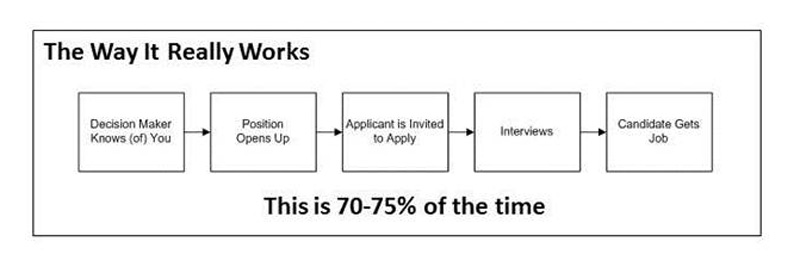
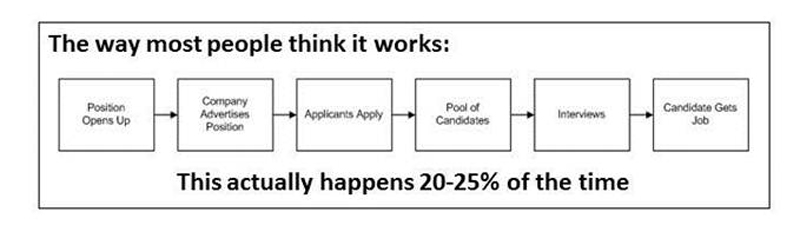
Seventy five to eighty percent of all jobs are NOT advertised.

And remember, this type of hiring (20-25%) includes  the McDonald’s and other entry-level jobs. This also includes all the internet job postings, newspaper job postings, and LinkedIn job postings.

Seventy five to eighty percent of the jobs are in the HIDDEN JOB MARKET.

 The other 5% of hiring happens when the candidate persuades the decider to create a specific job for him.  (Not common, but it happens).

Don Asher in his book Cracking the Hidden Job Market says that you get a job by talking to people.  He’s not talking about interviewing.  He means talking to pretty much everyone who will listen about your job search.  He recommends using every technique available:  face to face, email, phone, LinkedIn, Facebook, and even snail mail.  People are much more comfortable hiring you–or even considering you–when they know you, or when someone close to them knows you.  It’s a lot like dating.

You also need to know what kind of job you want–what industry, function, role, company type.  Then you need to TARGET those jobs.  It is like deciding you want to marry a millionaire.  That is more focused than if you want to marry someone or if you just want to date.  Where do you find millionaires?  How do you know which ones would fit with you?  How do you have to come across to marry a millionaire.  You get the point–it isn’t just throwing your resume at recruiters who have posted jobs.

There are a few  books that I recommend:

Now the Excuses

  • It’s way more work to do it this way.
  • I don’t want people to know I’m out of a job.
  • No one I know knows of any jobs–they would tell me if they did.
  • And on and on and on

Yeah, it is more work.  You want a job, you do the work.  People who know how to work these systems and find the hidden jobs control their careers.  The rest of us are flotsam floating on the river of chance.  EVERYONE knows about jobs or knows someone who does.  It isn’t top of mind.  By talking to people about your job search, you help them remember you when they hear about jobs.

Oh, and don’t wait till you need a job to do this.  Start building the network and targeting the organizations now so that you are ready.  Get ready to lose your job!

1 Comment

Filed under Books, Career Development, Career Goals, Executive Development, Job Hunt, Networking, Recession Proof

It All Starts With That First . . . Step

Know What You Want

I used to be in charge of Executive Development for a large corporation.  One day a middle manager came to talk to me about her career dreams.  Within the organization, she had been designated a “hi po”–a high potential with the ability and likelihood to progress several steps higher.  She was a good performer at her management job.  She was quiet and soft spoken, and well respected among her peers.

She told me that she wanted to work internationally.  She became quite animated as she discussed the kind of opportunity she wanted.  Our company provided, at that time, international opportunity for the very top leadership, but not for others.  Best case, she would have to wait years and have many other assignments before she got an international assignment.  Worst case, it wouldn’t happen at our company.  I didn’t share that explicitly with her, but we both knew it.  Instead, we talked about the kinds of skills she would need to be good at such an assignment and how she  could acquire those skills while she was working at her current job.  She went away with some lists and lots to think about.

Get Ready

She took a couple of different assignments within the company that broadened her skills.  Her desire for an international assignment didn’t abate, though, and she began to research opportunities.  She investigated recruiters and companies that could provide her with the kinds of opportunities she wanted.  She read about being an expatriate and came back to talk to me about the risks associated with that.   She discovered that failure rates are high and can vary between 10% and 50% depending on the country.  The reasons for failure range from cultural adjustments, language differences, assignment overburden, physical breakdown, and family stress to organizational issues such as a change of strategic direction, or failure to provide sufficient support.  Some organizations do a very good job at preparing employees for international job change, as well as helping them repatriate when the assignment is complete.

Doing it on your own is a completely different.  You have to teach yourself the things that the company would want you to know.  This preparation process took several years for her.  She was successfully employed during this time, but at the same time, she was focused on her goal–finding an international assignment where she could be successful.

Go

She found a job opportunity.  Luckily, there were people she knew connected to the company (this is highly recommended) and they were able to provide some
support.   She took a job in a country far from home–on the other side of the world.  She was lonely and overwhelmed and she turned all that into a blog-like communication to her friends and colleagues.  She told us about her new experiences–her challenges with different cultural norms at work, living in a building with an elevator but erratic electricity, travel, food, and expectations.  She worked several years for that company, landed another job at another company-same country, and then with another company, different country.  She continues to learn and grow and be a valuable asset to her employer.  And she is living her dream!

That First Step

All of us who received her communications were absolutely awestruck by her bravery.  She was actually doing it!  We were jealous.  What experiences she was having!

She did it for herself.  She didn’t wait for the organization to do it for her.  She didn’t let the reported failure rates, or the things she didn’t know how to do, or the fact that her current organization didn’t have the opportunities, or the thought of selling her stuff, moving and being completely out of her comfort zone stop her.  She took one step at a time, with a clear eye on what she wanted and where she was going.

What’s Stopping You From Taking That First Step Toward Your Dream?

1 Comment

Filed under Career Development, Career Goals, Executive Development, Goal Setting, Job Hunt, Personal Change

Get Ready to Lose Your Job

I hope you never need this advice. Chances are good, though, that you will–even if you are a high potential, can’t-do-anything-wrong super dooper employee. Most of us end up out on the job hunt street in our career.

The number one thing that you can work on right now to prepare for that day is to build your network. When clients end up on my coaching doorstep after a recent job loss, their number one regret is that they didn’t keep their network current. Ask yourself: if you lost your job next Monday, how many people in your network are familiar enough with what you do to be able to start referring you for job leads immediately? How many of them would want to? How many of them have you had contact with in the last month? year? five years? How many of them do you have current contact info on? When someone starts a job search, it usually takes months to rebuild a network. Months! How can I get your attention about this?

Yeah, I know. You don’t have time. You have to do (keep) your current job, take the kids to soccer, re-do the house.
If you lost your job, you would find the time. And you would wish you had done it sooner.

So what do you do? Start with two things:

1) Join, attend and volunteer for the appropriate professional groups. The people who do jobs like yours belong to these groups. They are also the first to know of the job openings in their own companies. There is a reason that the leadership of these professional groups (PMI, SHRM, ASTD) move easily from company to company. They know people.

2) Join/update/participate in LinkedIn. LinkedIn is becoming the largest recruiting tool in many professions. Join groups that interest you. Post answers/questions when appropriate (but don’t spam people with it).  Set your LinkedIn account up so that you get an email update of changes in your network.  Reach out to those who have had a change.  It doesn’t take much time, but it keeps that contact warm.  Post things of interest periodically.

Approximately 75% of jobs are landed through knowing someone who has some connection to the job (in the same company, referral, etc). 75%!  Make sure you are ready if you ever need it.

1 Comment

Filed under Executive Development, Job Hunt, Networking