Category Archives: Career Goals

Life, Death and Legacies

Death-Bed Regrets

I bet you have all heard the story about the guy on his death-bed who regretted how much he worked and how little time he spent with his family, or doing what he loved, or making a difference in the world.  This is a lot like the story of the ant and the grasshopper–a reminder not to waste our life away on what is not important. It is really hard, though, when you’re up to your eyeballs in everyday life–work, taking the kids to school, putting food on the table, mowing the grass– to know what will be important enough to you when you die to regret not doing.

Today’s The Day

The thing is, today may be the day you will face what you wish you had done less or more.  Today CAN be the day you face what you wish you were doing more of.  Any day, week, year can be your last.  I don’t say that to freak you out–I really think at some level you know this–but rather to get your attention to spend the time now to figure out what you want you life to be about.

My husband died 21 days after being diagnosed with cancer.  He didn’t have time to think about wishes from his death-bed–in fact, he was 100% focused on figuring out how to fight the disease and he wasn’t being reflective at all.  A little more than a month before he died (before he knew he was sick), however, he wrote the following in our Christmas letter:

As you can see, he knew what was important to him.  He was focused on what was important to him.  Even though he died when he was merely forty-two, he brought this kind of thinking to the life he lived.  The people in his life felt enriched and loved by him.    I learned this lesson from him, that today could be our last and we need to focus on what is important, what will be our legacy, NOW.  We need to live a life we’re proud of today, tomorrow and every day.

Write Your Obituary

One of the best ways to think about this is to write your obituary.  Decide an appropriate death date. Make it 50 or 100 years or so from now. Then, decide what you’ve accomplished. This involves two main steps:

  • First off, decide who you want to be (or  have been, if we’re talking  obituary time).
  • Second, decide what you have accomplished.  When you take an   “accomplishment” view of your life, listing the things you really want to   accomplish, it clarifies where you want to go. Try to make your   “accomplishments” as concrete and possible as you can. Try to  define yourself in terms of what you are  likely to be able to accomplish,  with a little or a lot of stretching.

Now, look at your obituary.  What was important enough to you to be mentioned in your obituary?  When you think about your life now, are you on a path to accomplish what you want to?  Are you on a path to concentrate on what you think is important?  Do you need to make changes to your life, to your priorities, to your behaviors to make the life you want to happen?

Think about it.

Leave a comment

Filed under Career Goals, Executive Development, Personal Change, Success

Get a Mentor. Use a Mentor.

Get a Mentor

I know you’ve heard it.  If you’ve been reading this blog, you’ve heard it from me.  You need a mentor to help your career.  Easier said than done, right?

How Do I Get a Mentor?

Typical questions about mentors and mentoring are:

  • What is mentoring?
  • How do I find a good mentor for me?
  • How do I ask someone to be my mentor?
  • How does having a mentor work to help my career?
  • What if my mentor and I don’t get along?
  • What if my mentor won’t meet with me?
  • How do I end the mentor relationship?

What Is Mentoring?

Mentoring, first and foremost, is a LEARNING relationship.  The old-school model of mentoring was that the senior, experienced successful mentor took the junior, inexperienced mentee under his wing (yes, it was always a ‘he’).  Today’s mentoring is much more complex, but much more productive.  It is different depending on the people involved.  It could be a senior person helping a junior person succeed in an organization.  It could be an expert helping a novice speed up the process of learning.  It could be a junior person helping an executive understand social media.  The key parts to a mentor/mentee effort are LEARNING and RELATIONSHIP.  It is a collaboration, not a one-way relationship.  Both parties, but most importantly the mentee, take responsibility for the success of the relationship.  The mentee must have a plan, goals and the willingness to step up and reach out for the mentoring to be maximally successful.

How Do You Find A Mentor?

You start with what you need.  When you think about your career, what is it that you need?  Do you need to learn how to navigate the organization’s politics?  Do you need to learn how to be an effective executive?  Do you need Executive presence? Do you need to learn how to manage technical people?  Do you need to learn to manage your peers?  Think strategically?  Present your ideas better?  Whatever it is (and don’t focus on everything at once–pick the biggest/most important thing), think about who you know, or know of, who can do it well.  If there is more than one person who fits that description, who do you think has the best ‘chemistry’ with you.  Who do you most want to learn from?  Who might have more time? Who do you think might be the better teacher?  Based on these questions, pick someone who could mentor you in what you need.

How Do You Ask Someone To Be A Mentor?

Once you’ve identified someone, make a plan.  What do you want to learn from the person?  Over what time period?  What format would work best for you?  Informal–like over coffee?  Formally scheduled meetings?  Asking questions?  Your mentor talking and telling stories?  Once you’ve thought through these, what kind of proposal can you make to your mentor?  Something like:

I’ve admired how well you navigate this organization to get things done for your organization for a while now.  I was wondering if you’d be willing to mentor me on how to do that?  I was thinking maybe we could have coffee some morning and you could share with me some of the things you wish someone had told you?

Imagine if someone approached you this way.  It’s likely that you would be flattered.  If you had the time, it is likely that you would be willing to do this.  You’re not asking for a long term commitment in this situation.  You’re testing the waters.  If you have the first meeting (which, if it is more comfortable for you, you could formally schedule a meeting), and the chemistry seems good and the mentor seemed to enjoy it as much as you did, then you can ask for another meeting.  In the second meeting, you can ask the person about him/herself.

  • How did you get to where you are in the organization?
  • What have been your biggest career learnings?
  • What do you wish you had known that you know now?
  • Are there things you would have done differently?
  • Which jobs have taught you the most?  Which bosses?

If this conversation goes well, then it is time to suggest that the person be a mentor.  Ask if he is willing to be your mentor.  Tell him what kinds of things you’d like to learn from him.  Over what period of time?  How often would you like to meet with him?  (Be very reasonable here).  Show him that you will take responsibility for learning with him as your guide.  If he agrees, ask him how he wants you to be prepared before your conversations?  What kind of follow-up and follow-through does he want?  Get clear on your goals.

If you approach it in these stages, you get to feel out the relationship element of the mentoring–do you think it will work?  Push yourself to ask if the relationship works for you, because it will be worth it.  If s/he says no, don’t take it personally.  It is probably about time commitment or, just as likely, about the mentor feeling inadequate to the task.

How Does Having A Mentor Work?

The mentoring relationship is about learning–usually both the mentor and the mentee learn.  Sometimes the mentor is able to open doors for opportunities, but almost always the mentor opens minds.  The mentor helps the mentee see the world through different eyes (usually higher ranking eyes).  The mentor helps the mentee have a new perspective–thinking strategically instead of tactically, thinking like a sales person instead of an HR person, understanding how decisions get made at the top of the organization.  These new perspectives are JUST AS IMPORTANT as if the mentor helps the mentee land a new job.  It is these new perspectives that enable the mentee to succeed at the new job.

What If We Don’t Get Along?

Sometimes mentors and mentees don’t get along.  Having a couple of exchanges before you ask for a more formal mentoring relationship can sometimes help avoid this, but not always.  If you don’t get along with your mentor, ask yourself why.  Is it because she is speaking truth to you and you don’t like it?  If that is the reason, it is probably very worth hanging in there.  It is really hard to get people to tell you the truth–it is easier to learn to deal with it than to find someone else who will tell it.  Is it because the mentor reminds you of someone who you haven’t gotten along with in the past?  Your father?  Your older sister?  Your first boss?  Again, it’s really better to work through these issues than to find someone else–this is the kind of issue that will continue to bit you until you learn to deal with it.  Is it because the person is a bully or abusive?  If so, then it is best to end the relationship.  Don’t end it by stomping out.  Just thank the person for all the help s/he has provided (this is VERY important) and tell him/her to be sure to let you know if you can return the favor.  Then don’t schedule any more appointments.

What If My Mentor Won’t Meet With Me?

It is highly that anyone you want to mentor you is a very busy person.  When you have the conversation requesting that she become your mentor, you need to agree how often you will meet.  The more you can talk it out–what to do if one of you has to cancel, what to do if scheduling becomes a problem, what are the expectations, what to do if this becomes too burdensome–the less likely this is to be a problem.  After a number of cancels–this number should be different if it is a CEO v. a manager–then it is appropriate to ask whether it would be better to take a break till a time that is better.  Then go find someone else.  The biggest risk here, though, is that you will interpret normal scheduling problems as the mentor not wanting to do this.  It is likely that the mentor just has a busy schedule.  Don’t read too much into it.

How Do I End The Mentor Relationship?

It is best that you make some kind of arrangement for the end of the mentoring relationship (not the end of the relationship) in the initial agreement that establishes the relationship.    You can make it time specific or task specific–get through your next performance review, or do an Executive level presentation, but you do need to identify what the goal and timing of the mentoring relationship should be.

Many, many mentor relationships end and friendship remains.  That is ok, but be careful to make the shift in your mental model.  Be sure to thank your mentor in a meaningful way.    It’s great to keep notes as the mentoring proceeds and to write a summary of what you learned over time for your mentor.  It will help cement the learning in both your minds.  This could be one of the most important relationships of your working life.

A Good Book That Will Help

1 Comment

Filed under Books, Career Development, Career Goals, Executive Development, Feedback, Success, Trust

Become a Great Leader

Leaders and Leadership as a Process

Do You Want to Become a Great Leader?

How you think about leadership has a profound affect on your success in becoming a good leader.  We all have our individual idea of what a good leader is.  Then we assume that everyone thinks the same thing.  And that is what gets us into trouble.

There are three parts to this:

  • What do you think makes a good leader?
  • What is leadership?
  • How can you adjust to be a good leader for others?

What Do You Think Makes a Good Leader?

When you think of the best leaders you’ve ever experienced, what were their traits?  Were they organized?  Were they decisive?  Were they fair?  Were they nice? “In charge?” Inspirational? Ambitious?  Smart? Successful? Charismatic?  Make your list.

We idealize leaders.  We want them to be what we think a leader should be.  There is a bit of magical thinking about leaders—they are supposed to be what you want them to be, regardless of who they are or what their style is.

In the United States, we want our leaders to be out there in front—leading the charge.  That kind of leadership is considered  inappropriate behavior in some other cultures.   Leaders actually come in all shapes and sizes.  When you do the above exercise–asking what the traits of good leaders are–in a large group of people, they don’t agree.  Each has his/her own vision of what a leader should be.  This comes as a surprise to the people in the group, because we all assume that what we believe is a great leader is universal.  If you ask the group WHO have been great leaders, they generally agree on a (very) few–Martin Luther King, Ghandi, Lincoln, but can’t come to agreement on others–Jobs, Bush, Welsh, for instance.

So What is Leadership?

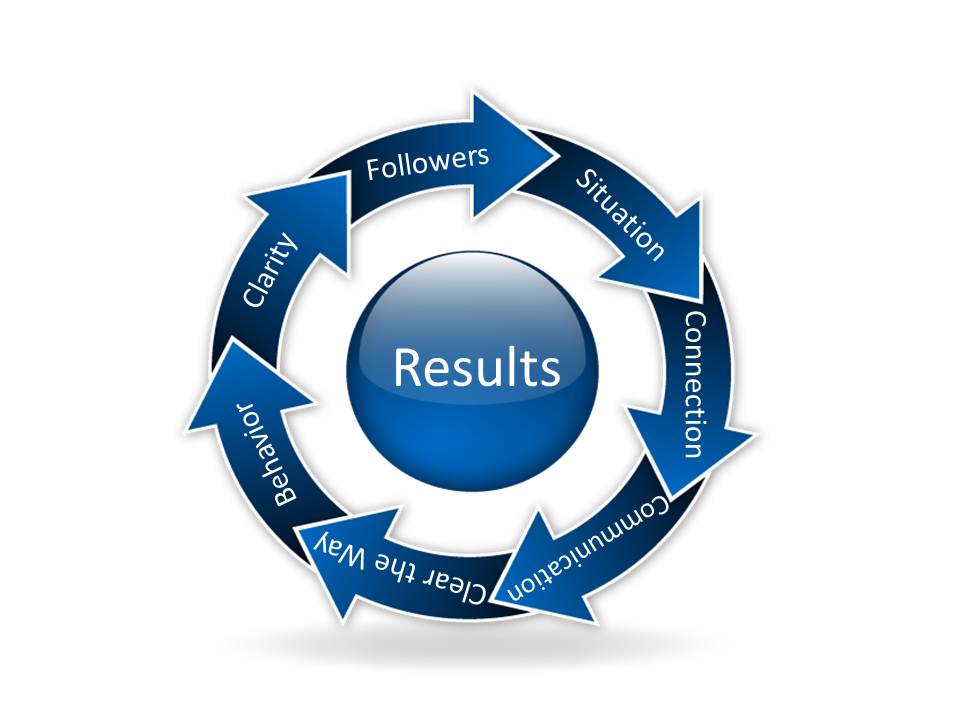
Leadership is more than just a person and who/what/how that person is.  It is results.  It is situational.  It is followers.  It is removing barriers for people.  It is connection. It is behavior.  It is communicating.  It is clarifying.  Leadership is the combination of all of these.  It is a process that combines all of these.

The leader is the instigator of this leadership process.  The leader is the instrument that stimulates and regulates the process.  The leader does not have to be a certain kind of person, but rather has to have the skills to manage this process and to integrate the elements of the process to achieve the results.

Now, rethink the people who you think are the best leaders in your experience.  How did they manage the elements of the leadership process?  Didn’t they do all of these steps well enough to get the results that the organization needed?

How can you adjust to be a good leader for others?

Reframe the way you think of leadership.  Think of it as a process instead of a particular way of being.  When you think of it this way, evaluate your ability to accomplish the skills of the leadership process.  How can you get better.  Depending on the results you need, the followers you have, the situation you are in, you need to remove barriers, communicate, clarify and adjust the integration of the leadership levers until you get results.  By thinking about it this way, it becomes a much more manageable task than if you have to have a personality transplant or develop charisma in order to be a great leader.

This view of leadership allows you to continue to ‘raise your game’ until you are a great leader.  Practice the skills that need development, hone the delivery of these tools, and learn to adjust to the situation and the followers.

4 Comments

Filed under Career Development, Career Goals, Communication, Executive Development, Leadership, Reframe, Success

Are You A Wannabe?

Are you an Executive wannabe?  An entrepreneur wannabe?  An artist wannabe? A marathoner wannabe? An author wannabe?  Do you put one of those on your New Year’s Resolutions list?  How about your career goals list?

What Is Stopping You?

Look at last week’s calendar.  Look at last month’s calendar.  Is your ‘wannabe’ goal anywhere on your calendar?  If not, why not?  How can you possibly accomplish your goal if you’re not spending any time on it?  Don’t tell me you don’t have time.  People who really want to do something have time.  Every successful accomplished person who has done what you want to do has EXACTLY the same amount of time that you do.  It comes down to six things:

  • Priority:  If this is your future, then you need to put it sufficiently up your priority list that you are spending time on it
  • Motivation:  Understand what motivates you and put that in your life.
  • Focus: You CANNOT do it all (at once).  Turn off the TV.  Stop surfing the Internet.  Stop texting.  Take yourself to some place quiet and isolated.
  • Determination:  Keep working toward your goal, no matter what gets in the way.
  • Create whatever support infrastructure you need.  If you need training, get it.  If you need a coach, get one.  If you need a place, find one.
  • Action:  I hate to be repetitive, but JUST DO IT

Winning

So, How Do You Do That?

  • Write it down.  Be very specific.  Not ‘Write a book’ but ‘Write a novel, get a book contract, and get it published by this time next year.
  • Once you’ve written the specific goal, work backwards.  In order to write a novel, get a book contract and get it published, what do you have to do?  In order to do those things, what do you have to do?  Ask what you have to do and detail it several times.
  • Once you have a fairly detailed list, decide what you are going to do tomorrow.  What are you going to do this week.  Look at your calendar and put these tasks on it.  Take something off your calendar to make room for it, if you have to.
  • What reward will you give yourself for which accomplishments.  It doesn’t have to be something big–just something that you will associate in your mind with accomplishing the task.
  • What are the big milestones in your plan?  How will you reward yourself for these big milestones?
  • Hold yourself accountable.  Tell someone–that makes it harder to escape the accountability.

Great books to help with this:

1 Comment

Filed under Books, Career Development, Career Goals, Goal Setting, Personal Change, Time Management

Create a Stakeholder Plan For Your Career

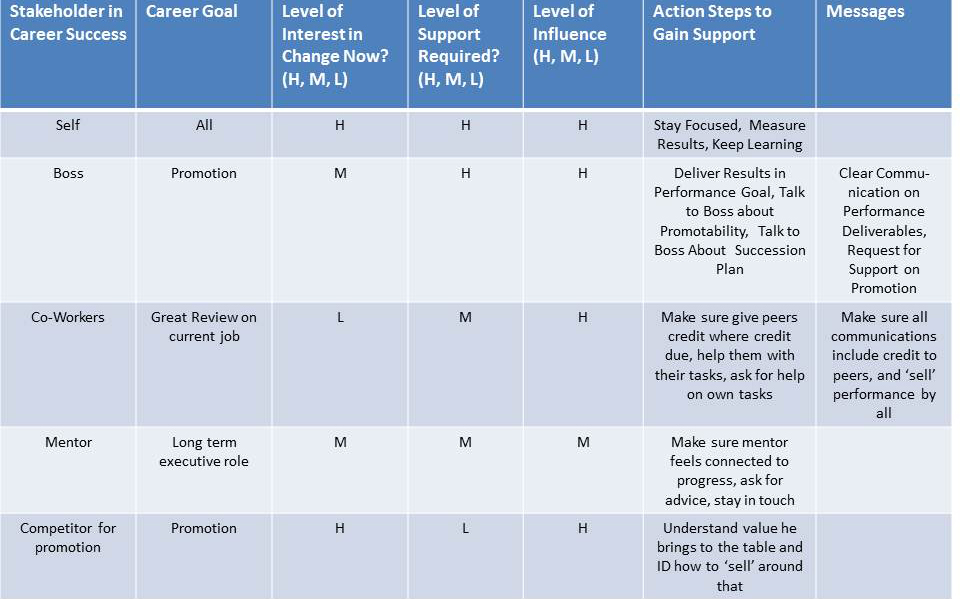
I’ve been working a lot with Stakeholder Plans for large organization change lately, and I was thinking that it would be a good idea to create one for a career plan.  For those who haven’t had the pleasure of creating a stakeholder plan yet, it is a way of identifying who has a vested interest (in this case, in your career success) and creating a plan to get their help in achieving your goals.

Who Are Your Stakeholders?

For example, identify who has any kind of an interest in your career success:  your boss, your peers, your mentor, your former bosses, your family, your future boss. Anyone, whether they are supportive, neutral or hostile to what you want to accomplish, should go on the list.

Stakeholder Assessment for your Career

Come Up With a Plan

Then identify which career goal each has an interest in and what that level of interest  is–your boss may have a high level of interest in your successful delivery of your current performance goals, but no interest at all in your promotion to a position outside his organization.  Understanding this, and creating a plan to mitigate your boss’ ambivalence may be essential to getting that promotion.  S/he may sabotage your promotion in order to keep you.  A stakeholder assessment–that requires you to think through all the players and come up with both an action plan and a communication plan for each, is likely to crystallize your thinking of next steps, and to speed your career on its way.

Categorize Them

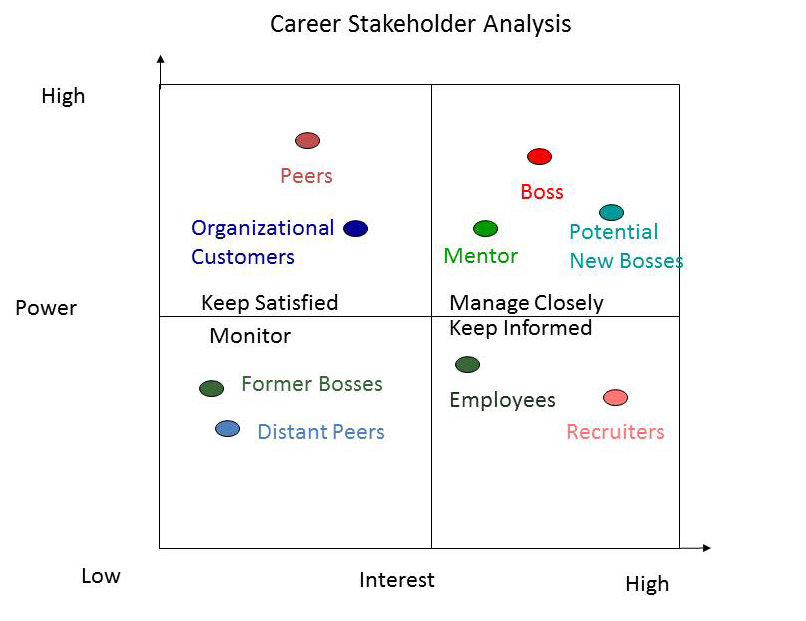
Once you’ve created a grid similar to the one above, you can create a graphic that divides your stakeholders into categories:

  • High Power/High Interest:  Manage Closely (like current boss/potential new boss)
  • High Power/Low Interest:  Keep Satisfied (like peers/organizational customers)
  • Low Power /Low Interest:  Monitor (like former bosses/distant peers)
  • Low Power/High Interest: Keep Informed (like employees/recruiters

Career Stakeholder Grid

Manage Them

Depending on your goals, your organizational situation and your timing, these stakeholders and their position on the grid will be different.  The most important part of this is to think it out–where are your key stakeholders on the support continuum, what is in the way of their full support and what can you do about it?  People feel threatened by other people’s career success and the more you’re aware of what people are thinking, the better you will be able to manage it.  Stakeholders who could be powerful supporters for your career goals may not know what they are–this exercise can help you identify that issue and come up with a great plan to solve it.

Leave a comment

Filed under Career Development, Career Goals, Executive Development, Goal Setting, Job Hunt, Recession Proof

Get Your ‘Get Up and Go’

motivate yourself

I spent much of Sunday morning watching a few hundred people participate in their first triathlon.  It was sixty-something degrees and drizzling.  What would possess these people—all ages, shapes and sizes—to come out in the rain to inflict discomfort on themselves?  They swam a quarter of a mile in a lake, biked 12 miles on rain slick country roads and ran 3.1 miles over hilly trails.  At the beginning and end of each portion of this event, each person had a small cheering section, but for the most part, each participant swam/biked/ran alone, competing against the elements and motivated by him/herself.  How did each person motivate him/herself?  How can you motivate yourself to do whatever your goal is?

Well, the good news AND the bad news is that motivation is individual.  Every person is motivated differently.  Some people need praise to be motivated.  Some people need to feel like they’re contributing.  Some people need to be able to tick off the boxes of their goals to be motivated.  Some people like public recognition, some hate it.  Few people, believe it or not, are motivated solely by money.  In fact, money can be a demotivater–it’s not enough or it’s less than so and so got–you spend more time thinking about the negative than the positive of money rewards.  Anyway, the way you are motivated is unique to you.  You need to figure out how that is and then put it to work for you.  You need to NOT wait for someone else to motivate you.  Others can help (like the individual cheering sections at the triathlon), but you need to take the responsibility and develop the skill to motivate yourself.

There are two types of motivation:  external and internal motivation. External motivation is in play when you are thinking that you “should” or you “want” to do something.  You’ve got internal motivation when you “love” something or you “gotta do it.”

There is a motivational continuum between external motivation and internal motivation.

Motivate yourself

If you are all the way at the external motivation end of the continuum, then your motivation comes not only from outside yourself, but actually from other people—people who tell you what to do.  You’re not doing it for yourself, but rather for others.  If you are at the internal motivation end of the continuum, then you do it because you feel whole when you do it.  You do it despite all the excuses/distractions/opportunities not to do it.  You REALLY do it.

The question is, how do you push yourself toward the internal motivation end of the spectrum?  First you need to understand what motivates you.

  • Are you a planner?  A list person?
  • Do you need to be encouraged by others? Recognized by others?
  • Do you need to feel like you accomplished something? Made a difference?

Think about times when you were most motivated.  What made that happen?  Was it that someone was proud of you?  (External motivation)  Was it that you could look at what was happening and you were proud of yourself? (Internal motivation). Whatever it is that pushes you, figure out a way to put that in your life.  Create a situation that provides the reward(s) that work for you.  They don’t have to be big rewards.  Frequently people are just as motivated by any reward–that they care about–as a big reward.

The key is that you have to take charge of your own motivation.  You will see your performance rocket significantly.  Steve Chandler’s book. 100 Ways to Motivate Yourself, will give you lots (100 to be precise) of ideas on how to motivate yourself.

Start experimenting.

3 Comments

Filed under Career Development, Career Goals, Executive Development, Goal Setting, Success

Face What’s Holding You Back

Career Roadblock

What Do You Think is Holding You Back?

What do you tell yourself about what is holding you back?  You need another degree? Your boss doesn’t like you?  You have to relocate for the next step? You’re too old?  Too young? You’ve been out of work too long? Your technical skills aren’t current? You’re overweight/a minority/gay/a woman? You don’t fit into the culture?  They don’t think you’re a ‘hi-po’?

Two Questions:

Whatever it is, I have two questions for you:

1)  How do you know you’re right?

Are you sure that you aren’t looking at it through ‘victim’ eyes?  What is your evidence that you are right?  Are you the only one with this problem? Are you fully engaged, working as hard as you can, delivering results and this is still happening?  Or have you checked out?  Have you talked to anyone about what is going on?  Have you asked for feedback? Has this been a pattern at other organizations/with other bosses/in other jobs? Are you on an emotional roller coaster or on an even keel?

If you are right in your assessment of what is holding you back, I have another question:

2)  What are you going to do about it?

If you need another degree, why don’t you get one?  No, really, why not?  No money? No time? Look at it through business case eyes–will it get you a better job, with more money, with a higher quality of life?  If so, tell me again why not?

If you are ‘too’ old, find someplace that appreciates your wisdom.  Why not?  There are places that do.  Just because your present organization doesn’t DOES not mean they all don’t.  Go FIND a better place.

Whatever the thing is that is holding you back, it is possible to overcome it.  It is possible to find a solution.  Set an audacious goal to fix/solve/overcome it and then do it.  Maybe it is the way you’re looking at it that is really what is holding you back?

Who can fix THAT?

(Did you notice that I asked more than two questions?:-))

1 Comment

Filed under Career Development, Career Goals, Derailment, Executive Development, Feedback, Hi Po, Personal Change

Career Accelerants

Win the Career Race

Do are you know people who are about your age, have about the same experience, and aren’t more talented/smart/capable than you, but who are more successful in their career than you?  Are you puzzled about what they have that you don’t?  What do they do/who do they know/how do they do it? Do you want to go faster, too?

There are some tools that can help you accelerate your career success.  I call them career accelerants.

Mindset.

How you think.  What you think.  When you think.  All make a huge difference in how fast and how well your career progresses.  Mind set includes:

  • Your Attitude–“I can.  I will.”
  • Being Positive
  • Constantly Learning
  • Being committed

Adaptability.

There is an old Chinese proverb that says that the wise adapt themselves to circumstances, as water molds itself to the pitcher.  The second you get stuck with “this is the way it is” or “I’m not going to do this,” is the beginning of the end of your upward trajectory in that organization.  The way I think of it is, “If I had started at this organization today, I wouldn’t object to this. I would just do it.”  This can apply to systems, processes, organizations, etc.  It doesn’t occur to us to ‘resist’ when we’re new to an organization.  Try to adopt that way of looking at things.

Tools.

Use whatever tools you can to help you learn/understand/experience faster.  Some of the best tools are:

  • Books
  • Feedback
  • Goals/Measures
  • Training

Energy.

You need a high level of energy to speed up your career.  You are more in control of your energy level than you might think.  For high energy you need:

  • Good Health
  • Fitness
  • Mindset

Infrastructure.

Successful careers need an infrastructure too.  Set up your life so that it supports your career.  To do this, you need:

  • A Support System
  • De-clutter your life–get rid of the things that you ‘tolerate,’ but which weigh you down–anything from messy desks to people who suck you dry
  • Balance–whatever this means for you (not what others think).  Keep adjusting this, it is a work in progress.

You are in control of your career.  If it isn’t moving the way you want it to, look at this list and start experimenting with changing the way you’re doing things.

Leave a comment

Filed under Career Development, Career Goals, Executive Development, Feedback, Goal Setting, Personal Change

You Have To Start To Succeed

Some people dream of success while others wake up and work hard at it.

I saw this quote yesterday and LOVED it.  I searched the Internet to try to find the author unsuccessfully, but discovered in the process that this quote has inspired a lot of blog posts.  Rightfully so.  It’s a lot like Nike’s “Just Do It.”  It makes sense, it inspires, and it is right.  If you start, do, work hard, you’ll get there.

Today is June 1.

This is a good day to review your New Year’s Resolutions again. If you don’t have New Year’s Resolutions, that’s ok.  Let’s talk about your goals.  Where do you stand on your goals?  For this year, for this decade, for this life?  Planning, hoping, dreaming of what you want isn’t enough.  It’s a great start, but it isn’t enough.  You have to START.  Just start.  What is the first step?  Write it down.  When will you do it?  How will you know it is done?

Are you committed to your success?  Or are you just hoping for it?  It won’t happen if you don’t DO SOMETHING toward accomplishing it.  Little steps can lead to big journeys.

JUST START.

2 Comments

Filed under Career Development, Career Goals, Executive Development, Goal Setting

Work As We Know It Is Changing–Get Ready!

That Was Then

My maternal grandmother went to work when she was thirteen years old at a china factory that made dishes for hotels and restaurants and, eventually, naval ships.  She stayed in a rental room with her two-year-older sister during the week and went home on the weekends.  She got married when she was seventeen and continued to work at the factory sporadically.  She was very good at what she did.  She was a Master Painter and she supported her family of eight during the Depression by painting.  It never occurred to her that that factory wouldn’t always be there, but when she was forty-seven the plant went out of business, taking hundreds of jobs with it.

Carr China Grafton WV

China from Carr China

My paternal grandfather spent his entire professional life at the Baltimore & Ohio Railroad, most of it as engineer driving passenger trains.  He told my father not to go to work for the railroad, because it wasn’t going to last.  The Baltimore & Ohio Railroad went out of business three years after my grandfather retired–taking hundreds of jobs with it.

Baltimore & Ohio Passenger Train

B&O Passenger Train

My mother’s cousin was forced to retire from the steel mill when he was fifty years old.  He wrote about it in an article published in the Beaver County (Pa) Times, “Now time has changed again, old friend [the steel mill] and now times are not certainly in your favor.  I am reasonably certain that my sons will never know you as I have but you can be sure I will tell them your story and how finally you were befallen by so many uncontrollable factors, and how you, who meant so much to so many, now sit mostly idle as wind whistles through your empty buildings; your coke batteries, your blast furnaces and continuous caster are now cold, dark, and silent.”  And hundreds of jobs gone.

Steel Mill in Pennsylvania

Steel Mill in Aliqiuppa, Pa

You may have similar stories from your grandparents, parents and even from your own experience.  This is happening to us.  Companies and work as we know it are changing irrevocably.  It’s sad.  There is a lot to grieve.  There are things you can do about it, though, so when YOUR company and YOUR job change, you land on your feet.

This Is Now

I read a couple of things over the weekend that discuss something that I’m seeing in the workforce among my coaching  and organizational clients. It is the next way that work will be.  The longer you don’t believe it, the louder you rail against it, the longer it will be before you are ready for the next “way we work.”  The first thing I read was  The Rise of the Supertemp by Jody Greenstone Miller and Matt Miller in Harvard Business Review.  They describe a phenomenon that many of us have seen.  Companies are going to contract workers.  According to a McKinsey  2011 study cited in the article, 58%  of US companies surveyed are planning to increase use of temporary employees AT ALL LEVELS.   Not only are they using project, technical and finance contract workers, they are starting to hire contract Executive talent–business development, marketing, lawyers, CFOs, and even CEOs.  BOTH companies and Executives need to adjust to this new reality.

Companies need to learn how to organize work so that these Supertemps can come in and make a difference. Mostly this means that work needs to be organized into project-type work.   Executives need to package and sell themselves for this work.  The most telling thing in the Harvard article, however, is that those who have done this work DO NOT want to return to the ‘old way.’  This is true of the people I know who have done this kind of work as well.  They really like it.

Think about how you make yourself a well qualified candidate for these positions.  There are some ideas for that in the second thing I read this weekend–The Finch Effect by Nacie Carson.  Carson suggests that like Darwin’s finches, today’s workers need to evolve to adapt to the current work environment.   She points out that unlike the time it takes other species to evolve, humans can evolve their behaviors to adapt as they choose.  Her suggested strategies for adapting to the new work environment:

  • Adopt a ‘gig’ mindset: piece together a combination of contracting, consulting, and free lance work that gives you a income equal to or more than your ‘full time’ job
  • Identify your value:  this is your professional brand–it communicates intangibles like values, personality and mission
  • Cultivate your skills: you (not your company) take responsibility for growing your skills
  • Nurture your social network: use appropriate sites for appropriate messages, rebrand as necessary, communicate your brand
  • Harness your entrepreneurial energy: look at your job and skills from a position of personal responsibility, initiative and personal direction

AND you can apply all of these to you ‘real’ job.  They will help you stay in it and succeed.  And they will help you be ready for the next ‘way we work.’

5 Comments

Filed under Books, Career Development, Career Goals, Job Hunt, Leadership, Networking, Reframe, Success