
Here She Goes Again
I suggest books all the time to my friends and clients. I’m sure some people hide the eye rolling from me while they think: “here she goes again.” I learn best from books, so I want to share my love of learning and my love of books. I got to wondering this week, if I had to pick just five books to recommend, what would they be?
The Books
The books that I selected are the ones that made the most difference for me at the time in my life when I read them. Each of them provided a major “Ah Ha” moment that moved my career to another level. These are the books that changed the trajectory of my career in one way or another.

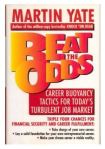 The big idea that I got from this book is the concept of having three careers that you’re working on at the same time–your core career (the one that makes you money), an entrepreneurial career (where you’re learning skills and beginning to make money in a different way) and your dream career. This approach forced me to really figure out what my goals were, and, more importantly, it took my focus off the day to day stuff and let me take all that more in stride. I became happier and more productive all in one. This book is out of print, but Yate has a new book, Knock ‘Em Dead Secrets and Strategies for Success in an Uncertain World, that includes all the same concepts.
Change or Die by Alan Deutschman
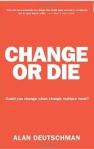 Deutschman asks the question, “If someone told you that you were going to die if you didn’t change, would you?” Of course the answer is “yes!” But is it? Don’t we all know how we should eat? How we should exercise? We know that we should stop smoking or drinking too much. We know if we don’t, it will adversely affect us and that the consequences may be that we will die earlier. So, even though we know that we will die earlier if we don’t change, we don’t. He analyzes why some people actually do effectively change. It helped me begin to make personal changes that I had “resolved” to for years.
Breaking the Code of Change edited by Beer and Nohria 
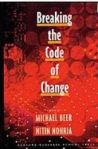 This book was the product of a research conference of the same name in 1998. This was the first time that I encountered the concepts of “Theory E” (economic value) change and “Theory O” (organizational capability) change. Suddenly I understood why most organizational change failed–people were either doing Theory E (and as soon as they stopped, the organizational amoeba went back into place) or Theory O (which gets people on board but takes way too long to provide the organization leadership the results in the time they need). I suddenly understood that as a change manager, I had to figure out how to do both Theory E and Theory O to make a change happen and stick. It completely changed the way I did my work.
Management of Organizational Behavior by Blanchard and Hersey
 When I became a manager, I went searching for a book to tell me how to be a good manager. Scores of books later, I came across this book. This is actually a textbook. It opened the door on the study of organizational behavior, leadership theory and organizational change for me. The most important (among many) idea in the book for me is Situational Leadership(R). The theory of Situational Leadership discusses leadership styles in terms of different combinations of task and relationship focus. The theory lays out four leadership styles and suggests that different styles are more appropriate for different follower behaviors. The book is a wealth of powerful ideas on how individuals and organizations work.
Success and Betrayal by Hardesty Bray and Jacobs 
 This book, now out of print, was published in 1986. The book discusses women in corporations. Although the book describes women’s beliefs about the way things work in organizations, these ideas apply to men, too. We all believe certain things about the way organizations work–if we work hard, we will succeed; if you do a good job, you will be rewarded; we’re all a family in an organization, etc. You come by the things you believe about organizations through your experiences in childhood, in your family, in school, in your social and athletic experiences. The problem is, unless you are in charge of the organization, these aren’t necessarily the “real” rules of the organization. This book taught me to identify my own “myths” and to understand the “real” rules. If you understand, then you have the option to decide whether you want to “play the game” or not. If you don’t even know that you aren’t playing by the rules, then you don’t know why you never win. Once I understood the rules, I began to win.
This last book was so important to me that I sought out and met both authors. (I think they thought I was stalking them:-)
What books have had the biggest impact on you?
 Jo McDermott