Category Archives: Leadership

Promoted! Now What?

success at work

Congratulations!  You just got promoted.  Or you just got reorganized into a new department.  Or you just got a new boss.  How do you make this a step in the right direction and keep from crashing and burning.  Ok, crashing and burning is unlikely–you did persuade someone that you deserved the promotion.  Getting stuck is a possibility.  Looking like you weren’t ready is a possibility.  Not making a great impression is definitely a possibility.  So, what do you do?

It’s a New Job

One of the most important things to do is to understand that this is a NEW job.  Treat it as if you just got to a new company.  Look at the experience through new eyes.  Who are the people?  What is the power structure?  What does the company need to be successful.  What does the department need to accomplish in the short term?  In the long term? What does the department need from you to be successful?  Go talk to people as if you’re meeting them for the first time.  What is important to them? What are their goals? How can you hit the ground running?  How can you quickly show that choosing you was the right choice?

There is a subtle difference for most of us when we change jobs within the company and when we change companies.  When we go to a new organization, we are completely aware that we don’t know everything.  We have our hyper-alert antenna out.  We are in the “conscious unconscious” state of learning.  We are aware of all the things that are different from our last experience (although we frequently miss things because of our ‘old company’ mindset).  When we change jobs within the same organization, we think we know how it is.  We know a lot of the people (although through the eyes of the last group we were in), we know the business (ditto), we know the problems, challenges, opportunities (ditto, ditto, ditto).  The problem is, the new job within the same organization is just as new as the other.  If you put yourself in the same hyper-alert state, you are much more likely to be highly successful.  You are much more likely to impress, because people will see you differently (than they had before) too.

First Impressions

Remember that although people may know you (some may even have been your peers before your promotion), you still have the opportunity to make a ‘new’ first impression.  If you are really trying to make a good impression, you’re likely to get attention again.  Make sure it’s the right impression.  Make sure you don’t come across as arrogant or smug (especially to your former peers).  Make sure you come across as smart and interested and capable and willing.  Make sure that people see results QUICKLY.  The best way to do all of this is to treat the promotion as if it were a new job at a new company.

Helpful Books

Congratulations!  And good luck.

2 Comments

Filed under Books, Career Development, Executive Development, Leadership, Reframe, Success

Work As We Know It Is Changing–Get Ready!

That Was Then

My maternal grandmother went to work when she was thirteen years old at a china factory that made dishes for hotels and restaurants and, eventually, naval ships.  She stayed in a rental room with her two-year-older sister during the week and went home on the weekends.  She got married when she was seventeen and continued to work at the factory sporadically.  She was very good at what she did.  She was a Master Painter and she supported her family of eight during the Depression by painting.  It never occurred to her that that factory wouldn’t always be there, but when she was forty-seven the plant went out of business, taking hundreds of jobs with it.

Carr China Grafton WV

China from Carr China

My paternal grandfather spent his entire professional life at the Baltimore & Ohio Railroad, most of it as engineer driving passenger trains.  He told my father not to go to work for the railroad, because it wasn’t going to last.  The Baltimore & Ohio Railroad went out of business three years after my grandfather retired–taking hundreds of jobs with it.

Baltimore & Ohio Passenger Train

B&O Passenger Train

My mother’s cousin was forced to retire from the steel mill when he was fifty years old.  He wrote about it in an article published in the Beaver County (Pa) Times, “Now time has changed again, old friend [the steel mill] and now times are not certainly in your favor.  I am reasonably certain that my sons will never know you as I have but you can be sure I will tell them your story and how finally you were befallen by so many uncontrollable factors, and how you, who meant so much to so many, now sit mostly idle as wind whistles through your empty buildings; your coke batteries, your blast furnaces and continuous caster are now cold, dark, and silent.”  And hundreds of jobs gone.

Steel Mill in Pennsylvania

Steel Mill in Aliqiuppa, Pa

You may have similar stories from your grandparents, parents and even from your own experience.  This is happening to us.  Companies and work as we know it are changing irrevocably.  It’s sad.  There is a lot to grieve.  There are things you can do about it, though, so when YOUR company and YOUR job change, you land on your feet.

This Is Now

I read a couple of things over the weekend that discuss something that I’m seeing in the workforce among my coaching  and organizational clients. It is the next way that work will be.  The longer you don’t believe it, the louder you rail against it, the longer it will be before you are ready for the next “way we work.”  The first thing I read was  The Rise of the Supertemp by Jody Greenstone Miller and Matt Miller in Harvard Business Review.  They describe a phenomenon that many of us have seen.  Companies are going to contract workers.  According to a McKinsey  2011 study cited in the article, 58%  of US companies surveyed are planning to increase use of temporary employees AT ALL LEVELS.   Not only are they using project, technical and finance contract workers, they are starting to hire contract Executive talent–business development, marketing, lawyers, CFOs, and even CEOs.  BOTH companies and Executives need to adjust to this new reality.

Companies need to learn how to organize work so that these Supertemps can come in and make a difference. Mostly this means that work needs to be organized into project-type work.   Executives need to package and sell themselves for this work.  The most telling thing in the Harvard article, however, is that those who have done this work DO NOT want to return to the ‘old way.’  This is true of the people I know who have done this kind of work as well.  They really like it.

Think about how you make yourself a well qualified candidate for these positions.  There are some ideas for that in the second thing I read this weekend–The Finch Effect by Nacie Carson.  Carson suggests that like Darwin’s finches, today’s workers need to evolve to adapt to the current work environment.   She points out that unlike the time it takes other species to evolve, humans can evolve their behaviors to adapt as they choose.  Her suggested strategies for adapting to the new work environment:

  • Adopt a ‘gig’ mindset: piece together a combination of contracting, consulting, and free lance work that gives you a income equal to or more than your ‘full time’ job
  • Identify your value:  this is your professional brand–it communicates intangibles like values, personality and mission
  • Cultivate your skills: you (not your company) take responsibility for growing your skills
  • Nurture your social network: use appropriate sites for appropriate messages, rebrand as necessary, communicate your brand
  • Harness your entrepreneurial energy: look at your job and skills from a position of personal responsibility, initiative and personal direction

AND you can apply all of these to you ‘real’ job.  They will help you stay in it and succeed.  And they will help you be ready for the next ‘way we work.’

5 Comments

Filed under Books, Career Development, Career Goals, Job Hunt, Leadership, Networking, Reframe, Success

Get Off Your Butt! DIY Executive Development

I’m going to rant a little

l talk to people all the time who are sitting around waiting for their company to “do something” about their development.  They know that they are talented (and for the most part, the company agrees), they know that they are “hi po” (high potential–recognized by the company as having potential to move up), and they know that they do a good job.  So, why doesn’t the company send them to Executive Development programs, or provide them with developmental opportunities, or generally take an interest and develop them?

There are all kinds of reasons

Maybe the company doesn’t have a well-developed Executive Development system.  Maybe the company doesn’t classify these people as “hi po” enough.  (Lots of companies, maybe most companies, take the view that only the most “hi po” gets developed).  When I ran an Executive Development Program for a company, I found that the “hi po”s who were selected by the ‘deciders’ were all over the place.  Potential is in the eye of the beholder.  You may not fit the profile for hi potential for the person in YOUR management chain who makes the decision.  The company may be trying to develop a certain skill (like innovation) at this time and are picking people who they think have the most potential in that area.  Someone up there may not like you.  There are all kinds of reasons why it is not you, not this year, not at this company.

So What?

So why am I going to rant?  Because I think it’s totally nuts for ANYONE to sit around and wait for your company to develop YOU.  Who cares more about your career and your abilities more than you?  Who wants you to succeed  than you?  How long will you stay at THIS company?  They will develop you for their organizational profile and needs.  Will that make you a fully rounded Executive candidate? Maybe, but probably not.  What one organization believes are the key attributes of leadership is another organization’s rejection list.

Get Off Your Butt and Develop You

Most well run organizations have well thought out Executive Development plans and programs (just because it doesn’t focus on you doesn’t mean that there isn’t a plan).  These programs look at what the organization needs, what it has, and puts in place a plan to hire or develop the necessary skills to take the organization to the next level.  You can do the same thing, with you, and only you, as the hi po being developed.  (this applies to you hi pos who are already “being developed” by your organization—make if faster, or develop skills that are outside the organization’s focus that you know you need).  If you do this right, it could have more impact than an MBA (although it is possible that an MBA is a necessary part of your personal development plan).

After years of helping organizations develop Executive Development programs and of coaching all kinds of individuals, I’ve come up with an outline of what needs to be addressed in Do-It-Yourself Executive Development.

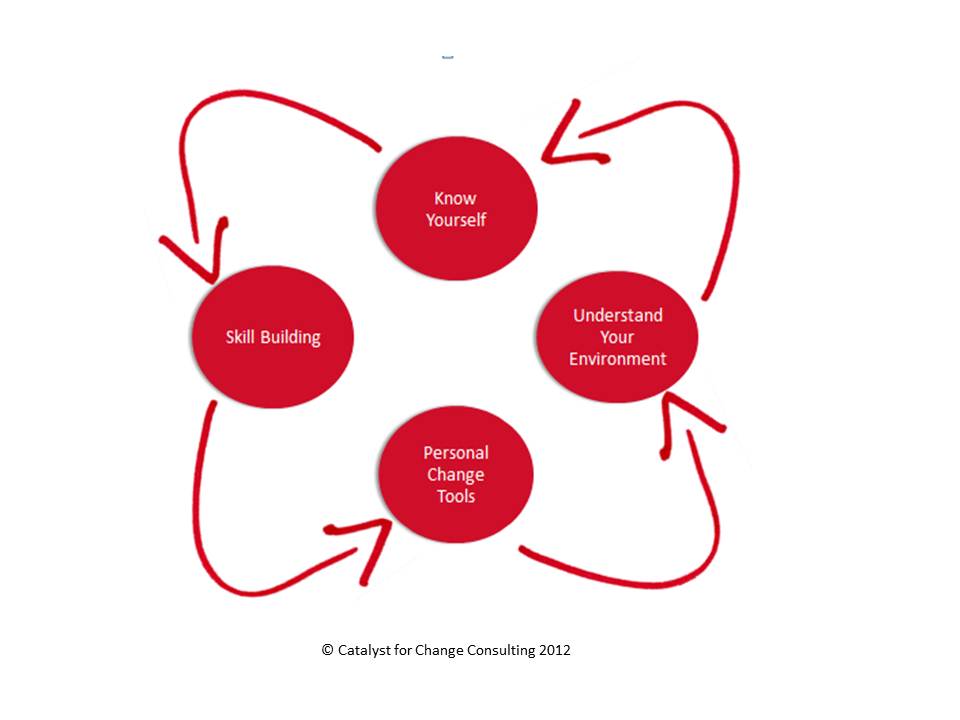
DIY Executive Development

Do-It-Yourself Executive Development

I know the print on the diagram is too small to read, but I wanted you to see how it all fit together.  There are four areas of developmental concentration:  1) Know Yourself, 2) Understand Your Environment, 3) Personal Change Tools and 4) Skill Building.   You can start anywhere—they all support each other.

4 Essentials for Do-It-Yourself Executive Development

The Recipe for DIY Executive Development:

Know Yourself–Understand Your:

  • Motivation
  • Habits
  • Personality
  • Beliefs About How Things Work
  • Strengths/Weaknesses
  • Temperament
  • Flaws (aka Derailers)

Understand Your Environment:

  • What is the Culture?
  • What is Your Fit in that Culture?
  • What is the Power Structure?
  • What Gets Rewarded?
  • What is the Organization Life Cycle Stage?

Personal Change Tools–Understand:

  • Reframing
  • Habits
  • Feedback

Skill Building–Develop:

  • Execution Skills
  • Leadership
  • Financial Acumen
  • Organization Assessment
  • Organizational Political Saavy
  • Personal Brand Management
  • Emotional Intelligence
  • Organizational Change Management

The well-rounded, and highly successful Executive has all of these.  No one is born with all of them; they need to be developed.  If you want to be a successful Executive, stop waiting for your organization to do it.  Get off your butt and start working on developing yourself.  You’ll do a much better job than any organization if you focus on it.

Leave a comment

Filed under Brand Yourself, Career Development, Career Goals, Derailment, Executive Development, Hi Po, Leadership, Personal Change, Recession Proof, Reframe, Success

My Boss Doesn’t Listen to Me!

What Language Are You Speaking?

My first question to you is– Are you speaking your boss’ language?  And, I’m sure your answer is, “Of Course!”  But are you really?  One of the most important tools that I use to help people understand this problem is the Myers Briggs Type Indicator.  The Myers Briggs is a tool that enables great conversations about your personality and the personalities of others.  It is one of many tools that can facilitate these conversations and investigations..  I like it best because of the research behind it, but it doesn’t matter if you use this tool.  Just look at your own personality/behaviors/interactions through the lens of a tool that helps you evaluate yourself in the context of interactions with others.

Anyway, Myers Briggs divides people into 16 different types using four dichotomies:

  • Extroversion(E)————————————Introversion(I)
  • Sensing(S)——————————————–Intuition (N)
  • Thinking(T)——————————————Feeling(F)
  • Judging(J)——————————————–Perceiving(P)

Myers Briggs assigns personality types based on these dichotomies. I am not going to go into Myers Briggs in detail here. Check it out on the Internet. Or pick a different tool, such as DISC, to apply what I’m saying here. The point is, a ESTJ (Extrovert/Sensing/Thinking/Judger) looks at the world very differently, processes information and needs to be communicated with differently than a INFP (Introvert/Intuitive/Feeling/Perceiver). The practical impact of this is that if your boss has a different type (or DISC profile) than you, then it is highly likely that the problem is not that you aren’t listening to each other. The problem is most likely that you are both sending messages out into the universe and they are falling into space without being “heard.”

What Type Are You?

For example, someone who is an MBTI “Extrovert” gets his ENERGY from interacting with people. He goes to a party and gets energized.  An MBTI “Introvert” gets her ENERGY from being alone, from reading, from spending a quiet evening at home.  An Extrovert might take a break at work and walk around and talk to people to get a second wind.  An Introvert boss might see this as an employee who is wasting her time.  A MBTI “Senser” boss needs hard cold facts to make a decision.  An “Intuitive” employee will struggle to tell the boss how she knows what she knows.  She just “knows” it.

I frequently do the exercise in class sessions where I divide the “Judgers” and “Perceivers” into separate groups and have them plan a vacation. The “Judgers” plan everything right down to when and where they are going to go buy new underwear for their vacation. The “Perceivers” are lucky if they actually come up with a destination and a mode of transportation.  Both of these are adequate plans (for the ones doing the planning) and completely deficient and faulty plans for the other group. So, if you are a “P” and you have a “J” boss, your plan is unlikely to be considered a “real” plan.  If you a “P,” the “J’s” plan is likely to be serious overkill.

These communication gaps cause more problems at work than probably anything else.  I highly recommend the book, Type Talk at Work, How the 16 Personality Types Determine Your Success on the Job, by Otto Kroeger and Janet Thuesen, to provide you with examples and strategies to deal with these gaps.

So, Fix It

So . . . since this is a problem on both sides–boss and subordinate–why should you step up and do something about it instead of your boss?  Of course your boss should do something about it.  I tell all the leaders that I coach that they should (and of course, they have the same problems with their bosses, too).  If your boss isn’t doing it, though, you have limited options.  You can go on failing to successfully communicate with your boss (framed as “my boss won’t listen to me), or you can work on these skills, develop the ability to successfully communicate with any boss (framed as “my boss always listens to me) and you can succeed at what you’re trying to do.

I had a boss for whom I used to prepare long, detailed (and if I do say so myself) brilliant reports that answered all his questions.  He would take them, set them aside and repeatedly ask me questions that were answered in the reports.  I finally figured out that not only was he not reading them, he also didn’t value the time that I put into preparing them AT ALL.  I started paying attention to the kinds of questions he was asking, and put together a VERY SHORT bullet  list that answered the questions.   (OK, this was a long time ago, and I’m a lot smarter now.)  He stopped being so frustrated with me and I stopped being so insulted that he was ignoring my work and we became much better boss/subordinates for each other.

Stop being so frustrated with your boss and solve the puzzle of HOW to communicate with him. (By the way, if you have an employee who won’t listen to you, re-read this post substituting the word boss with employee and save me from having to write another post:-))

Leave a comment

Filed under Books, Career Development, Communication, Executive Development, Inclusion, Leadership, Reframe, Success

New Job? Here’s What You Do:

First Thing

The first thing you do is remember that you don’t know what you don’t know.  Be very careful about your assumptions.  If you had the same job in a different organization, remember it might not be the same job in this one–just the same title.  If Directors act/do/are a certain way in your old organization, they might act/do/be different in this one.  If you get promoted in your (same) organization, it is a NEW job, not just more of the same.  Treat it as a new job.  If you manage a new group, move to a different location, get a new boss (yeah, I said if you get a new boss), it is a new job.  Just like all jobs, this job will have good things and bad things.  If you get off to a good start, it will have more good than bad.  Move on to the second thing:

Second Thing

Become hyper-sensitive to your surroundings.  Pay attention.  Listen.  Watch.  Notice.  Who are the power players?  What is the informal network?  Who are the formal and informal leaders?  What is the culture?  Put your antenna up and start to feel out the unwritten rules.  Ask questions.  At the beginning, you have a window of opportunity where people expect you to ask questions and you feel comfortable doing it.  Learn the language (every organization has its own set of acronyms).

Put on a consultant’s hat–do an organization assessment.  What works, what doesn’t work?  What are the opportunities for quick hits?  Talk to lots of people!  Ask them what they do.  Ask them about themselves.  Learn their names.  Learn as much as fast as you can.  Work on putting together your own picture of how it all works together. If you do this right, you will very quickly know more about the organization, or at least have a different view, than many who work there because you will be actively investigating it.  Not very many people do this about their own organizations.

Third Thing

Make a good impression.  Get there early and stay late.  Come across friendly, confident and interested. Dress not only to look good, but to feel good.  It will come across.  Take the initiative–even when it is uncomfortable.  Commit and deliver on your commitments.  Don’t over commit–it’s really easy to do in the early days, when you want to impress.  It’s better to surprise by delivering beyond your commitment than by failing to land your promised deliverables–remember you’re still in the impression-making days.  Work on making a good impression on all levels of the organization.  You never know who listens to whom.

The Fourth Thing

Work on your networks and alliances.  The Center for Creative Leadership has done research that the most successful leaders have what is called “Manager Trade Routes,” informal networks of reciprocal exchanges.(Trade Routes: The Manager’s Network of Relationships (Technical Report) by Robert E. Kaplan and  Mignon Mazique)  It’s best to get started on this early.  Figure out your peers–who are they, what motivates them, what are they trying to accomplish.  Begin to work on developing powerful relationships with them.  My experience is that more Executives fail because of their failed interactions with their peers than with their bosses.

And Finally, The Fifth Thing

Figure out and stay on top of what your boss wants from you.  Learn how your boss asks for things.   Learn how s/he wants things communicated back.  Ask for reports or presentations that will clue you in about what your boss values.  Don’t assume s/he knows what you’re doing in your first weeks.  Ask how s/he wants to be updated.  Over-communicate at first.  Be enthusiastic, energetic and positive in your interactions with your boss.  Make him/her glad s/he hired you.

Check out the book,    The First 90 Days: Critical Success Strategies for New Leaders by Michael Watkins, for some good tips.

Good Luck!

2 Comments

Filed under Books, Career Development, Communication, Executive Development, Leadership, Success, Uncategorized

What You Believe About How the Organization Works is WRONG

If you are the CEO-Founder of the organization, nothing I’m going to say applies to you.  If you are anyone else, it probably does.  We all have beliefs about how organizations work.  For the most part, at least some of these beliefs are myths.

organization mythsSome Typical Myths:

  • If you work hard, you will be rewarded.
  • Organizations are meritocracies.
  • Leaders Are Heroes.
  • The more hours you put in, the more you will be rewarded.
  • Organizations are families.
  • This organization is better (than all others).
  • I have unlimited potential.
  • The organization will recognize what I do.
  • I am irreplaceable.
  • If I just do a good job, I can ignore organizational politics.
  • Younger employees have more potential than older employees.
  • Older employees are more wise than younger employees.
  • If I work hard enough and do a good job, my career will take care of itself.

But, you say, (some of) “these are true!”  Or, “I don’t believe any of those.”  That’s the thing about myths–they exist as myths or truths in the eye of the beholder.  And they are powerful enough to control your behavior, if not your life.  A myth is only a myth if it isn’t reality.  (Yeah, I know–what the heck did that mean?)

Whose Reality Is It?

I started this post with the statement that if you are the CEO-Founder this doesn’t apply to you.  If you are the CEO-Founder of your organization, then your beliefs are the reality of the organization.  Everyone else’s beliefs are the myths.  Of course everyone has some beliefs that are true (and therefore reality), such as if  ‘I get to work on time, I won’t get in trouble for being late’.  Hmm, even this is not “true” in some organizations.  I used to work in an organization where the official start time was 8am, but the expected start time was more like 7am.  Why?  Because that is what leadership thought was indicative of a motivated, productive, successful workforce.  It is critically important to understand what the top of your organization believes about how organizations work, and how that is different from what you believe.

We come to our beliefs about how things work through a circuitous route.  Our parents drill things into our head.  Work hard, you will be rewarded with grades. (Lesson–effort leads to reward)  Our teachers reinforce beliefs.  You can do anything you want to do. (Lesson–unlimited potential)  Our coaches add to it.  Always get the ball to Russell; whatever you do, get the ball to Kevin!  (Lesson–irreplaceability)  These lessons stick in our minds and we begin to apply them to other venues.

By the time we get to our first jobs, they are pretty much set.  As a coach, I work with people helping them understand the unwritten rules in their organizations.  The reason people struggle so much with this, is that these “rules”–the accumulated “realities” of leadership over the years–don’t match their own “rules.”  And it makes no sense.  When you put in long hours and you aren’t rewarded and appreciated for it, you get disillusioned and angry.  What you don’t understand is that the person(s) in charge believes that it is results that count and effort in and of itself is irrelevant.

Interestingly, as I have started working with more men who work in woman-run organizations, they are finding themselves with the same problem–the “rules” make no sense to them.  Why should we “talk” about it?  Let’s just DO it.  Who cares if we have a consensus?  (Not that I’m saying these “rules” apply to all female run organizations–these are examples I’ve encountered).

It Is Hard

It is REALLY hard to let go of your beliefs.  They are tightly wound with how you derive your sense of personal value.  If you find yourself angry at work a lot–angry at not being appreciated, at not being valued, at not being rewarded, you need to look deeply at how you believe things should work.  Then you need to look–really look–at evidence that it is true in your organization.  Look hard for what the organization’s leadership believes about how things work.  How is it different?  Don’t dismiss these differences.  (Remember, however, that leadership is likely to be in the same boat to some extent about their own beliefs, unless they founded the company.)

Experiment

Experiment with reframing your communications to match the beliefs of those who evaluate you.  If you think results are most important, but your boss talks about effort–communicate your results AND the effort it took to get them.  If your boss thinks she is irreplaceable, decide whether you want to frame communications in terms of that belief.  If you understand these beliefs and their impact on your work life, then it gives you more options and tools to improve your work experience and enhance your career.

. . . just sayin’

3 Comments

Filed under Career Development, Communication, Executive Development, Leadership, Reframe

Great Leaders and Their Paradoxes

I have always loved the concept of paradoxes.  A paradox is a self-contradictory proposition.  Paradoxes  are the embodiment of complexity.  Great leaders are full of them.

Extreme Self Confidence v. Humility:

I don’t think you can be a leader without having self-confidence.  Self-confidence and self-worth combined make up self-esteem.  I’ve seen leaders (although not great leaders)  without a good sense of self-worth, but I don’t think I’ve ever encountered a leader who didn’t have a realistic belief in his own ability to deal with the situation.  It is this self-confidence that inspires others to follow.

At the same time, great leaders demonstrate real humility.  Self-confidence does not preclude humility.  Since self-confidence is a realistic view of your abilities, humility is a realistic view of your limitations.    Humility is a demonstrated sense of modesty.  Humble leaders can take feedback, can admit their mistakes, and are much more respected by their followers.

Decisive v. Consensus Building:

A great leader is comfortable making decisions based on the information that is available.  Decisions are the lubrication that make organizations go.  Without decisions, things slowly grind to a halt.  Sometimes there just isn’t enough information to make a comfortable decision.  Great leaders step up and make the decisions anyway.

At the same time, great leaders have the skill and know the value of consensus building.  There are times when it is best to take the time for the group to make the decision, rather than for the leader to make the decision alone.  Great leaders know not only that is, but they also know how to do it.  They allow followers to participate in the organization decision making and get follower buy-in in the process.

Leader v. Follower:

Leaders challenge and change.  They inspire and energize.  Leaders lead.  It goes without saying that great leaders are leaders.  Leaders do not lead 100% of the time, however.  Leaders follow sometimes, too.  They follow thought leaders.  They follow their bosses and their heroes.  Sometimes, they even follow their followers.  Great leaders are as comfortable being followers as being leaders because they aren’t so into themselves that they need to lead all the time.

Detail Focused v. Big Picture:

There are tons of examples of Executives who failed because they weren’t paying attention to the details.  This does not mean that you need to be in the details all the time;  in fact, that is probably as bad as not being able to deal with details at all.  You do need to be able to dive into the details and spot the aberrations when the situation arises that demands it.  Steve Jobs was famous for his ability to crawl into the details of his products.

At least as important is the ability to see the big picture.  The big picture includes what is going on outside your organization, outside your community, and outside your industry.  You need to be able to see how things fit together and “what is wrong with this picture.”   Fred Smith saw the big picture when he came up with the idea of Federal Express.  Steve Jobs saw the big picture when he saw the need to combine extreme marketing concepts with bleeding edge technology ideas.  The ability to see the big picture can keep you going long after others would have given up.

Hands Off v Hands On:

Delegation is a very important skill for leaders.  The higher up you go the more you need to be able to delegate.  Except when you need to be hands-on.  Situational Leadership Theory by Hershey and Blanchard suggests that different leadership styles are required in different situations.  In other words, it isn’t always appropriate to delegate, even if you are at the top of the organization and have Executives reporting to you.  It isn’t appropriate to be hands-on all the time–your more experienced/senior employees will feel micro-managed.  You need to understand what your personal style is, when you should be using it and when you should be flexing your style.

The Dark Side–The Success Paradox:

Success changes us.  Those changes are mostly good.  We become more confident, more comfortable in our skins.  But we also develop blind spots.  Success robs us of the uncertainty that helps us be more sensitive to our environment.  We develop blind spots about our personal flaws.  We discount negative feedback about our interpersonal skills.  We aren’t as open to seeing organizational issues.  Most importantly, we miss the big, external-to-the-organization contextual issues–the world is changing around the organization and the organization is so busy doing what it does, that it misses it.  Think Borders with Amazon.

Great leadership requires complex responses.

Leave a comment

Filed under Career Development, Executive Development, Leadership, Reframe, Success

Lead from where you are

Tops, Middles, Bottoms

Are you the same kind of leader at work that you are at home? at church? with your friends?  If you’re like most people, probably not.  Why is that?  Most people have a picture of the “power structure” at work that influences the way they behave.  This picture is remarkably the same for almost everyone.

Our picture:  The people at the “top” tell everyone what to do, the people in the “middle” try to get the people at the “bottom” to do what the “top”wants, while struggling to get the “top” be clear about what it is that they want.

Sound familiar?  There is a interactive exercise developed by Barry Oshry and documented in his book, Seeing Systems, Understanding the Mysteries of Organizational Life, in which people at all levels of the organization, when assigned to be a “top,” “middle” or “bottom,” play out this power structure role–even though they have a different role (and behave differently) in their own organization.  It’s as if you put a group of people in a room and told them all that they were 5th graders–and they started acting like it!

This  “picture” of the way things (should) work  exists in most organizations, across organization boundaries, global cultures, and all organization sizes.  The behaviors that go with these unconscious roles hold us all back.  It makes the organization slow.  If we accept these roles, it’s hard to get be excellent–organizationally or PERSONALLY.

Step Up, Step Out

LeadFfrom Where You Are

If you don’t step up and step out, if you go along with the “way they do it,” then you aren’t standing out.  People frequently err on the side of getting along and not challenging the status quo.  How does that help the organization?  How does it help your career?  (It’s easier for managers to lay off the ones who’ve never been exceptional–solid and steady doesn’t get you very far for very long any more.)

I realize that I’m saying that you should take risks.  Yep.  And it’s really hard to take risks.  Yep. So start with little risks.  Instead of waiting till someone tells you what to do, figure out what you think should happen?  If you were “king” of the company, what would you have happen?  Just figure it out.   What’s the worst thing that can happen if you did it?  What would you do if that happened.  What’s the best that could happen? Start with thinking it out.  Turn off your “going-along” thinking and be proactive about solutions.

Just Do It

There is a reason that “It’s better to ask forgiveness than to ask permission,” is so popular in organizations.  It’s mostly true.  My first, and for me, probably the most important, Executive, used to say over and over, “Make a decision.  It is easier to fix a bad decision than to fix the damage from not doing anything.  There are almost always several “right” decisions for every business problem–pick one and DECIDE.”  I had already heard this mantra several times in the first three months that I worked for this guy before my first one-on-one with him.  I had spent these first three months researching the details of a very serious problem and I was presenting the results of my research to him in this meeting.  Looking back, I can’t believe how naive and unaware of organizational politics I was.  My boss sent me to this meeting, fully knowing how bad it was, alone.  I was about 15 minutes into the details when he stood up, looked at me and said, “You’ve made me sick at my stomach,” and he walked out.   I was shocked.  I sat there.  I thought he was coming back.  He didn’t.  I waited probably 20 minutes and got up and left.  I didn’t know what to do.

I waited about a week.  I tried to figure out what to do.  My boss was on vacation.  I thought about the Exec’s  mantra, “Make a decision.”  This one wasn’t mine to make–it was his (or above).  But I needed to figure out how to get him to make it.  I walked into his office and asked when he wanted to finish our meeting.  He looked at me, and said, “I don’t want to, but I guess we better.”  We rescheduled and he listened to me all the way through.  At the end of the meeting, he told me to figure out how much money it would take to fix it.  When I did, he had me present to the entire Executive team and he persuaded them to fund it (it was several million dollars).  I had a leadership role in implementing the fixes–way beyond my original job.  I’m pretty sure that I wouldn’t have had a role in it if I hadn’t walked into his office and pushed him for another meeting.  I am sure the project would have happened eventually,  later and without me.

It was a powerful lesson.  I think if I had been in the organization longer, I would have adopted the “power structure picture,” and wouldn’t have done it.  I would have waited for my boss to do it.  Or whoever.  I wouldn’t have learned the lesson that helped shape my career.

2 Comments

Filed under Books, Career Development, Executive Development, Leadership, Personal Change, Reframe

Fail. Fail. Fail.

Failing Isn’t Fun.

I really, really to hate to fail.  In fact, I hate it so much that I rarely admit that I failed when I do–it’s not that I lie about it–I just don’t even admit to myself.  So why does every guru on leadership say that failing is good?  I had the opportunity to watch lots of kids this weekend–kids of all ages.  They “fail” all the time.  They try something, it doesn’t work, they try again, or they walk away and try something else.  Sometimes they get upset, sometimes they get hurt, but they pretty much pick themselves up and keep trying.  They don’t usually see it as “failure.”  They just see it as a part of living.

Imagine if they were so afraid of failure that they didn’t try.  What if they didn’t learn to walk because they would fall down.  What if they didn’t learn to read because they wouldn’t be able to figure out all the words.  The way they keep going in the face of what we adults would see as “failure” is an important lesson for us.  Some time around late elementary school or middle school, kids start to stress about failing and start to be afraid of trying.  By the time we’re adults, we’ve got that lesson well-learned.

Failure Is A Step

The flip side of failure, though, is that without it, you don’t get better.  Even if we succeed we don’t do it as well as if we fail first and try again.  If I spend my time obsessing about how I failed at something, rather than treating it like a baby treats a fall–that way didn’t work, maybe the next way will–then my forward movement becomes a loop at best.  One of my favorite quotes is from Thomas Edison, “I have not failed. I’ve just found 10,000 ways that won’t work.”

There are LOTS of books on the benefits of failure:  Fail Forward; Celebrating Failure, The Power of Failure, Great Failures of the Extremely Successful Adapt: Why Success Always Starts With Failure, to name just the ones I’ve read in the last two years.  So, I  get why failure is critical.  The problem is the way we look at it.  Failure isn’t an event.  To quote Edison again,  “I am not discouraged, because every wrong attempt discarded is another step forward.”  Failure is a step.

Try, Try, Try

So, remember the way a kid thinks: Try. Try. Try.

4 Comments

Filed under Books, Executive Development, Leadership, Personal Change, Reframe, Success

Leadership Lessons From MLK

His Name Always Comes Up

Leadership Lessons from MLKIn my leadership classes, I always asked my students for the names of great leaders.  I’ve never had a class where Martin Luther King’s name didn’t come up.  This week is the 44th anniversary of his death.  We’re still struggling to realize his dreams, but we have made significant progress.  But why do we remember his so clearly?  Many of my students weren’t born when he died, but they identify him as a great leader.  He is still leading us.

What are the lessons that leaders can learn from MLK?

  • Dream –MLK dreamed a BIG dream.  His dream was not to be a good minister at a Church in Atlanta.  His dream was thought to be impossible among some of his followers–‘I have a dream that one day this nation will rise up and live out the true meaning of its creed: “We hold these truths to be self-evident, that all men are created equal.’ . . I have a dream that one day on the red hills of Georgia the sons of former slaves and the sons of former slave owners will be able to sit down together at the table of brotherhood.  .  . I have a dream that my four little children will one day live in a nation where they will not be judged by the color of their skin but by the content of their character.”  Sadly, at that time, that was a big dream.  Joyfully, some of this dream has come to pass.  There are young people reading this who can’t imagine the way it was.  Unfortunately, we still have the cancer of racism in our American body.  I’d like to think that had MLK lived, we’d be much further along.

As a leader, are your dreams big enough?  Is it enough to dream of making this year’s numbers, or finishing this project on time, or delivering the product in your strategy?  The difference between a leader and a great leader is the size of the dream.

  • Inspire  –MLK inspired people from all parts of the country, from all walks of life and of all ages to fight for his dream.  His dream became theirs.  His peaceful methods became theirs. He inspired through his words and through his actions.

As a leader, do you inspire or do you tell? Do you speak to some and ignore others?  Do you act your beliefs and words, or are you a hypocrite? Are you brave and do you speak truth to power, or do you go along.

  • Take Risk –MLK kept going despite the risks.  He knew them, but his dream was bigger.  His commitment was bigger.  Risk was a constant in his life as a black man in the South. The risks he took as a leader were breathtaking.

MLK’s risks put most of the risks that today’s leaders take (or don’t take) into perspective.  The stakes for most of us are much smaller.  Even so, we resist risk.  As MLK knew, change doesn’t happen without risk.  I worry that readers will take this point wrong–I don’t want to diminish MLK’s accomplishment by comparing the risk he lived with with the risks that leaders take today.  Understanding and taking risk, however, is essential to great leadership.  Risking your life isn’t necessary, but risking your ego is.  Risking your identity is.  Risking being wrong or failing is necessary for great leadership. When was the last time you took a breathtaking risk?

  • Be Persistent He was tired.  He was exhausted.  He kept going.  He kept standing.  He kept inspiring.  He kept dreaming.  He got results.

He went to jail! To Jail!  To be a great leader, you’ve got to keep believing  it can happen.  You’ve got to help your people believe that it can be done.  Pretty much every great person I know is persistent.  Persistent in the face of set backs, failures, temptations and loneliness.

MLK was a great leader.  He was a great man.  He continues to inspire me to be a better person and a better leader.  Thinking about MLK and his contributions to my world gives me perspective on what is possible and how much more growing I have to do.

2 Comments

Filed under Career Goals, Communication, Executive Development, Leadership, Personal Change