Category Archives: Derailment

Are You Making Mistakes On Purpose?

We all make mistakes.  Mistakes have consequences.  We learn from our mistakes and don’t make them again.  Or do we?  Sometimes, especially when you find yourself doing something over and over again—being late, forgetting to send something, leaving certain people off invitations, forgetting status reports, losing important information, doing things that make the boss mad—it isn’t just a mistake.  Sometimes it is self-sabotage.  Shooting yourself in the foot.  Failing on purpose (albeit sometimes unconsciously).  Proving that you aren’t ‘good enough,’ ‘ready for the position,’ ‘at the right level.’

Identity

Each of us has a self-image that pretty much dictates our identity.  I’m a mother, a daughter, an introvert, smart, good at math, an Executive, a business woman, etc., etc.  When something happens that challenges that identity, we have something called cognitive dissonance.  Cognitive dissonance is the experience of having two conflicting “cognitions”—ideas, thoughts, ‘mental models’—simultaneously.  This is so stressful to us that we take action to bring them into alignment.

For example, when I wrote “good at math” above (which I am not), I went back three different times to amend it.  I first put “(just kidding),” erased it and then put “not really,” erased that and then wrote “(wanna be)” in front of it.  I was so uncomfortable with writing something that is so much not a part of my identity that I had a really hard time leaving it unadorned while I wrote the rest of the paragraph.  If I have such a strong reaction to something so minuscule, imagine the difficulty I would have if something happened to challenge my “mother” or “business woman” or “Executive” identities.

This is why people who are laid off have such a hard time.  Most of us these days identify with what we do.  If we can’t do it anymore, then it is extremely painful.

Why Do We Self-Sabotage?

This is equally true of good things about our identity and bad things about it.  If we think badly about certain aspects of ourselves—that we aren’t good at math, or that we aren’t smart or that we shouldn’t be at an Executive-level, or that we aren’t likeable—then we will struggle to reconcile those two cognitions.  We will do things that prove, despite the fact that we just got promoted, or that we are being praised for a job well done, or that our boss likes us—that we don’t deserve the promotion, or being praised, or liked.  We will self-sabotage until we are back where we are most comfortable.  We will do things like miss important appointments, become unresponsive to assignments, or tell off our boss until we prove (to ourselves and others) that our self-image is right.

So How Do You Know If You’re Self-Sabotaging

Pay attention to what is going on.  Are there consistent patterns that keep you from getting to where (you think) you want?  Do you have the same experience in position after position, or in company after company, or in relationship after relationship?  Do you get uncomfortable when people praise you or when you are considered for/get a promotion?  Do you keep getting stuck at a certain level in organizations and not seem to be able to climb to the next rung, no matter what?  These can all be signs of self-sabotage.

Recognizing it is most of the battle.  If you see that you’re doing it, then you will have to do some really hard work to adjust your self-image.  If you never see it, however, you never have the opportunity to start changing.  Self-sabotage is related to your self-image.  Once you change your self-image, then stopping the self-sabotage is pretty easy.   You have already changed your self-image.  You don’t think the same of yourself as you did at 12 or 18 or 24 or . . .  You can change again, and again.  You just need to be more conscious, mindful and determined to create the self-image that you want.


1 Comment

Filed under Career Development, Derailment, Executive Development, Reframe, Success

Just a Paycheck

Just a Paycheck

Just a Paycheck”

If the reason that you’re working at the job that you have is for “just a paycheck,” you’re wasting your time and maybe your life.  I’m not talking about people who are working at a job to fund the things that they like to do, or their family, or the things that are important to them.  I’m talking about the people who really see that they are just working for the money.  I’ve been told this by lots of people.  It’s all I can do not to  get on my high horse when someone says it to me.  If you’re only working ‘for the paycheck’ that radiates from you.  You have no energy.  You have no enthusiasm for the tasks of the job, or even for your co-workers. You aren’t looking for a better way to do things; you’re just doing the bare minimum of what it takes.  It is highly likely that you’ll be among the first to go in a layoff, just because it is easy to put someone on a list who clearly isn’t having fun and who isn’t doing anything extra.

NO, you say.  It doesn’t show.  You’re doing the job; you’re just not enjoying it.  Ask yourself if that is true.  Look around.  Are you seeking to do better?  Are you taking on more without it being foisted on you?  Probably not.  And you probably aren’t taking on more because you don’t have the energy for it.  When you frame your experience in such a negative way, you don’t have energy.  You resent being there.  It’s all you can do to get to the end of the day, and it’s really hard to get there in the morning. 

Reframe!

I’m not saying that your job is fun.  It probably isn’t.  Your boss may be terrible.  Your co-workers may not be worthy of your time.  So what?  Find something that is worth being there for.  It could be as simple as reframing your experience to being about what your paycheck lets you do outside of the job.  It could be what you’re learning from this experience.  Or how it fits into your career path goals.  Or that you are LUCKY to have a job in these tough times.  REFRAME the way you think about it.

If you are able to reframe, it is likely that you will suddenly find that you have more energy.  You may have enough energy to look around the organization for a better job, or a better boss.  You may have the energy to figure out what you really want to do long term.  You may have enough energy to figure out how to get another stream of revenue that will enable you to find another job/career/hobby that will make you happy(ier).

Get A New Job!

If you can’t reframe,  GO FIND ANOTHER JOB—before someone forces you to.  I work with so many people who would be glad to have their old job back—somehow they can see a lot of value/interest/fun in it now that someone has decided they are out.  Find a job that you can do for other reasons than a paycheck.  Find a job that you can/will be good at and that will help you feel better about yourself.

LIFE IS TOO SHORT to work for ‘just a paycheck!’

1 Comment

Filed under Career Goals, Derailment, Executive Development, Job Hunt, Recession Proof, Reframe

Face What’s Holding You Back

Career Roadblock

What Do You Think is Holding You Back?

What do you tell yourself about what is holding you back?  You need another degree? Your boss doesn’t like you?  You have to relocate for the next step? You’re too old?  Too young? You’ve been out of work too long? Your technical skills aren’t current? You’re overweight/a minority/gay/a woman? You don’t fit into the culture?  They don’t think you’re a ‘hi-po’?

Two Questions:

Whatever it is, I have two questions for you:

1)  How do you know you’re right?

Are you sure that you aren’t looking at it through ‘victim’ eyes?  What is your evidence that you are right?  Are you the only one with this problem? Are you fully engaged, working as hard as you can, delivering results and this is still happening?  Or have you checked out?  Have you talked to anyone about what is going on?  Have you asked for feedback? Has this been a pattern at other organizations/with other bosses/in other jobs? Are you on an emotional roller coaster or on an even keel?

If you are right in your assessment of what is holding you back, I have another question:

2)  What are you going to do about it?

If you need another degree, why don’t you get one?  No, really, why not?  No money? No time? Look at it through business case eyes–will it get you a better job, with more money, with a higher quality of life?  If so, tell me again why not?

If you are ‘too’ old, find someplace that appreciates your wisdom.  Why not?  There are places that do.  Just because your present organization doesn’t DOES not mean they all don’t.  Go FIND a better place.

Whatever the thing is that is holding you back, it is possible to overcome it.  It is possible to find a solution.  Set an audacious goal to fix/solve/overcome it and then do it.  Maybe it is the way you’re looking at it that is really what is holding you back?

Who can fix THAT?

(Did you notice that I asked more than two questions?:-))

1 Comment

Filed under Career Development, Career Goals, Derailment, Executive Development, Feedback, Hi Po, Personal Change

Get Off Your Butt! DIY Executive Development

I’m going to rant a little

l talk to people all the time who are sitting around waiting for their company to “do something” about their development.  They know that they are talented (and for the most part, the company agrees), they know that they are “hi po” (high potential–recognized by the company as having potential to move up), and they know that they do a good job.  So, why doesn’t the company send them to Executive Development programs, or provide them with developmental opportunities, or generally take an interest and develop them?

There are all kinds of reasons

Maybe the company doesn’t have a well-developed Executive Development system.  Maybe the company doesn’t classify these people as “hi po” enough.  (Lots of companies, maybe most companies, take the view that only the most “hi po” gets developed).  When I ran an Executive Development Program for a company, I found that the “hi po”s who were selected by the ‘deciders’ were all over the place.  Potential is in the eye of the beholder.  You may not fit the profile for hi potential for the person in YOUR management chain who makes the decision.  The company may be trying to develop a certain skill (like innovation) at this time and are picking people who they think have the most potential in that area.  Someone up there may not like you.  There are all kinds of reasons why it is not you, not this year, not at this company.

So What?

So why am I going to rant?  Because I think it’s totally nuts for ANYONE to sit around and wait for your company to develop YOU.  Who cares more about your career and your abilities more than you?  Who wants you to succeed  than you?  How long will you stay at THIS company?  They will develop you for their organizational profile and needs.  Will that make you a fully rounded Executive candidate? Maybe, but probably not.  What one organization believes are the key attributes of leadership is another organization’s rejection list.

Get Off Your Butt and Develop You

Most well run organizations have well thought out Executive Development plans and programs (just because it doesn’t focus on you doesn’t mean that there isn’t a plan).  These programs look at what the organization needs, what it has, and puts in place a plan to hire or develop the necessary skills to take the organization to the next level.  You can do the same thing, with you, and only you, as the hi po being developed.  (this applies to you hi pos who are already “being developed” by your organization—make if faster, or develop skills that are outside the organization’s focus that you know you need).  If you do this right, it could have more impact than an MBA (although it is possible that an MBA is a necessary part of your personal development plan).

After years of helping organizations develop Executive Development programs and of coaching all kinds of individuals, I’ve come up with an outline of what needs to be addressed in Do-It-Yourself Executive Development.

DIY Executive Development

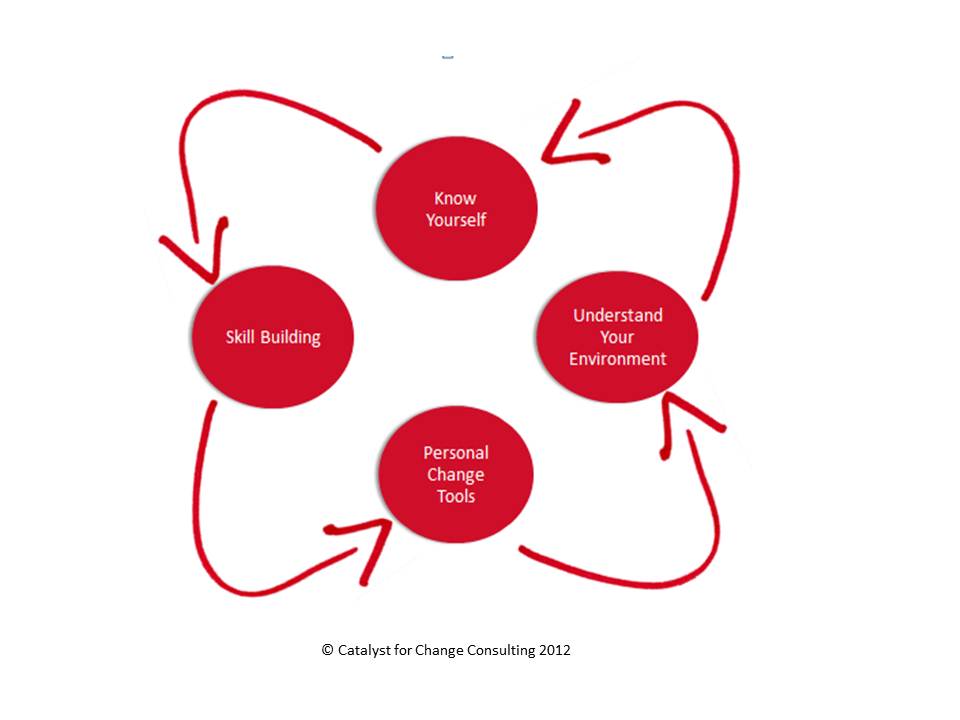
Do-It-Yourself Executive Development

I know the print on the diagram is too small to read, but I wanted you to see how it all fit together.  There are four areas of developmental concentration:  1) Know Yourself, 2) Understand Your Environment, 3) Personal Change Tools and 4) Skill Building.   You can start anywhere—they all support each other.

4 Essentials for Do-It-Yourself Executive Development

The Recipe for DIY Executive Development:

Know Yourself–Understand Your:

  • Motivation
  • Habits
  • Personality
  • Beliefs About How Things Work
  • Strengths/Weaknesses
  • Temperament
  • Flaws (aka Derailers)

Understand Your Environment:

  • What is the Culture?
  • What is Your Fit in that Culture?
  • What is the Power Structure?
  • What Gets Rewarded?
  • What is the Organization Life Cycle Stage?

Personal Change Tools–Understand:

  • Reframing
  • Habits
  • Feedback

Skill Building–Develop:

  • Execution Skills
  • Leadership
  • Financial Acumen
  • Organization Assessment
  • Organizational Political Saavy
  • Personal Brand Management
  • Emotional Intelligence
  • Organizational Change Management

The well-rounded, and highly successful Executive has all of these.  No one is born with all of them; they need to be developed.  If you want to be a successful Executive, stop waiting for your organization to do it.  Get off your butt and start working on developing yourself.  You’ll do a much better job than any organization if you focus on it.

Leave a comment

Filed under Brand Yourself, Career Development, Career Goals, Derailment, Executive Development, Hi Po, Leadership, Personal Change, Recession Proof, Reframe, Success

Take Feedback, Especially Bad Feedback, As a Gift

My “Bad” Feedback

I remember the first time that feedback got my attention.  It didn’t get enough attention, but I kept thinking about it—for a really long time.  My mentor told me, “Well, you didn’t get where you are on your looks or your charm, but on your hard work.”  I took it as a compliment.  And it was, but there was a message underneath that I ignored.  The next time that I got feedback that I should have paid more attention to was a couple of years later, when my CEO said, “You should smile more.”  My reaction was that smiling or not smiling didn’t affect the quality of my work—which in my opinion was quite good.    Let me run that by you again.  My CEO told me that I should smile more and I felt completely justified in totally ignoring his feedback.   Not only could I not see the connection between the quality of my work and how I came across to people (by not smiling), I didn’t even get how ridiculous it was that I was ignoring feedback from my CEO!  Looking back on it, I’m surprised he didn’t fire me on the spot.

Even More “Bad” Feedback

My company had a process that it called “New Manager Assimilation,” that was an onboarding process for new managers.  I moved around the organization quite a bit (usually being selected to go “fix” an organization with process redesign and continuous improvement), and therefore, I went through new Manager Assimilation several times.  I got the same feedback, over and over.  My new employees had difficulty reading me and wanted to know more of what was going through my head.  Again, my reaction was that it wasn’t necessary for them to “read” me.  From my perspective, what they saw was what they got.  I told them that I had 2 speeds: neutral or pissed.  It was clear when I pissed, so they could assume if I wasn’t then everything was OK.  I really thought I was providing them helpful information about me.  In one of my organizations, my direct reports got together and gave me the top knob on a gear shift and told me that they wanted more speeds.  I FINALLY got it.  My failure to be openly expressive made it difficult to work for me.  What was going on in my head was so different from that.  Everything was OK.  I wasn’t mad or unhappy unless I expressed that.  What was in my head didn’t count AT ALL.  People needed me to smile and have open expressions to be comfortable around me.   People assumed the worse when they couldn’t read me.

I heard variations on a theme—lack of charm, smile more, unreadable—repeatedly.  I discounted it.  I didn’t believe it.  I looked at it from inside my head—from my perspective—rather than from the perspective of the people who were giving it.  So I didn’t act on it, until they got my attention with a symbol.  Once I “got” it,  I started acting on it immediately.  It took me a long time, but I finally figured out how to be more openly expressive.  And my job got a lot easier.  I became much more effective.  I got promotions (and raises  :-)).

Feedback is a GiftFeedback as a Gift

Chances are really good that you’ve gotten feedback that is equally important.  Chances are that you discounted it the way I did.  “It doesn’t really matter.”  “It isn’t important in getting my job done.”  OR “I couldn’t get my job done if I weren’t like that/didn’t do that.  You may think that the people who count don’t think that or that the good things you do outweigh the negatives.  This last is probably true.  Until it isn’t true.  At a certain point in your career, the things that have been tolerated become too important/irritating/in-the-way to be tolerated any longer.

This feedback is a gift.  Do yourself a favor.  “Get” that it is a gift earlier than I did.  Remember that the perception of others regarding your performance is probably more important (and probably more accurate) than your own opinion.  Sure you have to be confident and believe in yourself.  BUT you also have to be open to feedback and able to change your behavior to be more effective.

What Do You Do?

First, think about the patterns.  What have you heard repeatedly?  Think about why it keeps coming up.  Think also about what your reaction is to the feedback.  If you blow it off or make excuses about it, pay especially close attention to that.

Second, think about what you would do if it is accurate and you need to change.  Even if you don’t think it’s important or accurate—what would you do.  What would you change? How would you change?  Try little changes (they’re easier).  Experiment.

Finally, get more feedback.  Ask people you trust about their opinion.  Don’t ask them if it’s important or right; ask them if they can see why people say what they do.  Have them explain it to you.  DO NOT ARGUE!!! Feedback is a GIFT!   When someone gives you a gift you don’t tell them why blue is the wrong color.  You thank them.  Ask questions.  Make yourself pay attention and stop thinking about why it’s wrong.

Then go away and think about it.  Repeat the second step above.  Then repeat again.

2 Comments

Filed under Career Development, Communication, Derailment, Personal Change

Are You On Your Way to Failure?

Derailment

Executive coaches call it “derailment.”  Derailment happens when the organization has made an assessment of you that basically takes you off the planned (yours or the organization’s) trajectory of your career.  Derailment is usually talked about from the perspective of the organization–you’re not living up to expectations.  From your perspective, you feel that you’re stuck.  You are not moving up anymore.  The new jobs, promotions, or opportunities have dried up.  This might take a while to notice.  It usually is noticed by the organization much sooner than you notice it.

Evidence of Being “Stuck”

The evidence is easy to miss at first.  The  way most people notice it is that things are just not going the way they used to go.  It’s longer between promotions.  Someone else is asked to do the special project (or in some organizations, you are the ONLY one asked to do the special projects.)  Your boss doesn’t ask your opinion as much.  You feel shunted aside.

Being Able to See That You’re Stuck is a Lucky Break

Ironically, one of the things most likely to cause you to get off your career track is what has helped you succeed so far.  In other words, as you move up levels in organizations, your strengths become weaknesses.  Just like the things that worked for you in 5th grade, didn’t work for you in high school;  the things that make you an outstanding individual contributor don’t make you a great team leader. If you are highly technical or detail oriented, and you’ve been praised for your tactical implementations, the next level may require you to let go of some of the details and to see the big picture.  If you have been a heads down technology star and got promoted to be a manager, you need to pull your head up and learn how to deal with interpersonal issues.  If you have always been the smartest one in the room, but a little abrasive, and you suddenly are leading a team, that abrasiveness will cause you real problems.   If you are the boss’ favorite and suddenly that boss is gone, you’re in trouble.

The sooner you see that there is an issue, the sooner you can start working on it and the sooner you can get back on track.  It’s possible to re-energize your career, even at the same company.  The first step is to understand what it is that is in your way.

Most Common Causes of Derailment

Lois Frankel lists common reasons for derailment in her book, Overcoming Your Strengths, Harmony Books (New York 1997):

  • Poor People Skills
  • Inability to Work As Part of a Team
  • Inattention to Image and Communication Style
  • Insensitive to One’s Effect on Others
  • Difficulty Working with Others
  • Too Broad or Too Narrow a Vision
  • Lack of Concern for Customer or Client  Needs
  • Works in Isolation.

The Center for Creative Leadership includes others based on their research:

  • Too loyal to a boss or organization
  • Too personable–relies on relationships to get things done
  • Inability to adapt
  • Failure to deliver results

But None of Those Are True of Me

I don’t know about you, but I wouldn’t want to admit any of those are true of me.  The easiest way to be able to see the “off-ness” of your behavior is to frame your observations as if you just started this job, instead of finishing up your 15th year with the organization.  When you are new to an organization, you are MUCH more open to reading the signs that people are putting out.  You are much more able to assess your performance in the eyes of the people who matter.

If you feel “stuck,” start paying attention to how you interact with the organization.  Ask someone you trust to tell you the truth.  (Remember telling the truth in this situation is very hard).  Listen, and thank the person.  Then leave.  Don’t get defensive.  Don’t debate.  Leave.  Think about it.  The person might not be right, but s/he is giving you important information–a perception about you.  You know they say perception is reality.  You can’t deal with it if you don’t know it.  You need to spend some time thinking about it.  And maybe getting some more feedback.  And maybe observing yourself in the organization as if you were a new employee.

Expect Emotions

This is not easy.  Expect to be unhappy about it.  That’s ok.  Give it some time.  It’s better to feel it now than when they fire you.  You’ll get over it.  Once you can be more rational about it, figure out what you are going to do about it.

Leave a comment

Filed under Career Development, Derailment, Executive Development, Personal Change