Category Archives: Books

Fed Up With Looking For a Job?

Fed Up With Looking For A Job?

Have you been looking for a job for a while?  Have you sent out dozens of resumés and heard NOTHING back?  Have you talked to recruiters who told you that you weren’t qualified even though you had way more education, but you didn’t have an obscure certification that was listed in the job description?  Have you had one conversation with a recruiter or a company HR person who said they’d get right back to you and then NOTHING?  Are you getting mad about it?  Are you feeling discouraged?  Are you beginning to think that you’ll never find anything?

fed up with looking for a job?

All of the above?

The bad news —  you are not alone.  In fact, there are thousands and thousands and thousands and thousands of others.  The good news–there are ways to crack the code of this.  The most important thing is to keep a positive attitude. The hardest thing, and most important,  is keeping up your energy, your determination and your commitment.  The hardest part is to ignore all the ‘NOTHING’s and treat each new attempt as if it is the first one.  It is hard, also, to keep learning from the negative experiences, while you keep approaching each application with as much optimism and energy as you did the first one.

The things that you tell yourself when you get discouraged–that YOU’LL never find something, that there is something wrong with YOU, that it’s hopeless–ARE NOT TRUE.

We have a very difficult confluence of a lot of things happening at once that are making this worse:

  • companies are not hiring
  • recruiters are able to find enough people without being mindful about how they treat people (and I’m really being diplomatic about that!)
  • companies use software to ‘weed’ out resumes that don’t have all the keywords–even when the keywords aren’t relevant
  • older people are not leaving the workforce because their retirement funds evaporated
  • so many jobs are moving around the globe
  • etc., etc., etc.

And so it’s easy not to be optimistic.  I get it.  It’s hard to keep trying.  It’s not fun.  It’s SO frustrating when you hear nothing back.  It’s SO frustrating when you find a job that is just right for you and you apply and NOTHING.  Even though there are people who find a job quickly, most don’t.  Almost everyone gets discouraged before they hit pay dirt.  The lucky ones, though, can get past being discouraged.

You have to figure out how to keep your energy, commitment, optimism, and determination up.  That is way more important than making sure your resumé is perfect.  Because if you have your optimism and your energy, then you can fix your resume over and over.  You can keep getting yourself out there to network. You can ignore how much you hate working with recruiters because of the stupid things they say and talk to THIS one as if she’ll be different.

How Do You Do That?

  • Find someone (or a few someones) to talk to.  You need someone who can pump you up on a regular basis.  When you talk to yourself in the vacuum of your own thoughts, you are not as objective as you need to be.  There are techniques that you need to use to find a job, and you need someone to remind you when you lose sight of them.  There are lessons, strategies and tactics to finding a job and you need to be reminded of them regularly.
  • Remember that the number of rejections that you get is irrelevant–the number of acceptances is what is important.  In order to get acceptances, you have to crack the code.  In order to crack the code, you have to keep learning and refining your tactics.  In order to do that, you have to keep applying.  In order to do that, you have to keep your energy and determination up.
  • Network.  Socializing (even for you introverts) helps you have a different perspective.  It gets you out of your head.  If you’re going to socialize, you might as well network.  I don’t mean going out to a networking event.  I mean going to a social event, or spending some time online on a social networking site, reconnecting/connecting and finding out what people are doing.  And telling people that you’re looking for a job.  And telling people what kind of a job you’re looking for.  And asking people if they know anyone they think would be good for you to approach for an informational interview.
  • Don’t take it personally.  Hard, I know.  It isn’t personal, though.  Chances are really good that your resumé never got in front of anyone who could make a decision about it.   Chances are that the selection software looking for keywords weeded you out, or the recruiter (who rarely understands the industry, company, job or requirements thoroughly) weeded you out, or your resume was #402 and they cut off at #400.  Any of those things are not about you.  You still have to surmount them, though.  You just shouldn’t take it personally, because it isn’t.
  • Think about it like a puzzle.  Is it the resumé?  Is it the cover letter?  Is it that you need to hit it as soon as the job is posted–yes, at 4:14 am?  Is it that you need to find someone in the company?  Is it that need to follow up better?  Keep trying things until you crack the code.

Some Good Books That Might Help:

2 Comments

Filed under Books, Career Development, Career Goals, Executive Development, Goal Setting, Job Hunt, Recession Proof

The Transition From Manager to Leader

manager to leaderLeaders v. Managers

I’m sure you’ve probably heard about the differences between managers and leaders.  Managers do things right and leaders do the right thing–right? I think that this is an interesting discussion, but it isn’t that easy.  Managers do leader things and leaders do manager things. Each of us is naturally oriented toward one or the other–we either are inclined toward structure, processes, policies and systems or toward strategy, inspiration, vision and people.  But we can all learn to be either a manager or a leader or both a manager and a leader.

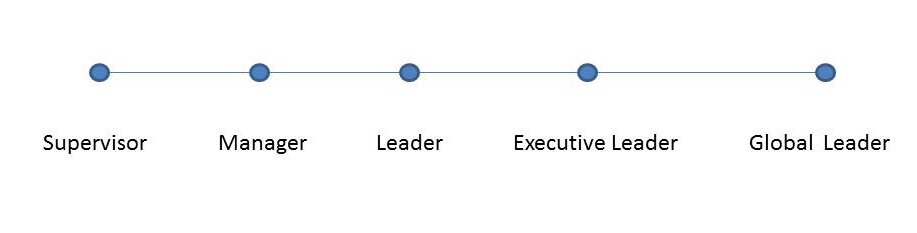
The Leadership Continuum

Many have described this as a dyad–either/or, a choice between two options.  I see it more as a continuum.

Manager to Leader

A continuum that ranges from supervisor to manager to leader to Executive Leader to Global Leader. This is not to say that supervisors can’t be leaders or that Global Leaders (positionally) aren’t managers.  There are cumulative skills, though, across those roles that are needed to deal with increasing complexity as a person accumulates more responsibility.

Moving Along the Continuum

Michael Watkins, whose books I’ve recommended in this blog before (The First 90 Days and Your Next Move) has a recent article in Harvard Business Review that is well worth the read.  He writes How Managers Become Leaders in the June issue of HBR.   Watkins identifies seven “shifts” that are required to grow managers into leaders.  These shifts are:

  • From specialist to generalist
  • From analyst to integrator
  • From tactician to strategist
  • From bricklayer to architect
  • From problem solver to agenda setter
  • From warrior to diplomat
  • From supporting cast member to leading role

These shifts require developmental experiences that change your perspective and force you to step out of your comfort zone.  You also need to be exposed to regular 360º feedback that allows you to understand whether or not your behavior is working for you in the situation.  And finally, you need to be dedicated to continuing to grow your self by challenging your assumptions, habits and behaviors to move along the continuum.

Leave a comment

Filed under Books, Career Development, Executive Development, Feedback, Hi Po, Leadership, Personal Change, Success

Get a Mentor. Use a Mentor.

Get a Mentor

I know you’ve heard it.  If you’ve been reading this blog, you’ve heard it from me.  You need a mentor to help your career.  Easier said than done, right?

How Do I Get a Mentor?

Typical questions about mentors and mentoring are:

  • What is mentoring?
  • How do I find a good mentor for me?
  • How do I ask someone to be my mentor?
  • How does having a mentor work to help my career?
  • What if my mentor and I don’t get along?
  • What if my mentor won’t meet with me?
  • How do I end the mentor relationship?

What Is Mentoring?

Mentoring, first and foremost, is a LEARNING relationship.  The old-school model of mentoring was that the senior, experienced successful mentor took the junior, inexperienced mentee under his wing (yes, it was always a ‘he’).  Today’s mentoring is much more complex, but much more productive.  It is different depending on the people involved.  It could be a senior person helping a junior person succeed in an organization.  It could be an expert helping a novice speed up the process of learning.  It could be a junior person helping an executive understand social media.  The key parts to a mentor/mentee effort are LEARNING and RELATIONSHIP.  It is a collaboration, not a one-way relationship.  Both parties, but most importantly the mentee, take responsibility for the success of the relationship.  The mentee must have a plan, goals and the willingness to step up and reach out for the mentoring to be maximally successful.

How Do You Find A Mentor?

You start with what you need.  When you think about your career, what is it that you need?  Do you need to learn how to navigate the organization’s politics?  Do you need to learn how to be an effective executive?  Do you need Executive presence? Do you need to learn how to manage technical people?  Do you need to learn to manage your peers?  Think strategically?  Present your ideas better?  Whatever it is (and don’t focus on everything at once–pick the biggest/most important thing), think about who you know, or know of, who can do it well.  If there is more than one person who fits that description, who do you think has the best ‘chemistry’ with you.  Who do you most want to learn from?  Who might have more time? Who do you think might be the better teacher?  Based on these questions, pick someone who could mentor you in what you need.

How Do You Ask Someone To Be A Mentor?

Once you’ve identified someone, make a plan.  What do you want to learn from the person?  Over what time period?  What format would work best for you?  Informal–like over coffee?  Formally scheduled meetings?  Asking questions?  Your mentor talking and telling stories?  Once you’ve thought through these, what kind of proposal can you make to your mentor?  Something like:

I’ve admired how well you navigate this organization to get things done for your organization for a while now.  I was wondering if you’d be willing to mentor me on how to do that?  I was thinking maybe we could have coffee some morning and you could share with me some of the things you wish someone had told you?

Imagine if someone approached you this way.  It’s likely that you would be flattered.  If you had the time, it is likely that you would be willing to do this.  You’re not asking for a long term commitment in this situation.  You’re testing the waters.  If you have the first meeting (which, if it is more comfortable for you, you could formally schedule a meeting), and the chemistry seems good and the mentor seemed to enjoy it as much as you did, then you can ask for another meeting.  In the second meeting, you can ask the person about him/herself.

  • How did you get to where you are in the organization?
  • What have been your biggest career learnings?
  • What do you wish you had known that you know now?
  • Are there things you would have done differently?
  • Which jobs have taught you the most?  Which bosses?

If this conversation goes well, then it is time to suggest that the person be a mentor.  Ask if he is willing to be your mentor.  Tell him what kinds of things you’d like to learn from him.  Over what period of time?  How often would you like to meet with him?  (Be very reasonable here).  Show him that you will take responsibility for learning with him as your guide.  If he agrees, ask him how he wants you to be prepared before your conversations?  What kind of follow-up and follow-through does he want?  Get clear on your goals.

If you approach it in these stages, you get to feel out the relationship element of the mentoring–do you think it will work?  Push yourself to ask if the relationship works for you, because it will be worth it.  If s/he says no, don’t take it personally.  It is probably about time commitment or, just as likely, about the mentor feeling inadequate to the task.

How Does Having A Mentor Work?

The mentoring relationship is about learning–usually both the mentor and the mentee learn.  Sometimes the mentor is able to open doors for opportunities, but almost always the mentor opens minds.  The mentor helps the mentee see the world through different eyes (usually higher ranking eyes).  The mentor helps the mentee have a new perspective–thinking strategically instead of tactically, thinking like a sales person instead of an HR person, understanding how decisions get made at the top of the organization.  These new perspectives are JUST AS IMPORTANT as if the mentor helps the mentee land a new job.  It is these new perspectives that enable the mentee to succeed at the new job.

What If We Don’t Get Along?

Sometimes mentors and mentees don’t get along.  Having a couple of exchanges before you ask for a more formal mentoring relationship can sometimes help avoid this, but not always.  If you don’t get along with your mentor, ask yourself why.  Is it because she is speaking truth to you and you don’t like it?  If that is the reason, it is probably very worth hanging in there.  It is really hard to get people to tell you the truth–it is easier to learn to deal with it than to find someone else who will tell it.  Is it because the mentor reminds you of someone who you haven’t gotten along with in the past?  Your father?  Your older sister?  Your first boss?  Again, it’s really better to work through these issues than to find someone else–this is the kind of issue that will continue to bit you until you learn to deal with it.  Is it because the person is a bully or abusive?  If so, then it is best to end the relationship.  Don’t end it by stomping out.  Just thank the person for all the help s/he has provided (this is VERY important) and tell him/her to be sure to let you know if you can return the favor.  Then don’t schedule any more appointments.

What If My Mentor Won’t Meet With Me?

It is highly that anyone you want to mentor you is a very busy person.  When you have the conversation requesting that she become your mentor, you need to agree how often you will meet.  The more you can talk it out–what to do if one of you has to cancel, what to do if scheduling becomes a problem, what are the expectations, what to do if this becomes too burdensome–the less likely this is to be a problem.  After a number of cancels–this number should be different if it is a CEO v. a manager–then it is appropriate to ask whether it would be better to take a break till a time that is better.  Then go find someone else.  The biggest risk here, though, is that you will interpret normal scheduling problems as the mentor not wanting to do this.  It is likely that the mentor just has a busy schedule.  Don’t read too much into it.

How Do I End The Mentor Relationship?

It is best that you make some kind of arrangement for the end of the mentoring relationship (not the end of the relationship) in the initial agreement that establishes the relationship.    You can make it time specific or task specific–get through your next performance review, or do an Executive level presentation, but you do need to identify what the goal and timing of the mentoring relationship should be.

Many, many mentor relationships end and friendship remains.  That is ok, but be careful to make the shift in your mental model.  Be sure to thank your mentor in a meaningful way.    It’s great to keep notes as the mentoring proceeds and to write a summary of what you learned over time for your mentor.  It will help cement the learning in both your minds.  This could be one of the most important relationships of your working life.

A Good Book That Will Help

1 Comment

Filed under Books, Career Development, Career Goals, Executive Development, Feedback, Success, Trust

Stephen Covey and his Gifts to Business People

All business people owe a lot to Stephen Covey, who died this week at the age of 79.  Covey wrote his book, The 7 Habits of Highly Effective People, in 1989.  There were no earth shatteringly new concepts in it—to be highly effective, people should:

  • Be Proactive
  • Start with the End in Mind
  • Put First Things First
  • Think Win-Win
  • Seek First to Understand, Then to Be Understood
  • Synergize
  • Sharpen the Saw (balance and renew yourself)

At some level, most of us know that these are things to do.  In a way, though, Covey took it a step further.  He seemed to say, these are a good way to BE.  Practice these behaviors until these are a part of who you are.

Covey infused his work, and his speaking and teaching, with what is known as Spiritual Intelligence (SQ).  In his 2004 book, The 8th Habit, Covey defined Spiritual Intelligence :

“Spiritual Intelligence is the central and most fundamental of all the Intelligences because it becomes the source of guidance for the other three . . .  Spiritual Quotient [is] “conscience, ” having the following characteristics:

  • enthusiastic
  • intuitive
  • takes responsibility
  • moral
  • wise
  • integrity
  • servant
  • humble
  • fair
  • ethical
  • abundant
  • compassionate
  • respectful
  • cause-oriented”

Covey was one of the first, and certainly the first popularly available, to bring this kind of thinking into the workplace.  It was Stephen Covey who helped leaders understand that there was something greater than the bottom line, something somewhat intangible—you know it when you see it– to bring to the table when leading organizations.  Covey helped people understand their own personal responsibility for ‘leading’ themselves through self-management and positive interaction with others.  He encouraged people to “find your voice” and inspire others to find theirs.

His writing and teaching encouraged people to be whole, to focus on all the parts of their lives and to do that which was most important, not what was more urgent.  When I read Jim Collin’s later book, Good to Great, I was struck by the description of Level 5 Leadership and how closely these leaders seemed to follow Covey’s 8 Habits:

Level 5 Leaders

  • They are humble and modest.
  • They have “unwavering resolve.”
  • They display a “workmanlike diligence – more plow horse than show horse.”
  • They give credit to others for their success and take full responsibility for poor results. They “attribute much of their success to ‘good luck’ rather than personal greatness.”

One of the most important things that I ever heard Stephen Covey say was his description of how he came to these ideas.  He said that he went through all the theories of leadership, all the writing on leadership and pulled these behaviors on leadership from that research.  At the time, I was envious of the research that he had done, and I took with a grain of salt his conclusions.  I have since done my own research, traveling through many of the same thought leaders and historians that he did, and I now know that his conclusions are pretty right on, and much more coherent and inspiring than anything I could have come up with on my own.

R.I.P.  Stephen R. Covey, October 24, 1932 – July 16, 2012

1 Comment

Filed under Books, Executive Development, Leadership, Personal Change, Success

Onboard Yourself

Onboarding

Onboarding is the process that organizations use to get their employees up to speed enough to do their jobs.  Another term for it is “organizational socialization.”  Organizations have informal and formal methods for the knowledge transfer or processes, tools, methods, culture and introductions that is sufficient for the employee to be effective in his/her new job.  I’ve seen really good onboarding and really horrible onboarding.

The best onboarding I ever experienced personally was as a consultant when I was going to work for a group of consultants.   The onboarding was a combination of providing me with detailed “playbooks” of how the organization did its work and of having me spend intense time with each team of consultants to see/understand how they put the playbook into action.  I traveled weekly for my onboarding and in three weeks’ time, I felt that I understood the whole and was fully able to go do it myself.  It was the combination of the intensity, the excellent documentation, and the seeing it all in action—including being given tasks I didn’t know how to do, but being surrounded by people who could/would help me.

I’ve had so many “worst” onboardings that it is hard to pick just one.  They range from putting me in a room with a year’s worth of reading and leaving me to read for two weeks to putting me at a desk and spending less than 10 minutes telling me what to do and walking away, never to return.  I think that I eventually did OK, even at the jobs with these onboardings, but the time it took to get me up to speed and to be productive was vastly different.

I finally decided that I needed to take responsibility for my own onboarding.  As a consultant, it is critical that I hit the ground running and know enough in a week to make a difference.  If I wait for people (who all have other jobs and many of whom are not sure they want me here, anyway) to tell me what/how/when/why in the organization, then I will fail.  These processes can apply for anyone, in any job, including people who have been in the job for a long time.

DIY Onboarding

Steps to Your Own Onboarding:

  • Make a Plan:  Identify what you want to accomplish and how fast.  You have a fairly short period of time before people get over you being new and expect you to “do” something.  They are very open to questions in the early days; they think you’re dumb if you’re still asking questions later (even then, you need to ask questions to learn—deal with what they think).  Who do you need to know?  What do you need to know?  What do you need to be able to do?  Ask people what they think you need to do to be successful.  Then put in place a plan that gets you there.  Fast.
  •  Meet People:  Meet people at every level.  Set up meetings.  Invite people to lunch or breakfast.  Accept all invitations.  Learn the power structures.  Learn the informal networks.  Learn the ‘go to’ people.  Learn the whiners.  Learn who to listen to and who to avoid.  The only way to do that is to throw yourself into meeting people.  (Even introverts need to do this)  Ask people to help you.  Ask people who you should meet.  Ask people who helped them when they started.  Target someone to be a mentor in this process and ask for his/her help.
  •  Figure Out the Tools:  Luckily, today most organizations use the same fundamental tools—the Microsoft Office suite plus SharePoint.  If the organization uses different/other tools, however, learn these as soon as possible.  Learn Oracle, Salesforce.com, EPDM, or whatever other tool your organization uses.  You need to understand it and be conversant in its strengths and weaknesses.  (Every tool you learn makes you more marketable—use the opportunity of being new to dive in and learn new tools).
  •  Understand the Culture:  Every organization has its own culture.  This is like the water the fish swim in—the people inside the organization are not very aware of it consciously, but it shapes all behavior unconsciously.  When you’re new is the only time you can actually “see” the culture.  Don’t make the mistake of assuming it is like the culture you just came from.  Just because engineers are the dominant players in the new culture as they were in the old, there will be huge differences.  Learn these differences with “new eyes.”  Learn what the organization thinks about what makes success, who are the people who seem to “get it.”  What are they like?  How much does the leader shape the organization?  Is the founder still there?  How long since the founder was there?  What are the left over influences from that?  (These are frequently the things that don’t seem to make sense because they started a long time ago but are still there).  Write down your observations of the culture.  Make a mind map.  How does the culture influence the way that you will get your work done?  How can you use the culture to be more effective?
  •  Learn the Product/Customers/Processes:  Become an expert.  Take all the classes you can.  (Organizations frequently have classes for new sales people that are available to others).  Ask people about the processes.  Become best friends with the Intranet.  What’s there and what can you learn from what’s there?  What do others outside the organization say?  What do people in the organization say in reaction?  Everyone in every part of the organization needs to thoroughly understand the Product and the Customers.  You need to at least understand the processes in your own organization and those that take product to market and get money to the bank.  Like I said, BECOME AN EXPERT.
  •  Take Actions:  You have a very short window before people start to see action.  Look for opportunities to take early action.  It is better to be right about these actions, so be careful—but not too careful.  Action is better than no action, even if you make mistakes.  Ask your boss and peers what kinds of actions they are expecting from you and deliver them as soon as possible.

 Good Books That Help With This:

The First 90 Days, Critical Strategies for New Leaders at All Levels  byMichael Watkins

The New Leader’s 100-Day Action Plan by George Bradt, Jamye Check, and Jorge Pedrassa

2 Comments

Filed under Books, Career Development, Communication, Executive Development, Hi Po, Leadership, Networking, Recession Proof, Success, Time Management, Uncategorized

Are You A Wannabe?

Are you an Executive wannabe?  An entrepreneur wannabe?  An artist wannabe? A marathoner wannabe? An author wannabe?  Do you put one of those on your New Year’s Resolutions list?  How about your career goals list?

What Is Stopping You?

Look at last week’s calendar.  Look at last month’s calendar.  Is your ‘wannabe’ goal anywhere on your calendar?  If not, why not?  How can you possibly accomplish your goal if you’re not spending any time on it?  Don’t tell me you don’t have time.  People who really want to do something have time.  Every successful accomplished person who has done what you want to do has EXACTLY the same amount of time that you do.  It comes down to six things:

  • Priority:  If this is your future, then you need to put it sufficiently up your priority list that you are spending time on it
  • Motivation:  Understand what motivates you and put that in your life.
  • Focus: You CANNOT do it all (at once).  Turn off the TV.  Stop surfing the Internet.  Stop texting.  Take yourself to some place quiet and isolated.
  • Determination:  Keep working toward your goal, no matter what gets in the way.
  • Create whatever support infrastructure you need.  If you need training, get it.  If you need a coach, get one.  If you need a place, find one.
  • Action:  I hate to be repetitive, but JUST DO IT

Winning

So, How Do You Do That?

  • Write it down.  Be very specific.  Not ‘Write a book’ but ‘Write a novel, get a book contract, and get it published by this time next year.
  • Once you’ve written the specific goal, work backwards.  In order to write a novel, get a book contract and get it published, what do you have to do?  In order to do those things, what do you have to do?  Ask what you have to do and detail it several times.
  • Once you have a fairly detailed list, decide what you are going to do tomorrow.  What are you going to do this week.  Look at your calendar and put these tasks on it.  Take something off your calendar to make room for it, if you have to.
  • What reward will you give yourself for which accomplishments.  It doesn’t have to be something big–just something that you will associate in your mind with accomplishing the task.
  • What are the big milestones in your plan?  How will you reward yourself for these big milestones?
  • Hold yourself accountable.  Tell someone–that makes it harder to escape the accountability.

Great books to help with this:

1 Comment

Filed under Books, Career Development, Career Goals, Goal Setting, Personal Change, Time Management

Promoted! Now What?

success at work

Congratulations!  You just got promoted.  Or you just got reorganized into a new department.  Or you just got a new boss.  How do you make this a step in the right direction and keep from crashing and burning.  Ok, crashing and burning is unlikely–you did persuade someone that you deserved the promotion.  Getting stuck is a possibility.  Looking like you weren’t ready is a possibility.  Not making a great impression is definitely a possibility.  So, what do you do?

It’s a New Job

One of the most important things to do is to understand that this is a NEW job.  Treat it as if you just got to a new company.  Look at the experience through new eyes.  Who are the people?  What is the power structure?  What does the company need to be successful.  What does the department need to accomplish in the short term?  In the long term? What does the department need from you to be successful?  Go talk to people as if you’re meeting them for the first time.  What is important to them? What are their goals? How can you hit the ground running?  How can you quickly show that choosing you was the right choice?

There is a subtle difference for most of us when we change jobs within the company and when we change companies.  When we go to a new organization, we are completely aware that we don’t know everything.  We have our hyper-alert antenna out.  We are in the “conscious unconscious” state of learning.  We are aware of all the things that are different from our last experience (although we frequently miss things because of our ‘old company’ mindset).  When we change jobs within the same organization, we think we know how it is.  We know a lot of the people (although through the eyes of the last group we were in), we know the business (ditto), we know the problems, challenges, opportunities (ditto, ditto, ditto).  The problem is, the new job within the same organization is just as new as the other.  If you put yourself in the same hyper-alert state, you are much more likely to be highly successful.  You are much more likely to impress, because people will see you differently (than they had before) too.

First Impressions

Remember that although people may know you (some may even have been your peers before your promotion), you still have the opportunity to make a ‘new’ first impression.  If you are really trying to make a good impression, you’re likely to get attention again.  Make sure it’s the right impression.  Make sure you don’t come across as arrogant or smug (especially to your former peers).  Make sure you come across as smart and interested and capable and willing.  Make sure that people see results QUICKLY.  The best way to do all of this is to treat the promotion as if it were a new job at a new company.

Helpful Books

Congratulations!  And good luck.

2 Comments

Filed under Books, Career Development, Executive Development, Leadership, Reframe, Success

Work As We Know It Is Changing–Get Ready!

That Was Then

My maternal grandmother went to work when she was thirteen years old at a china factory that made dishes for hotels and restaurants and, eventually, naval ships.  She stayed in a rental room with her two-year-older sister during the week and went home on the weekends.  She got married when she was seventeen and continued to work at the factory sporadically.  She was very good at what she did.  She was a Master Painter and she supported her family of eight during the Depression by painting.  It never occurred to her that that factory wouldn’t always be there, but when she was forty-seven the plant went out of business, taking hundreds of jobs with it.

Carr China Grafton WV

China from Carr China

My paternal grandfather spent his entire professional life at the Baltimore & Ohio Railroad, most of it as engineer driving passenger trains.  He told my father not to go to work for the railroad, because it wasn’t going to last.  The Baltimore & Ohio Railroad went out of business three years after my grandfather retired–taking hundreds of jobs with it.

Baltimore & Ohio Passenger Train

B&O Passenger Train

My mother’s cousin was forced to retire from the steel mill when he was fifty years old.  He wrote about it in an article published in the Beaver County (Pa) Times, “Now time has changed again, old friend [the steel mill] and now times are not certainly in your favor.  I am reasonably certain that my sons will never know you as I have but you can be sure I will tell them your story and how finally you were befallen by so many uncontrollable factors, and how you, who meant so much to so many, now sit mostly idle as wind whistles through your empty buildings; your coke batteries, your blast furnaces and continuous caster are now cold, dark, and silent.”  And hundreds of jobs gone.

Steel Mill in Pennsylvania

Steel Mill in Aliqiuppa, Pa

You may have similar stories from your grandparents, parents and even from your own experience.  This is happening to us.  Companies and work as we know it are changing irrevocably.  It’s sad.  There is a lot to grieve.  There are things you can do about it, though, so when YOUR company and YOUR job change, you land on your feet.

This Is Now

I read a couple of things over the weekend that discuss something that I’m seeing in the workforce among my coaching  and organizational clients. It is the next way that work will be.  The longer you don’t believe it, the louder you rail against it, the longer it will be before you are ready for the next “way we work.”  The first thing I read was  The Rise of the Supertemp by Jody Greenstone Miller and Matt Miller in Harvard Business Review.  They describe a phenomenon that many of us have seen.  Companies are going to contract workers.  According to a McKinsey  2011 study cited in the article, 58%  of US companies surveyed are planning to increase use of temporary employees AT ALL LEVELS.   Not only are they using project, technical and finance contract workers, they are starting to hire contract Executive talent–business development, marketing, lawyers, CFOs, and even CEOs.  BOTH companies and Executives need to adjust to this new reality.

Companies need to learn how to organize work so that these Supertemps can come in and make a difference. Mostly this means that work needs to be organized into project-type work.   Executives need to package and sell themselves for this work.  The most telling thing in the Harvard article, however, is that those who have done this work DO NOT want to return to the ‘old way.’  This is true of the people I know who have done this kind of work as well.  They really like it.

Think about how you make yourself a well qualified candidate for these positions.  There are some ideas for that in the second thing I read this weekend–The Finch Effect by Nacie Carson.  Carson suggests that like Darwin’s finches, today’s workers need to evolve to adapt to the current work environment.   She points out that unlike the time it takes other species to evolve, humans can evolve their behaviors to adapt as they choose.  Her suggested strategies for adapting to the new work environment:

  • Adopt a ‘gig’ mindset: piece together a combination of contracting, consulting, and free lance work that gives you a income equal to or more than your ‘full time’ job
  • Identify your value:  this is your professional brand–it communicates intangibles like values, personality and mission
  • Cultivate your skills: you (not your company) take responsibility for growing your skills
  • Nurture your social network: use appropriate sites for appropriate messages, rebrand as necessary, communicate your brand
  • Harness your entrepreneurial energy: look at your job and skills from a position of personal responsibility, initiative and personal direction

AND you can apply all of these to you ‘real’ job.  They will help you stay in it and succeed.  And they will help you be ready for the next ‘way we work.’

5 Comments

Filed under Books, Career Development, Career Goals, Job Hunt, Leadership, Networking, Reframe, Success

There’s Networking, and Then There’s NETWORKING

Do It Before You Need It

I started this blog out of frustration.  I had just talked to my umpteenth client/friend/student/colleague who found him/herself out of a job with a stone cold network and a total freak out about what to do.  (See my first blog post–Get Ready to Lose Your Job)  Networking definitely helps when you need to find a job.  In fact, it is probably the best tool to have in your arsenal for finding a job.  These days, a powerful network can make the difference between finding a job in weeks or months and it taking more than a year.

Networking also helps with just about everything else you might need–getting promoted, finding business opportunities, selling products, building your reputation/brand, getting answers to tough questions, staying in touch, and even finding someone to date (I’ll leave this last one to other blog writers).  You can build your network purposefully, or you can build it serendipitously, but be sure to keep building it. Remember, though, networks are about RELATIONSHIPS, not about numbers or names or tools or connections.

Serendipity

Let’s talk first about building it serendipitously.  There are marvelous tools available now that make it easy and fun.  Facebook, Linkedin, and Google+ are the top tools right now, but there are many more–Plaxo, Twitter, MyLife, etc. Not being involved in a social network these days is like not having a resume or appropriate business attire.  To function in today’s business world–no matter your age or organizational position–you have to be saavy enough to be using social networks.  If you participate in these social networks–let’s say Facebook or Linkedin–and just reach out to people you know and accept invitations from people who reach out to you, you will build your network.  If you particpate in LinkedIn Groups discussions, answer questions and comment on people’s status, you will strengthen the connections/relationships.  If you share a little of who you are on Facebook and comment on friends’ posts, you will build the relationships.  It starts at one level and grows to other levels.  It has to be real.  Superficial interactions are obvious and quickly shunned.  If you do it gradually  over time, then it doesn’t take a lot of time and you have the beginnings of what you need when you need to look for a job or a promotion or business opportunities.

This serendipitous network building also has the benefit of creating a network of strong connections–you know all these people pretty well.  When you need something from these folks, you are more likely to be comfortable asking, and they are likely to respond.  Not much work/lots of potential benefit.  Why not?

Purposeful

The other way to build your network is purposefully.  This is what I recommend.  Take a look at your networks.

On Facebook using myfnetwork :

Visualize your facebook network using myfnetwork

On Linkedin using LinkedIn Maps

Visualize your network using LinkedIn Maps

What do you see?  If your networks are anything like mine (and they may not be–every network is unique), you will see people who are “hubs,” and you will see clusters.  For me, one of the interesting things about these two pictures is that some of the “hubs” of my Facebook network are on the edges of my “clusters” on LinkedIn.  This makes sense to me, because I see these as two different networks.  One is more friends and family and one is more professional.  There is strong overlap between the two, but there are lots of people on one and not the other.  The LinkedIn Maps feature allows you to label the colored clusters.  This provides you with the ability to see the relationships among the groups in your network.

Now, pull up.  Look again.  What do you see?  What is there?  What is missing?

What Do You Want From Your Network?

Do you want a job?  Do you want to make a career change?  Do you want a promotion?  Do you want to make sales?  Do you want business opportunities? Do you want venture capital money? Do you want to build your brand?

Now, based on what you want, look at your network again.  Can it get you what you want today?  What’s missing?  Professional connections in a particular field?  Venture capitalists? Senior executives at other companies?  Senior executives at your company? Are there people at all levels in organizations?  Are there people at all generations in companies?  What about geography?  Do you have a strong network in all the locations you need?

What Are You Going to Do About It?

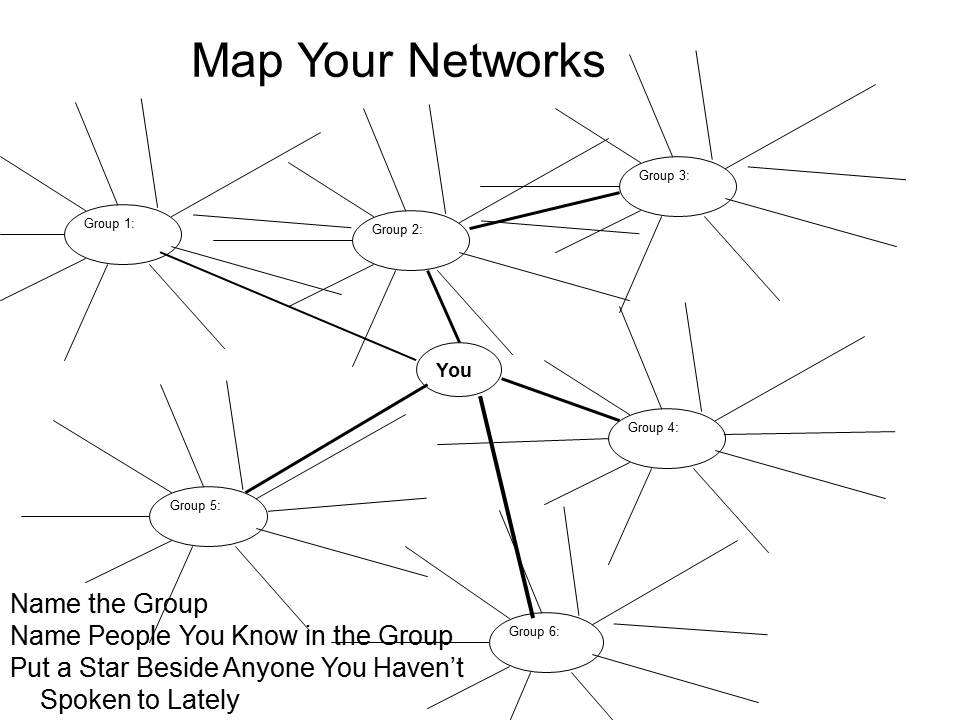
First, let’s go old school.  On paper, or using mind mapping software, do a brain storm of who you know.  Start with the groups you belong to or are associated with.  Once you’ve listed the groups, start listing the people associated with the groups.  Who are the key players in those groups?  Who are the best connected?  Who have you talked to lately?  If you haven’t talked/connected with people, then reach out to them.  Do it via email, phone or one of the social networking sites.  Prioritize people according to the purpose of your network.

Map Your Network Worksheet

Address what is missing.  How can you reach out to people you need to be connected to in those areas that you need to grow?  Get introductions through your existing connections.  Use the helpful tools that LinkedIn provides.  Attend professional functions, follow thought leaders’ blogs and make comments.  Participate in Linkedin Groups discussions.

Create a plan on how you’re going to keep up with your network.  Do regular (but not obsessive) work to stay in touch with your existing network and to grow it.

Some Myths About Networking

  • It’s  about the numbers. IIt’s really about quality connections.
  • It’s about your connections’ job title.  Looking at the visualization of your network should show you that the ‘most’ connected people are not necessarily (and not even likely) the highest ranking.

Some Truths About Networking

  • It has to be real.
  • It takes time.
  • It’s about mutual win/win.
  • It works.

Some Books

10 Comments

Filed under Books, Career Development, Career Goals, Executive Development, Goal Setting, Networking, Recession Proof, Success

Let’s talk about the most marketable skill of all

Which Skill is So Marketable?

What is that, you ask?  What could possibly be the MOST marketable skill?  EXECUTION.  Execution comes in all flavors–marketing, IT, Project Management, Human Resources, strategy, operations, software, finance and on and on.

Organizations spend tons of time in developing a strategy and planning.  This work is usually done by the leaders of organizations.  They then communicate the strategy and the plan to the next several levels of the organization for execution.  The problem is, the strategy and the execution of that strategy are rarely aligned.  According to Professor  Marco Iansit  of Harvard  Business School, “Strategy  becomes the product of the firm’s incentives, structures, and patterns of behavior, not the other way around,” in his book,   One Strategy: Organization, Planning, and Decision Making.  In other words, the clarity that those who develop the strategy and the plan believe that they have gets lost quickly through the lenses of the “way things work” in the organization.

Why Organizations Need Execution Experts So Badly

Research says that more than seventy percent of large projects FAIL!  Depending on who you ask, between 75% and 95% of new product launches fail.   Email marketing campaigns have a four percent success rate.  This makes it sound like we’re all incompetent.  But we aren’t.  We (most of us) work very hard trying to accomplish what the company needs/wants.  We just aren’t working on the right things.

Those people who figure out how to execute–to actually deliver what the company needs–are highly valuable and very marketable, both within the organization and outside.  To actually execute the tasks that need to happen for the organization to thrive takes everyone.  It takes fully engaged, fully empowered employees who understand what needs to happen and are willing to do it–so they have to agree enough, believe in it enough, do enough to make it happen.

What Does It Take To Execute?

So what does this have to do with you?  YOU have to engage.  YOU have to be empowered.  YOU have to do it.  This is not about “them.”  This is about you.  If you want to have the most marketable skill, and the career security that goes with that, YOU have to learn how to execute.  And how to get other people to execute.  And you have to learn how to understand the strategy well enough to execute THE strategy, as opposed to some watered down version of it.

It doesn’t matter if you are at the top of the organization, in the middle, or if you just started yesterday.  You need to learn how to understand clearly what needs to happen and then to do it WITH the other folks who you work with.

I’ve recently gotten to work on a string of successful projects.  The difference between them and the ones that are late/over budget/don’t happen/completely fail is:

  • They have a team of people who are committed to getting it done–no matter what gets in the way
  • They have people who challenge things that are wrong–the way people are acting, the lack of resources, the lack of commitment, the inadequacy of the technology
  • No one is on autopilot
  • They have incredibly difficult deadlines
  • Leaders are deeply involved in what is going on

Remember, when you can execute consistently and persistently, you pretty much don’t have to worry about where your next job is coming from.  Companies will want you.

Good Books on Execution

Leave a comment

Filed under Books, Career Development, Executive Development, Goal Setting, Success