Monthly Archives: July 2012

Multiple Intelligences: IQ, EQ, SQ and the other SQ

What kind of intelligence do you have?

We’ve all heard of IQ (Intelligence Quotient) which measures our ‘intelligence.’  Most of us have  heard of EQ (Emotional Intelligence), first mentioned by Wayne Payne in  1985 and made famous by Daniel Goleman in 1995.  A few of us have heard of one of the SQs–Spiritual Intelligence or Social Intelligence.  What do they really mean, though?  How important are they to career development?

IQ:  Intelligence Quotient which measures rational thought abilities,  is  considered a critical ‘trait’ for leadership.  IQ associated learning is step-by-step rule based learning.  To be successful, you don’t have to be the smartest guy in the room, but you have to be smart enough.  What ‘smart enough’ is depends on what kind of organization that you’re leading.  Meredith Belbin, a British researcher who focuses on teams, started his research with the assumptions that if he created a team of the smartest people–“A” players–then it will be a high performance team.  What he found was that intelligence itself was not enough.  A high performing team needs team members with a variety of skills and perspectives.

EQ: Emotional intelligence is the ability to assess, access and  control your emotions, and those of others.  Basically, if you have emotional intelligence, you have the ability to perceive, understand, use, and manage emotions.  There are lots of arguments about whether this is “real” intelligence, but most of us know people who are good at this and can see that there is something to it.  Again, EQ is considered a requisite for success in leadership.

SQ(1): Social intelligence is the ability to understand, manage, and navigate complex social networks.  It is also called ‘interpersonal intelligence.’  Leaders of global organizations and project managers of virtual teams require this SQ to be successful.  Some assert that autistic children have low social intelligence.  As the world has grown more complex, as organizations have grown, changed, evolved, this intelligence has become more important.

SQ(2): Perhaps the most controversial of the ‘Q’s’, spiritual intelligence is defined as  “the adaptive use of spiritual information to facilitate everyday problem solving and goal attainment.”(Robert Emmons (2000) )  Emmons proposed 5 components of spiritual intelligence:

  •    The capacity to transcend the physical and material.
  •     The ability to experience heightened states of consciousness.
  •     The ability to sanctify everyday experience.
  •     The ability to utilize spiritual resources to solve problems.
  •     The capacity to be virtuous.

Increasingly, companies are paying attention to spiritual intelligence among their leaders.

So What?

Each of us has certain strengths and natural styles.  We have all met (and perhaps are) the person who is incredibly book smart, but who has absolutely no common sense.  We all know the incredibly smart arrogant emotional bully.  Being too much of one of these, and not enough of the others makes you a “flat tire.”  You can be successful–up to a point.  Depending on your job (scientist, lawyer, teacher, executive) you need more of one and less of the others.  To be successful in almost any job, however, you need some of all of these.

There are tools for each of these that purport to measure these ‘Q’s.’  There are books on each of them.  Check them out.  Start working on developing some of your ‘flat’ spots.

Books That Will Help

2 Comments

Filed under Personal Change, Reframe, Success

Become a Great Leader

Leaders and Leadership as a Process

Do You Want to Become a Great Leader?

How you think about leadership has a profound affect on your success in becoming a good leader.  We all have our individual idea of what a good leader is.  Then we assume that everyone thinks the same thing.  And that is what gets us into trouble.

There are three parts to this:

  • What do you think makes a good leader?
  • What is leadership?
  • How can you adjust to be a good leader for others?

What Do You Think Makes a Good Leader?

When you think of the best leaders you’ve ever experienced, what were their traits?  Were they organized?  Were they decisive?  Were they fair?  Were they nice? “In charge?” Inspirational? Ambitious?  Smart? Successful? Charismatic?  Make your list.

We idealize leaders.  We want them to be what we think a leader should be.  There is a bit of magical thinking about leaders—they are supposed to be what you want them to be, regardless of who they are or what their style is.

In the United States, we want our leaders to be out there in front—leading the charge.  That kind of leadership is considered  inappropriate behavior in some other cultures.   Leaders actually come in all shapes and sizes.  When you do the above exercise–asking what the traits of good leaders are–in a large group of people, they don’t agree.  Each has his/her own vision of what a leader should be.  This comes as a surprise to the people in the group, because we all assume that what we believe is a great leader is universal.  If you ask the group WHO have been great leaders, they generally agree on a (very) few–Martin Luther King, Ghandi, Lincoln, but can’t come to agreement on others–Jobs, Bush, Welsh, for instance.

So What is Leadership?

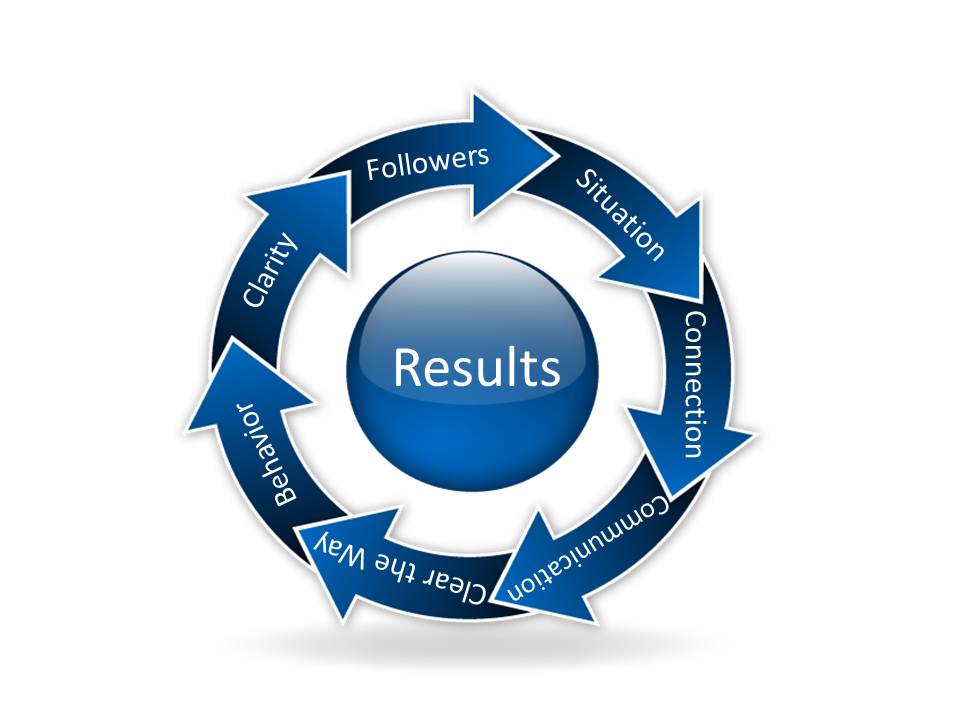
Leadership is more than just a person and who/what/how that person is.  It is results.  It is situational.  It is followers.  It is removing barriers for people.  It is connection. It is behavior.  It is communicating.  It is clarifying.  Leadership is the combination of all of these.  It is a process that combines all of these.

The leader is the instigator of this leadership process.  The leader is the instrument that stimulates and regulates the process.  The leader does not have to be a certain kind of person, but rather has to have the skills to manage this process and to integrate the elements of the process to achieve the results.

Now, rethink the people who you think are the best leaders in your experience.  How did they manage the elements of the leadership process?  Didn’t they do all of these steps well enough to get the results that the organization needed?

How can you adjust to be a good leader for others?

Reframe the way you think of leadership.  Think of it as a process instead of a particular way of being.  When you think of it this way, evaluate your ability to accomplish the skills of the leadership process.  How can you get better.  Depending on the results you need, the followers you have, the situation you are in, you need to remove barriers, communicate, clarify and adjust the integration of the leadership levers until you get results.  By thinking about it this way, it becomes a much more manageable task than if you have to have a personality transplant or develop charisma in order to be a great leader.

This view of leadership allows you to continue to ‘raise your game’ until you are a great leader.  Practice the skills that need development, hone the delivery of these tools, and learn to adjust to the situation and the followers.

4 Comments

Filed under Career Development, Career Goals, Communication, Executive Development, Leadership, Reframe, Success

Flip the Switch

Reframe by thinking differently

A Story

I’m going to tell you a story so that you can learn an important lesson without having to go through what I went through to learn it.  How’s that for a deal?  Then you’ll be able to do something that is incredibly easy and you won’t suffer through the lesson on how to do it.

A few years ago, I woke up to the news that there had been an ice storm and school was delayed by a couple of hours.  I was a single Mom and I did what most single Moms do when they learn they have a little extra time.   I decided to do something that I should have done and that I had been putting off.  I decided to go check on my empty house that I had for sale.  Now, why I thought it was a good idea to do that on icy roads, I don’t know, but I did.  As I drove across town to my house, my mind was full of all the things that I needed to do for work, things that wouldn’t happen because I was starting two hours late, and all the people who I  wouldn’t get to talk to because of the weather, etc.  You know how that is—work, work, work.

It was still dark outside when I arrived at the house.  I walked up on the porch and looked through the diamond window in the door.  I made my first discovery of this adventure—ice on the inside of the window.  Just so you know, that is a bad sign.  I opened the door and was astonished to find water pouring from the ceiling.  I reached over to turn on the light (bad idea, just so you know, when you’re standing in water).  The light didn’t come on, so I felt my way across the room and down the stairs to the basement where I felt my way along the wall to the water shut-off.  I came back upstairs and saw that the water had been turning to steam as it came through the ceiling (because the air was so much colder than the water) and then was forming ice on the walls and the floors.  The wind on an outside wall had apparently frozen the pipe, the pipe had burst, causing water to flow down to the basement and put out the furnace, which reduced the temperature in the house thereby freezing more pipes that then burst.  It was a mess!

What do you think happened to the thoughts of work?  Right.  Shoved aside.  Now I was thinking, OMG what do I do?  Is this insured?  How do I clean this mess up?  I called a plumber who came over.  He said, “Lady, we’re going to have to figure out what to do once we figure out if this house can be saved!”  SAVED?!  It’s a house!  It’s just water!

I spent the day dry vac’ing and mopping, calling insurance agents, and trying to get the mess cleaned up.  The house made the newspaper being described as “the ice house.”  (There was a spectacular ice flow that had made its way out the bricks and draped itself down the back wall of the house!)

The next morning was a Saturday.  Soccer practice and kid errands.  Before the kids got up, I decided to go check the house.   On my drive to the house, I was thinking about the house—how was it? What would happen?  What would happen to the floors?  The walls?  When I arrived at the house, I was relieved to see that the downpour had slowed to drip drip drips that were being caught by buckets.  The floors and walls looked ok (that was before I understood what happened to wood floors and paint when it dried out after a coating of ice).
I headed home much relieved.

I got out of the car and my feet slipped out from under me on the ice. The back of my head hit hard on the driveway.  As I was losing consciousness, I realized that I was going to be laying outside in way below freezing temperatures for potentially a long time (it was, after all, a Saturday morning and my house was full of teenagers—they wouldn’t even miss me for hours).  The neighbors would just think we left something in the driveway again and wouldn’t come to investigate.  I also realized that I couldn’t move—at all.  It really is true that all of these thoughts can happen very quickly.  I don’t think it was as much as a minute between the time my head hit the concrete and I lost consciousness.

Where do you think the thoughts of the house went?  Right.  Gone.  I was worried—in this order—about moving ever again and about living. I didn’t have a single thought about the house and work was so far removed that it probably wasn’t even in my brain anywhere.  I came to after a while—don’t know how long it was, but my fingers were frost bitten.  I could move when I came to and I crawled to the house and woke up a kid to take me to the hospital.  My brain didn’t work right for a while, but I learned a huge lesson.

And The Lesson

There is switch in your brain that you can flip. You can change your perspective on what is important, how you’re approaching a problem, how you think about things.  You can do it instantly.  Obviously it was forced on me.  But after I thought about it for a while, I experimented with it.  I would try to “flip the switch” about how I was approaching a problem.  Or a person.

I had a problem with my boss.  I “flipped the switch” and decided to think of her as a customer—customer is always right, right?  Once I started doing that, she didn’t get to me as much.  I started “flipping the switch” to look at problems from the other person’s perspective.  When I did it with work problems, it created more energy—it helped get me “unstuck.”

Try it.  Let me know how it works for you.

1 Comment

Filed under Career Development, Executive Development, Reframe, Success

Is That Smoke Smell Your Burnout?

Are You Burned Out?

Burnout Burning From Both Ends

Here are the symptoms:

  • Everything looks bleak
  • You don’t even have enough energy to care
  • Your tolerance of other people is very low
  • You feel unappreciated
  • You feel like you’re going through the motions
  • It doesn’t seem like anything you do makes a difference
  • You’re tired all the time
  • You’re  accident prone/clumsy
  • You have low immunity and are getting lots of colds/illnesses

Burnout happens to everyone at one time or another.  Sometimes you can see it coming.  Usually burnout takes a while to develop.  Sometimes burnout catches you by surprise, when you didn’t notice it coming on.  It is caused by relentless stress.  This is not the same as too much stress.  You can have too much stress, too much work, too much responsibility and not be burned out.  Lots of overworked people still have a positive perspective and feel hope that the work will end/be done/get better.  Burned out people don’t.  “It’s always going to be this way.” “It will never get better.”

The things that cause your burnout are different than the things that cause mine. We’re all different.  If you need to be appreciated and you can’t get any appreciation, that can cause burnout.  If you need to be in control and the situation has you feeling completely without control (different from feeling out of control), that can cause burnout.  If you don’t get to take any time for yourself, and you need some quiet introspection or if you need to be creative and that is missing from your work–burnout.

So What Do You Do?

Curing your burnout is hard.  It is hard not because what you have to do is hard, but because it is hard to find the energy to do it.  So the first thing you do is acknowledge that you’re burned out.  Look at the list above.  Does that describe you?  If so, decide that you’re going to work on curing your burnout.  Think of it as a cold.  If you don’t take care of a cold, it can get worse.  If you don’t do something to stop throwing up when you’ve got the flu, you can get much worse.  The consequences of not fixing your burnout can be that you get stuck.  It can have serious consequences for your career, for your family and for your future.  So, even if you don’t feel like it–force yourself.  It’ll get better.

1)  Try to figure out what’s causing it.  Look at the list above.  Do you feel unappreciated?  Without control? Do you feel like you aren’t good enough?  Whatever it is, just recognize the issue.

2) Try to think of a way to “reframe” the situation.  Appreciate yourself — acknowledge why you deserve to be appreciated.  Know that you are always in control of the way you deal with a situation, even if you aren’t in control of the situation.  If failed perfection is your problem, understand that that is your standard–not others’.  Let up.  Spend the time and effort to try to figure out a way to think of the problem differently.

3)  Do something nice for yourself.  Several somethings.  Be your own best friend.  Go for a walk.  Go to a movie.  Take a Saturday just for doing anything you want.  Read a good book.  Get a massage.  Play handball. See a friend you haven’t seen in a long time.  Break the pattern of not seeing the good in life.  Force yourself.

4)  Exercise.  Eat healthy food.  Yeah, I know, everybody says to do this.  It will help your immune system.  It will make you think of yourself and do something for yourself.

5) Write.  Write about what’s bothering you.  Write about all the things that are good in your life, your gratitudes.  Write about all the nice things you can do for yourself.  Write about your goals and your bucket list.  Write, write, write.

6) Create something.  Woodwork.  Draw.  Sew.  Paint. Fix something. Make music.  Using the part of your brain that does, rather than the part of your brain than thinks, will help.

7)  Talk to someone.  Talk to a friend.  Talk to a therapist.  Getting someone else’s perspective usually helps.

Keep trying things till you break the pattern.  I know it’s really hard to believe because burnout feels so physical, but it is more in your thinking patterns than in your job.  Once you figure out a way to break the pattern–even for a few hours–then keep doing it.  Build your resilience.  The more skilled you get at diagnosing your burnout before it takes hold and turning it around, the more in control you are of your reactions.

Leave a comment

Filed under Executive Development, Personal Change, Reframe